How to Make AI Writing Sound Human for Copyleaks: 15 Style Changes

Learn how to make AI writing sound human for Copyleaks with 15 practical style changes that reduce detection patterns and improve authenticity, supported by research like a peer-reviewed study in Science showing humans struggle to distinguish AI from human text.
How to Make AI Writing Sound Human for Copyleaks: 15 Style Changes
If you are trying to figure out how to make AI writing sound human for Copyleaks, you have likely run into frustrating detection flags on content that reads perfectly fine to you. Many writers testing do AI humanizers work claims discover that surface-level tweaks rarely hold up under closer scrutiny.
The issue usually is not grammar or clarity, but patterns that feel too even, too polished, or too predictable. Even tools marketed as the best AI rewriters for conservative content rewrites can preserve structural signals that detection systems are trained to spot.
On top of that, scoring models are sensitive to rhythm, repetition, and sentence uniformity in ways that are not obvious at first glance. Recent analysis of Copyleaks AI detection reliability data shows that small stylistic adjustments can meaningfully change classification outcomes.
| # | Strategy focus | Practical takeaway |
|---|---|---|
| 1 | Vary sentence rhythm | Break predictable pacing so the text feels less mechanically structured. |
| 2 | Loosen uniform structure | Adjust repeated patterns in paragraph openings and transitions. |
| 3 | Introduce natural phrasing | Replace overly polished wording with language people actually use. |
| 4 | Add contextual nuance | Layer in specific situations that ground the ideas in reality. |
| 5 | Soften transitions | Avoid formulaic connectors that signal templated flow. |
| 6 | Blend sentence lengths | Mix short and long lines to create conversational pacing. |
| 7 | Reduce keyword rigidity | Ease repetition that can trigger pattern-based scoring. |
| 8 | Adjust tone consistency | Introduce subtle tonal variation so the voice feels lived-in. |
| 9 | Rework list formatting | Convert rigid bullet logic into more fluid narrative structure. |
| 10 | Use grounded examples | Anchor ideas in realistic scenarios rather than abstract claims. |
| 11 | Break symmetry | Interrupt repetitive paragraph shapes that feel auto-generated. |
| 12 | Refine word choice | Swap generic phrasing for more precise, situational language. |
| 13 | Introduce mild imperfection | Allow subtle asymmetry that mirrors real human drafting. |
| 14 | Reframe predictable conclusions | Avoid tidy wrap-ups that mirror common model outputs. |
| 15 | Edit in layers | Review structure, tone, and flow separately instead of making surface edits only. |
15 Style Changes to How to Make AI Writing Sound Human for Copyleaks
How to Make AI Writing Sound Human for Copyleaks – Strategy #1: Vary sentence rhythm
One of the most reliable ways to improve how to make AI writing sound human for Copyleaks is to deliberately vary sentence rhythm so the text does not move in evenly spaced, predictable beats that resemble machine-generated cadence. This means blending longer, layered sentences that unfold gradually with shorter reflections that create pauses, while ensuring the pacing feels organic rather than engineered. When every sentence follows a similar length and structure, detection systems can interpret that symmetry as a statistical pattern rather than an authentic writing voice.
In practice, this often requires reading the draft aloud and noticing whether the flow feels too smooth, almost as if it were ironed flat and stripped of natural hesitation or emphasis. A human draft tends to stretch in some places, compress in others, and occasionally linger on a clarification that feels slightly indulgent yet believable. Adjusting rhythm in this way introduces subtle irregularity, which is often enough to disrupt the uniform pacing that detection models are trained to flag.
How to Make AI Writing Sound Human for Copyleaks – Strategy #2: Loosen uniform structure
When focusing on how to make AI writing sound human for Copyleaks, it is important to examine paragraph openings and transitions that may follow identical patterns throughout the piece. AI drafts frequently begin paragraphs with formulaic framing statements, which creates a repeated structural blueprint that can be statistically detected even if the wording itself changes. Loosening this structure involves reordering ideas, embedding context before claims, and occasionally starting with a reflective observation instead of a direct assertion.
This does not mean abandoning clarity, but rather allowing the organization to feel shaped by thought rather than by template. For example, instead of consistently introducing a point and then explaining it, you might present a brief scenario and then unfold the reasoning from there, which mirrors how people often think through an idea. That slight shift in structure reduces visible symmetry and gives the impression that the content developed through revision rather than automatic generation.
How to Make AI Writing Sound Human for Copyleaks – Strategy #3: Introduce natural phrasing
A central part of how to make AI writing sound human for Copyleaks involves replacing overly polished or generic phrasing with language that reflects how people genuinely express nuance and uncertainty. AI systems often default to tidy, neutral expressions that sound technically correct but lack the subtle variation present in real conversation. Introducing natural phrasing means allowing mild qualifiers, contextual clarifications, and even slightly imperfect constructions that mirror authentic communication.
For instance, instead of declaring a point in absolute terms, you might frame it as something that tends to happen under certain conditions, which immediately feels less mechanical. Human writers frequently soften their statements, add clarifying clauses, or revise mid-thought to reflect complexity. These small adjustments create linguistic fingerprints that diverge from the smooth, generalized tone that detection systems are optimized to identify.
How to Make AI Writing Sound Human for Copyleaks – Strategy #4: Add contextual nuance
If you are refining how to make AI writing sound human for Copyleaks, contextual nuance becomes essential because detection systems respond not only to syntax but to informational density and specificity. Generic explanations that could apply anywhere tend to resemble model outputs, especially when they avoid situational detail. Adding nuance means referencing realistic constraints, trade-offs, or scenarios that shape how advice actually unfolds in practice.
Rather than stating that stylistic edits improve detection outcomes, you might describe how a compliance team reviewing marketing copy notices reduced flags after adjusting tone and structure. That grounded layer transforms abstract guidance into a lived scenario, which is harder to reduce to statistical uniformity. Nuance introduces complexity and texture, and those qualities often distinguish organic writing from automated composition.
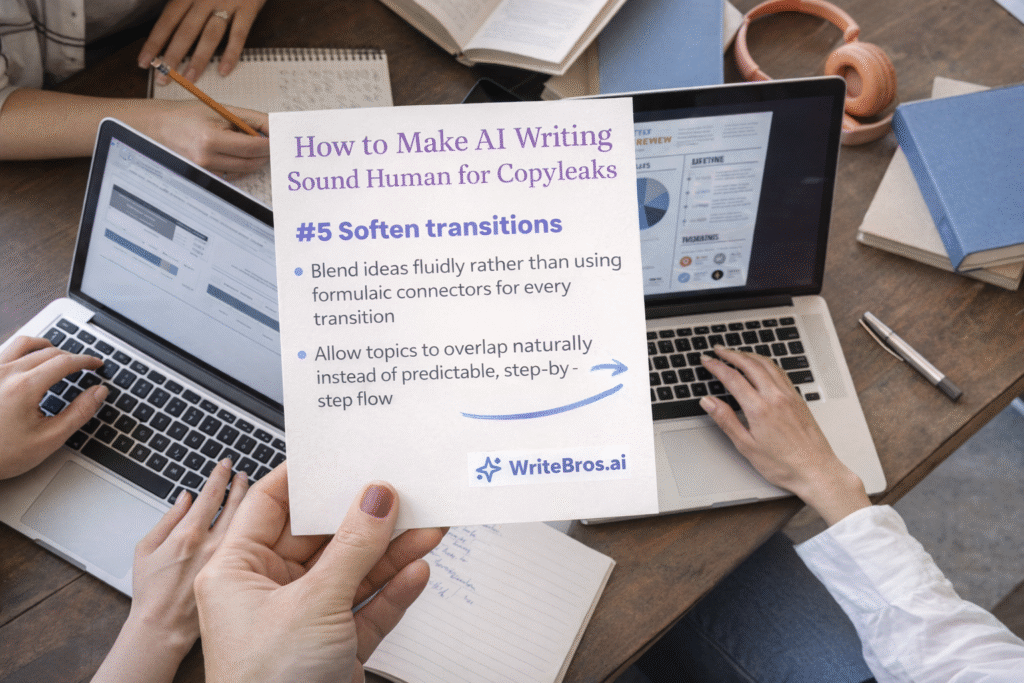
How to Make AI Writing Sound Human for Copyleaks – Strategy #5: Soften transitions
Another important step in how to make AI writing sound human for Copyleaks is softening transitions that appear overly polished or formulaic. AI-generated drafts often rely on predictable connectors that move cleanly from one idea to the next, creating a seamless but suspiciously tidy progression. Reworking these transitions involves blending ideas more fluidly, sometimes allowing them to overlap or evolve without explicit signposting.
Human writers frequently shift direction subtly, adding a qualifying phrase or embedding a counterpoint within the same paragraph instead of announcing every change. This kind of movement feels less engineered and more reflective of genuine reasoning. Softened transitions reduce the appearance of rigid scaffolding, which can help diminish the structured signals that detection algorithms analyze.
How to Make AI Writing Sound Human for Copyleaks – Strategy #6: Blend sentence lengths
To strengthen how to make AI writing sound human for Copyleaks, blending sentence lengths is necessary because uniformity in line structure often signals automated generation. A draft filled with medium-length sentences that follow identical grammatical patterns can create an unintended statistical footprint. Mixing extended analytical sentences with shorter reflections introduces variability that mirrors natural drafting and revision processes.
This technique works best when variation feels intuitive rather than forced, meaning that longer sentences unfold where explanation is needed and shorter ones punctuate emphasis or reflection. Real human writing rarely maintains consistent cadence across an entire section, especially when exploring layered ideas. By adjusting sentence length intentionally yet subtly, you create a rhythm that feels lived-in rather than mechanically optimized.
How to Make AI Writing Sound Human for Copyleaks – Strategy #7: Reduce keyword rigidity
Part of mastering how to make AI writing sound human for Copyleaks involves reducing rigid keyword repetition that can create detectable patterns. AI drafts optimized for SEO sometimes repeat exact phrases at fixed intervals, which strengthens topical focus but also increases statistical predictability. Loosening this rigidity requires weaving related language naturally without relying on strict repetition cycles.
This does not weaken clarity, because synonyms and contextual references can maintain meaning while diversifying expression. A human writer might restate a concept in slightly different terms depending on emphasis, audience, or sentence structure. That organic variation helps break repetitive footprints that detection systems might otherwise interpret as model-generated consistency.
How to Make AI Writing Sound Human for Copyleaks – Strategy #8: Adjust tone consistency
When considering how to make AI writing sound human for Copyleaks, tone consistency should not mean tonal flatness, since overly stable voice can appear algorithmic. AI-generated content often maintains the same level of formality and emotional distance throughout, which can read as impressively coherent yet subtly artificial. Introducing controlled tonal variation adds dimension without compromising professionalism.
For example, a slightly reflective aside within an analytical paragraph can signal genuine authorship because it mirrors how people process ideas. Human writing often fluctuates in intensity, moving from objective explanation to cautious interpretation within the same section. That tonal modulation creates a layered voice, which reduces the impression of a single calibrated output profile.
How to Make AI Writing Sound Human for Copyleaks – Strategy #9: Rework list formatting
Improving how to make AI writing sound human for Copyleaks sometimes requires transforming rigid list logic into more fluid narrative development. AI systems frequently produce neatly segmented points that follow identical structural templates, especially in instructional content. Converting some of that structure into integrated paragraphs can soften visible repetition.
Rather than presenting every idea as a discrete unit, you might allow related concepts to evolve within the same paragraph, building naturally from one to the next. This approach mirrors how human writers often draft, revise, and connect ideas organically. Reducing overt structural symmetry makes the piece feel shaped by reasoning rather than by algorithmic formatting.
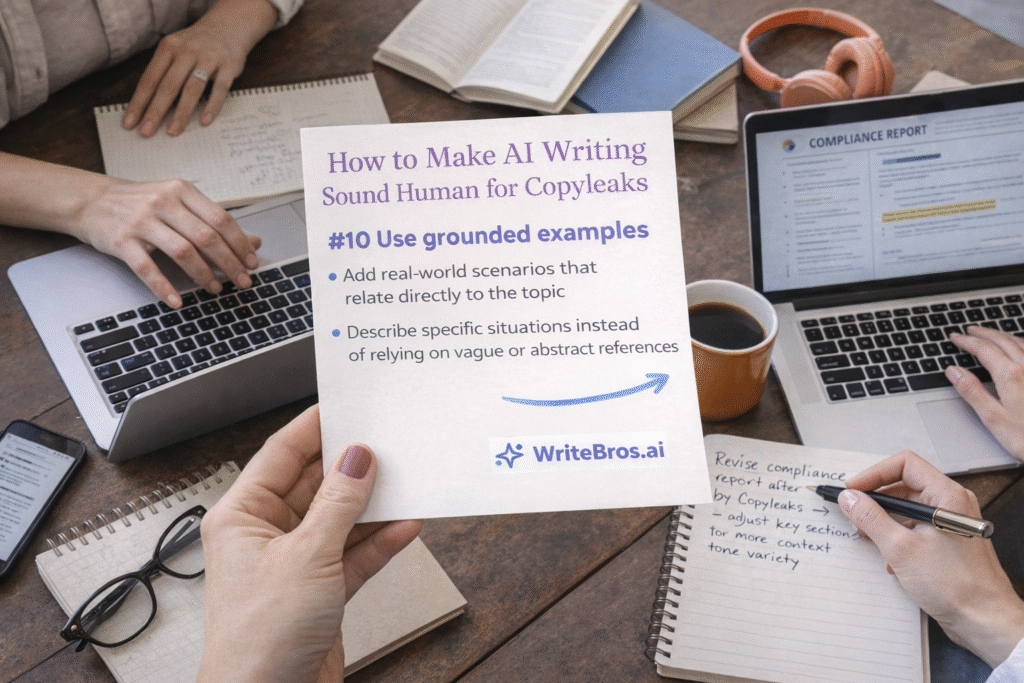
How to Make AI Writing Sound Human for Copyleaks – Strategy #10: Use grounded examples
A strong component of how to make AI writing sound human for Copyleaks is incorporating grounded examples that reflect realistic experience rather than abstract instruction. AI drafts often describe processes in universal terms, which can feel detached from practical application. Grounded examples introduce specificity that adds credibility and narrative texture.
Describing how a writer revises a compliance report after receiving unexpected flags, and how subtle stylistic adjustments influence outcomes, brings the advice into a tangible setting. That situational clarity makes the content harder to generalize into pattern-based output. Concrete examples increase informational uniqueness, which can reduce detection exposure rooted in generic phrasing.
How to Make AI Writing Sound Human for Copyleaks – Strategy #11: Break symmetry
Refining how to make AI writing sound human for Copyleaks often means identifying and breaking visual and structural symmetry that appears across sections. AI-generated drafts tend to produce paragraphs of similar length, parallel sentence construction, and evenly distributed subpoints. Interrupting that symmetry requires conscious deviation from repetitive structural molds.
You might expand one section with layered clarification while allowing another to remain concise, reflecting how emphasis naturally varies. Human drafts rarely distribute attention perfectly evenly across all points. That imbalance, when intentional and thoughtful, signals authenticity rather than algorithmic uniformity.
How to Make AI Writing Sound Human for Copyleaks – Strategy #12: Refine word choice
Another technique for how to make AI writing sound human for Copyleaks is refining word choice to avoid overused, neutral phrasing common in automated outputs. AI systems frequently select safe, broadly applicable vocabulary that fits most contexts but lacks distinctiveness. Replacing those terms with more situationally precise language adds individuality to the prose.
This refinement might involve selecting verbs that better capture process, or adjectives that reflect measured interpretation rather than sweeping generalization. Human writers often choose words that subtly reflect perspective, experience, or domain familiarity. Precision in vocabulary introduces variability that disrupts generic language signatures.
How to Make AI Writing Sound Human for Copyleaks – Strategy #13: Introduce mild imperfection
In exploring how to make AI writing sound human for Copyleaks, introducing mild imperfection can paradoxically strengthen perceived authenticity. AI drafts frequently appear overly optimized, with flawless transitions and evenly balanced clauses throughout. Allowing slight asymmetry, such as an extended clarification or a nuanced aside, mirrors real revision habits.
This does not mean inserting errors, but rather preserving subtle irregularities that reflect thoughtful drafting. A sentence that stretches to accommodate complexity can feel more genuine than one trimmed for algorithmic neatness. Controlled imperfection reduces the appearance of hyper-optimized structure that detection systems may flag.
How to Make AI Writing Sound Human for Copyleaks – Strategy #14: Reframe predictable conclusions
Enhancing how to make AI writing sound human for Copyleaks includes revisiting conclusions that feel too tidy or formulaic. AI-generated endings often summarize points in balanced, symmetrical language that neatly ties every thread. Reframing conclusions involves emphasizing reflection or forward-looking nuance instead of mechanical recap.
A human conclusion might acknowledge limitations, suggest ongoing evaluation, or leave space for interpretation rather than closing every loop. That openness reflects genuine thought rather than programmed closure. Revising conclusions in this way reduces the structural predictability that detection tools can analyze.
How to Make AI Writing Sound Human for Copyleaks – Strategy #15: Edit in layers
Finally, mastering how to make AI writing sound human for Copyleaks requires editing in layers rather than making superficial wording changes in a single pass. Surface-level synonym swaps rarely address deeper structural and rhythmic patterns that detection systems examine. Layered editing separates structural revision, tonal adjustment, and clarity refinement into distinct review phases.
This process mirrors how experienced writers revise substantial drafts, often focusing on organization first and language second. Each layer introduces independent variation, reducing the probability of preserving machine-like symmetry. Editing in stages creates compounded human signals that are more durable under automated scrutiny.
Common mistakes
- Relying solely on synonym replacement tools without addressing structural uniformity often leads to drafts that look different on the surface but still retain the same rhythmic and organizational patterns, which detection systems can continue to identify despite superficial vocabulary changes.
- Maintaining identical paragraph lengths across an entire article creates visual and statistical symmetry that can unintentionally mirror model output, even if the language itself feels natural during casual reading.
- Overusing exact keyword phrases at fixed intervals in an attempt to preserve optimization can introduce detectable repetition cycles that undermine efforts to diversify stylistic signals.
- Keeping tone perfectly stable from introduction to conclusion may appear polished, yet it removes the subtle tonal fluctuations that characterize authentic human reasoning and reflection.
- Ending every section with a neatly summarized recap can create repetitive closure patterns that resemble templated output rather than evolving thought.
- Editing only at the sentence level without reviewing structure, pacing, and flow leaves deeper statistical footprints intact, which limits the effectiveness of surface revisions.
Edge cases
There are scenarios in which highly technical or compliance-driven writing must retain formal tone and structured organization, which can make stylistic diversification more challenging. In such cases, adjustments should focus on rhythm, nuance, and example selection rather than dramatic structural change.
Similarly, collaborative documents edited by multiple contributors may already contain natural variation, and excessive modification could inadvertently flatten authentic voice. Careful calibration is necessary so that revisions enhance human signals without introducing inconsistency or confusion.
Supporting tools
- Read-aloud software can help identify unnatural cadence or overly consistent pacing, since hearing the text exposes rhythmic uniformity that may not be obvious when scanning visually.
- Version comparison editors allow writers to track structural changes across drafts, making it easier to detect repeated patterns that persist through revisions.
- Style analysis platforms that highlight sentence length distribution provide quantitative insight into pacing symmetry that could influence detection scoring.
- Manual editorial checklists focused on transitions, tone variation, and structural diversity support layered revision beyond vocabulary swaps.
- Collaborative peer review sessions can surface subtle uniformity issues that a single writer might overlook after multiple self-edits.
- WriteBros.ai can assist with structured rewrites that adjust tone, rhythm, and phrasing in layered passes, helping introduce controlled variation without distorting original meaning.
Ready to Transform Your AI Content?
Try WriteBros.ai and make your AI-generated content truly human.
Conclusion
Learning how to make AI writing sound human for Copyleaks ultimately revolves around structural awareness, tonal flexibility, and layered revision rather than cosmetic word changes. The goal is not to disguise content, but to ensure that pacing, nuance, and organization reflect genuine thought development.
Perfection is less important than intentional variation that mirrors how people naturally draft, revise, and clarify ideas over time. When rhythm, structure, and tone are treated as editable dimensions, the resulting content stands on stronger footing under automated evaluation.
Did You Know?
If you are working on how to make AI writing sound human for Copyleaks, start with structural variation rather than isolated synonym changes, since evenly sized paragraphs and mirrored transitions can preserve a consistent detection signature.
Allow some explanations to expand with layered clarification while others tighten for emphasis, and vary how arguments unfold across sections, because uneven progression more closely reflects authentic authorship than perfectly balanced organization.
Ready to Transform Your AI Content?