How to Make ChatGPT Writing Sound Less Robotic: 15 Natural Language Tweaks
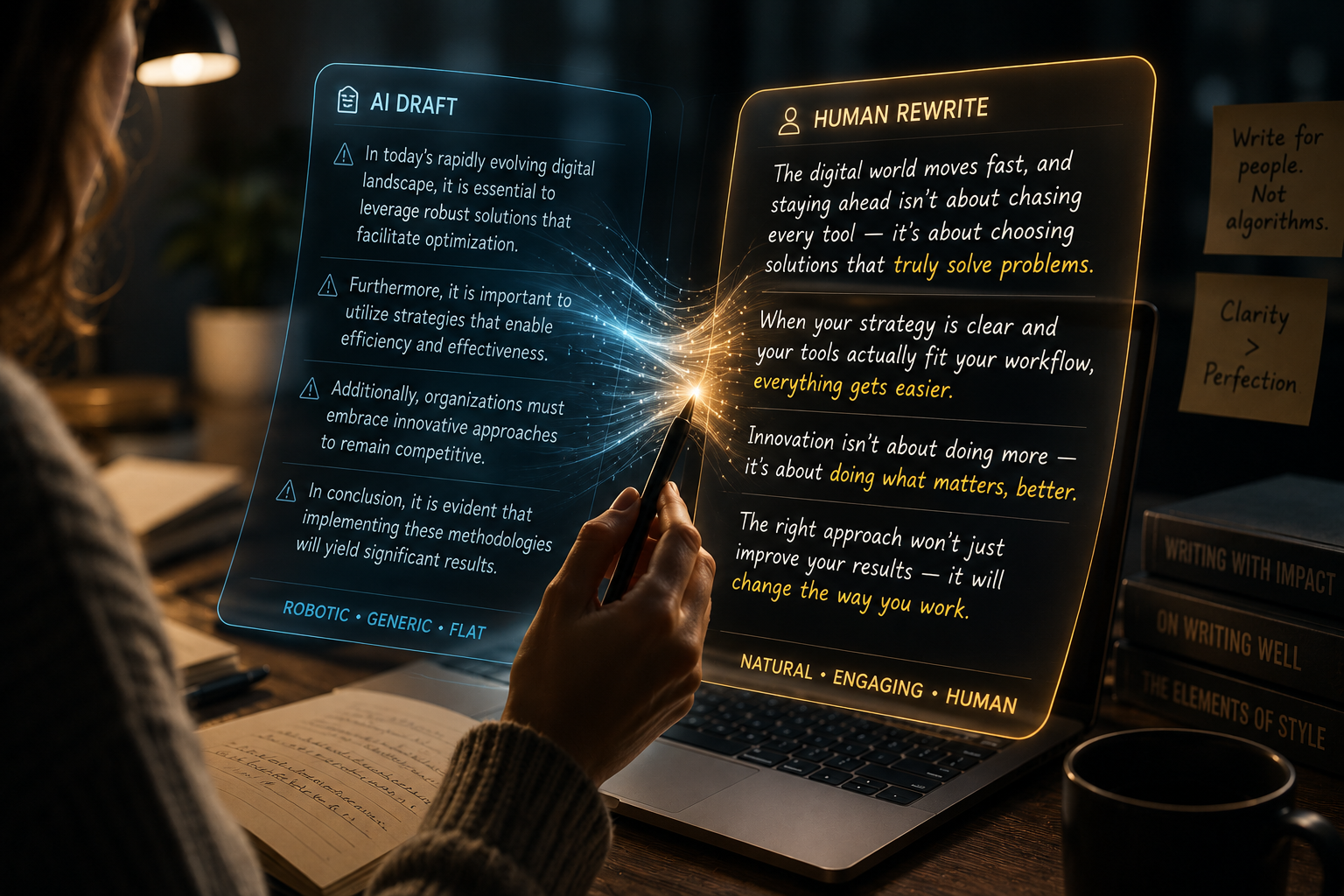
2026 editorial teams are spending more time rewriting stiff AI drafts into readable, audience-friendly content that feels natural without losing clarity. Research from PLOS ONE’s readability analysis of AI-generated and human-written text supports why sentence variation, nuance, and pacing dramatically affect how authentic writing feels to readers.
How to Make ChatGPT Writing Sound Less Robotic: 15 Natural Language Tweaks
Most AI-generated writing sounds technically correct but still feels stiff once you read it out loud. Learning how to reduce robotic tone in AI writing matters because readers quickly notice repetitive phrasing, flat transitions, and overly polished sentences.
That robotic feeling usually happens because ChatGPT defaults to predictable structure and safe wording patterns. Many writers rely too heavily on automation without reviewing rhythm, personality, or the subtle pacing techniques used in most trusted rewriters for ChatGPT SEO content.
Making AI writing feel natural does not require rewriting every sentence from scratch. Small adjustments to tone, sentence flow, and conversational detail can dramatically improve readability, especially when paired with ChatGPT marketing copy refinement data that shows how readers engage with human-sounding content.
| # | Strategy focus | Practical takeaway |
|---|---|---|
| 1 | Sentence rhythm variation | Breaking predictable pacing helps generated text feel more conversational and less mechanically structured. |
| 2 | Conversational transitions | Natural bridge phrases soften abrupt topic changes and improve readability across longer sections. |
| 3 | Specific real-world details | Adding grounded examples makes AI-generated content sound more believable and human-driven. |
| 4 | Reducing repetitive phrasing | Removing duplicated sentence patterns immediately improves flow and keeps readers engaged longer. |
| 5 | Controlled imperfection | Perfectly polished writing can feel artificial, so slight looseness often creates better authenticity. |
| 6 | Emotional tone balancing | Subtle emotional texture makes writing feel more relatable without becoming exaggerated or dramatic. |
| 7 | Paragraph pacing adjustments | Changing paragraph length prevents the repetitive visual structure common in AI-generated drafts. |
| 8 | Human-style qualifiers | Carefully placed qualifiers create nuance and reduce the overly certain tone AI often produces. |
| 9 | Removing filler intensity | Cutting exaggerated wording keeps content grounded and more trustworthy to readers. |
| 10 | Voice consistency | Keeping tone stable across sections prevents content from sounding stitched together or automated. |
| 11 | Context-aware phrasing | Tailoring language to audience expectations helps the writing sound intentional instead of generic. |
| 12 | Dialogue-style structure | Occasional conversational framing creates a more natural reading experience without sounding informal. |
| 13 | Sensory and visual language | Descriptive phrasing adds texture that AI writing often lacks in raw drafts. |
| 14 | Editing for spoken flow | Reading text aloud exposes robotic cadence and helps refine awkward sentence construction. |
| 15 | Intent-driven refinement | Clear writing goals make revisions more focused and prevent generic output from surviving edits. |
15 Natural Language Tweaks to Make ChatGPT Writing Sound Less Robotic
How to Make ChatGPT Writing Sound Less Robotic – Strategy #1: Sentence rhythm variation
One of the fastest ways to make AI-generated writing feel less mechanical is to vary the rhythm and pacing of your sentences instead of relying on the uniform structure that ChatGPT tends to produce when left unedited for long stretches of text. Many AI drafts fall into repetitive sentence lengths with nearly identical cadence, which quietly trains readers to predict the flow after only a few paragraphs, and that predictability makes the content feel automated even when the information itself is accurate and useful. Strong editing usually means mixing longer explanatory sentences with shorter reflective observations so the reading experience feels more natural and less mathematically balanced.
This works well because real human writing rarely maintains identical pacing for long periods of time, especially when someone is explaining a layered idea, sharing a personal reaction, or transitioning between examples that require different levels of detail and emotional weight. A marketing draft discussing customer frustration, for example, should not sound structurally identical to a technical explanation explaining platform features or analytics changes, yet AI systems frequently flatten those distinctions unless a writer intentionally adjusts the flow afterward. Paying attention to rhythm during editing creates subtle variation that readers notice subconsciously, which helps the writing feel more grounded and conversational without making it overly casual.
How to Make ChatGPT Writing Sound Less Robotic – Strategy #2: Conversational transitions
AI-generated content frequently moves between ideas too abruptly because the model prioritizes efficiency and topic coverage instead of the softer conversational bridges that people naturally use when explaining something in real life or guiding readers through a nuanced argument. Adding natural transitions between sections helps the writing breathe more comfortably because readers can follow the logic without feeling as though each paragraph was independently generated and stitched together afterward. Phrases that gently acknowledge contrast, continuation, uncertainty, or clarification create smoother movement through the article and reduce the rigid tone that makes many AI drafts sound overly optimized.
Writers often underestimate how much conversational flow contributes to perceived authenticity because readers rarely notice strong transitions directly, yet they immediately sense when those transitions are missing and the writing begins to feel segmented or robotic. A tutorial explaining content strategy, for example, becomes easier to trust when the writer naturally guides readers from planning to execution to refinement instead of presenting isolated blocks of information with no connective reasoning between them. Editing specifically for transition quality improves readability substantially because it mirrors the way people naturally speak and explain complicated topics during real conversations rather than formalized machine-generated summaries.
How to Make ChatGPT Writing Sound Less Robotic – Strategy #3: Specific real-world details
ChatGPT often produces technically clean writing that still feels emotionally empty because the content lacks grounded details that suggest lived experience, observation, or realistic context tied to actual situations that readers can visualize without much effort. Adding small but concrete references to workplace routines, client interactions, editing frustrations, publishing habits, or audience reactions immediately makes the writing feel more believable because those details interrupt the generic tone that AI systems naturally default toward. Readers respond more positively when the content reflects recognizable experiences rather than polished abstractions that could apply to almost any topic or industry without meaningful distinction.
This strategy works especially well in marketing, blogging, and educational writing because audiences tend to trust explanations that sound connected to real outcomes rather than purely theoretical commentary that remains detached from practical use. An article discussing AI editing becomes much more convincing when it references situations like reviewing awkward LinkedIn captions late at night, rewriting repetitive email introductions, or fixing robotic product descriptions before publication deadlines arrive. These realistic details add texture and specificity without requiring dramatic storytelling, and they help transform generic AI output into something that feels shaped by an actual person with experience navigating the same problems readers are trying to solve.
How to Make ChatGPT Writing Sound Less Robotic – Strategy #4: Reducing repetitive phrasing
One of the clearest indicators of AI-generated writing is repeated wording patterns that appear across multiple paragraphs, particularly when the same sentence openings, explanatory structures, or emphasis phrases appear so frequently that the article begins sounding algorithmically assembled. ChatGPT tends to reuse familiar frameworks because repetition statistically reinforces clarity within the model, but human readers interpret excessive consistency as artificial once they begin recognizing the pattern during extended reading sessions. Careful editing should focus on identifying repeated phrasing and replacing it with alternate structures that preserve meaning while improving tonal variety and making the writing feel more flexible.
This matters because repetitive phrasing quietly weakens reader engagement even when the content itself remains accurate and informative, especially in long-form articles where structural duplication becomes more noticeable after several sections. A common example appears in AI-generated blog posts that repeatedly open paragraphs with phrases like “this means,” “in addition,” or “one important factor,” creating a rhythm that eventually feels formulaic regardless of the subject matter. Reworking those repeated structures with more natural variations helps the content feel less templated and more reflective of genuine human thought patterns, which improves readability without dramatically changing the underlying information.
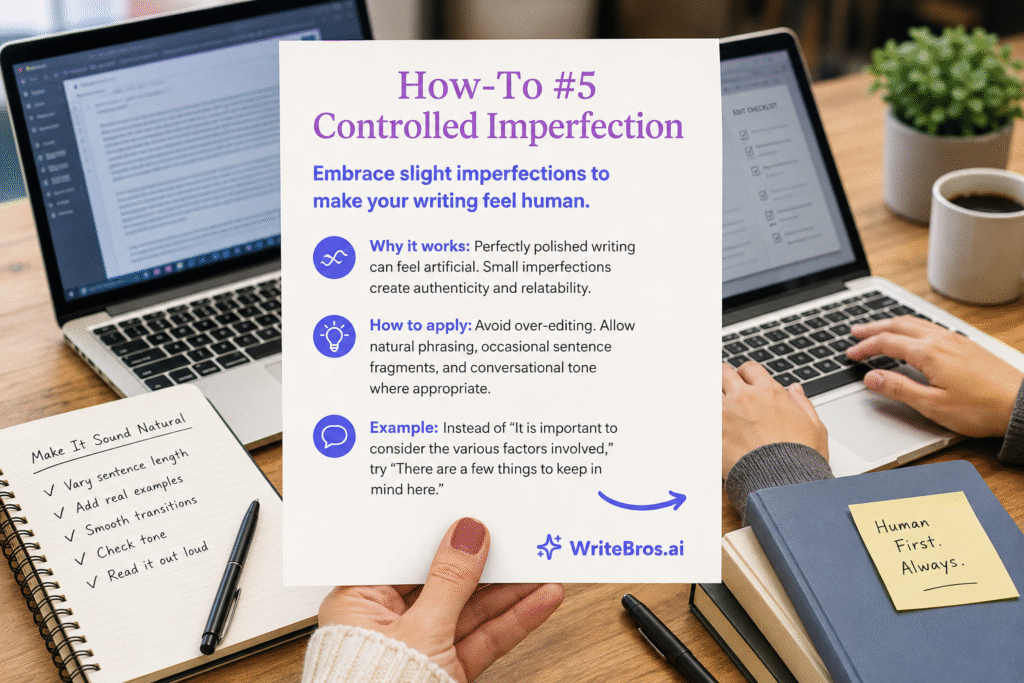
How to Make ChatGPT Writing Sound Less Robotic – Strategy #5: Controlled imperfection
Many AI-generated drafts sound robotic because they are too polished in a way that real human communication rarely is, particularly when every sentence feels equally refined, equally balanced, and equally optimized without any slight irregularities in tone or structure. Human writing naturally contains moments of hesitation, emphasis changes, softer phrasing, or occasional conversational detours that make the content feel alive and responsive rather than mechanically processed through a perfectly standardized editorial filter. Allowing a controlled amount of imperfection into the final draft often improves authenticity because readers associate overly flawless wording with automation rather than thoughtful communication.
This does not mean intentionally writing poorly or introducing grammatical mistakes, but it does mean resisting the urge to smooth every sentence into identical levels of precision that remove personality and emotional variation from the piece. A business article discussing difficult client feedback, for example, may feel more believable when the writer briefly acknowledges uncertainty or frustration instead of presenting every insight with absolute confidence and polished detachment. Small moments of natural looseness make the writing sound more human because they reflect the uneven pacing and emotional texture that real people naturally bring into communication when discussing practical experiences and nuanced situations.
How to Make ChatGPT Writing Sound Less Robotic – Strategy #6: Emotional tone balancing
AI writing frequently struggles with emotional calibration because it either sounds emotionally flat or swings too aggressively into exaggerated enthusiasm, particularly in marketing content where ChatGPT tends to overcompensate with dramatic language and inflated claims. Balancing emotional tone means introducing subtle feeling and personality into the writing without making every sentence sound performative, overly excited, or unnaturally intense for the subject being discussed. Readers generally respond better to writing that sounds emotionally aware and thoughtful because that balance creates trust without making the article feel artificially engineered for engagement metrics.
This strategy becomes especially important when writing educational or professional content because audiences usually want clarity and realism rather than emotionally overloaded phrasing that feels disconnected from the actual value being delivered. An article explaining AI editing workflows, for example, becomes more believable when it acknowledges mild frustration, creative fatigue, or uncertainty in a measured way instead of claiming every technique is revolutionary or life-changing. Emotional moderation makes the writing feel more mature and human because real people naturally express reactions with variation and restraint instead of maintaining exaggerated intensity across every paragraph and explanation.
How to Make ChatGPT Writing Sound Less Robotic – Strategy #7: Paragraph pacing adjustments
Another common feature of robotic AI writing is overly uniform paragraph construction, particularly when nearly every paragraph contains similar sentence counts, similar lengths, and similar pacing patterns that create visual and tonal monotony across the article. Human writers naturally vary paragraph density depending on whether they are explaining a process, emphasizing a key point, clarifying a misunderstanding, or transitioning into a more reflective observation that requires additional context and nuance. Adjusting paragraph pacing creates a more dynamic reading experience because the visual structure itself begins reflecting the natural movement of human thought instead of rigid content formatting.
This becomes increasingly important in long-form articles because readers subconsciously respond to pacing variation even when they are not consciously analyzing layout or sentence structure while moving through the content. A section introducing a new concept may benefit from slightly denser explanation, while a reflective observation or cautionary note may feel more natural when separated into a lighter paragraph with gentler pacing and more conversational spacing. Thoughtful paragraph variation helps reduce the repetitive visual rhythm that often exposes AI-generated content, especially when combined with stronger transitions and more natural sentence construction throughout the article.
How to Make ChatGPT Writing Sound Less Robotic – Strategy #8: Human-style qualifiers
AI-generated writing often sounds strangely absolute because ChatGPT tends to present ideas with excessive certainty even when the topic naturally contains exceptions, limitations, or situational differences that human writers would normally acknowledge during explanation. Introducing measured qualifiers into the writing creates nuance because it reflects the way real people communicate when discussing strategies, opinions, or experiences that may not apply equally across every audience or circumstance. Phrases that signal moderation, uncertainty, or conditional reasoning help soften the rigid tone that makes AI content feel detached from real-world complexity.
This strategy works because readers generally trust writers who acknowledge limitations and context rather than pretending every recommendation works perfectly in every scenario regardless of audience, platform, industry, or creative goal. An article discussing AI editing techniques, for example, feels more realistic when it admits that certain prompts may work better for email copy than long-form storytelling or that some audiences prefer more formal structure than others. Those nuanced clarifications mirror the way experienced professionals naturally speak when sharing advice, which makes the content sound less robotic and more grounded in practical understanding.
How to Make ChatGPT Writing Sound Less Robotic – Strategy #9: Removing filler intensity
Many AI-generated drafts become exhausting to read because the writing constantly tries to sound important through repetitive intensity words, exaggerated emphasis, and inflated descriptions that create emotional fatigue instead of clarity or persuasion. ChatGPT frequently relies on phrases like “extremely powerful,” “highly transformative,” or “incredibly effective” because those patterns statistically reinforce emphasis within training data, yet human readers quickly recognize the artificial tone once every paragraph begins sounding equally dramatic. Removing unnecessary intensity from the writing creates a calmer and more believable voice that feels more aligned with natural human communication.
This matters because credibility usually increases when the writing sounds measured and intentional rather than aggressively optimized to impress readers with exaggerated certainty or constant emotional escalation. A product tutorial explaining editing software, for example, becomes easier to trust when it calmly explains workflow improvements and realistic outcomes instead of repeatedly promising groundbreaking transformation or massive productivity gains in every section. Editing out filler intensity also creates more room for meaningful detail and practical explanation, which ultimately strengthens the writing because readers focus on substance rather than emotionally inflated phrasing patterns.
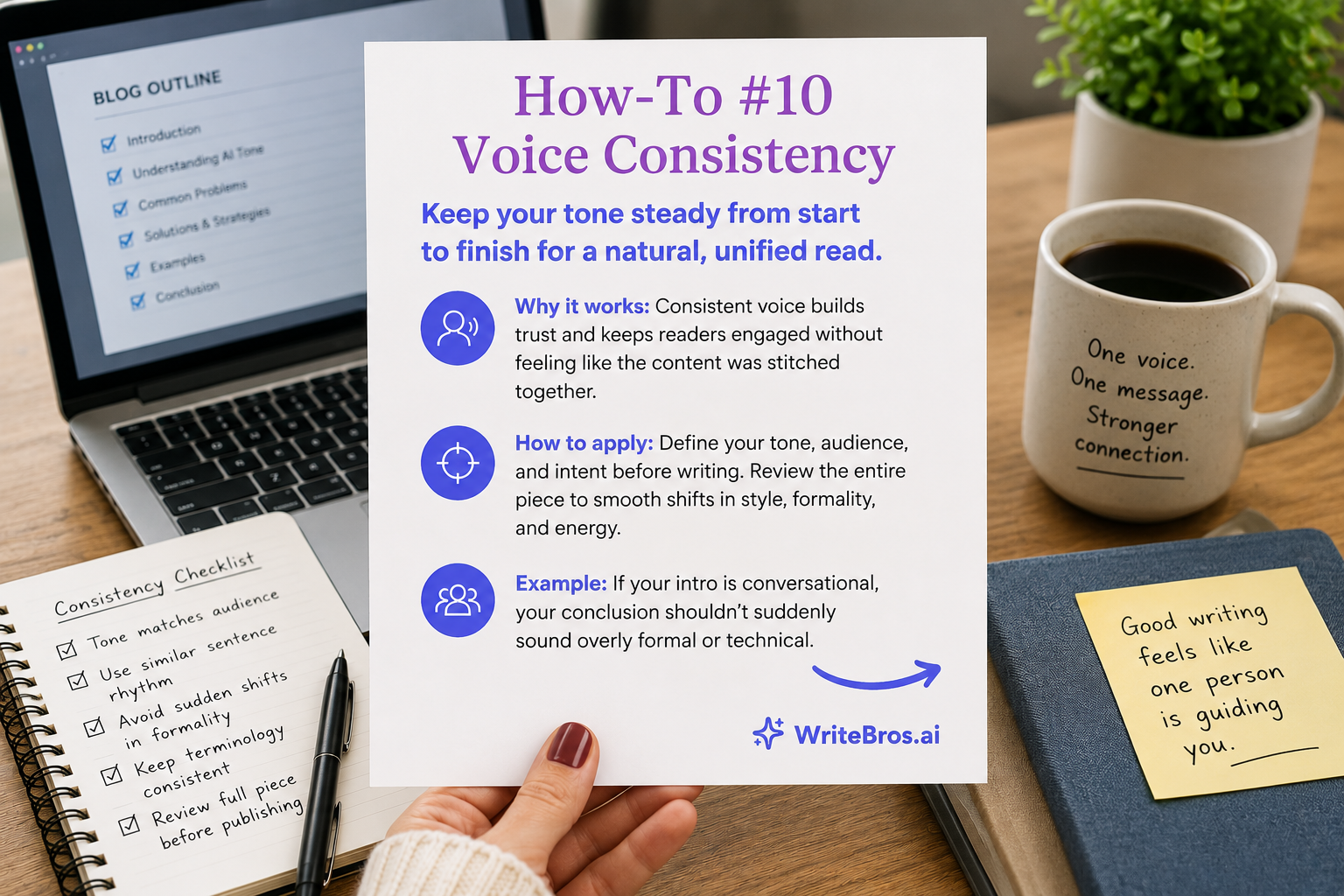
How to Make ChatGPT Writing Sound Less Robotic – Strategy #10: Voice consistency
AI-generated articles often feel disconnected because the tone subtly changes between sections depending on how the prompts were written, how the model interpreted the topic, or whether different sections were generated separately and combined afterward without enough editorial refinement. Maintaining a consistent voice throughout the article helps readers feel guided by a single perspective rather than moving through fragmented sections that sound as though different writers handled each portion independently. Strong voice consistency requires reviewing the entire article holistically instead of editing each paragraph in isolation without considering how the overall tone evolves from beginning to end.
This becomes especially noticeable in business and educational writing because readers expect stable communication patterns when someone is explaining a layered topic that requires trust, continuity, and emotional coherence throughout the experience. A guide explaining AI content editing may begin conversationally but suddenly become overly formal or technical halfway through if the writer does not intentionally smooth the tone during revision and refinement. Consistent voice creates a more immersive reading experience because the article begins feeling like a natural conversation with one person rather than a compilation of disconnected AI-generated fragments assembled without tonal alignment.
How to Make ChatGPT Writing Sound Less Robotic – Strategy #11: Context-aware phrasing
One reason AI writing frequently feels generic is that the language often remains detached from the audience, platform, or communication context, which causes the content to sound interchangeable regardless of who is actually reading it. Context-aware phrasing means adapting wording, pacing, and explanation style based on whether the audience expects technical precision, casual guidance, executive clarity, or emotionally persuasive storytelling connected to a specific goal or environment. Readers notice when the writing reflects awareness of their situation because the tone begins sounding intentional instead of mass-produced for broad algorithmic compatibility.
This works particularly well in content marketing because audiences on LinkedIn, personal blogs, academic websites, and ecommerce platforms naturally respond to different communication styles and levels of emotional intensity. A startup founder reading a productivity article, for example, may expect direct operational language and realistic business constraints, while a lifestyle reader may prefer softer pacing and more reflective storytelling woven throughout the explanations. Editing with contextual awareness helps the writing feel less robotic because real people instinctively adjust their communication depending on who they are speaking to and why the conversation matters.
How to Make ChatGPT Writing Sound Less Robotic – Strategy #12: Dialogue-style structure
Another effective way to soften robotic AI writing is to occasionally structure explanations as though the writer is anticipating reader questions, reactions, or moments of confusion instead of presenting information in a purely instructional and emotionally distant format. Human conversations naturally contain clarification, reassurance, hesitation, and implied back-and-forth interaction, yet AI-generated writing often removes those subtle conversational signals in favor of highly compressed informational efficiency. Introducing gentle dialogue-style phrasing creates a more engaging reading experience because the article begins feeling responsive instead of mechanically declarative from beginning to end.
This does not require writing in full conversational dialogue, but it does mean occasionally acknowledging reader concerns or naturally guiding them through thought processes that mirror real communication patterns and learning experiences. An article discussing AI editing, for example, may sound more human when it briefly recognizes that certain revisions feel awkward at first or that readers may struggle to identify robotic phrasing during early editing attempts. Those conversational acknowledgments create warmth and realism because they reflect the natural way people explain concepts during real discussions rather than delivering perfectly detached machine-generated summaries.
How to Make ChatGPT Writing Sound Less Robotic – Strategy #13: Sensory and visual language
AI-generated content often lacks sensory texture because ChatGPT naturally prioritizes informational clarity over atmospheric detail, which means many drafts technically explain ideas correctly while still feeling emotionally flat and visually difficult for readers to imagine clearly. Adding subtle sensory and visual language helps readers mentally experience the situation being described because the writing begins activating recognizable imagery instead of remaining abstract and emotionally distant throughout the article. Small descriptive touches can dramatically improve realism without making the content overly literary or distracting from the practical purpose of the piece.
This becomes especially useful in storytelling, marketing, and educational content because sensory detail helps break the sterile tone that frequently exposes AI-generated writing during longer reading sessions. A paragraph describing editing late at night beside glowing browser tabs, cluttered revision notes, and half-finished drafts immediately feels more human than a generic explanation discussing productivity improvements in abstract corporate language. Sensory detail works because people naturally communicate through remembered images, sounds, frustrations, and environments, which means even small descriptive additions can make AI-generated writing feel substantially more authentic and emotionally grounded.
How to Make ChatGPT Writing Sound Less Robotic – Strategy #14: Editing for spoken flow
One of the most reliable ways to detect robotic phrasing is to read the writing aloud because awkward rhythm, repetitive cadence, and unnatural transitions become much easier to notice once the sentences are processed through spoken language instead of silent scanning. AI-generated text frequently looks acceptable on a screen while still sounding strange when spoken because the structure prioritizes visual clarity and keyword efficiency more than conversational movement or realistic pacing. Editing for spoken flow helps reveal mechanical construction patterns that may otherwise survive multiple rounds of silent revision without being noticed clearly.
This strategy works because human communication evolved through speech long before digital publishing existed, which means readers naturally respond more positively to writing that sounds conversational when processed mentally during reading. A paragraph filled with repetitive sentence openings or overly dense transitions may appear polished visually, yet it often becomes exhausting or awkward once spoken aloud at a natural pace. Reading the article out loud encourages more intuitive editing decisions because the writer begins responding to rhythm, tone, and pacing emotionally instead of relying only on technical correctness or grammatical consistency.
How to Make ChatGPT Writing Sound Less Robotic – Strategy #15: Intent-driven refinement
Many AI-generated drafts remain robotic because the editing process focuses too heavily on grammar and structure while ignoring the deeper communication goal the writing is actually supposed to accomplish for the intended audience. Intent-driven refinement means reviewing every section through the lens of purpose, emotional effect, audience expectation, and practical outcome instead of simply asking whether the sentences are technically clean and logically organized. Writing begins sounding more human when the revisions reflect intentional communication choices connected to reader experience rather than purely mechanical optimization.
This becomes especially valuable in professional content because strong communication depends less on perfect formatting and more on whether the tone aligns naturally with the emotional and informational needs of the audience reading the piece. An article intended to reassure confused customers, for example, should feel calm and clarifying rather than aggressively persuasive or excessively polished in a way that creates emotional distance instead of trust. Editing with intention helps remove robotic phrasing because the writer stops treating the draft as a generic block of content and starts shaping it around realistic human interaction and communication goals.
Common mistakes
- Many writers assume that fixing robotic AI writing only requires swapping a few words or adding slang, but the deeper problem usually comes from repetitive pacing, emotional flatness, and structurally predictable phrasing that continues appearing throughout the article even after surface-level edits are completed.
- Another common mistake happens when writers over-edit AI content into something excessively dramatic or overly casual because they mistakenly believe human writing must sound emotionally exaggerated, which often creates awkward tone problems that feel just as artificial as the original robotic draft.
- Some people rely too heavily on synonym replacement tools without addressing the repetitive sentence structures underneath the wording, and that usually backfires because readers still recognize the mechanical cadence even when the vocabulary itself becomes slightly more varied or decorative.
- Writers also frequently ignore audience context while editing AI drafts, which causes the final content to sound disconnected from reader expectations because the tone remains too generic, too formal, or emotionally mismatched for the platform where the article will actually appear.
- Another issue appears when editors remove every conversational element in pursuit of maximum professionalism, because overly sterile writing tends to lose warmth and relatability, especially in long-form articles where readers expect some natural variation and emotional texture throughout the experience.
- Many creators forget to review AI-generated content aloud before publishing, even though spoken review is one of the easiest ways to identify awkward pacing, repetitive transitions, and unnatural phrasing patterns that remain surprisingly difficult to detect during silent reading sessions.
Edge cases
Some forms of writing naturally require more structured language, which means completely removing polished phrasing may actually weaken clarity in highly technical, legal, medical, or compliance-focused communication where consistency matters more than conversational warmth. In those situations, the goal should not be making the content sound casual, but rather reducing unnecessary repetition and improving readability without compromising precision, authority, or factual stability across the document.
There are also cases where intentionally polished AI writing performs well because the audience expects speed, clarity, and efficiency rather than emotional nuance or storytelling depth during the reading experience. Short product summaries, FAQ sections, onboarding instructions, and internal workflow documentation sometimes benefit from tighter structure, although even those formats still improve when transitions, pacing, and sentence rhythm feel slightly more natural and less mechanically repetitive.
Supporting tools
- Grammar and readability editors can help identify repetitive sentence construction, passive voice overuse, and pacing problems that quietly make AI-generated content sound mechanical even after several rounds of manual editing and structural refinement.
- Read-aloud browser extensions are useful because they expose robotic cadence and awkward transitions more clearly than silent reading, especially during long-form editing sessions where visual familiarity can make structural repetition harder to recognize objectively.
- Content optimization platforms with tone analysis features can help writers compare emotional consistency across sections, which becomes valuable when AI-generated drafts begin shifting unpredictably between formal, conversational, and promotional language patterns.
- Version comparison editors are helpful during AI refinement workflows because they allow writers to track whether revisions genuinely improve natural flow or simply replace one type of repetitive phrasing with another equally artificial writing pattern.
- Collaborative editing tools create stronger results because another reader can usually detect robotic wording faster than the original writer, particularly after long revision sessions where familiarity reduces sensitivity to awkward phrasing and repetitive structure.
- WriteBros.ai can support refinement workflows by helping writers soften repetitive AI patterns, improve tone consistency, and preserve natural readability without forcing the content into exaggerated or artificially humanized phrasing styles.
Ready to Transform Your AI Content?
Try WriteBros.ai and make your AI-generated content truly human.
Conclusion
Learning how to make AI-generated writing sound less robotic ultimately comes down to understanding how real people naturally communicate when explaining ideas, sharing experiences, and guiding readers through nuanced information that requires emotional clarity as well as technical structure. Small editorial choices related to pacing, rhythm, specificity, transitions, and tone usually matter far more than dramatic rewrites or forced attempts to imitate conversational language artificially.
The strongest AI-assisted writing rarely sounds perfectly polished because authentic communication naturally contains variation, subtle emotional texture, and moments of flexibility that make the content feel connected to real human thinking and practical experience. Consistent refinement with clear intention gradually produces stronger results over time, especially when the editing process focuses less on perfection and more on creating writing that feels readable, believable, and genuinely useful.
Did You Know?
ChatGPT writing usually feels robotic because of repetitive pacing, flat emotional tone, and predictable sentence structure rather than obvious grammar mistakes.
Small editing changes like smoother transitions and varied sentence rhythm often make AI-generated writing feel more human than complete rewrites.
Ready to Transform Your AI Content?