How to Refine AI Writing for Thought Leadership Content: 15 Authority-Building Edits

Thought leadership gets stronger when AI drafts are refined with sharper arguments, credible evidence, firsthand judgment, and a distinct expert voice. A peer-reviewed study on source credibility supports the role of expertise and trust in credible communication in thought leadership content online.
How to Refine AI Writing for Thought Leadership Content: 15 Authority-Building Edits
AI can help you develop ideas quickly, but thought leadership loses credibility when the finished piece sounds polished without revealing a clear point of view, firsthand judgment, or meaningful expertise behind the claims. The strongest approach is to treat AI output as raw material, especially when humanized content gives you more room to preserve useful ideas while rebuilding the reasoning and voice around them.
This problem keeps appearing because AI tends to organize information into familiar patterns, smooth over uncertainty, and present broadly acceptable conclusions even when authoritative writing needs sharper distinctions and more deliberate editorial choices. Even the most trusted AI rewriting platforms work best when the writer actively supplies the experience, specificity, and intellectual stance that distinguish genuine thought leadership from competent general content.
Refining these drafts therefore means examining more than sentence quality, since authority also depends on stronger arguments, original observations, credible evidence, purposeful examples, and language that reflects how an informed person would genuinely communicate the subject. The 15 edits below focus on those elements while accounting for broader AI humanization trends that increasingly favor natural delivery, distinctive perspective, and writing that feels shaped by human judgment rather than generated convention.
| # | Strategy focus | Practical takeaway |
|---|---|---|
| 1 | Clarify the central argument | Give the piece one defensible idea that readers can clearly identify, remember, and associate with your perspective. |
| 2 | Replace generic observations | Turn broad statements into sharper insights that reveal what you notice, believe, or understand differently from others. |
| 3 | Add firsthand judgment | Introduce conclusions shaped by experience so the article sounds informed rather than assembled from commonly available information. |
| 4 | Strengthen supporting evidence | Back important claims with relevant data, examples, research, or documented patterns instead of relying on polished assertions alone. |
| 5 | Challenge predictable framing | Look for conventional assumptions worth questioning so the article contributes something beyond a familiar summary of the topic. |
| 6 | Define meaningful distinctions | Separate concepts that are often treated as interchangeable, helping readers understand the issue with greater precision. |
| 7 | Use concrete examples | Ground abstract arguments in realistic situations that show how your reasoning holds up when applied outside the draft. |
| 8 | Expose tradeoffs | Acknowledge what a recommendation costs, limits, or complicates so the guidance feels experienced rather than overly tidy. |
| 9 | Remove empty authority signals | Cut inflated language and unsupported certainty, allowing specificity and reasoning to establish credibility instead. |
| 10 | Sharpen the writer’s voice | Revise phrasing and rhythm until the piece reflects a recognizable way of explaining, evaluating, and prioritizing ideas. |
| 11 | Make claims more precise | Replace sweeping conclusions with language that clearly states what is true, under which conditions, and for whom. |
| 12 | Improve argument progression | Arrange ideas so each section advances the reasoning rather than repeating the same conclusion in slightly different language. |
| 13 | Add informed disagreement | Engage competing viewpoints fairly, then explain where your interpretation differs and what evidence supports that position. |
| 14 | Cut unnecessary polish | Remove overly symmetrical phrasing, filler transitions, and manufactured sophistication that can make expertise sound generic. |
| 15 | End with a useful implication | Close by showing what readers should reconsider, notice, or approach differently after understanding the argument. |
15 Authority-Building Edits to Refine AI Writing for Thought Leadership Content
How to Refine AI Writing for Thought Leadership Content – Strategy #1: Clarify the Central Argument
Start by identifying the single argument the article is genuinely trying to advance, because thought leadership becomes difficult to trust when the draft moves through several respectable observations without establishing which one deserves the reader’s attention most. This edit matters especially when an AI-generated draft contains multiple competent points that feel equally weighted, since that structure often produces informative content without giving readers a clear intellectual position to remember. Good execution means being able to summarize the article’s core argument in one precise sentence and then checking whether every major section develops, qualifies, or supports that argument rather than simply adding related information.
This approach works because authority is easier to recognize when readers can see a coherent line of reasoning instead of a collection of disconnected insights that happen to share the same subject. For example, an article about AI adoption might initially discuss productivity, cost savings, training, governance, and employee resistance, but a stronger version could argue that organizational readiness matters more than tool sophistication and use every section to test that claim. The main constraint is that the central argument should remain defensible rather than artificially provocative, because forcing a dramatic thesis onto evidence that does not support it can make the piece sound more performative than authoritative.
How to Refine AI Writing for Thought Leadership Content – Strategy #2: Replace Generic Observations
Review the draft for statements that are technically correct but so broadly familiar that they contribute little beyond what an informed reader already knows, then replace those passages with observations that reveal a more specific interpretation of the subject. This is particularly useful when AI produces sentences about changing markets, rising competition, evolving customer expectations, or the importance of innovation, because those ideas often function as placeholders rather than meaningful analysis. Stronger execution requires asking what you have noticed that other people might overlook, what pattern appears beneath the obvious trend, and which part of the conventional explanation deserves more scrutiny.
The method works because thought leadership depends less on sounding polished than on helping readers see something they had not framed in quite the same way before, even when the underlying topic is familiar. A marketing article, for instance, might move beyond saying that audiences distrust generic content and instead argue that the real credibility problem comes from perfectly competent content that contains no evidence of what the writer has personally prioritized, rejected, or learned through repeated decisions. Avoid manufacturing novelty merely for effect, since a narrower but well-supported observation is far more useful than an exaggerated claim designed to appear original without adding substance.
How to Refine AI Writing for Thought Leadership Content – Strategy #3: Add Firsthand Judgment
Introduce moments where the writer evaluates the subject through experience, professional pattern recognition, or accumulated decision-making, because AI can summarize what is commonly said without automatically knowing which conclusions have proven more important in your own work. This strategy is most valuable when a draft reads like an excellent research brief but does not explain what the author believes after comparing the available evidence, seeing outcomes firsthand, or dealing with practical constraints repeatedly. Strong execution means adding judgment where it clarifies priority, such as explaining which recommendation matters most, which assumption repeatedly fails, or which seemingly minor factor tends to determine whether an approach succeeds.
Firsthand judgment strengthens authority because it gives readers access to the reasoning behind experience rather than merely adding autobiographical detail that does not change the argument. For example, a consultant discussing transformation projects might explain that leadership alignment receives considerable attention, yet projects often stall earlier because managers cannot translate abstract executive support into concrete operating decisions for frontline teams. The important caveat is to distinguish experience from universal truth, since the most credible version usually explains where an observation comes from, what situations produced it, and where another environment could reasonably lead to a different conclusion.
How to Refine AI Writing for Thought Leadership Content – Strategy #4: Strengthen Supporting Evidence
Audit every substantial claim and decide whether it needs data, research, a documented case, a concrete example, or a clearly stated basis for interpretation, because authoritative writing becomes vulnerable when polished language carries more certainty than the underlying support can justify. This is especially important in AI-assisted drafts, which can produce convincing transitions between claims even when those claims vary greatly in evidentiary strength and may therefore appear more settled than they really are. Good execution means matching the type of evidence to the claim, using quantitative sources for measurable trends, credible examples for practical consequences, and explicit reasoning when the argument depends primarily on interpretation.
This works because evidence allows readers to evaluate the writer’s conclusions rather than being asked to accept authority as a matter of tone, credentials, or stylistic confidence alone. For instance, instead of claiming that executives increasingly value expert-led content, a stronger paragraph might reference survey findings about buyer research behavior and then explain how those findings connect with the author’s observation that decision-makers spend more time evaluating expertise before speaking with vendors. Evidence should not overwhelm the article, however, because excessive citation can turn thought leadership into a literature review when the writer’s job is ultimately to interpret the evidence and explain why it changes how readers should think.
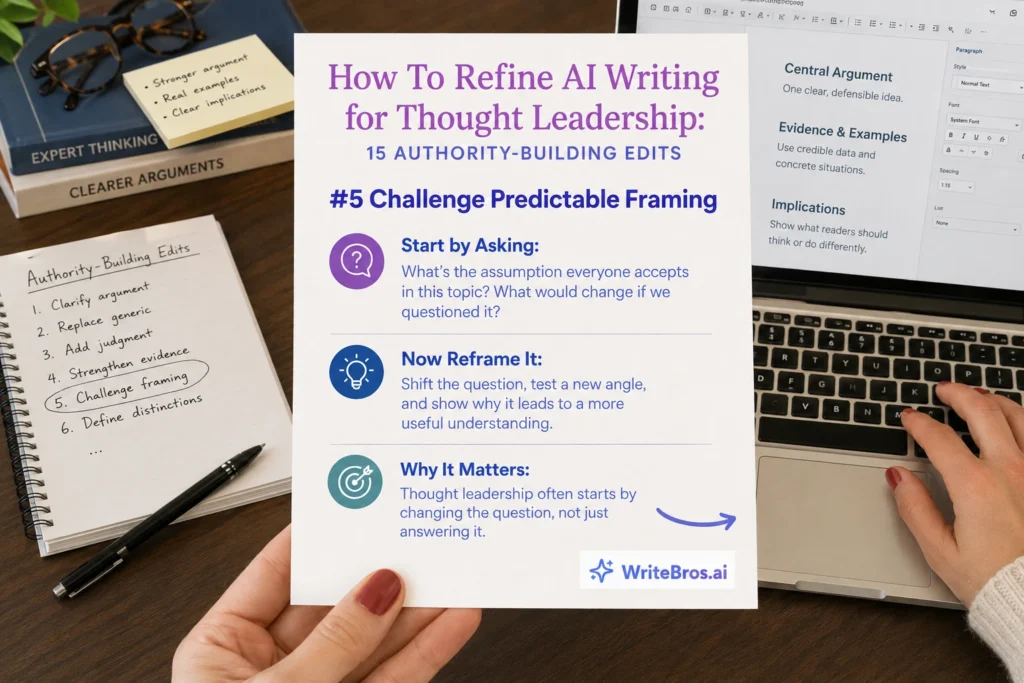
How to Refine AI Writing for Thought Leadership Content – Strategy #5: Challenge Predictable Framing
Look for places where the draft automatically accepts the dominant framing of the issue, then test whether the more useful argument begins by questioning the categories, assumptions, or cause-and-effect relationships that everyone else seems to repeat. This strategy is particularly effective when AI has generated a conventional structure built around familiar benefits, challenges, predictions, or best practices, because such frameworks can make a piece feel complete while leaving its underlying assumptions untouched. Good execution involves identifying one accepted premise worth examining and showing, through reasoning or evidence, why a different framing produces a more useful understanding of the problem.
This works because strong thought leadership often changes the question before it changes the answer, giving readers a more productive way to interpret something they may already have encountered many times. For example, rather than asking whether companies should use more AI, an article could argue that the more important question is which decisions should remain scarce, deliberate, and human even when automation makes producing additional outputs extremely cheap. The key restraint is to avoid contrarianism for its own sake, since challenging every familiar idea quickly becomes predictable in another way and weakens credibility when the alternative framing is not materially better supported.
How to Refine AI Writing for Thought Leadership Content – Strategy #6: Define Meaningful Distinctions
Separate concepts that the draft currently treats as interchangeable, because authority often becomes visible when a writer can explain why two ideas that sound similar behave differently in practice and therefore require different decisions. This edit is useful when AI compresses related terms such as visibility and credibility, efficiency and effectiveness, automation and delegation, or expertise and authority into broad categories that seem convenient but obscure important differences. Good execution means defining the distinction clearly, showing what changes when readers recognize it, and carrying that difference consistently through the rest of the argument instead of mentioning it once and abandoning it.
The technique works because precise distinctions help readers organize complex subjects, while also showing that the writer understands where common language can hide practical consequences that matter. For example, an article could distinguish content reach from content influence by showing that a widely viewed post may generate attention without materially changing how buyers evaluate a company, whereas a smaller piece read by the right decision-makers can affect procurement conversations much more directly. The distinction should remain useful rather than semantic, because splitting hairs over terminology that does not change interpretation, behavior, or decision-making adds complexity without creating additional insight.
How to Refine AI Writing for Thought Leadership Content – Strategy #7: Use Concrete Examples
Replace some of the draft’s abstract explanations with specific situations that demonstrate how the argument operates when real people, constraints, incentives, and consequences are involved, because authority becomes easier to trust when readers can see how an idea behaves outside a polished conceptual framework. This is particularly important when AI uses generalized phrases such as improving alignment, increasing efficiency, strengthening engagement, or creating value without showing what those outcomes would look like in practice. Strong execution means selecting examples that illuminate the reasoning itself, preferably by revealing a decision point, a tradeoff, or a consequence that would remain invisible in a purely abstract explanation.
Concrete examples work because they force both the writer and the reader to test whether a principle still makes sense after practical complications enter the picture, which is often where superficial advice begins to fail. A leadership article, for example, could explain that telling managers to communicate more frequently sounds useful until employees receive five overlapping updates from different departments and become less certain about which instruction governs their work. The example does not need to become a lengthy case study, but it should be specific enough to demonstrate mechanism and consequence rather than merely restating the original point in a more conversational form.
How to Refine AI Writing for Thought Leadership Content – Strategy #8: Expose the Tradeoffs
Add the costs, limitations, opportunity losses, or competing priorities that accompany important recommendations, because AI-generated advice often becomes suspiciously clean when every proposed action appears beneficial and no meaningful downside has to be managed. This strategy is especially useful for strategic, operational, financial, or organizational topics where leaders rarely choose between a good option and a bad one, but instead decide which disadvantage they are most prepared to accept. Strong execution means naming the tradeoff directly, explaining why it exists, and helping readers understand the circumstances under which one side of the decision should reasonably take priority over another.
This works because credible experts tend to recognize that useful decisions create second-order effects, whereas shallow advice frequently stops after describing the most obvious benefit and therefore underestimates the cost of implementation. For example, standardizing a content process may improve consistency and measurement, yet the same system can reduce experimentation if writers begin optimizing every idea around predetermined templates and approval criteria. The caveat is that tradeoffs should not become an excuse for indecision, because the purpose is not to make every recommendation inconclusive but to show readers which compromises are acceptable and which ones would undermine the intended result.
How to Refine AI Writing for Thought Leadership Content – Strategy #9: Remove Empty Authority Signals
Cut phrases that attempt to manufacture credibility through certainty, sophistication, or status rather than through reasoning, because expressions such as clearly, unquestionably, game-changing, revolutionary, or industry-leading often ask readers to accept a conclusion before the article has earned it. This edit matters when AI has produced highly polished prose that sounds executive or authoritative on the surface but depends heavily on confident modifiers, sweeping declarations, and abstract language to create that impression. Good execution means replacing those signals with evidence, specificity, comparison, or an explanation of mechanism so that readers reach the intended conclusion through the substance of the argument.
The approach works because genuine authority usually sounds more calibrated than promotional authority, particularly when the subject contains uncertainty, competing evidence, or conditions that experienced readers already know cannot be reduced to one universal conclusion. For example, instead of writing that a new technology will unquestionably redefine an industry, the article could explain which cost structures, workflows, and customer behaviors it is already changing and which parts of the sector remain relatively insulated. Avoid becoming timid in the process, however, because removing inflated certainty does not require weakening every claim with unnecessary qualifiers when the available evidence genuinely supports a strong conclusion.
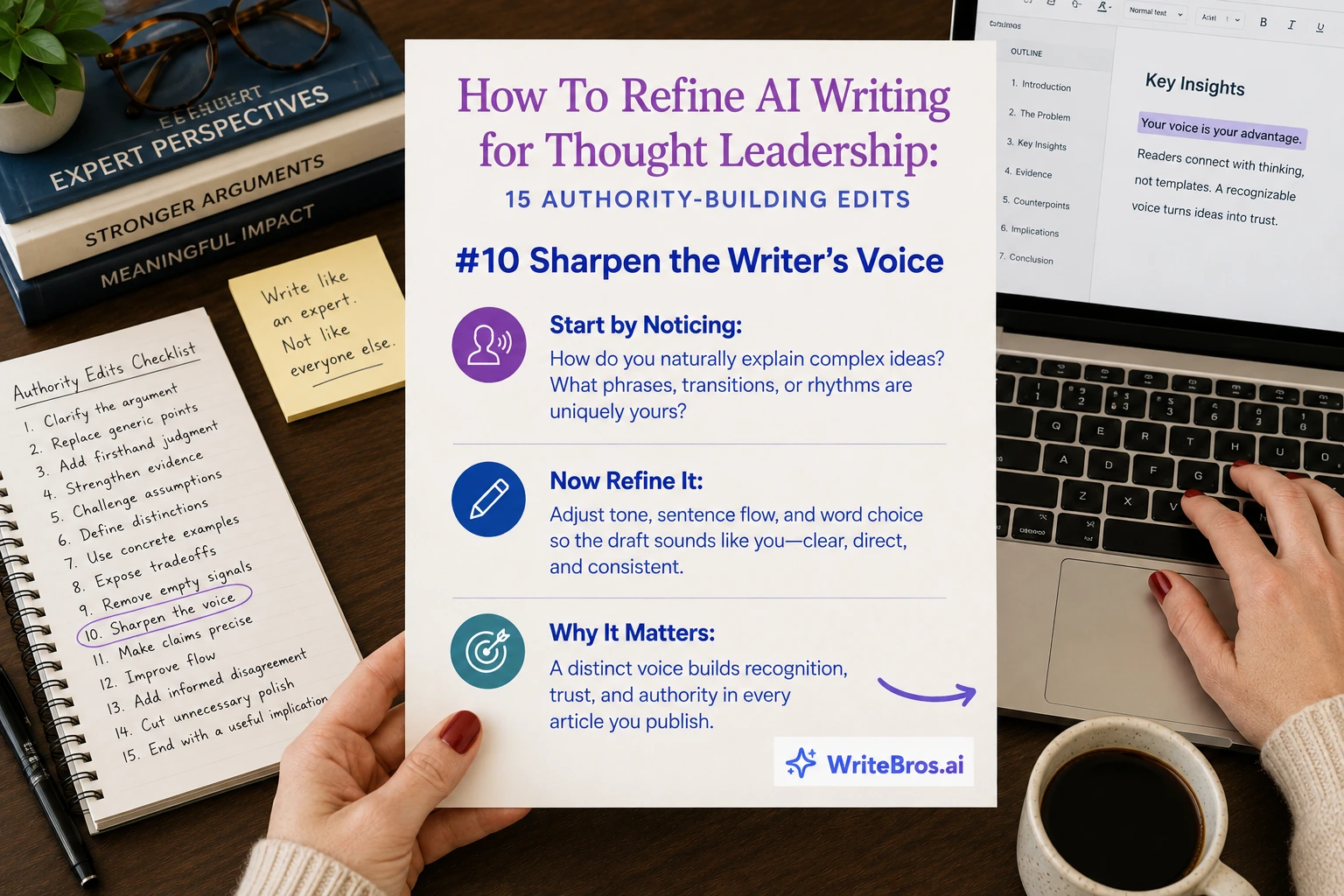
How to Refine AI Writing for Thought Leadership Content – Strategy #10: Sharpen the Writer’s Voice
Revise wording, cadence, emphasis, and transitions so the article reflects how the writer naturally explains difficult ideas, weighs evidence, and moves between observation and conclusion, because a recognizable voice helps readers associate the argument with a person rather than with a generic content system. This strategy is especially useful after the conceptual edits are complete, since improving voice too early can lead to polishing sentences that later need substantial structural changes anyway. Strong execution means preserving recurring patterns that genuinely belong to the writer, including preferred sentence rhythms, levels of directness, degrees of formality, and characteristic ways of qualifying or intensifying a point.
This works because voice functions as a form of intellectual continuity, allowing readers to recognize not only what the author says but also how that person habitually approaches uncertainty, disagreement, and explanation. For example, one executive may naturally use restrained comparisons and operational detail, while another communicates best through vivid analogies and direct observations from customer conversations, and forcing both into the same polished corporate cadence would diminish their credibility. The goal is not to make every sentence unusual, because distinctive writing still needs clarity, but to remove the anonymous smoothness that makes one expert sound interchangeable with another.
How to Refine AI Writing for Thought Leadership Content – Strategy #11: Make Claims More Precise
Narrow broad claims until the wording reflects what the evidence, experience, or reasoning can genuinely support, because authority weakens when a draft treats tendencies as rules, correlations as causes, or context-dependent outcomes as universal truths. This edit is especially important when AI uses expansive language such as businesses are shifting, consumers expect, leaders need, or technology is transforming without defining which businesses, which consumers, which leaders, or which part of the transformation is relevant. Good execution means specifying the population, condition, timeframe, or mechanism whenever that additional precision materially changes how a reader should understand the claim.
Precision works because it gives readers a clearer sense of where an argument applies and where they should remain cautious, which is often more useful than a dramatic statement that collapses under closer examination. For example, rather than claiming that executives no longer trust vendor content, a stronger formulation might explain that senior buyers in complex B2B purchases increasingly scrutinize whether a vendor demonstrates domain expertise before engaging sales. Avoid burying every sentence beneath qualifications, however, because precision should sharpen meaning rather than create legalistic prose that becomes so defensive that readers struggle to identify what the writer believes.
How to Refine AI Writing for Thought Leadership Content – Strategy #12: Improve Argument Progression
Reorder the draft so each section creates a reason for the next one to exist, because thought leadership becomes much more persuasive when the reader can follow a deliberate progression from problem to interpretation, evidence, consequence, and implication rather than encountering several related sections in interchangeable order. This strategy matters when AI has produced a structurally tidy article whose headings appear logical individually but do not build cumulative reasoning across the full piece. Good execution means checking what each section adds that the previous one did not, then removing repetitions, moving necessary context earlier, and placing the strongest implications only after enough evidence has been established.
This works because argument progression turns information into a guided line of thought, allowing readers to experience the writer’s reasoning instead of merely receiving a sequence of conclusions that could have appeared in almost any order. For instance, an article about declining trust in automated communication might first establish the observable behavior, then explain the operational incentives causing it, then show the customer consequence, and only afterward argue for a different content model. The structure should not become rigid, though, because some subjects benefit from opening with a surprising implication or practical example before returning to the evidence that explains why it matters.
How to Refine AI Writing for Thought Leadership Content – Strategy #13: Add Informed Disagreement
Identify a credible competing viewpoint and engage with it seriously, because authority becomes stronger when a writer can explain why reasonable people reach a different conclusion and then show where the evidence, assumptions, or priorities lead the argument elsewhere. This strategy is most useful when the draft presents one interpretation as obvious, especially in fields where practitioners disagree about implementation, risk, measurement, governance, or the pace of change. Good execution means representing the alternative position fairly enough that someone who holds it would recognize their reasoning, then responding to its strongest version rather than dismissing a simplified caricature.
Informed disagreement works because it demonstrates intellectual confidence without requiring exaggerated contrarianism, while also helping readers understand which assumptions determine whether two apparently conflicting recommendations can both be reasonable in different contexts. For example, one camp may favor aggressively automating repetitive knowledge work, while another emphasizes preserving human review, and a useful article could argue that the difference depends less on ideology than on reversibility, error cost, and how quickly bad outputs can propagate. The main caution is to avoid manufacturing controversy where little meaningful disagreement exists, because performative opposition can make the piece feel engineered for attention rather than grounded in genuine professional judgment.
How to Refine AI Writing for Thought Leadership Content – Strategy #14: Cut Unnecessary Polish
Remove phrases, transitions, and sentence structures that feel excessively symmetrical or manufactured, because AI often creates prose in which every paragraph arrives neatly, develops predictably, and concludes with the same polished balance that makes the writing easier to process but less recognizably human. This edit is particularly useful when the argument is already strong but the presentation still sounds uniformly smooth, formal, or corporate in ways that flatten the writer’s personality. Good execution means keeping clarity while allowing some natural variation in sentence length, emphasis, transition style, and paragraph movement so the prose reflects how people genuinely develop complex ideas.
This works because readers often associate credible expertise with selective emphasis and uneven attention, since people who know a subject well tend to spend more time on what is consequential instead of giving every point identical rhetorical weight. For example, a founder might move quickly through an obvious market trend but linger over one operational detail that repeatedly determines whether customers adopt the product, and preserving that imbalance can make the article feel much more informed. Avoid making the prose deliberately rough, however, because natural writing still benefits from careful editing and should not confuse authenticity with unnecessary repetition, grammatical looseness, or preventable ambiguity.
How to Refine AI Writing for Thought Leadership Content – Strategy #15: End With a Useful Implication
Conclude by showing what the argument changes for the reader’s decisions, assumptions, priorities, or future observations, because a thought leadership article should leave behind more than a summary of the points that appeared in the preceding sections. This edit matters when AI-generated conclusions default to generic recaps, optimistic predictions, or broad encouragement that repeats the article without clarifying why the reasoning should continue to matter after the reader closes the page. Good execution means translating the central argument into a consequence, such as what leaders should reconsider, what signal they should watch more carefully, or which familiar practice now deserves a different interpretation.
This works because useful implications extend the article beyond explanation and give readers a framework they can apply to situations the writer never addressed directly, which is one of the clearest signs that an idea has genuine strategic value. For example, an article arguing that AI lowers the cost of producing competent content could conclude that future differentiation will depend less on publishing volume and more on controlling which judgments, evidence, and experiences remain difficult for competitors to reproduce. The ending should remain proportional to the argument, however, because an understated implication supported by the article is usually more memorable than a sweeping prediction that reaches beyond what the evidence can reasonably sustain.
Common mistakes
- Treating stylistic cleanup as the entire editing process is a common mistake because a draft can become smoother, more readable, and more grammatically consistent without gaining any stronger argument, evidence, or perspective. This happens when editors focus first on wording because those changes are easy to see, but it backfires when the final piece still feels interchangeable with dozens of competent articles on the same subject.
- Adding personal anecdotes without connecting them to the argument often happens because writers know firsthand experience can strengthen authority, yet they include stories simply to make the article feel more human. The result can feel decorative rather than insightful, and it backfires when readers cannot see what the experience proves, changes, or helps them understand about the larger issue.
- Forcing contrarian claims is another frequent mistake because thought leadership is often confused with taking the opposite position from whatever appears popular or accepted. This approach can produce attention temporarily, but it backfires when the argument relies on exaggerated disagreement, ignores reasonable evidence, or makes the writer appear more interested in differentiation than in helping readers understand the subject accurately.
- Overloading the article with statistics can happen when writers try to compensate for weak original thinking by increasing the volume of supporting evidence throughout the draft. Although strong sources can improve credibility, the tactic backfires when readers encounter a sequence of numbers without enough interpretation to understand which findings matter, how they connect, or why the author’s perspective adds anything beyond summarizing research.
- Removing every sign of uncertainty is a mistake because editors sometimes assume authoritative writing must sound completely certain, particularly when an AI-generated draft already uses confident language and polished conclusions. This backfires in complex fields where knowledgeable readers understand that outcomes depend on context, since overstated certainty can signal shallow reasoning and make otherwise useful analysis easier to challenge.
- Trying to preserve every useful AI-generated point often happens because deleting competent material can feel wasteful, especially after considerable effort has already gone into producing and organizing the draft. The result is usually an article that covers too much, repeats similar ideas, and weakens its central argument, while a more selective edit would give the strongest insights enough space to become memorable.
Edge cases
Not every thought leadership piece needs a highly original thesis, particularly when the writer’s value comes from synthesizing fragmented information, translating technical developments for a specific audience, or applying established ideas to a new operational context. In those cases, authority can come from unusually clear interpretation, strong prioritization, or a practical framework that helps readers make sense of information they already encounter elsewhere, provided the article remains explicit about what is synthesis and what is the author’s own conclusion.
Likewise, highly regulated, scientific, or risk-sensitive subjects may require more conservative language than general business commentary, because novelty should never take priority over accuracy or responsible qualification. A writer can still demonstrate authority by clarifying uncertainty, comparing competing evidence, identifying decision thresholds, and explaining what remains unknown, which often produces more trust than attempting to manufacture certainty or originality where the available evidence does not support either.
Supporting tools
- Research databases and academic search tools help verify whether a claim is supported by credible evidence, particularly when the draft includes broad statements about behavior, markets, technology, or organizational performance. They are most useful when you treat them as sources for interpretation rather than as substitutes for an argument, because collecting studies without explaining their relevance can make the article denser without making it more insightful.
- Interview transcripts, meeting notes, and recorded customer conversations can surface firsthand language, recurring objections, and operational details that generic AI output is unlikely to reproduce accurately. Reviewing these materials before editing helps identify which observations deserve emphasis, although private information should be anonymized or removed when the source was not intended for public attribution.
- Version comparison tools are useful when substantial restructuring is involved because they make it easier to see whether an edit genuinely improved the argument or merely changed the wording. Comparing versions also helps writers notice when distinctive observations have been accidentally flattened during cleanup, particularly across long articles where several rounds of revision can gradually make the prose more generic.
- Readability and grammar checkers can identify awkward constructions, repetition, punctuation problems, and excessively dense sentences after the substantive thinking is already in place. They work best as diagnostic tools rather than automatic decision-makers, since accepting every suggestion can standardize sentence patterns and remove deliberate stylistic choices that contribute to a recognizable expert voice.
- Source-management tools help organize research, publication details, quotes, and supporting references so that major claims can be traced back to credible material during editing. This becomes especially valuable in long-form expert content where dozens of sources may be involved, because losing track of evidence can lead to unsupported statements, unnecessary duplication, or citations that no longer match the final argument.
- WriteBros.ai can support the rewriting stage when an AI-assisted draft needs to sound less formulaic while preserving the writer’s intended meaning, tone, and overall direction. It is most useful after the core argument and evidence are settled, because humanizing surface-level language cannot compensate for missing expertise, weak reasoning, or claims that still require stronger support.
Ready to Transform Your AI Content?
Try WriteBros.ai and make your AI-generated content truly human.
Conclusion
Refining AI-assisted thought leadership is ultimately less about hiding how a draft was produced and more about making sure the finished article contains reasoning worth associating with a credible expert. Strong editing clarifies the argument, strengthens evidence, introduces firsthand judgment, exposes meaningful tradeoffs, and removes the generic language that can make even technically polished writing feel interchangeable with everything else readers encounter online each day.
The goal is not to make every sentence unusually distinctive or every argument provocative, because authority develops through consistent judgment rather than constant performance. When the writer chooses what deserves emphasis, acknowledges where evidence is limited, explains why certain conclusions matter, and preserves a recognizable way of thinking through complexity, AI becomes useful drafting support without determining the intellectual character of the final piece.
An AI-generated thought leadership draft can be accurate, polished, and logically structured while still doing very little to establish authority, because readers do not judge expertise from fluency alone; they also look for credible reasoning, informed judgment, evidence, specificity, and a perspective that gives them a useful way to interpret the subject. The most consequential editing therefore happens beyond sentence cleanup, where generic observations are replaced with sharper claims, meaningful distinctions, real-world tradeoffs, and conclusions that reveal what the writer understands rather than merely what the draft can summarize.
Research examining the effects of source expertise and trustworthiness found that people generally perceive sources with greater expertise and trustworthiness as more credible, reinforcing why visible expert judgment matters when developing authority-led content. For AI-assisted thought leadership, the practical lesson is to treat generation as the beginning of the reasoning process, then refine the central argument, supporting evidence, firsthand observations, precision, counterpoints, tradeoffs, and voice until readers can clearly recognize the expertise and judgment behind the finished piece.
Ready to Transform Your AI Content?