How to Refine DeepSeek AI Writing Naturally: 15 Human-Centered Editing Techniques

DeepSeek drafts can sound complete while still missing the voice, context, and judgment readers trust. This guide shows how to revise structure, rhythm, examples, and tone with human-centered care, supported by research on authorship and voice.
How to Refine DeepSeek AI Writing Naturally: 15 Human-Centered Editing Techniques
DeepSeek can give you a useful first draft, but the writing often still feels a little too smooth, stiff, or distant from the person who is supposed to be saying it. That matters even more when the draft is meant for professional use, where small wording choices can change how much the reader trusts the message.
This usually happens because AI writing is built to be complete, efficient, and broadly acceptable, not necessarily specific, textured, or emotionally aware. The same issue shows up in academic writing, marketing copy, emails, and essays when the structure is solid but the voice still feels flattened.
This guide walks through practical ways to keep the useful parts of a DeepSeek draft while making the final version sound more natural, intentional, and human. You will see how tone preservation, sentence-level judgment, and audience-aware editing work together across 15 human-centered techniques.
| # | Strategy focus | Practical takeaway |
|---|---|---|
| 1 | Start with intent | Clarify what the draft should do before changing the wording, so every edit serves the reader instead of just making the text sound nicer. |
| 2 | Keep the useful frame | Preserve the parts that already work, then improve weak transitions, flat explanations, and generic phrasing without rebuilding the whole piece unnecessarily. |
| 3 | Adjust sentence rhythm | Mix sentence lengths and patterns so the writing feels spoken by a real person rather than generated in one polished, predictable flow. |
| 4 | Add concrete details | Replace broad claims with specific examples, situations, or reader-facing context that make the point easier to believe and remember. |
| 5 | Reduce overexplaining | Cut repeated setup, obvious definitions, and unnecessary wrap-up lines so the final draft respects the reader’s attention. |
| 6 | Strengthen transitions | Make each idea connect naturally to the next, especially where the original draft jumps between points without showing the relationship. |
| 7 | Use natural emphasis | Highlight the most important point with placement, contrast, or plain wording instead of relying on inflated adjectives or dramatic phrasing. |
| 8 | Match reader expectations | Tune the language for the audience’s knowledge level, mood, and purpose so the draft feels useful rather than merely complete. |
| 9 | Soften mechanical tone | Remove phrases that sound too formal, balanced, or template-like, then replace them with wording that feels closer to everyday professional communication. |
| 10 | Preserve original meaning | Edit for clarity and voice without changing the argument, promise, evidence, or position the draft is supposed to communicate. |
| 11 | Make examples realistic | Choose examples that sound like something a reader would actually encounter, not polished scenarios that exist only to prove a point. |
| 12 | Clean up repetition | Merge overlapping ideas and remove repeated phrasing so the piece feels purposeful instead of padded or circular. |
| 13 | Sharpen the ending | Close with a clear final thought that leaves the reader with direction, not a generic summary that restates what they already read. |
| 14 | Read for voice fit | Check whether the final version sounds like the intended writer, brand, or context before treating the edit as finished. |
| 15 | Review in layers | Edit structure, clarity, tone, and polish separately so each pass improves the draft without creating new problems elsewhere. |
15 Human-Centered Editing Techniques to Refine DeepSeek AI Writing Naturally
How to Refine DeepSeek AI Writing Naturally – Strategy #1: Start with intent
Before changing individual sentences, define what the draft is supposed to accomplish for the reader, because a natural edit depends on purpose before style. This is especially important when DeepSeek gives you a polished draft that sounds complete but does not clearly signal whether it should persuade, explain, reassure, compare, or instruct. Good execution means writing one plain sentence about the goal, then using that sentence as the filter for every structural and tonal decision that follows.
This works because many awkward AI edits happen when the editor starts smoothing language without knowing what the piece should make the reader understand or feel. For example, a service page may need confidence and specificity, while a student explanation may need clarity and restraint, even if both drafts cover similar facts. The main constraint is that intent should guide the edit without becoming rigid, since useful writing still needs room for nuance, context, and reader questions.
How to Refine DeepSeek AI Writing Naturally – Strategy #2: Keep the useful frame
Start by identifying the parts of the DeepSeek draft that already work, because natural editing does not mean tearing down a usable structure just to prove the text was heavily revised. A draft may have a clear order, helpful headings, or a logical explanation, even if the voice feels generic or the examples feel thin. Good execution means protecting the strongest frame first, then improving the places where the draft sounds flat, repetitive, or disconnected from a real audience.
This works in real situations because many AI drafts are structurally serviceable but tonally underdeveloped, so rebuilding everything can waste time and sometimes make the piece less organized. For example, a how-to article may already move from problem to solution in the right sequence, but each section may need more human judgment and less textbook phrasing. Watch for drafts where the frame looks orderly but hides weak reasoning, because keeping structure should not mean preserving shallow logic.
How to Refine DeepSeek AI Writing Naturally – Strategy #3: Adjust sentence rhythm
Read the draft aloud or slowly enough to hear whether every sentence lands with the same shape, because AI writing often sounds unnatural when its rhythm is too even. DeepSeek may produce sentences that are grammatically clean but similarly paced, with repeated transitions, balanced clauses, and predictable endings that make the page feel manufactured. Good execution means varying length, opening patterns, and emphasis while keeping the meaning steady, so the writing feels guided by thought rather than generated by formula.
This works because human writing usually carries small changes in pace that reflect attention, hesitation, confidence, or emphasis, even in professional contexts. For example, a paragraph explaining a pricing change may need one longer sentence for context, followed by a more direct sentence that clarifies what changes for the customer. The caveat is that rhythm should support comprehension, so do not create variety by adding fragments, dramatic pauses, or decorative phrasing that distracts from the message.
How to Refine DeepSeek AI Writing Naturally – Strategy #4: Add concrete details
Replace broad statements with details that help the reader picture the situation, because natural writing usually feels grounded in something observable rather than floating above the topic. DeepSeek often explains ideas in general terms, which can make a paragraph sound reasonable but forgettable when the reader wants proof, context, or practical texture. Good execution means adding a specific use case, condition, audience detail, or realistic scenario without stuffing the draft with unnecessary facts.
This works because readers trust writing more when they can see how the point applies to an actual moment, task, or decision. For example, instead of saying a revised email is more engaging, you might show that it names the client’s concern, explains the next step, and removes a vague promise. The constraint is that details must be relevant, because random specificity can feel forced and may make the writing seem less credible rather than more human.
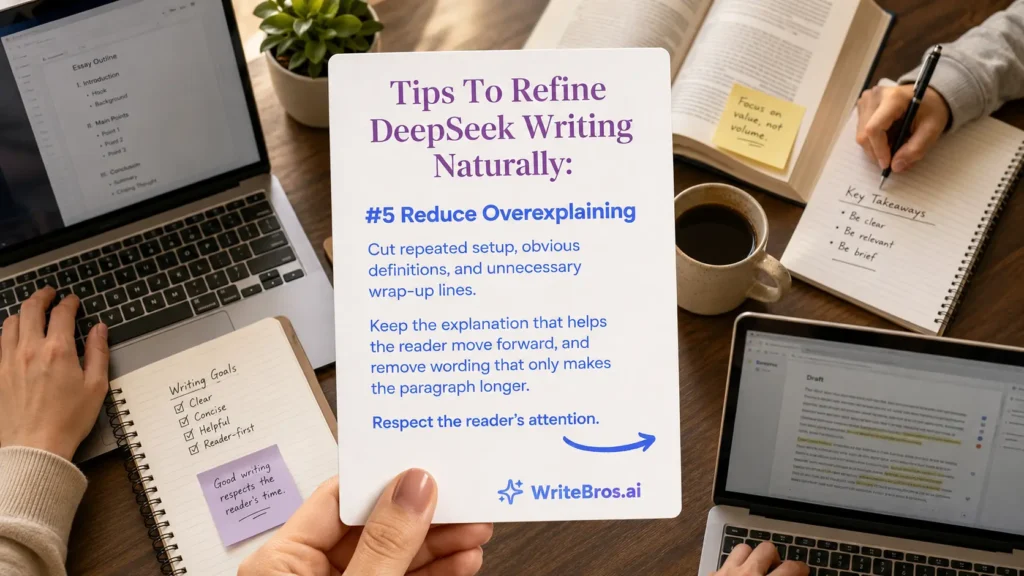
How to Refine DeepSeek AI Writing Naturally – Strategy #5: Reduce overexplaining
Look for places where the draft explains what the reader already knows, because AI writing often tries to be helpful by adding extra setup, repeated definitions, or unnecessary transitions. DeepSeek may introduce a concept, restate it in slightly different language, and then summarize it again before moving forward, which makes the writing feel padded. Good execution means keeping the explanation that helps the reader move ahead and removing the language that only makes the paragraph look fuller.
This works because natural writing respects the reader’s attention and usually trusts them to follow a point once it has been clearly made. For example, an article about editing AI drafts does not need to repeatedly explain that AI tools can save time, since most readers already understand that basic premise. The thing to watch is context, because beginner audiences may need more explanation than expert readers, so the goal is not minimalism but appropriate support.
How to Refine DeepSeek AI Writing Naturally – Strategy #6: Strengthen transitions
Review how each paragraph moves into the next, because natural writing depends on visible connections between ideas rather than a sequence of polished but separate points. DeepSeek can produce sections that look organized on the surface while still making quiet jumps in logic, especially when a draft moves from problem to advice too quickly. Good execution means adding connective language that explains cause, contrast, sequence, or consequence without relying on stiff phrases that sound like a template.
This works because readers rarely complain about transitions directly, but they feel the effect when a piece suddenly becomes harder to follow. For example, after explaining why a draft sounds robotic, the next paragraph should show how that problem affects trust or readability before introducing an editing technique. The caveat is that transitions should clarify the relationship between ideas, not decorate the prose, since too many signposts can make the writing feel slow and overmanaged.
How to Refine DeepSeek AI Writing Naturally – Strategy #7: Use natural emphasis
Decide which point in a paragraph deserves the most attention, because AI writing often spreads emphasis evenly across every sentence and makes everything sound equally important. DeepSeek may use strong adjectives, repeated framing, or balanced phrasing to create importance, but that can leave the reader unsure where the real message sits. Good execution means placing the strongest idea where it naturally lands, then supporting it with context instead of exaggerating the language around it.
This works because human emphasis usually comes from judgment, contrast, and placement, not from making every claim sound more impressive than it is. For example, a product explanation may become more convincing when the clearest benefit appears after a practical pain point, rather than being introduced with inflated words like powerful or game-changing. The constraint is that emphasis should stay proportionate, because overstating a minor point can make the whole draft feel less trustworthy.
How to Refine DeepSeek AI Writing Naturally – Strategy #8: Match reader expectations
Adjust the draft according to what the reader likely knows, needs, and expects from the format, because natural writing changes depending on the relationship between writer and audience. DeepSeek may produce a balanced explanation that seems broadly useful, but a broad version can still miss the level of detail, directness, or reassurance the reader actually needs. Good execution means checking whether the draft should sound instructional, conversational, formal, cautious, persuasive, or practical for that specific context.
This works because readers judge naturalness partly by fit, not just by whether the sentences sound smooth when read in isolation. For example, a LinkedIn post about an editing workflow can be warmer and more personal than a compliance note, while an academic paragraph may need careful restraint instead of casual phrasing. The caveat is that matching expectations should not flatten the writer’s voice, because the goal is alignment with the reader, not bland conformity.
How to Refine DeepSeek AI Writing Naturally – Strategy #9: Soften mechanical tone
Identify phrases that sound overly balanced, formal, or template-like, because DeepSeek can produce language that is correct but oddly distant from how people usually communicate. This often appears in phrases that announce the structure too heavily, praise the topic too broadly, or create a polished neutrality that feels safe but impersonal. Good execution means replacing mechanical wording with plain, context-aware language that still respects the seriousness of the subject.
This works because readers can often sense when a paragraph has been optimized for general acceptability rather than written for a particular moment. For example, instead of saying it is important to note that effective communication plays a crucial role, the edit might explain what clearer communication prevents in that specific workplace or assignment. Watch for overcorrection, though, because making the tone too casual can be just as unnatural when the subject calls for professionalism.
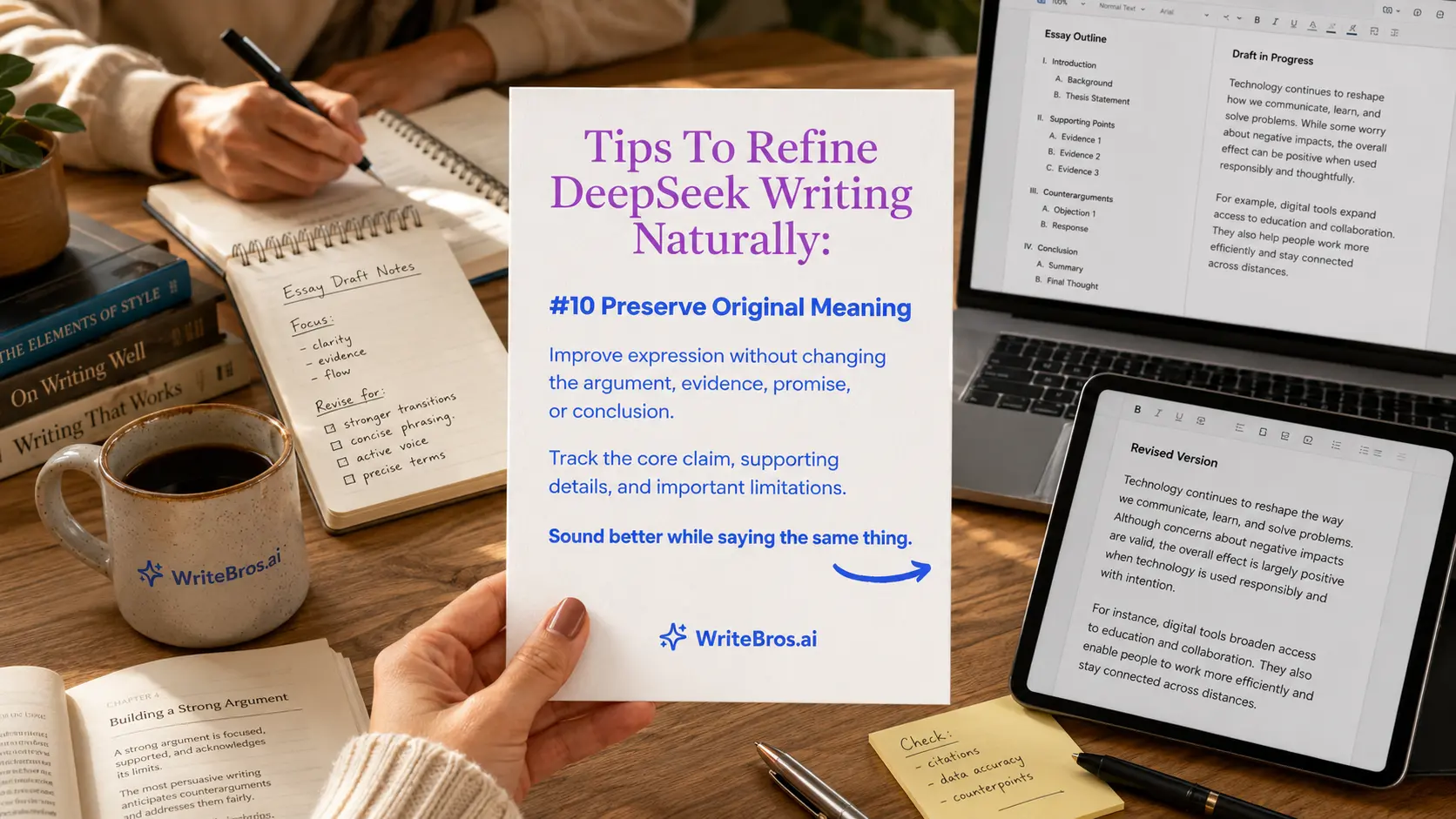
How to Refine DeepSeek AI Writing Naturally – Strategy #10: Preserve original meaning
Compare the edited version against the original point before finalizing, because natural editing should improve expression without quietly changing the argument, evidence, promise, or conclusion. DeepSeek drafts can become distorted during revision when the editor makes the tone warmer, sharper, or more persuasive without checking whether the substance stayed intact. Good execution means tracking the core claim, the supporting details, and any important limitations so the final version sounds better while still saying the same thing.
This works because a human-sounding draft is not useful if it becomes less accurate, less careful, or less aligned with the writer’s actual position. For example, changing a cautious recommendation into a confident guarantee may make the paragraph sound stronger, but it also creates a meaning problem that can damage trust. The constraint is especially important for academic, legal, medical, financial, and technical topics, where tone improvements must never outrun the evidence.
How to Refine DeepSeek AI Writing Naturally – Strategy #11: Make examples realistic
Revise examples so they feel like situations a real reader might recognize, because AI-generated examples often sound neat, generic, or too perfectly arranged around the lesson. DeepSeek may give you a scenario that technically proves the point, but it can still feel artificial if the details are vague or the outcome is too convenient. Good execution means choosing examples with ordinary constraints, imperfect context, and practical consequences that make the guidance easier to believe.
This works because realistic examples help the reader connect the advice to their own work, instead of treating the paragraph as abstract instruction. For example, an editing tip becomes more useful when it shows a busy marketer revising a client-facing email under deadline, rather than an unnamed writer improving content quality in general. The caveat is that examples should support the point without taking over the section, because too much scenario-building can slow the article down.
How to Refine DeepSeek AI Writing Naturally – Strategy #12: Clean up repetition
Scan for repeated ideas, phrases, and sentence functions, because DeepSeek can make a draft feel thorough by restating the same point in slightly different language. This repetition is not always obvious at first, since each sentence may look polished when read alone, but the paragraph can still feel circular when read as a whole. Good execution means merging overlapping points, keeping the strongest version, and removing lines that only echo what the reader has already understood.
This works because natural writing usually moves the reader forward, while repetitive writing creates the feeling that the piece is circling around an idea without adding new value. For example, a paragraph does not need to say that editing improves clarity, improves readability, and makes content easier to understand unless each phrase introduces a distinct angle. The main constraint is not to cut useful reinforcement, since some repetition is helpful when it clarifies a complex or high-stakes point.
How to Refine DeepSeek AI Writing Naturally – Strategy #13: Sharpen the ending
Give each section or full draft an ending that leaves the reader with a clear sense of direction, because AI writing often closes with a broad summary instead of a meaningful final thought. DeepSeek may end by repeating the main idea in polished language, which can make the section feel complete but not especially useful. Good execution means ending with the implication, next consideration, or practical reminder the reader should carry into the next decision.
This works because endings shape how readers remember the point, especially when the body of the paragraph has already done the explaining. For example, a section about reducing generic phrasing might end by reminding the writer to keep the reader’s actual situation visible, rather than simply restating that specificity matters. The caveat is that the ending should not become dramatic or overly conclusive, because natural writing often closes calmly while still giving the reader something concrete to use.
How to Refine DeepSeek AI Writing Naturally – Strategy #14: Read for voice fit
After improving clarity and flow, check whether the draft sounds like the intended writer, brand, or context, because natural writing is partly a matter of recognizable voice. DeepSeek can create a version that is cleaner than the original but still not quite aligned with the person or organization that will publish it. Good execution means comparing the draft against previous writing, audience expectations, and the writer’s usual level of warmth, directness, humor, caution, or detail.
This works because readers often notice voice mismatch even when they cannot explain exactly what feels wrong about the text. For example, a founder known for plain and practical advice may sound unnatural if the final edit uses corporate phrasing, while a university submission may sound inappropriate if it becomes too casual. The constraint is that voice fit should not protect unclear writing, so preserve the writer’s character while still improving precision, structure, and readability.
How to Refine DeepSeek AI Writing Naturally – Strategy #15: Review in layers
Edit the draft in separate passes for structure, clarity, tone, and polish, because trying to fix everything at once often creates uneven changes and missed problems. DeepSeek output may look finished enough to invite sentence-level edits immediately, but deeper issues can remain hidden if the structure and argument are not checked first. Good execution means moving from larger concerns to smaller ones, so each pass has a clear purpose and does not interfere with the previous one.
This works because layered review mirrors how strong editors make decisions, with each pass reducing a different kind of friction for the reader. For example, one pass might reorder sections, the next might simplify explanations, and a final pass might remove stiff phrasing or repeated transitions. The caveat is that layered editing takes more attention than quick polishing, so use the full process for important drafts and a lighter version for routine content.
Common mistakes
- Editing only for smoother wording is a common mistake because the draft may become more polished without becoming more useful. This happens when the editor treats natural writing as a surface-level style issue, but it backfires when the final version still lacks purpose, specificity, or reader awareness.
- Removing every sign of structure can make the writing feel less robotic at first, but it often creates a draft that is harder to follow. This happens when editors overreact to AI stiffness, and it backfires because readers still need clear progression, especially in instructional or professional content.
- Adding casual language everywhere can create a forced human tone that does not fit the audience or subject. This usually happens when naturalness is mistaken for informality, and it backfires when serious topics start sounding careless, underdeveloped, or disconnected from the expectations of the reader.
- Changing the meaning while improving the sound of the sentence is especially risky because the final draft may feel better but say something less accurate. This happens during aggressive rewrites, and it backfires when claims become stronger, softer, broader, or more certain than the source material supports.
- Keeping generic examples because they are technically relevant can make the draft feel complete while still failing to earn the reader’s trust. This happens when examples are treated as decoration, and it backfires because vague scenarios rarely help readers understand how the advice works in practice.
- Skipping a final read for voice fit can leave the draft clear but disconnected from the person, brand, or institution publishing it. This happens when editors stop after fixing grammar and flow, and it backfires because readers often sense inconsistency even when the writing is technically clean.
Edge cases
Some DeepSeek drafts need a lighter edit because the original output already matches the purpose, audience, and tone closely enough. In those cases, heavy rewriting can make the piece less natural by stripping away useful structure or adding unnecessary personality where clarity mattered more.
Other drafts need a deeper rebuild, especially when the reasoning is thin, the examples are generic, or the claims do not match the evidence. The key is to judge the draft by reader impact rather than by how obviously AI-written it sounds at first glance.
Supporting tools
- A style guide helps you make consistent editing decisions across drafts, especially when several people are revising the same kind of content. It gives you a shared reference for tone, formatting, preferred terms, and wording choices, which keeps natural editing from becoming subjective guesswork.
- A read-aloud tool is useful for catching stiff rhythm, repeated sentence patterns, and transitions that look fine on the page but sound awkward when spoken. It works best when you listen for pace and emphasis rather than treating the audio as a simple proofreading step.
- A document comparison tool helps you check whether the edited version changed the meaning of the original draft. This is especially practical for academic, technical, or client-facing work, where even small changes in certainty, scope, or terminology can create problems after publication.
- A grammar and clarity checker can catch mechanical issues after the main human edit is finished. It should be used near the end of the process, because automated suggestions are more helpful when the structure, meaning, and tone have already been reviewed intentionally.
- A swipe file of strong examples gives you practical models for pacing, openings, transitions, and endings without copying anyone’s wording. This helps you recognize what natural writing looks like in your specific field, instead of relying on vague advice about sounding more human.
- WriteBros.ai can help when you want to refine AI-generated text while keeping the draft’s intended meaning, structure, and audience purpose visible. It is most useful when paired with human review, because the best results still depend on judgment, context, and final voice fit.
Ready to Transform Your AI Content?
Try WriteBros.ai and make your AI-generated content truly human.
Conclusion
Refining DeepSeek writing naturally is not about hiding the tool or making every sentence sound casual. It is about keeping the useful draft while adding the judgment that readers expect from a real writer. When you clarify intent, strengthen rhythm, add context, and protect meaning, the edit becomes clearer without losing control.
The best result usually comes from intention, not perfection. A natural draft can still be structured, professional, and carefully edited, as long as the language feels shaped for a specific reader and purpose. Treat each pass as a way to remove distance between the idea and the person reading it.
Did You Know?
DeepSeek drafts can sound fluent while still missing the voice, context, rhythm, and judgment that make writing feel natural.
The strongest refinement keeps the draft’s meaning intact while improving sentence flow, examples, tone, transitions, and reader fit.
Ready to Transform Your AI Content?