How to Rewrite AI Content for Brand Consistency: 15 Messaging Alignment Techniques

AI drafts often sound polished yet disconnected from the company behind them. Learn how to align tone, terminology, examples, and calls to action, supported by research showing that brand consistency strengthens trust, so every channel presents a recognizable, credible identity with greater clarity.
How to Rewrite AI Content for Brand Consistency: 15 Messaging Alignment Techniques
AI can produce clean, readable drafts, yet they often sound like they came from a completely different company than the one publishing them. If every article, email, landing page, and social post feels slightly disconnected, learning how to maintain brand voice when rewriting AI content becomes just as important as improving the writing itself.
The problem usually isn’t grammar or structure but the accumulation of small inconsistencies in tone, vocabulary, positioning, and customer messaging. Even with talented teams and trusted AI editors for collaborative writing, those subtle differences can gradually weaken recognition and make content feel less cohesive over time.
Creating consistent messaging requires a repeatable editing process instead of relying on instinct for every draft. The techniques below show how to rewrite AI content for brand consistency while protecting clarity, personality, and the human voice preservation metrics that help audiences recognize your brand across every channel.
| # | Strategy focus | Practical takeaway |
|---|---|---|
| 1 | Clarify brand identity | Start every revision with a clear understanding of the company’s personality and positioning. |
| 2 | Define audience expectations | Adjust language so it consistently matches the people the content is written for. |
| 3 | Standardize key terminology | Use preferred words and phrases consistently across every piece of content. |
| 4 | Align tone throughout | Remove shifts in personality so the writing feels cohesive from beginning to end. |
| 5 | Strengthen value messaging | Ensure every section reinforces the same core promises and differentiators. |
| 6 | Refine opening sections | Create introductions that immediately establish the expected voice and direction. |
| 7 | Improve transitions | Connect ideas smoothly so the message develops naturally instead of feeling assembled. |
| 8 | Remove generic language | Replace broad statements with wording that reflects the organization’s perspective. |
| 9 | Keep examples consistent | Use scenarios that reinforce the same positioning across different sections. |
| 10 | Review calls to action | Make every closing prompt sound like it belongs to the same brand. |
| 11 | Check emotional consistency | Maintain a stable level of confidence, warmth, or authority throughout the draft. |
| 12 | Adapt for each channel | Preserve recognizable messaging while adjusting for different publishing formats. |
| 13 | Use collaborative reviews | Gather feedback that improves consistency without introducing conflicting edits. |
| 14 | Build editorial checklists | Create repeatable review standards that reduce variation between writers. |
| 15 | Measure long-term consistency | Evaluate published content regularly to keep messaging aligned as the brand evolves. |
15 Messaging Alignment Techniques to Rewrite AI Content for Brand Consistency
How to Rewrite AI Content for Brand Consistency – Strategy #1: Clarify Brand Identity
Begin by defining the few characteristics that should remain recognizable in every piece of content, including the brand’s personality, point of view, level of formality, and relationship with its audience. This foundation matters because an AI draft can be grammatically sound while still feeling disconnected from the company publishing it. Apply this step before line editing so every later decision has a clear reference point rather than depending on personal taste.
A strong identity guide should describe how the brand behaves in language, not merely list vague adjectives such as friendly, confident, or professional. For example, a financial platform might sound calm and practical by explaining risk plainly, avoiding dramatic promises, and acknowledging tradeoffs without becoming overly cautious. Keep the definition specific enough to guide revisions while leaving room for different topics, formats, and emotional contexts across the broader content program.
How to Rewrite AI Content for Brand Consistency – Strategy #2: Define Audience Expectations
Review the draft through the expectations of the intended reader, paying close attention to what they already understand, what they may distrust, and what kind of explanation will help them move forward. Brand consistency depends partly on maintaining a stable relationship with the audience, because the same company should not sound highly technical in one article and strangely simplistic in another without a clear reason. Use audience profiles to calibrate vocabulary, pacing, examples, and assumed knowledge.
This approach works because readers often recognize a brand through how accurately it anticipates their concerns rather than through repeated slogans or stylistic flourishes. A software company serving small business owners, for instance, might replace abstract language about workflow optimization with direct explanations of saved time, fewer handoffs, and clearer accountability. Avoid flattening every audience into one voice, however, since different segments may require adjusted emphasis while still sharing the same underlying personality and messaging principles.
How to Rewrite AI Content for Brand Consistency – Strategy #3: Standardize Key Terminology
Create a controlled vocabulary that identifies preferred product names, service descriptions, customer labels, technical terms, and phrases that should either be used consistently or avoided altogether. This step prevents AI-generated drafts from introducing subtle variations that make the company appear uncertain about its own offerings or positioning. Apply the terminology list during revision by replacing inconsistent wording and checking whether each term reflects the way the brand currently speaks across its website, sales materials, and support content.
Consistent terminology strengthens recognition because readers encounter the same concepts in familiar language wherever they interact with the company. A project management platform, for example, should decide whether it refers to customers as teams, organizations, workspaces, or accounts rather than allowing each article to choose a different label. Keep the list updated when products evolve, and avoid enforcing terminology so rigidly that sentences become repetitive, unnatural, or difficult to understand in context.
How to Rewrite AI Content for Brand Consistency – Strategy #4: Align Tone Throughout
Read the entire draft for shifts in attitude, energy, formality, and emotional distance, since AI-generated content often changes tone between sections without an obvious reason. One paragraph may sound warm and conversational while the next becomes stiff, promotional, or unusually technical, which makes the piece feel assembled rather than authored. Revise these transitions by choosing a consistent tonal range and smoothing any sentence that falls noticeably outside it.
This works because audiences experience tone cumulatively, meaning one sharp change can weaken the sense that a single, recognizable brand is speaking throughout the piece. An educational company might maintain an encouraging tone by explaining complexity patiently, acknowledging common confusion, and avoiding language that sounds dismissive or superior. Do not force every sentence into identical rhythm, however, because natural variation is useful as long as the underlying attitude remains stable and appropriate to the subject.
How to Rewrite AI Content for Brand Consistency – Strategy #5: Strengthen Value Messaging
Identify the central value proposition behind the content and make sure each section supports it without repeating the same claim in slightly different words. AI drafts often accumulate generic benefits such as saving time, improving efficiency, or getting better results, even when those statements do not reflect the brand’s distinctive position. Rewrite those passages so the promised value is specific, credible, and connected to the customer problem the company is genuinely equipped to solve.
Clear value messaging creates consistency because every article begins reinforcing the same strategic story, even when the topic, channel, or format changes. A writing platform focused on preserving personal voice, for example, should emphasize control, recognizable expression, and thoughtful revision rather than presenting itself as merely another speed-oriented automation tool. Watch for claims that are broader than the evidence supports, and preserve nuance when the product’s real advantage depends on context, user effort, or proper implementation.

How to Rewrite AI Content for Brand Consistency – Strategy #6: Refine Opening Sections
Rewrite the introduction so it establishes the brand’s expected voice, level of authority, and approach to the reader within the first few sentences. AI-generated openings often rely on broad observations, predictable questions, or inflated claims that could belong to almost any company in the same industry. Replace those patterns with a direct framing of the problem, a clear indication of relevance, and language that reflects how the brand normally begins a useful conversation.
Strong openings improve consistency because readers form an immediate impression of who is speaking and whether the content feels familiar, credible, and worth continuing. A cybersecurity company, for instance, might begin by naming a specific operational risk rather than declaring that the digital landscape is constantly evolving. Avoid stuffing the introduction with every key message at once, since the goal is to establish direction and trust without making the opening feel crowded, theatrical, or overly self-conscious.
How to Rewrite AI Content for Brand Consistency – Strategy #7: Improve Transitions
Examine how each paragraph and section leads into the next, then rewrite abrupt transitions that make the article feel like a collection of separately generated blocks. Brand-consistent writing should guide the reader through a coherent line of thought, with each idea building on what came before rather than appearing because the outline demanded another section. Use connective phrasing, brief clarification, and logical sequencing to show why the next point matters at that particular moment.
This technique works because smooth transitions make the content feel intentional, which supports the impression of a thoughtful and dependable brand voice. In a guide about customer retention, for example, a section on onboarding should naturally explain how early expectations influence later loyalty before moving into long-term engagement tactics. Avoid mechanical phrases such as moving on or another important factor, since they reveal the structure without strengthening the reasoning that connects one idea to the next.
How to Rewrite AI Content for Brand Consistency – Strategy #8: Remove Generic Language
Search for phrases that sound polished but reveal little about the company’s actual perspective, including broad claims, empty intensifiers, and familiar industry expressions that could appear on a competitor’s website unchanged. Generic wording weakens consistency because it replaces the brand’s distinctive judgment with language optimized only for fluency. Rewrite those sections by adding concrete observations, specific implications, and a recognizable stance on what matters, what does not, and why.
This works especially well when the brand competes in a crowded category where many companies use nearly identical language about innovation, transformation, simplicity, or growth. A logistics provider, for example, could replace seamless end-to-end solutions with a precise explanation of how fewer manual handoffs reduce missed updates and delivery delays. Be careful not to manufacture personality through forced cleverness, because specificity and useful judgment usually create a stronger voice than unusual wording added merely to sound different.
How to Rewrite AI Content for Brand Consistency – Strategy #9: Keep Examples Consistent
Review every example, analogy, and hypothetical scenario to confirm that it reflects the audience, use cases, and market position the brand wants to reinforce. AI-generated drafts often introduce random industries, unrealistic situations, or exaggerated outcomes that make the content feel disconnected from the company’s real customers. Replace those examples with scenarios that are plausible, relevant, and aligned with the kinds of problems the brand regularly helps people understand or solve.
Consistent examples build familiarity because they repeatedly show the brand operating in a recognizable world rather than jumping between unrelated contexts for convenience. A collaboration platform serving distributed teams, for instance, might use examples involving handoffs, time zones, approvals, and project visibility instead of generic stories about increasing productivity. Avoid making every example identical, however, since variation remains useful when it demonstrates range without confusing the company’s core audience or diluting its position.
How to Rewrite AI Content for Brand Consistency – Strategy #10: Review Calls to Action
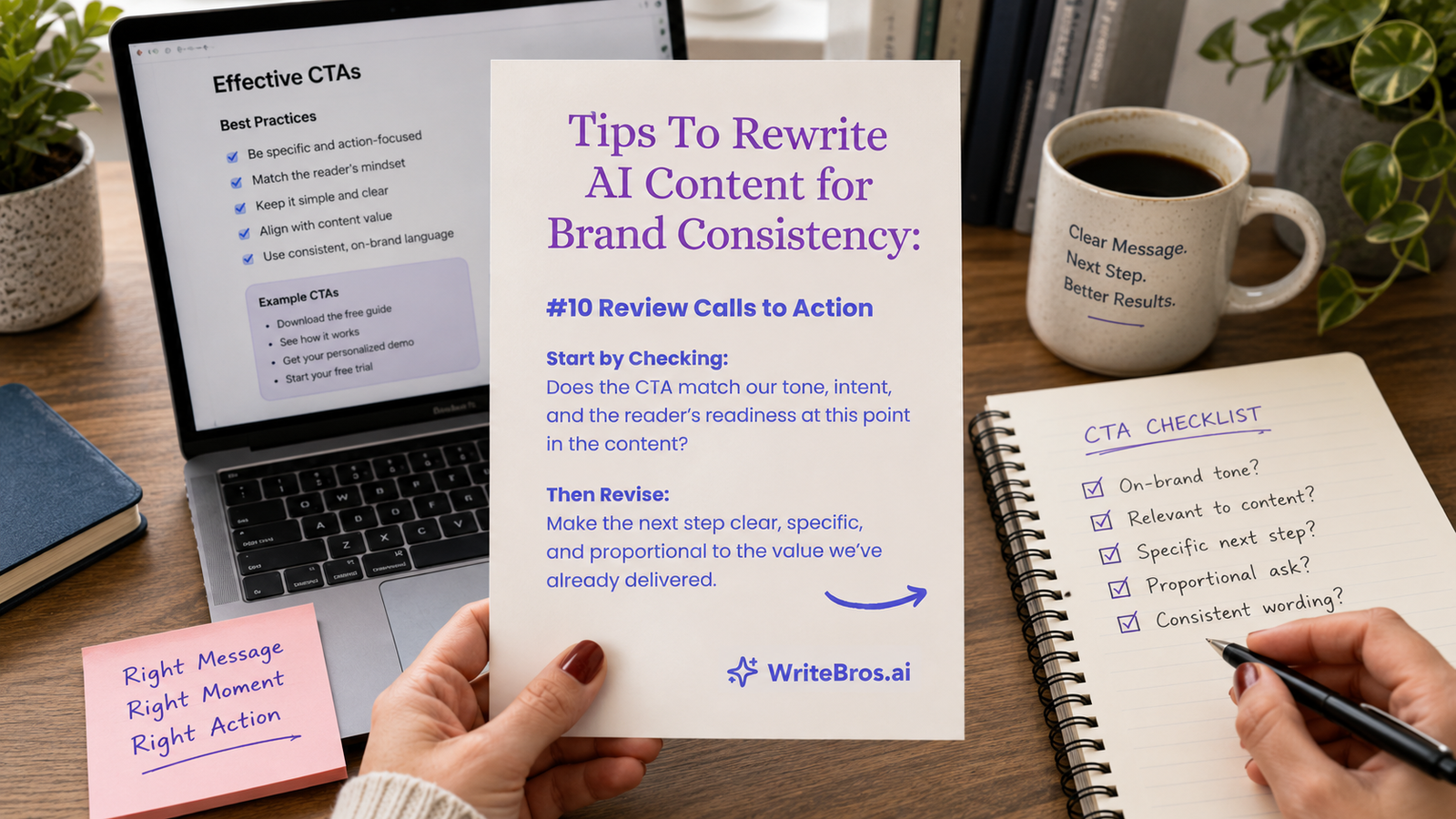
Evaluate every call to action for tone, urgency, specificity, and fit with the surrounding content rather than accepting the generic closing language produced by the AI. A brand that communicates patiently and practically should not suddenly become aggressive, exaggerated, or overly promotional in the final paragraph. Rewrite the action so it feels like a natural next step, reflects the reader’s current level of readiness, and matches the company’s established approach to persuasion.
This method works because the call to action often leaves the strongest final impression of the brand’s priorities and respect for the audience. A consulting firm might invite readers to assess a specific operational gap instead of pushing them to transform their business today. Keep the request proportionate to the content, and avoid asking for a major commitment after a lightweight article unless the brand has provided enough evidence, context, and trust to justify that transition.
How to Rewrite AI Content for Brand Consistency – Strategy #11: Check Emotional Consistency
Assess the emotional register of the draft by noting where it becomes unusually enthusiastic, fearful, reassuring, detached, or forceful compared with the rest of the brand’s content. AI systems often amplify emotional cues because they are trying to make the writing engaging, yet that amplification can feel manipulative or out of character. Rewrite those moments so the level of emotion supports the subject without distorting the brand’s normal degree of confidence, empathy, or restraint.
Emotional consistency matters because readers quickly notice when a company treats similar situations with very different levels of urgency or sensitivity. A healthcare platform, for example, should discuss patient concerns with steadiness and care rather than shifting between clinical detachment and dramatic reassurance. Preserve appropriate emotional variation for serious or celebratory topics, but ensure those changes still feel like the same organization responding thoughtfully rather than adopting a completely different personality whenever the subject changes.
How to Rewrite AI Content for Brand Consistency – Strategy #12: Adapt for Each Channel
Adjust the draft for the expectations of the channel while preserving the core voice, terminology, and message that make the brand recognizable. A long-form article can support nuance and explanation, whereas an email, product page, or social post may require greater compression, faster context, and a more immediate purpose. Rewrite for format by changing length, structure, and emphasis without allowing the brand’s underlying perspective to disappear in the process.
This approach works because consistency does not mean copying the same sentences everywhere; it means expressing the same identity appropriately across different environments. A professional services firm might sound detailed and analytical in a report, concise and helpful in an email, and more conversational on social media while maintaining the same measured confidence. Avoid applying one channel’s conventions too rigidly, since trending formats, forced informality, or excessive brevity can make the brand sound borrowed rather than genuinely adapted.
How to Rewrite AI Content for Brand Consistency – Strategy #13: Use Collaborative Reviews
Build a review process in which contributors evaluate the draft against shared brand standards rather than editing according to individual preference. Collaborative review is most effective when each person has a defined role, such as checking accuracy, customer relevance, voice, or strategic messaging, because uncontrolled feedback often creates more inconsistency than it removes. Consolidate comments before revising so the final draft reflects one coordinated direction instead of a sequence of competing stylistic decisions.
This works in real teams because brand alignment usually depends on knowledge distributed across marketing, product, leadership, sales, and customer support. For example, a product marketer may catch inaccurate positioning while a support lead notices language that does not match how customers describe the problem. Limit the number of final decision-makers, however, and document recurring disagreements so the team can resolve the underlying standard rather than debating the same wording issue in every future draft.
How to Rewrite AI Content for Brand Consistency – Strategy #14: Build Editorial Checklists
Create a concise editorial checklist that turns abstract brand guidance into observable revision tasks, such as verifying terminology, removing unsupported claims, checking tone shifts, and confirming the intended audience. This makes consistency easier to maintain across writers, editors, agencies, and high-volume production schedules because everyone reviews the same essential elements. Use the checklist near the end of the process, after substantive rewriting, so it serves as quality control rather than a substitute for thoughtful editing.
A practical checklist works because it reduces dependence on memory and makes hidden expectations visible to people who were not involved in defining the brand. A content team, for instance, might require every draft to include one concrete customer implication, avoid three prohibited phrases, and use the approved product description. Keep the checklist short enough to use consistently, and revise it when repeated problems reveal that an important standard is missing, unclear, or no longer relevant.
How to Rewrite AI Content for Brand Consistency – Strategy #15: Measure Long-Term Consistency
Review published content periodically to identify patterns that individual draft checks may miss, including gradual tone drift, outdated terminology, inconsistent claims, and differences between channels or contributors. Brand consistency is not a one-time editing achievement because products, audiences, leadership priorities, and market expectations continue to change. Compare representative samples over time and record where the messaging feels aligned, where it has weakened, and which standards need clarification or revision.
This process works because inconsistency often emerges slowly, especially when each individual piece appears acceptable on its own. A quarterly review might reveal that blog content emphasizes education while email campaigns increasingly rely on urgency, creating two conflicting impressions of the same company. Use both qualitative judgment and repeatable indicators, but avoid reducing voice to a score alone, since strong measurement should support editorial reasoning rather than replace the context and nuance required for meaningful brand decisions.
Common mistakes
- Relying on a list of broad adjectives without explaining how those qualities appear in actual sentences is a common mistake, because teams assume words such as friendly or authoritative provide enough direction. In practice, those labels mean different things to different editors, which produces inconsistent revisions and ongoing disagreement about whether the final content sounds right.
- Editing only for grammar and readability often happens because those problems are easy to spot, while messaging alignment requires more judgment and context. The draft may become smoother and more polished, yet still misrepresent the company’s priorities, audience relationship, or value proposition, which leaves the content technically improved but strategically disconnected.
- Copying the same tone across every format can seem like the safest way to maintain consistency, particularly when teams fear that adaptation will dilute the brand. This approach backfires because a detailed report, short email, product page, and social post require different pacing and levels of context, even when they express the same underlying identity.
- Allowing too many reviewers to rewrite the same passages without a clear decision process usually happens in collaborative teams where everyone wants to protect the brand. The result is often a patchwork draft that reflects several personal preferences, weakens the original logic, and creates more tonal variation than the AI-generated version initially contained.
- Forcing distinctive language into every sentence is another frequent mistake, especially when a team equates brand voice with cleverness, humor, or unusual phrasing. This can make the content tiring, self-conscious, or difficult to understand, while genuine consistency usually comes from stable judgment, clear priorities, and recognizable ways of explaining important ideas.
- Using outdated brand guidance without reviewing current products, audiences, and positioning often happens because established documents appear authoritative even after the business has evolved. This causes editors to preserve language that no longer reflects reality, creating a polished but inaccurate version of the brand that can confuse customers and internal teams alike.
- Measuring consistency only through automated scores can be tempting because numerical results appear objective and easy to compare across drafts. However, those systems may miss context, intentional tonal variation, strategic nuance, and factual positioning, which means a high score can create false confidence in content that still feels wrong to experienced readers.
Edge cases
Some content should depart from the usual tone because the situation demands greater sensitivity, urgency, restraint, or technical precision than the brand normally uses. Crisis communication, legal notices, security updates, and emotionally difficult customer messages may require a narrower voice that prioritizes clarity and responsibility over familiarity, even though the underlying values should remain recognizable.
Brand consistency can also become more complex when one company serves several audiences with different levels of knowledge, cultural expectations, or purchasing authority. In those cases, create controlled variations rather than forcing one universal style, and define which elements must remain stable across segments, including positioning, terminology, ethical boundaries, and the company’s core relationship with readers.
Supporting tools
- A shared brand voice guide gives writers and editors one reference for preferred tone, terminology, audience assumptions, messaging principles, and prohibited claims. The most useful versions include before-and-after examples, because concrete contrasts make abstract guidance easier to apply during actual revision work.
- A terminology database helps teams maintain consistent product names, feature descriptions, customer labels, capitalization rules, and industry language across channels. It should be searchable, regularly updated, and connected to the people responsible for approving changes when the company’s offerings or positioning evolve.
- Collaborative document platforms make it easier to assign review roles, consolidate feedback, compare revisions, and prevent multiple editors from creating conflicting versions. Clear permissions and comment conventions matter, since the tool alone cannot solve confusion about who owns the final decision.
- Content audit spreadsheets provide a practical way to compare published pieces by channel, audience, tone, terminology, value message, and update status. Reviewing these patterns over time can reveal gradual drift that remains difficult to notice when editors assess only one draft at a time.
- Read-aloud tools help editors hear awkward rhythm, sudden tonal shifts, excessive repetition, and sentences that feel more formal or promotional than the surrounding content. Listening is especially useful near the end of revision, when the logic is stable and attention can shift toward consistency and flow.
- Version comparison tools allow teams to examine how AI output changed during editing and identify which revisions improved alignment or introduced new inconsistencies. This record is useful for training contributors, refining prompts, and understanding which brand standards repeatedly require human judgment.
- WriteBros.ai can support the rewriting process by helping users reshape AI-generated language around a more recognizable personal or organizational voice. It should still be used alongside clear brand standards, factual review, and human editorial judgment rather than treated as an automatic replacement for them.
Ready to Transform Your AI Content?
Try WriteBros.ai and make your AI-generated content truly human.
Conclusion
Rewriting AI content for brand consistency is less about making every sentence sound identical and more about protecting a recognizable way of thinking, explaining, and relating to readers. Clear standards for tone, terminology, audience, examples, and value messaging give editors the structure needed to turn fluent drafts into content that genuinely belongs to the company.
The strongest results come from deliberate revision rather than perfect first drafts, because consistency develops through repeated choices made with context and care. Use these techniques as practical reference points, adapt them when the situation requires nuance, and focus on preserving intention across every channel instead of chasing a rigid version of uniformity.
Did You Know?
Readers recognize a brand not only through its visual identity but also through repeated tone, terminology, examples, and messaging patterns that remain familiar across every piece of content.
A peer-reviewed study published in the Journal of Marketing found that consistent brand communication is associated with stronger brand performance. Applying structured editing standards when rewriting AI-generated content helps organizations preserve recognizable messaging, reduce voice drift, and create a more cohesive experience across articles, emails, landing pages, and social content.
Ready to Transform Your AI Content?