How to Rewrite AI Content for Turnitin: 15 Compliance-Focused Revisions

In 2026, compliance-focused rewriting is essential for students using AI tools. Research published in the journal Computers and Education: Artificial Intelligence supports that detection systems rely on linguistic pattern analysis, reinforcing why structured human revision improves authenticity and reduces false flags.
How to Rewrite AI Content for Turnitin: 15 Compliance-Focused Revisions
You drafted your paper with AI support, but now you are worried it will trigger detection flags. Learning how to rewrite AI content for Turnitin becomes urgent when you realize even well-structured work can raise concerns.
This keeps happening because detection systems evaluate patterns, predictability, and structural uniformity rather than intent. Many students end up scrambling after reviewing AI detectors students use after a Turnitin flag without fully understanding what signals triggered the issue.
The solution is not random editing or surface paraphrasing, but deliberate revision grounded in clarity, variation, and authorship control. In this guide, you will learn structured strategies informed by best AI rewriter tools that perform well with Copyleaks and insights from detailed Copyleaks AI detection analysis so your final draft reflects authentic academic voice.
| # | Strategy focus | Practical takeaway |
|---|---|---|
| 1 | Clarify thesis intent | Re-anchor the draft around a precise argument so the structure reflects human reasoning, not template logic. |
| 2 | Vary sentence rhythm | Adjust length and pacing to reduce predictable patterns that detection systems often flag. |
| 3 | Rework generic phrasing | Replace broad, safe language with concrete and context-specific wording tied to your assignment. |
| 4 | Insert analytical transitions | Add reasoning bridges that show how ideas connect rather than listing them mechanically. |
| 5 | Strengthen source integration | Embed citations naturally within commentary so evidence supports original interpretation. |
| 6 | Reduce structural symmetry | Break repetitive paragraph shapes to avoid uniform AI-like organization. |
| 7 | Personalize examples | Use assignment-specific illustrations to demonstrate ownership of the material. |
| 8 | Tighten hedging language | Remove excessive qualifiers so arguments sound decisive and intentional. |
| 9 | Adjust lexical predictability | Swap high-frequency AI word patterns with more natural academic phrasing. |
| 10 | Rebalance paragraph emphasis | Ensure no section feels formulaic by varying depth and focus across points. |
| 11 | Embed reflective commentary | Layer interpretation on top of facts to show critical thinking beyond summary. |
| 12 | Refine opening hooks | Replace generic introductions with focused context relevant to the assignment prompt. |
| 13 | Control tone consistency | Align vocabulary and formality so the paper reads as a unified human voice. |
| 14 | Eliminate filler conclusions | Revise closing paragraphs to synthesize insights instead of repeating earlier claims. |
| 15 | Run structured review passes | Conduct targeted edits for flow, originality signals, and argument clarity before final submission. |
15 Compliance-Focused Revisions to How to Rewrite AI Content for Turnitin
How to Rewrite AI Content for Turnitin – Strategy #1: Clarify thesis intent
Begin by isolating your core claim and rewriting it in language that reflects your own understanding of the assignment rather than a broadly framed summary that could apply to almost any topic. When you clarify the thesis with specific scope, defined terms, and an intentional stance, the entire structure of the paper starts to align around purposeful reasoning instead of formulaic balance. This matters because detection systems tend to flag text that feels generically structured, whereas a sharply defined thesis naturally produces uneven emphasis, selective depth, and more authentic argumentative flow.
In real academic writing, students often submit drafts that sound polished but detached from the exact wording of the prompt, which makes the argument feel mechanically assembled rather than personally constructed. When you rewrite your thesis to reference the assignment criteria directly and adjust each paragraph to support that refined claim, the revisions cascade through the rest of the draft in a way that reflects ownership. The constraint to watch is overcompensation, since inserting overly dramatic or exaggerated claims can create new inconsistencies that undermine credibility instead of strengthening compliance.
How to Rewrite AI Content for Turnitin – Strategy #2: Vary sentence rhythm
AI-generated drafts frequently rely on evenly sized sentences that follow predictable syntactic patterns, which may appear polished yet lack the subtle irregularities present in natural academic prose. To address this, deliberately combine shorter analytical statements with longer explanatory lines that unfold through dependent clauses, clarifications, and carefully placed transitions. This variation in rhythm not only improves readability for instructors but also disrupts the uniform statistical patterns that automated systems are trained to detect.
When reviewing your draft aloud, you may notice that many sentences begin with similar structures or maintain the same cadence, which creates an almost metronomic effect across paragraphs. Adjusting that cadence by restructuring clauses, embedding qualifiers naturally, and occasionally inverting emphasis allows the writing to feel less templated and more reflective of individual reasoning. The important caveat is to preserve clarity, because overly complex restructuring that sacrifices coherence will weaken your argument even if it reduces pattern predictability.
How to Rewrite AI Content for Turnitin – Strategy #3: Rework generic phrasing
Generic language such as broad evaluative statements or universal claims often signals AI assistance because it lacks contextual anchoring and concrete specificity tied to the assignment. Rewriting these sections means identifying abstract phrases and replacing them with examples, definitions, or constraints that demonstrate engagement with the particular topic under discussion. This added precision narrows interpretive scope and makes the prose feel grounded in course material rather than detached general knowledge.
For instance, instead of stating that an issue is widely debated, you might clarify which scholars, theories, or case studies frame that debate within your discipline. Such revisions show that you are not merely summarizing a theme but actively situating your argument within a defined academic context. The key limitation to monitor is relevance, since adding detail for its own sake without aligning it to your thesis can dilute the central claim instead of strengthening authenticity.
How to Rewrite AI Content for Turnitin – Strategy #4: Insert analytical transitions
Many AI drafts list points sequentially without fully explaining the logical relationship between them, which results in smooth yet shallow progression from one paragraph to the next. To counter this tendency, write transitional sentences that explicitly articulate cause, contrast, qualification, or implication, thereby making the reasoning process visible to the reader. These connective statements reveal how each section builds upon the previous one, reflecting genuine analysis rather than automated assembly.
When you revisit each paragraph boundary and ask why this idea follows the last, you often uncover missing reasoning that can be articulated in a nuanced transitional bridge. Adding that bridge deepens coherence and reduces the impression that paragraphs were generated independently and then stitched together. However, transitions should not become formulaic signals repeated in identical structure, since repetition of the same linking pattern can reintroduce detectable uniformity.
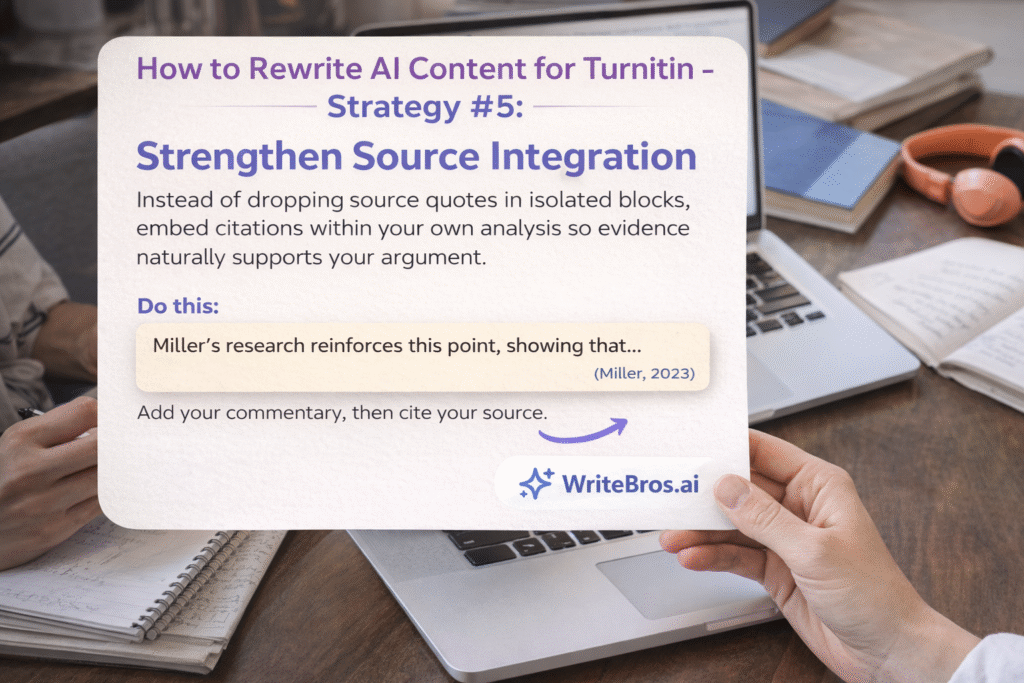
How to Rewrite AI Content for Turnitin – Strategy #5: Strengthen source integration
AI-assisted drafts frequently present sources in isolated blocks that summarize findings without weaving them into the writer’s interpretive voice. Strengthening integration means embedding citations within your own commentary so that evidence supports and interacts with your argument rather than appearing as standalone authority. This technique demonstrates critical engagement and reduces the impression of automated summarization.
Instead of presenting a quotation and moving on, follow it with analysis that clarifies why the source matters, how it supports your thesis, and where its limitations might lie. Such layered integration signals that you are actively processing information rather than compiling it. The practical constraint is maintaining balance, since excessive commentary that overshadows evidence can weaken academic credibility even as it increases perceived authorship.
How to Rewrite AI Content for Turnitin – Strategy #6: Reduce structural symmetry
AI-generated essays often produce paragraphs that mirror one another in length, internal organization, and even the number of supporting points, which creates a polished but mechanical symmetry across the page. To reduce this uniformity, intentionally vary how you develop each section, allowing some paragraphs to explore complexity in greater depth while others remain concise and tightly focused. This uneven distribution of attention reflects natural human prioritization and makes the argumentative landscape less statistically predictable.
When revising, examine whether each paragraph follows an identical pattern of topic sentence, two examples, and concluding line, since such repetition can appear algorithmically optimized rather than organically composed. Adjusting the internal flow by combining ideas, introducing sub-arguments, or expanding analysis where it genuinely matters produces a more authentic progression. The key is intentional imbalance guided by argument needs rather than randomness that disrupts clarity.
How to Rewrite AI Content for Turnitin – Strategy #7: Personalize examples
One subtle yet effective revision involves embedding examples that are closely aligned with the specific course context, instructor expectations, or case studies discussed in class. When examples feel uniquely tied to your academic environment, the writing naturally distances itself from generic datasets commonly reflected in AI training material. This personalization enhances credibility and signals active participation in the learning process.
You might reference a classroom discussion, a particular framework emphasized in lectures, or a case study highlighted in assigned readings, thereby situating your argument within lived academic experience. These contextual cues demonstrate authorship without relying on informal tone or overt personal narrative. The limitation to consider is privacy or over-specificity, since unnecessary anecdotal detail can distract from analytical focus.
How to Rewrite AI Content for Turnitin – Strategy #8: Tighten hedging language
AI text frequently relies on cautious qualifiers such as suggests, may, or could in an effort to remain broadly accurate across contexts, which can create a diluted argumentative stance. Tightening hedging language involves evaluating each qualifier and deciding whether it reflects genuine scholarly caution or unnecessary vagueness. Strengthening decisive phrasing, when supported by evidence, produces a more confident and distinctly human argumentative voice.
As you revise, identify clusters of tentative phrasing that accumulate within a single paragraph, since repetition of cautious verbs can flatten rhetorical impact. Replacing them with precise claims supported by clearly cited evidence restores balance between confidence and credibility. Care must be taken not to eliminate legitimate nuance, because academic writing still requires measured judgment grounded in evidence.
How to Rewrite AI Content for Turnitin – Strategy #9: Adjust lexical predictability
Detection systems often evaluate frequency patterns of common AI-associated terms, which means that repetitive vocabulary can unintentionally increase perceived automation. Adjusting lexical predictability requires substituting overused transitional phrases and high-frequency descriptors with varied yet contextually appropriate alternatives. This variation should arise from meaning rather than decorative synonym swaps.
During revision, scan for repeated terms that appear across multiple sections and consider whether they can be replaced with more precise terminology tied to disciplinary language. Such substitutions enrich specificity and subtly alter statistical patterns without compromising coherence. The essential caution is to avoid obscure vocabulary that disrupts readability or appears artificially inserted.
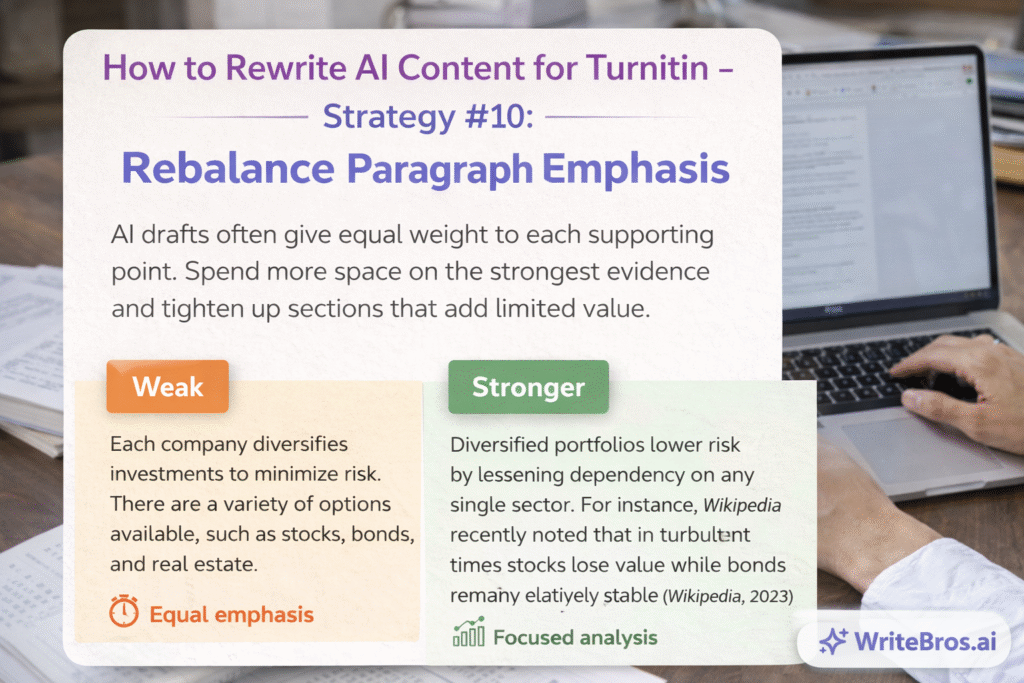
How to Rewrite AI Content for Turnitin – Strategy #10: Rebalance paragraph emphasis
AI drafts often distribute equal weight to each supporting point, regardless of its relevance or argumentative significance. Rebalancing emphasis involves expanding on the most compelling evidence while trimming sections that contribute marginal value to the thesis. This prioritization reflects authentic critical judgment and creates a more persuasive hierarchy of ideas.
When revising, ask which paragraph carries the strongest analytical insight and allow that section additional space to explore implications and counterarguments. Conversely, condense repetitive explanations that reiterate established points without adding depth. The goal is intentional asymmetry guided by intellectual importance rather than uniform completeness.
How to Rewrite AI Content for Turnitin – Strategy #11: Embed reflective commentary
Reflective commentary moves beyond summarizing evidence and instead interprets its significance in relation to your central claim, thereby demonstrating independent thought. Embedding such commentary after presenting research findings clarifies how you understand, evaluate, and synthesize the material. This interpretive layer differentiates authentic student writing from neutral compilation.
In practice, this means adding sentences that explain the broader implications of cited data, the tensions between competing viewpoints, or the limitations of existing scholarship. These reflections show intellectual engagement that cannot be reduced to automated paraphrasing. The constraint lies in maintaining academic tone while expressing analysis rather than personal opinion detached from evidence.
How to Rewrite AI Content for Turnitin – Strategy #12: Refine opening hooks
AI introductions frequently begin with sweeping generalizations that aim to establish context but lack disciplinary specificity. Refining the opening requires replacing broad framing with a focused entry point that directly addresses the assignment question or theoretical framework. This sharper beginning immediately signals intent and reduces formulaic tone.
Instead of beginning with universal claims, you might open with a precise definition, a narrowly framed problem statement, or a targeted reference to course material. Such specificity grounds the essay from the outset and guides readers into a clearly defined analytical path. Care should be taken to maintain clarity rather than overcomplicating the introduction with excessive detail.
How to Rewrite AI Content for Turnitin – Strategy #13: Control tone consistency
AI drafts can fluctuate subtly between formal academic phrasing and neutral explanatory tone, creating small inconsistencies that accumulate across the essay. Controlling tone involves reviewing vocabulary, sentence structure, and citation style to ensure a unified academic register. This consistency strengthens credibility and reduces stylistic irregularities that may appear machine generated.
During revision, examine whether certain sections adopt conversational phrasing or overly generic exposition compared to the rest of the paper. Aligning these segments with your established academic voice ensures continuity throughout the draft. The challenge is preserving clarity while maintaining a consistent level of formality appropriate to the discipline.
How to Rewrite AI Content for Turnitin – Strategy #14: Eliminate filler conclusions
AI-generated conclusions often restate earlier points in slightly varied wording without advancing the argument or synthesizing insights. Eliminating filler means rewriting the closing section to integrate key findings into a cohesive reflection on their broader implications. This synthesis demonstrates intellectual control rather than repetition.
When revising the conclusion, focus on drawing connections between major themes rather than repeating supporting details. Highlighting implications, unanswered questions, or theoretical consequences adds depth to the final paragraph. The essential balance is avoiding new unsupported claims while still offering forward-looking insight.
How to Rewrite AI Content for Turnitin – Strategy #15: Run structured review passes
Final compliance requires more than a single read-through, since subtle patterns may persist even after major revisions. Running structured review passes means focusing on one dimension at a time, such as sentence variation, lexical repetition, or source integration, to ensure thorough refinement. This systematic approach increases confidence before submission.
Consider conducting separate passes dedicated to argument clarity, stylistic variation, and citation accuracy, allowing each layer of revision to receive focused attention. Such segmentation prevents oversight that can occur when attempting to fix everything simultaneously. The limitation to manage is time, as thorough review requires disciplined allocation before deadlines.
Common mistakes
- Relying on simple synonym replacement tools without reconsidering argument structure often leaves deeper patterns untouched, which means the writing may appear superficially altered yet statistically similar in syntax and flow, ultimately undermining the intent of revision.
- Submitting a draft that retains evenly structured paragraphs of identical length and development can signal automated generation, because human writers rarely distribute emphasis with such mechanical balance across every supporting point.
- Overcorrecting by inserting exaggerated personal language or informal commentary may create stylistic inconsistency that distracts instructors and weakens academic credibility, even if it reduces uniformity.
- Neglecting to integrate sources thoughtfully and instead stacking summaries one after another reduces analytical depth and can resemble compiled AI output rather than reflective scholarship.
- Ignoring repetitive transitional phrases across paragraphs allows subtle lexical patterns to persist, which detection systems may interpret as uniform machine-generated structure.
- Rushing final edits without conducting focused review passes increases the likelihood that predictable cadence, hedging clusters, or symmetrical organization remain visible in the submitted draft.
Edge cases
In highly technical disciplines that require standardized phrasing, such as laboratory reports or legal analysis, variation must be introduced carefully so that essential terminology remains intact and disciplinary conventions are respected. In these contexts, compliance-focused rewriting centers more on argument framing and structural nuance than on altering established technical language.
Similarly, shorter assignments may offer limited room for expansive restructuring, which means that precision and clarity become the primary tools for demonstrating authorship rather than extensive stylistic variation. Strategic refinement within tight constraints can still meaningfully reduce predictability while preserving academic rigor.
Supporting tools
- Draft comparison software that highlights repeated phrases across paragraphs helps identify lexical clusters and structural repetition that may otherwise go unnoticed during manual review.
- Read-aloud functionality within word processors allows you to hear cadence patterns and detect overly uniform sentence rhythm that visual scanning might overlook.
- Plagiarism checkers that focus on similarity indexing, when used responsibly, can reveal citation gaps or excessive paraphrasing that requires clearer attribution.
- Academic style guides specific to your discipline provide benchmarks for tone consistency and proper source integration, ensuring revisions remain aligned with expectations.
- Peer review from a classmate or writing center consultant can uncover structural symmetry or vague phrasing that automated tools cannot fully interpret in context.
- WriteBros.ai can assist with structured rewriting passes that refine clarity and variation while preserving original meaning and academic tone.
Ready to Transform Your AI Content?
Try WriteBros.ai and make your AI-generated content truly human.
Conclusion
Learning how to rewrite AI content for Turnitin ultimately centers on clarity, intentional structure, and visible analytical ownership rather than cosmetic alteration. When each revision aligns argument depth, stylistic variation, and source integration with the assignment’s demands, the draft evolves into work that reflects genuine academic reasoning.
Perfection is less important than deliberate refinement guided by understanding of how detection systems interpret patterns and structure. With thoughtful revision passes and disciplined attention to detail, you can submit writing that communicates both compliance and intellectual integrity.
Did You Know?
If you are using How to Rewrite AI Content for Turnitin, surface-level rephrasing rarely changes outcomes when paragraph symmetry, sentence openings, and transitional scaffolds remain statistically consistent across the full document, because the evaluation relies on cumulative structural patterns rather than single-line edits.
Introducing variation in pacing, adjusting how claims are framed and qualified, and reshaping how evidence develops across sections can alter the draft’s overall profile, since organic irregularity tends to look more like authentic academic cognition than evenly balanced formatting that repeats the same argumentative arc throughout.
Ready to Transform Your AI Content?