How to Rewrite ChatGPT SEO Content Naturally: 15 Search-Friendly Improvements

How to Rewrite ChatGPT SEO Content Naturally breaks down practical editing techniques that make AI-generated SEO articles feel smoother, more believable, and easier to trust without weakening search visibility. Research from a 2025 corpus-based study on AI-generated and human-written essays supports the idea that human writing uses stronger engagement patterns and more nuanced rhetorical structure.
How to Rewrite ChatGPT SEO Content Naturally: 15 Search-Friendly Improvements
AI-generated SEO content can look polished on the surface but still feel repetitive, flat, or strangely predictable once people start reading. Many publishers now spend extra time fixing tone, structure, and flow because humanize AI SEO content processes have become necessary for keeping readers engaged.
A lot of ChatGPT drafts rely on patterns that search engines and readers recognize quickly, especially when every section sounds equally polished without real variation or rhythm. That problem becomes harder to hide at scale, which is why many editors now study the best systems for humanizing ChatGPT essays before publishing long-form content.
Natural rewriting is less about sounding clever and more about making the content feel believable, readable, and genuinely useful from beginning to end. This guide breaks down practical ways to improve pacing, sentence texture, and search clarity using ideas supported by recent ChatGPT SEO content optimization statistics and real editorial habits.
| # | Strategy focus | Practical takeaway |
|---|---|---|
| 1 | Sentence rhythm | Break repetitive pacing so the content feels more conversational and less machine-generated. |
| 2 | Opening clarity | Replace generic introductions with direct setups that immediately explain the reader problem. |
| 3 | Natural transitions | Smooth section flow with wording that sounds editorial instead of formula-based. |
| 4 | Human phrasing | Swap robotic wording for everyday language that sounds believable and grounded. |
| 5 | Search intent alignment | Keep every section tied closely to what readers actually expect from the topic. |
| 6 | Paragraph texture | Mix short and medium-length sentences to avoid uniform blocks of text. |
| 7 | Specific examples | Add realistic situations that make the advice feel lived-in instead of abstract. |
| 8 | Keyword balance | Use important phrases naturally without forcing repetitive wording into every paragraph. |
| 9 | Structural variation | Adjust formatting patterns so the article stops sounding mechanically organized. |
| 10 | Editorial tone | Introduce subtle opinions and observations that give the writing personality. |
| 11 | Redundancy cleanup | Remove repeated ideas and filler phrases that weaken readability and trust. |
| 12 | Context layering | Support explanations with timing, audience context, and practical limitations. |
| 13 | Emotional realism | Add believable reactions and subtle tension so the content feels less synthetic. |
| 14 | Reader pacing | Control information flow so dense sections stay easy to process and skim. |
| 15 | Final polish | Review the full article for consistency, readability, and natural search visibility. |
15 Search-Friendly Improvements to Rewrite ChatGPT SEO Content Naturally
How to Rewrite ChatGPT SEO Content Naturally – Strategy #1: Improve sentence rhythm
One of the fastest ways to make AI-generated writing sound less artificial is to change the pacing of the sentences so the article stops moving in the exact same rhythm from beginning to end, because readers unconsciously notice when every line follows identical structure and length. Strong editorial content usually alternates between explanatory thoughts, transitional observations, and more direct statements that guide the reader naturally through the topic without sounding overly calculated. This matters most in SEO articles that exceed one thousand words because repetitive pacing becomes increasingly visible as the content expands across multiple sections.
Natural sentence rhythm works because human writers rarely maintain the same cadence for long stretches of text, especially when explaining layered ideas that require clarification, examples, or subtle changes in tone as the article progresses. A practical example appears in product comparison articles where AI often repeats the same sentence shape across every feature explanation, making the page feel predictable even when the information itself remains accurate and useful. Careful rewrites that vary openings, insert transitional observations, and occasionally slow the pace for explanation tend to hold reader attention longer while making the content feel edited rather than automatically assembled.
How to Rewrite ChatGPT SEO Content Naturally – Strategy #2: Rewrite generic openings
Many ChatGPT introductions sound technically correct while still feeling emotionally distant because they rely on broad framing language that never fully identifies the reader’s actual frustration, concern, or reason for searching in the first place. A stronger rewrite begins by describing the exact situation that pushed someone toward the search query, whether that involves declining rankings, thin engagement metrics, or a growing concern that AI-heavy content is becoming easier to detect. Readers usually stay longer when the introduction immediately mirrors their experience rather than spending several sentences defining concepts they already understand.
This adjustment works well because most people searching for SEO rewriting guidance already recognize the existence of AI-generated content problems and simply want realistic ways to improve quality without sacrificing publishing speed or search visibility. A common example appears in agency blogs where the original AI draft begins with overly educational wording before eventually arriving at the real topic several paragraphs later, creating unnecessary distance between the search intent and the actual advice. Rewriting the opening around a concrete publishing challenge usually creates smoother engagement because the article feels aware of real editorial pressure instead of sounding like a detached overview.
How to Rewrite ChatGPT SEO Content Naturally – Strategy #3: Use smoother transitions
AI-generated articles frequently move between ideas too abruptly because the model tends to organize sections like isolated blocks of information rather than connected conversations that naturally build on earlier thoughts and examples. Effective rewrites add connective phrasing that gently carries the reader from one point to the next, especially when the article changes direction from explanation into strategy, comparison, or cautionary guidance. This creates a reading experience that feels intentionally structured rather than mechanically segmented around headings and keyword clusters.
Smoother transitions matter because readers interpret continuity as a sign that a human editor shaped the article with awareness of flow, emphasis, and progression rather than simply compiling related information into a single page. A strong example appears in long SEO tutorials where one section discusses keyword intent while the next suddenly shifts into formatting advice without clarifying the relationship between those ideas or explaining why the change matters. Transitional phrases that connect cause and effect, reinforce context, or acknowledge earlier points help the content feel guided and cohesive without slowing the overall reading experience.
How to Rewrite ChatGPT SEO Content Naturally – Strategy #4: Replace robotic wording
ChatGPT content often includes phrases that technically communicate the correct meaning while still sounding strangely detached because the wording feels overly polished, excessively neutral, or too consistently formal across every section. Rewriting those lines with more grounded language helps the article sound closer to real editorial writing, especially when the phrasing reflects how people naturally explain experiences, frustrations, or observations during conversations and collaborative work. This does not mean forcing slang or exaggerated personality into professional content because subtle realism usually performs better than dramatic tone changes.
Readers tend to trust writing that sounds slightly imperfect and situational because human communication naturally contains nuance, clarification, and occasional shifts in phrasing depending on context and emphasis. A realistic example appears in SEO service pages where AI repeatedly uses phrases like “it is important to note” or “in today’s digital landscape,” even though experienced editors rarely speak that way in polished client-facing copy anymore. Replacing those patterns with clearer and more direct wording usually improves readability immediately while helping the article feel current rather than heavily templated.
How to Rewrite ChatGPT SEO Content Naturally – Strategy #5: Match search intent closely
Natural rewriting becomes much easier when every section remains tightly connected to the actual reason someone searched for the topic, because many AI drafts drift into broad explanations that technically relate to the keyword while failing to answer the user’s practical concern. Search intent alignment requires understanding whether readers want troubleshooting help, workflow improvements, strategic comparisons, or direct implementation guidance before restructuring the article around those expectations. Content that consistently serves the intended outcome usually feels more human because it responds to genuine needs instead of trying to cover every related angle equally.
This works especially well for SEO-focused articles because search engines increasingly reward pages that maintain topical clarity and satisfy the implied purpose behind the query rather than simply repeating keywords throughout multiple sections. A useful example appears in AI rewriting tutorials that spend excessive time discussing the history of generative AI even though readers primarily want actionable editing techniques that improve readability and search performance. Rebuilding the structure around the strongest user intent often removes unnecessary filler naturally while making the content feel more focused, relevant, and editorially intentional.

How to Rewrite ChatGPT SEO Content Naturally – Strategy #6: Vary paragraph texture
AI-generated content often develops a visually repetitive texture because every paragraph follows similar length, density, and sentence structure, which gradually makes the article feel uniform even when the information remains accurate and well organized. Editorial rewrites usually improve readability by mixing descriptive paragraphs with lighter observations, clarifications, and transitional moments that allow the pacing to breathe naturally as readers move through the page. This variation becomes especially important in long-form SEO articles where visual monotony quietly reduces engagement and makes the writing feel algorithmically assembled.
Readers process information more comfortably when paragraphs feel dynamic rather than mechanically balanced, because natural writing rarely maintains identical visual weight across every section of a document. A practical example appears in affiliate-style articles where each paragraph contains almost exactly the same number of sentences and explanatory points, causing the page to resemble a template instead of a thoughtfully edited publication. Breaking that pattern through intentional paragraph variation creates a smoother reading experience while making the content feel more flexible, conversational, and grounded in real editorial judgment.
How to Rewrite ChatGPT SEO Content Naturally – Strategy #7: Add realistic examples
Many AI-written articles remain technically informative while still feeling emotionally empty because they explain strategies in broad terms without demonstrating how those strategies appear in actual publishing, editing, or marketing situations. Adding realistic examples helps readers visualize the advice in action, particularly when the examples include believable constraints, imperfect outcomes, or small operational details that make the explanation feel lived-in rather than theoretically generated. Examples do not need to be dramatic or deeply personal because even subtle specificity can make an article feel far more credible.
This technique works because human editors naturally draw from patterns they have seen across projects, clients, drafts, and publishing workflows, which creates contextual texture that AI systems often struggle to reproduce consistently. A useful example appears in articles discussing SEO rewrites where the improved version references a real situation such as reducing repetitive headers across a product category page or restructuring AI-generated intros that repeatedly buried the main point. These grounded details help readers trust the guidance more easily because the article sounds connected to actual editorial experience instead of abstract theory.
How to Rewrite ChatGPT SEO Content Naturally – Strategy #8: Balance keyword usage
SEO rewriting becomes noticeably more natural when keywords are distributed with restraint rather than inserted aggressively into every paragraph, because readers quickly recognize unnatural repetition even when the article technically remains optimized for search visibility. Strong rewrites usually prioritize semantic variation, contextual phrasing, and smoother integration so the keyword supports the content instead of dominating the rhythm of every section. This balance matters because overly concentrated keyword usage often makes AI-generated writing feel calculated and commercially forced rather than genuinely informative.
Search-focused writers sometimes overcorrect after generating AI drafts by inserting additional keyword mentions during editing, which can unintentionally make the article sound less natural even though the intention was to improve optimization. A common example appears in blog posts where the primary phrase repeats in every heading, every introductory sentence, and nearly every transition despite the surrounding information already making the topic obvious to readers and search engines alike. Rewriting with more flexible phrasing and stronger contextual signals usually improves readability while still preserving topical clarity and search relevance.
How to Rewrite ChatGPT SEO Content Naturally – Strategy #9: Break structural repetition
One of the clearest signs of AI-generated writing appears in the structure itself because many drafts organize information using identical formatting patterns across every section, making the article feel rigid regardless of how accurate the content may be. Editorial rewrites often introduce subtle shifts in presentation, explanation order, and emphasis so the article develops a more organic flow that reflects human decision-making rather than automated assembly. Readers may not consciously identify the repetition, but they often sense when the structure feels too predictable over time.
This issue becomes more visible in long tutorials where every section begins with the same transitional phrase, follows the same explanatory order, and ends with nearly identical conclusions that flatten the overall reading experience. A realistic example appears in AI-generated SEO guides that repeatedly open sections with definitions before eventually arriving at the actionable insight, even when some topics would feel stronger starting with a caution, observation, or practical scenario instead. Structural variation helps maintain engagement because the article feels responsive to the topic instead of locked into a repeating framework.
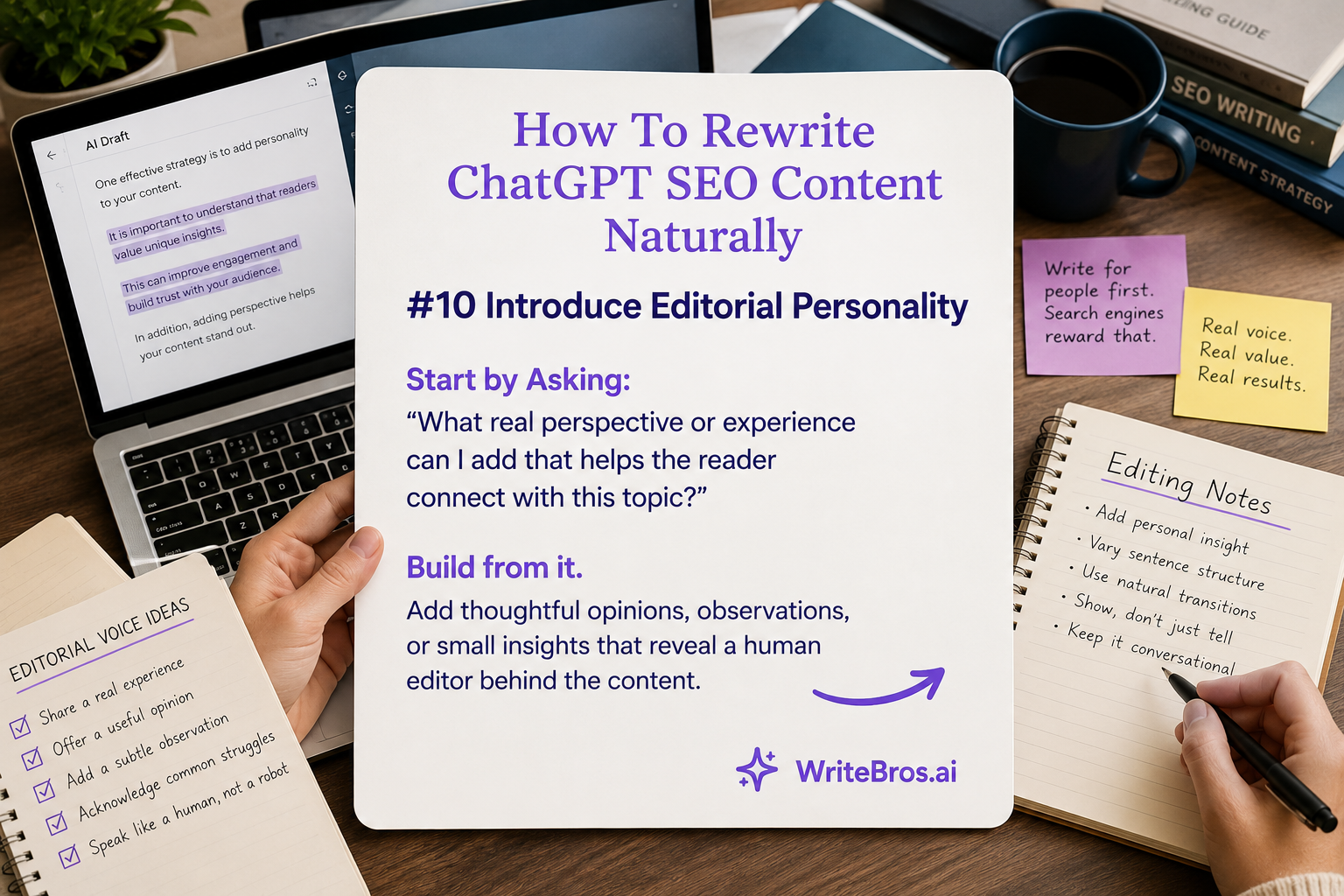
How to Rewrite ChatGPT SEO Content Naturally – Strategy #10: Introduce editorial personality
Completely neutral AI writing often sounds emotionally distant because it avoids small observations, judgments, or reactions that naturally appear in experienced editorial work, particularly when discussing trends, frustrations, or common publishing mistakes. Adding light editorial personality helps the article feel more believable without sacrificing professionalism, especially when the tone reflects practical experience instead of exaggerated confidence or performative opinions. Readers generally respond better to content that sounds aware of real publishing realities rather than mechanically objective at every moment.
This works because human-written SEO content usually contains subtle perspective shifts that reveal the writer understands the frustrations behind ranking pressure, content production speed, or editorial cleanup after large AI-assisted workflows. A practical example appears in rewriting guides that briefly acknowledge how exhausting repetitive optimization patterns can become for editors managing hundreds of pages at scale while still maintaining a calm and informative tone overall. These understated observations create warmth and realism that help the content feel authored rather than automatically generated through a neutral language system.
How to Rewrite ChatGPT SEO Content Naturally – Strategy #11: Remove repeated ideas
AI-generated articles frequently circle back to the same core idea using slightly different wording because language models naturally reinforce recurring themes during long-form generation, especially when prompted to maintain clarity and topical relevance throughout the article. Effective rewrites identify those repeated explanations and consolidate them into stronger sections that communicate the idea once with enough depth and context to feel complete. Readers usually interpret repetition as a sign that the article lacks editorial refinement even when the underlying information remains accurate.
This becomes especially noticeable in SEO content where phrases related to optimization, readability, engagement, and authority appear repeatedly across multiple sections without introducing meaningful distinctions or new insight. A common example appears in AI-generated rewriting tutorials that restate the importance of sounding human in nearly every strategy while offering only minor wording changes instead of adding fresh practical detail. Removing unnecessary repetition creates tighter pacing, clearer progression, and a more confident editorial tone that helps the article feel intentionally shaped rather than automatically expanded.
How to Rewrite ChatGPT SEO Content Naturally – Strategy #12: Add contextual nuance
Natural editorial writing usually acknowledges that strategies work differently depending on audience expectations, publishing goals, content length, and industry context, while many AI drafts present advice as universally applicable without discussing practical limitations or situational differences. Rewriting with contextual nuance helps the article feel more trustworthy because readers recognize that experienced writers understand the complexity behind implementation rather than treating every workflow as identical. This added realism also prevents the content from sounding overly simplified or artificially authoritative.
A useful example appears in SEO rewriting advice that explains how aggressive tone adjustments may work well for consumer-focused blogs but feel inappropriate for highly regulated industries such as finance, healthcare, or legal publishing. AI-generated drafts often skip those distinctions because they prioritize generalized clarity over situational precision, which can make the article feel detached from real operational decisions. Including context around timing, audience expectations, workflow limitations, or brand constraints creates richer guidance that feels connected to actual publishing environments rather than generic internet advice.
How to Rewrite ChatGPT SEO Content Naturally – Strategy #13: Use emotional realism
Completely emotionless AI writing tends to feel synthetic because real editorial content usually contains subtle emotional cues that reflect frustration, uncertainty, curiosity, or cautious optimism depending on the subject being discussed. Adding emotional realism does not require dramatic storytelling because even restrained acknowledgment of common experiences can make the article feel noticeably more human and relatable to readers. This matters particularly in SEO and content production topics where many readers already feel pressure around rankings, deadlines, or publishing performance.
A realistic example appears in rewriting articles that acknowledge how discouraging it can feel when technically optimized content still struggles to maintain engagement despite heavy editing and publishing effort across multiple revisions. AI systems often avoid those small emotional observations because they default toward balanced neutrality, which can unintentionally make the writing feel detached from real editorial stress and workflow challenges. Controlled emotional realism helps readers connect with the content more naturally because the article sounds aware of the human side of publishing instead of treating every issue like a purely technical process.
How to Rewrite ChatGPT SEO Content Naturally – Strategy #14: Control reading pace
Natural content flow depends heavily on pacing because readers need moments of clarification, expansion, and transition rather than constant streams of equally dense information delivered without variation across the article. AI-generated drafts often overload sections with layered explanations that technically remain coherent while still feeling exhausting to process over time, particularly in educational or strategy-focused content. Rewriting for pace means deciding where the article should slow down for explanation and where it should move more quickly to maintain momentum.
This works well because strong editorial pacing mirrors how people naturally absorb information, especially when learning unfamiliar workflows or comparing several connected concepts within the same article. A practical example appears in SEO tutorials where AI stacks several optimization tips into one overloaded paragraph without pausing to clarify why each point matters or how the recommendations connect operationally. Breaking those sections into more deliberate sequences improves readability significantly while helping the article feel guided, thoughtful, and easier to navigate from beginning to end.
How to Rewrite ChatGPT SEO Content Naturally – Strategy #15: Finish with editorial polish
The final rewrite stage matters because even strong drafts can still contain small inconsistencies in tone, phrasing, formatting, or pacing that quietly reveal the article originated from an AI-assisted workflow before receiving editorial refinement. Careful polishing focuses on continuity across the entire piece rather than isolated sentence improvements, ensuring that headings, transitions, examples, and explanations feel connected within one coherent voice. This broader review often determines whether the article feels professionally edited or simply corrected at the sentence level.
A thorough editorial pass usually includes reading the article aloud, checking for repetitive sentence openings, removing unnecessary filler, and confirming that the pacing remains smooth across long sections without sudden tonal changes. A realistic example appears in SEO articles where the first half sounds conversational while later sections gradually become overly formal because the editing attention weakened as the draft expanded. Consistent polishing helps maintain credibility because readers experience the article as one unified piece of writing rather than a sequence of unevenly revised AI-generated sections.
Common mistakes
- Many writers try to humanize AI-generated content by randomly adding slang, exaggerated personality, or forced humor throughout the article, but this usually backfires because the writing begins to sound performative and inconsistent instead of naturally conversational and professionally edited.
- Another common mistake happens when editors only rewrite the introduction while leaving the remaining sections untouched, which creates an uneven reading experience where the opening feels human but the rest of the article gradually returns to repetitive AI-generated structure and phrasing.
- Some SEO writers overcorrect repetitive AI wording by aggressively removing keywords from nearly every paragraph, which can weaken topical clarity and reduce the article’s ability to maintain strong alignment with the original search intent and search visibility goals.
- Writers frequently focus on sentence-level corrections without reviewing the article’s broader structure, even though repetitive formatting patterns, predictable pacing, and identical section organization are often stronger indicators of AI generation than individual phrases alone.
- A major problem appears when editors add examples that feel too vague, exaggerated, or disconnected from realistic publishing situations, because readers tend to trust grounded operational details more than polished hypothetical scenarios that sound artificially constructed.
- Some publishers rely too heavily on AI rewriting tools without performing a final human editorial pass, which often leaves behind inconsistent tone, repeated ideas, awkward transitions, and unnatural pacing that become increasingly noticeable in long-form SEO articles.
Edge cases
Some AI-generated SEO content already sounds relatively natural because the original prompts were highly specific, the source material contained strong editorial structure, or the workflow included human revisions before generation even started. In those cases, excessive rewriting can actually damage clarity by introducing unnecessary stylistic variation that weakens consistency and distracts from the article’s original purpose. Technical industries also require additional caution because over-humanizing the tone may reduce precision or create phrasing that feels too casual for professional readers expecting accuracy and restraint.
There are also situations where speed matters more than heavy stylistic refinement, especially for large-scale publishing operations managing hundreds of indexed pages across multiple content categories within strict deadlines and workflow limitations. In those environments, the goal may not be perfect editorial realism but rather reducing the strongest AI patterns enough to improve readability, trust, and engagement without dramatically slowing production. Effective rewriting therefore depends on balancing quality expectations with operational realities instead of applying identical editing standards to every project.
Supporting tools
- Google Search Console helps identify pages with strong impressions but weak click-through rates, which can reveal where AI-generated titles, introductions, or article structures feel too generic to compete effectively in search results.
- Grammarly can assist with surface-level cleanup during rewrites, particularly when AI-generated drafts contain repetitive sentence construction, awkward transitions, or overly formal phrasing that interrupts the article’s natural editorial flow.
- Hemingway Editor is useful for identifying overly dense passages and repetitive sentence rhythm, especially in long-form SEO content where AI systems tend to stack explanations together without enough pacing variation or structural breathing room.
- Surfer SEO helps maintain topical relevance during rewrites by monitoring semantic coverage and optimization balance, which reduces the risk of accidentally weakening search intent alignment while improving the article’s readability and tone.
- Originality.ai is commonly used by publishers who want to review AI probability signals after major rewrites, particularly when refining high-volume SEO articles intended for competitive search environments and stricter editorial standards.
- WriteBros.ai can support large-scale rewriting workflows by helping editors refine repetitive AI phrasing, improve tonal consistency, and reshape search-focused drafts into content that feels more natural without slowing production dramatically.
Ready to Transform Your AI Content?
Try WriteBros.ai and make your AI-generated content truly human.
Conclusion
Rewriting AI-generated SEO content naturally is rarely about hiding the use of AI completely because most readers care more about clarity, usefulness, pacing, and credibility than the specific tools used during production. The stronger goal is creating content that feels thoughtfully edited, structurally intentional, and genuinely connected to the reader’s reason for searching, especially as search engines continue rewarding pages that demonstrate stronger user alignment and deeper editorial quality.
Natural rewriting improves gradually through repetition, observation, and careful editorial judgment rather than through rigid formulas that guarantee perfectly human-sounding results every time. Some articles may only require lighter refinements while others demand deeper restructuring, but consistent attention to rhythm, nuance, context, and readability usually produces content that feels more trustworthy, engaging, and durable across evolving search environments.
Did You Know?
ChatGPT SEO articles often feel artificial because of repetitive pacing, identical structure, and emotionally flat explanations rather than obvious grammar errors.
Smaller editorial rewrites usually make AI-generated SEO content feel more believable than aggressive rewrites that disrupt clarity and natural reading flow.
Ready to Transform Your AI Content?