AI Product Description Optimization Statistics: Top 20 Ecommerce Findings

2026 has shifted product content from simple catalog copy to a competitive intelligence asset. These AI Product Description Optimization Statistics reveal how product-page quality, AI-assisted shopping, review summarization, and structured content influence conversions, purchase confidence, and ecommerce performance across modern retail.
Product pages are being asked to carry more of the buying journey as shoppers compare specifications, benefits, pricing, and credibility before adding anything to a cart. Teams that know how to rewrite AI product descriptions for conversions can turn machine-generated starting points into clearer decision support rather than publishing generic feature summaries.
Performance varies because speed alone does not guarantee that automated copy answers the questions influencing a purchase. The same editorial discipline used to refine AI blog posts for better engagement also helps product teams improve specificity, readability, and relevance across large catalogs.
Current evidence suggests that detailed content, personalization, search visibility, and product-page usability reinforce one another rather than operating as isolated improvements. A description may therefore appear polished while still underperforming because it omits practical details, relies on vague benefits, or fails to match the language customers use during discovery.
Human review remains important when brands need to protect factual accuracy, tone, and consistency across hundreds or thousands of listings. In practice, evaluating leading AI editors for AI draft cleanup can be as consequential as choosing the original generator because refinement determines whether scalable copy becomes genuinely useful.
Top 20 AI Product Description Optimization Statistics (Summary)
| # | Statistic | Key figure |
|---|---|---|
| 1 | Large ecommerce sites with product descriptions that consistently lack sufficient detail | 10% |
| 2 | Leading desktop ecommerce sites with mediocre or worse product-page user experience | 52% |
| 3 | Leading mobile ecommerce sites with mediocre or worse product-page user experience | 62% |
| 4 | Leading ecommerce apps with mediocre or worse product-page user experience | 64% |
| 5 | Desktop ecommerce sites achieving decent or good product-page user experience | 48% |
| 6 | Mobile ecommerce sites achieving decent or good product-page user experience | 38% |
| 7 | Relative click-through-rate improvement recorded for AI-generated ecommerce items over human-designed alternatives | More than 13% |
| 8 | Relative conversion-rate improvement recorded for AI-generated ecommerce items over human-designed alternatives | More than 13% |
| 9 | Products evaluated in a benchmark comparing AI-generated and human-written product advertising copy | 100 products |
| 10 | AI models compared with human-written descriptions across persuasion, clarity, readability, and SEO criteria | 4 models |
| 11 | Consumers expressing purchase intent after reading AI-generated summaries of product reviews | 84% |
| 12 | Consumers expressing purchase intent after reading the original human-written product reviews | 52% |
| 13 | Hallucination rate identified in AI-generated summaries used in product-purchase testing | 60% |
| 14 | Participants included in research measuring the effect of AI-generated review summaries on purchase intent | 70 participants |
| 15 | Product reviews assessed in research comparing AI summaries with original review content | 2,000 reviews |
| 16 | American shoppers reporting weekly use of AI to browse products or support purchasing decisions | 58% |
| 17 | American shoppers represented in research into AI-assisted product browsing and purchasing behavior | More than 2,300 |
| 18 | Conversion rate recorded for ecommerce visits referred by AI recommendation platforms | 3.6% |
| 19 | Conversion rate recorded for comparable ecommerce visits referred through traditional Google search | 1.23% |
| 20 | Additional revenue generated per session by AI-referred ecommerce visitors compared with traditional search visitors | About 30% more |
Top 20 AI Product Description Optimization Statistics and the Road Ahead
AI Product Description Optimization Statistics #1. Insufficient Detail Remains a Catalog-Wide Risk
The clearest weakness is that 10% of large ecommerce sites still publish product descriptions that lack enough detail for confident comparison. Shoppers may see the basic feature list yet remain unsure about fit, compatibility, materials, or everyday use. That uncertainty pushes them to keep searching, even when the product could have met their needs.
This happens because catalogs grow faster than editorial teams can review them, so manufacturer copy is duplicated across listings. AI can speed up expansion, but it cannot recover details that were never included in the source material. Missing facts therefore become a data problem before they become a writing problem.
A human editor notices when a description leaves a question unanswered and adds context a buyer needs. Raw AI copy may turn three supplied facts into polished but repetitive benefits, preserving the gap. Teams should audit descriptions by category and require dimensions, materials, compatibility, limitations, and usage details, which improves decision quality and reduces avoidable exits.
AI Product Description Optimization Statistics #2. Desktop Product Pages Still Underperform
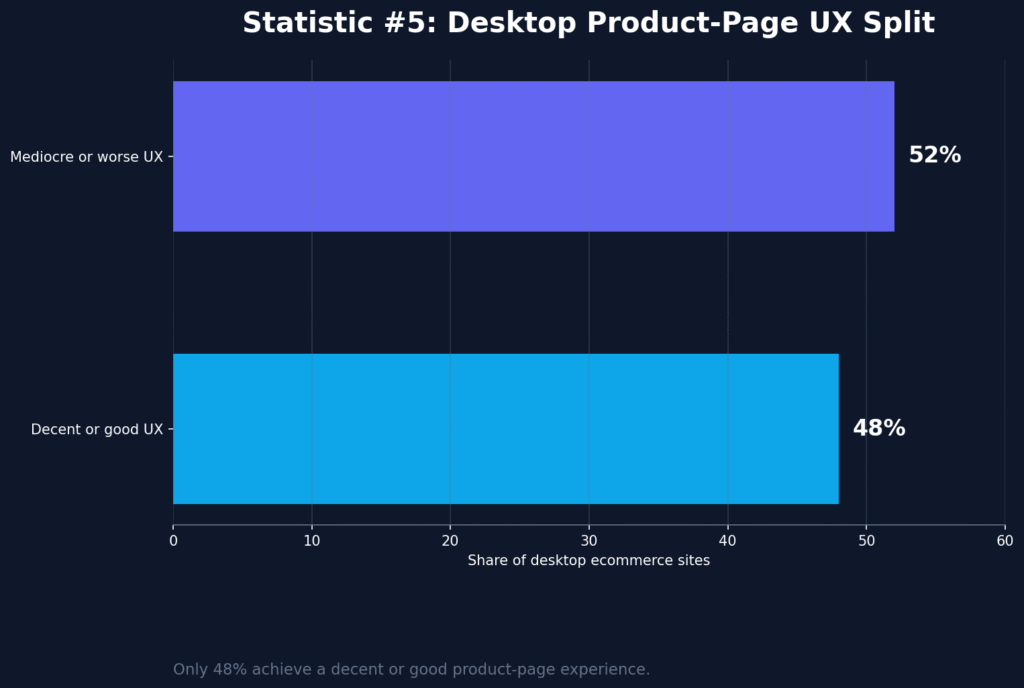
The desktop benchmark shows that 52% of desktop ecommerce sites provide a mediocre or worse product-page experience. Larger screens offer more space, yet many pages still make shoppers work to understand what the item does and whether it fits. The problem is rarely content volume alone, because poorly arranged information can be as frustrating as missing information.
Desktop pages often spread specifications, descriptions, reviews, and delivery details across separate tabs or competing modules. This forces buyers to assemble the product story while promotional elements interrupt the sequence. Even accurate copy underperforms when decisive details appear too late or in the wrong place.
A human editor organizes the description around how buyers evaluate the offer, beginning with relevance and moving toward proof. Raw AI output may repeat features in different wording without improving the page’s information hierarchy. Optimization should therefore examine the full desktop journey, placing benefits, specifications, evidence, and limitations where they resolve uncertainty before comparison turns into abandonment.
AI Product Description Optimization Statistics #3. Mobile Product Pages Create Greater Friction
The mobile gap is wider, with 62% of mobile ecommerce sites delivering a mediocre or worse product-page experience. On a small screen, every unnecessary sentence increases the distance between a shopper and the detail needed to make a decision. Weak descriptions become more visible because buried specifications and repeated benefits require extra scrolling.
Mobile layouts often inherit desktop copy without reconsidering sequence, density, or scanability. Long paragraphs may appear readable in a document but become tiring when broken across a narrow screen. The result is slower comprehension, especially for shoppers comparing several products in quick succession.
A human editor compresses the path from question to answer while protecting details that affect suitability. Raw AI copy can add fluent language around each feature, making the page longer without making the choice easier. Teams should write mobile-first summaries, front-load decisive proof, use compact sections, and label specifications clearly, which preserves momentum and gives buyers faster access to purchase-supporting information.
AI Product Description Optimization Statistics #4. Ecommerce Apps Leave Buying Questions Unresolved
The app benchmark is slightly weaker, as 64% of ecommerce apps deliver a mediocre or worse product-page experience. Apps may make browsing feel smooth, but visual polish does not guarantee that users can evaluate an item confidently. When descriptions are abbreviated too aggressively, questions about fit, compatibility, care, or limitations remain unresolved.
This happens because app interfaces often prioritize imagery, recommendations, and rapid discovery while pushing product information lower in the flow. Teams may assume returning users need less explanation, even though app shoppers still compare unfamiliar products. Attractive presentation then supports exploration but not necessarily a confident final choice.
A human reviewer connects the visual experience with decision support and checks whether essential facts appear before purchase controls. Generic AI output may sound refined while avoiding the precise details that distinguish one option from another. Product teams should test descriptions inside the live app journey, not only in a document, which reveals where information disappears and where hesitation begins.
AI Product Description Optimization Statistics #5. Strong Desktop Product Pages Remain Uncommon
Only 48% of desktop ecommerce sites achieve a decent or good product-page experience, showing that competent execution is not the norm. Stronger pages help buyers understand the offer without opening several tabs or leaving the retailer to research basic facts. Their descriptions support comparison rather than merely adding promotional language.
These pages usually combine clear structure with enough depth to explain features, outcomes, constraints, and use cases. The description also works alongside images, specifications, reviews, and delivery information instead of repeating them. Buyers receive a coordinated evidence set, so each section answers a different part of the decision.
A skilled editor decides which attributes deserve emphasis based on category risk and customer questions. Raw AI text often gives every feature equal weight, which can bury the details that change purchase confidence. Teams should prioritize attributes that reduce uncertainty and place them where comparison naturally happens, making the page more useful while giving optimization tests a clearer commercial signal.
AI Product Description Optimization Statistics #6. Good Mobile Product Pages Are Even Rarer
Only 38% of mobile ecommerce sites achieve a decent or good product-page experience, leaving most shoppers to work through avoidable friction. A strong mobile page makes the offer understandable without forcing users through long blocks of text or repeated expansion menus. It keeps decisive details visible while preserving enough depth for careful comparison.
The difficulty comes from fitting specifications, benefits, reviews, images, and delivery information into a narrow interface. Teams often respond by shortening everything, but excessive compression removes the context that explains why a feature matters. Others retain desktop-length copy, which makes the page feel dense and slow to navigate.
A human editor creates layers, beginning with a concise overview and allowing shoppers to reach supporting detail when needed. Raw AI drafts may remain fluent while producing paragraphs that feel heavy on a phone. Product teams should test reading order, scanning effort, and information visibility on real devices, creating a clearer mobile buying implication.
AI Product Description Optimization Statistics #7. AI-Generated Items Can Improve Click-Through Performance
AI-generated ecommerce items produced more than 13% higher click-through performance than human-designed alternatives in the observed comparison. That improvement suggests automated copy and creative variation can make an offer appear more relevant at the point of discovery. More shoppers click when the wording reflects the need, category, or benefit they are already considering.
The gain is partly explained by scale, because AI can produce many targeted versions without requiring each one to be written from scratch. Teams can test different angles, tones, and benefit sequences across audiences more quickly. Relevance improves when the system receives accurate product data and clear guidance about the intended shopper.
A human strategist interprets the result as evidence for disciplined experimentation rather than proof that automation always wins. Raw AI enthusiasm may treat one uplift as permission to generate endless variants without quality control. Brands should compare qualified clicks, engagement, and downstream behavior before scaling a winning pattern, leading to a more useful optimization implication.
AI Product Description Optimization Statistics #8. AI-Generated Items Can Lift Conversion Performance
The same comparison recorded more than 13% higher conversion performance for AI-generated ecommerce items than for human-designed alternatives. A click becomes a purchase only when the product page confirms relevance and resolves the doubts that remain after discovery. The result therefore points to more than surface-level wording improvement.
Conversion gains appear when generated content explains fit, benefits, and practical use in language matched to the shopper’s intent. Automation also makes it easier to update descriptions as positioning, inventory, or audience priorities change. The advantage disappears, however, when the generated claim exceeds the available product evidence.
A human editor checks whether the uplift reflects clearer information rather than exaggerated promises or accidental discount emphasis. Raw AI copy may chase persuasion while overlooking return risk, compliance, or customer expectations. Teams should measure purchases alongside returns, complaints, order value, and margin before expanding a generated description pattern, producing a more commercially reliable implication.
AI Product Description Optimization Statistics #9. Broader Product Benchmarks Expose Model Consistency
A benchmark covering 100 products provides a more demanding test than a handful of polished examples. Product categories differ in complexity, emotional appeal, technical detail, and the level of risk buyers associate with the purchase. A model that writes well for simple consumer goods may struggle with products requiring precise compatibility or safety information.
Broader testing reveals whether quality survives changes in source material, tone, audience, and specification density. It also exposes recurring weaknesses, such as vague benefits, repeated phrasing, or missing limitations. Those patterns matter because catalog-wide deployment multiplies small errors across many pages.
A human evaluator notices category-specific failures that can disappear inside a single overall score. Raw model comparisons may highlight the strongest outputs and make them appear representative of routine performance. Teams should benchmark tools on a realistic sample from their own catalog, including difficult and low-information products, which creates a more dependable selection implication.
AI Product Description Optimization Statistics #10. Model Selection Changes Product-Copy Quality
The benchmark compared 4 AI models across persuasion, clarity, readability, SEO, and related product-copy criteria. The result matters because different systems can produce noticeably different descriptions from the same product facts. One model may create stronger benefits, while another preserves technical accuracy or follows structural instructions more reliably.
These differences come from training data, model architecture, prompt sensitivity, and the amount of context each system can manage. They also shape the editing burden placed on the team after generation. A model that appears fluent may still require extensive factual correction, while a less expressive model may produce safer first drafts.
A human editor evaluates which weaknesses are acceptable within the actual production workflow. Raw automation often treats every generator as interchangeable and assumes prompting can eliminate all model-specific limitations. Teams should score candidate systems against their own categories, brand rules, compliance needs, and revision capacity, leading to a better model-selection implication.
AI Product Description Optimization Statistics #11. AI Review Summaries Can Strengthen Purchase Intent
84% of participants expressed purchase intent after reading AI-generated summaries of product reviews. The summaries reduced the effort required to identify recurring opinions across many individual comments. Buyers could understand the overall balance of praise, criticism, and product fit without reading every review separately.
The effect comes from compression, because scattered experiences become a shorter and more organized decision aid. Shoppers gain confidence when common strengths and weaknesses are presented in language they can process quickly. That efficiency matters most when the review volume is large or the differences between products are difficult to compare.
A human reviewer checks whether the summary represents mixed evidence and preserves important exceptions. Raw AI synthesis can make uncertain patterns sound more settled than the underlying reviews support. Teams should use review summaries to enrich product descriptions while linking claims back to verified customer evidence, which improves convenience without allowing confident language to replace accuracy.
AI Product Description Optimization Statistics #12. Original Reviews Demand More Buyer Effort
52% of participants expressed purchase intent after reading the original human-written reviews. Individual reviews preserve the voice and detail of each customer, but they require more time to interpret. Shoppers must separate isolated experiences from recurring patterns before deciding whether the product suits them.
This lower intent does not mean original reviews lack value, because they contain nuance that summaries may remove. The difficulty is cognitive load, especially when comments vary in length, quality, and relevance. Buyers can lose momentum before finding the information that answers their specific concern.
A human merchandiser can translate common review themes into clearer product-page guidance while retaining access to the source comments. Raw AI may compress disagreement into a simple positive or negative conclusion that overstates consensus. Retailers should pair concise review insights with visible original reviews, giving shoppers a faster overview and a way to verify details before purchase.
AI Product Description Optimization Statistics #13. Hallucinated Summaries Create a Serious Accuracy Risk
60% of AI-generated summaries contained hallucinated information in the purchase-intent study. The language often remained fluent and convincing even when a claim was not supported by the underlying reviews. That combination is dangerous because shoppers may treat a confident summary as verified product evidence.
Hallucinations emerge when a model fills gaps, merges separate comments, or turns an implied pattern into a factual statement. Product descriptions face the same risk whenever generated copy goes beyond approved specifications or source material. The commercial consequence can include disappointed customers, higher returns, complaints, or compliance exposure.
A human fact-checker compares each claim with verified product data and the reviews being summarized. Raw AI output may convert probability into apparent certainty without signaling where interpretation occurred. Teams should require source-grounded generation, claim-level review, and publication blocks for unsupported statements, creating a safer optimization process and a more trustworthy customer implication.
AI Product Description Optimization Statistics #14. Small Samples Require Careful Interpretation
70 participants took part in the research measuring responses to AI-generated review summaries. That sample can reveal a meaningful directional pattern, but it cannot represent every buyer, category, or purchase context. Reactions may differ when products involve higher prices, greater risk, stronger familiarity, or more technical evaluation.
Small studies can produce striking percentages because each participant has a visible effect on the final result. The findings still matter, especially when they expose a mechanism such as reduced reading effort. The limitation is that teams should not assume the same uplift will appear across every audience.
A human analyst treats the result as a signal to investigate rather than a universal performance guarantee. Raw automated interpretation may repeat the percentage without explaining the sample behind it. Brands should replicate the test with their own traffic, categories, and product-page formats before making major content decisions, creating a more defensible optimization implication.
AI Product Description Optimization Statistics #15. Large Review Sets Create a Summarization Challenge
2,000 product reviews were assessed when AI-generated summaries were compared with original review content. A collection of that size contains valuable evidence, yet few shoppers will read enough comments to identify every important pattern. Product teams also struggle to convert that volume into useful, category-specific description improvements.
The challenge comes from separating frequent language from commercially important meaning. A commonly repeated observation may be minor, while a less frequent concern could strongly affect fit, safety, or returns. Useful summarization therefore requires more than counting positive and negative words.
A human editor can organize review evidence by attribute, use case, sentiment, and verified product relevance. Raw AI may overemphasize repeated wording or merge distinct issues into a general conclusion. Teams should structure the source reviews before generating summaries and only add verified themes to descriptions, creating a clearer connection between customer experience and product-page optimization.
AI Product Description Optimization Statistics #16. AI-Assisted Shopping Is Becoming a Weekly Habit
58% of American shoppers report using AI every week to browse products or support purchasing decisions. That figure suggests conversational product discovery is becoming a regular behavior instead of an occasional experiment. As shoppers become more comfortable asking AI detailed questions, they increasingly expect product pages to provide equally specific answers.
The change reflects how recommendation systems interpret natural language rather than isolated keywords. Buyers now describe problems, preferences, budgets, and intended use, expecting recommendations that feel personalized instead of generic. Product descriptions therefore need structured information that AI systems can recognize and present accurately during assisted discovery.
A human optimizer writes descriptions that answer real customer questions while maintaining factual precision throughout the page. Raw AI copy often repeats familiar category language without introducing meaningful product-specific information. Teams should organize descriptions around concrete attributes, compatibility, limitations, and outcomes so both shoppers and AI recommendation systems can retrieve trustworthy information, creating a stronger long-term optimization implication.
AI Product Description Optimization Statistics #17. Larger Surveys Confirm Meaningful Adoption
More than 2,300 American shoppers were represented in research examining AI-assisted browsing and purchasing behavior. A sample of that size provides stronger evidence than isolated anecdotes because it captures a wider range of shopping habits and consumer expectations. The findings indicate that AI-assisted discovery is becoming relevant across a meaningful portion of the ecommerce market.
Larger surveys reduce the influence of unusual responses and make broader behavioral patterns easier to identify. They also allow researchers to observe how shoppers incorporate AI into different stages of product evaluation rather than treating it as a single activity. That wider perspective helps explain why product content strategy is changing alongside search behavior.
A human researcher still examines category differences, demographic variation, and purchase frequency before applying broad conclusions. Raw automated summaries may flatten those distinctions into a single headline about AI adoption. Brands should segment their own analytics according to customer behavior instead of assuming every audience interacts with AI in the same way, producing a more reliable optimization implication.
AI Product Description Optimization Statistics #18. AI Referrals Arrive With Stronger Purchase Intent
A 3.6% conversion rate was recorded for ecommerce visits referred through AI recommendation platforms. Visitors reaching a product page from an AI conversation have often narrowed their options before clicking through. They arrive expecting the page to confirm details rather than introduce the product from the beginning.
This creates an opportunity for product descriptions to reinforce the reasoning already established during the recommendation process. Buyers want clear specifications, practical use cases, compatibility guidance, and evidence that the suggested product genuinely matches their request. Weak or generic descriptions can interrupt that momentum despite the visitor’s stronger buying intent.
A human editor ensures the landing page continues the logic established by the recommendation rather than forcing shoppers to restart their evaluation. Raw AI-generated descriptions may default to broad marketing language that fails to answer the specific question behind the referral. Teams should align product copy with conversational buying journeys, creating smoother transitions and stronger commercial performance as a practical implication.
AI Product Description Optimization Statistics #19. Traditional Search Brings Broader Intent
A 1.23% conversion rate was recorded for comparable ecommerce visits originating from traditional Google search. Search visitors frequently arrive at earlier stages of the buying journey, where research and comparison remain more important than immediate purchase decisions. Their expectations are therefore different from shoppers who already received AI-assisted recommendations.
Traditional search attracts a broader mix of informational, navigational, and transactional intent. Some visitors only want to understand the product category, while others compare multiple retailers before making a final decision. Product descriptions must therefore educate as well as persuade if they are expected to convert this wider audience.
A human strategist recognizes that not every visitor requires the same amount of detail or reassurance before purchasing. Raw AI copy may emphasize urgency before establishing relevance or product fit. Teams should support multiple decision stages with layered descriptions, accessible specifications, and clear explanations that help both early researchers and purchase-ready visitors, resulting in a stronger optimization implication.
AI Product Description Optimization Statistics #20. AI-Referred Sessions Can Produce More Revenue
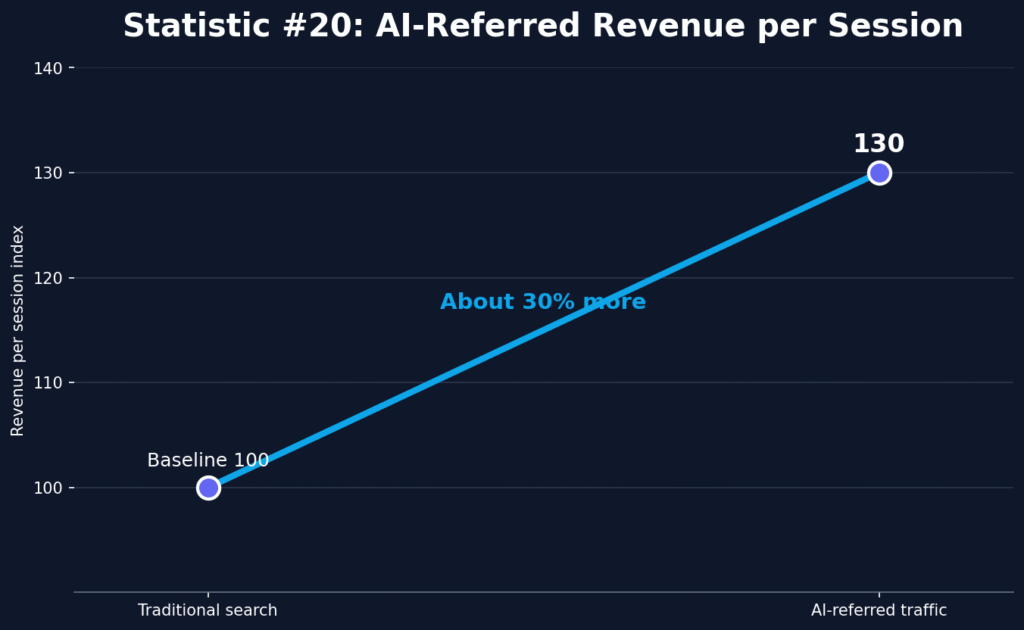
About 30% more revenue per session was generated by AI-referred ecommerce visitors than by comparable traditional search visitors. Higher-value sessions suggest recommendation systems often deliver shoppers whose needs already align closely with the products being presented. Better alignment reduces unnecessary browsing and allows buyers to focus on confirming their decision.
Revenue improves when recommendation quality and product-page quality reinforce one another throughout the buying journey. AI may successfully identify the right product, but the description still determines whether confidence is maintained until checkout. Poor information can weaken even highly qualified traffic if important questions remain unanswered.
A human analyst evaluates revenue together with order value, returns, customer satisfaction, and long-term profitability before declaring success. Raw AI reporting may celebrate the headline number without examining the commercial quality behind it. Product teams should optimize descriptions for accurate decisions rather than simple persuasion, creating stronger customer outcomes and more sustainable revenue growth as the lasting implication.
What These AI Product Description Optimization Statistics Mean
Across the research, one pattern appears repeatedly: stronger product performance begins with clearer information rather than more persuasive language. AI accelerates content production, yet the statistics consistently show that shoppers respond best when descriptions answer practical questions instead of simply expanding promotional copy.
Another recurring theme is that structure matters as much as wording. Product pages perform better when specifications, benefits, evidence, compatibility, and limitations work together to reduce uncertainty before buyers feel the need to continue searching elsewhere.
The findings also illustrate that AI is changing both sides of ecommerce at the same time. Businesses are using automation to create descriptions more efficiently while consumers increasingly rely on AI systems to discover, compare, and evaluate products before reaching the retailer.
The long-term opportunity therefore belongs to teams that combine scalable generation with disciplined editorial review. Product descriptions that remain accurate, specific, and genuinely useful will continue to outperform faster but less trustworthy alternatives as AI-assisted commerce becomes increasingly common.
Sources
- Baymard Institute research explaining why many ecommerce product descriptions still lack sufficient detail for confident purchasing decisions
- Baymard Institute benchmark evaluating desktop mobile and app product page user experience across leading ecommerce websites
- Academic benchmark comparing AI-generated product advertising with human-created alternatives across multiple evaluation criteria
- Peer-reviewed study describing large-scale automatic product copywriting deployment within ecommerce environments
- Research introducing practical automatic product copywriting methods for real-world ecommerce catalog generation
- Research examining controllable AI systems for generating optimized ecommerce product descriptions
- Scientific study investigating AI-generated review summaries purchase intention and hallucination effects
- Industry analysis comparing AI referral traffic with traditional search conversion performance across ecommerce websites
- Reuters coverage discussing Adobe research into AI-assisted shopping behavior and ecommerce revenue trends
- Adobe Digital Insights research exploring how AI-assisted shopping influences consumer purchasing behavior
- Research investigating product description sentence ranking methods for ecommerce search optimization
- Technical discussion explaining how generative AI improves retail product discovery and recommendations