How to Refine AI Blog Posts for Better Engagement: 15 Reader-Centered Improvements
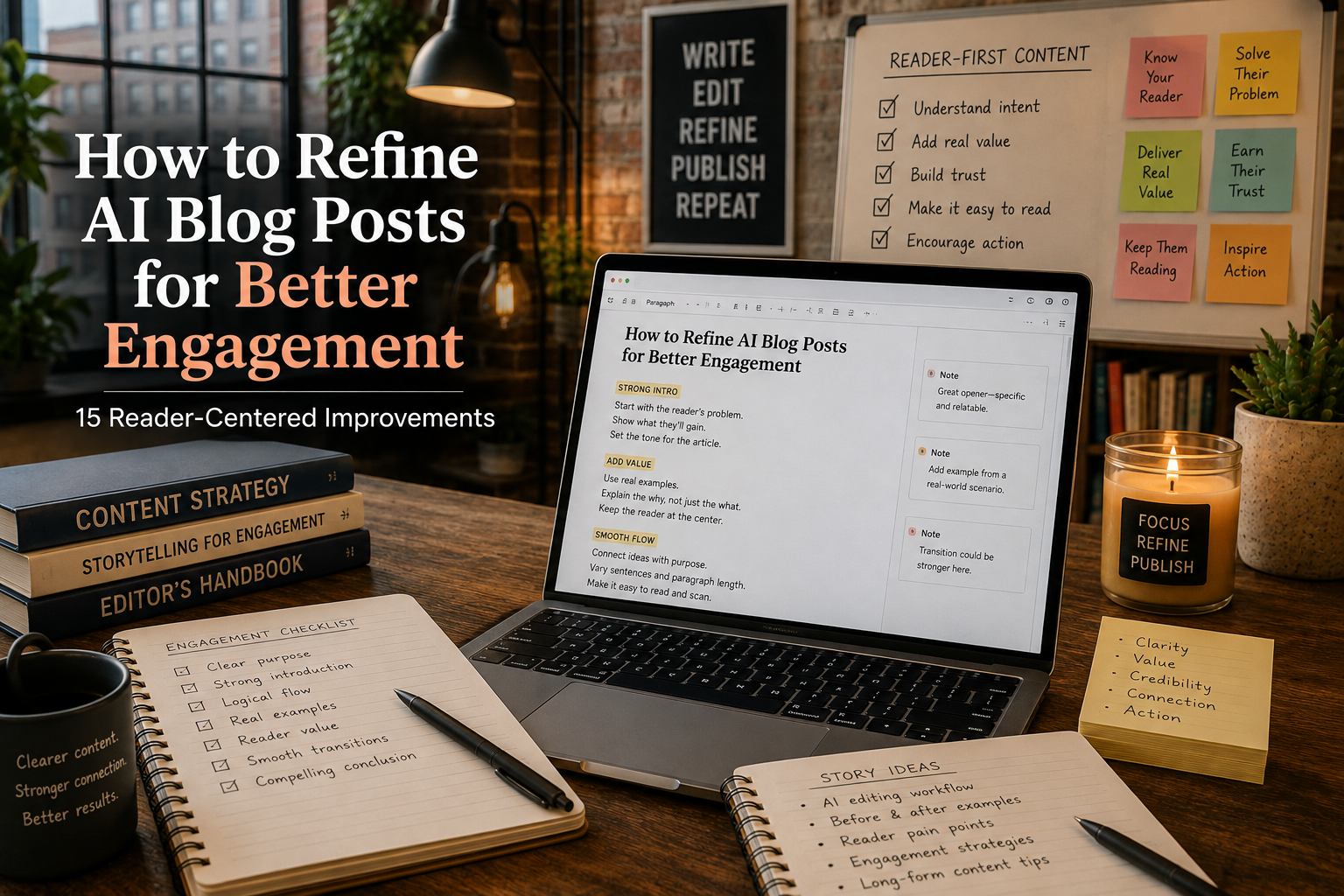
In 2026, the difference between publishing AI content and earning sustained attention comes down to thoughtful editing. Learn 15 practical ways to improve clarity, structure, pacing, and reader value, supported by research on reader expectation principles for maximizing clarity.
How to Refine AI Blog Posts for Better Engagement: 15 Reader-Centered Improvements
Publishing AI-assisted articles is easier than ever, but keeping readers engaged from the opening paragraph to the final sentence is still a challenge. If your posts feel technically correct yet struggle to hold attention, learning to humanize AI blog drafts for brand voice is often the missing piece.
Many AI-generated blog posts lose momentum because they prioritize completeness over readability, producing content that feels repetitive, predictable, or emotionally flat. Building stronger AI writing systems for human-AI collaboration helps create a review process where human judgment improves pacing, clarity, and audience connection before publication.
This guide walks through practical refinements that make AI-generated blog posts more engaging without rewriting everything from scratch. Along the way, you’ll also see how insights from AI Website Copy Conversion Statistics can reinforce writing decisions that encourage readers to stay longer, interact more, and return for future content.
| # | Strategy focus | Practical takeaway |
|---|---|---|
| 1 | Start with stronger intent | Lead with a clear purpose so readers immediately understand why the article matters to them. |
| 2 | Improve opening flow | Create introductions that naturally pull readers into the topic instead of repeating obvious context. |
| 3 | Strengthen structure | Organize ideas into logical sections that are easy to scan without sacrificing depth. |
| 4 | Reduce repetition | Remove recurring phrases and duplicate explanations that slow the reading experience. |
| 5 | Add real examples | Support advice with relatable situations that help readers visualize practical application. |
| 6 | Use natural transitions | Connect sections smoothly so ideas progress without abrupt jumps or mechanical wording. |
| 7 | Balance paragraph length | Mix shorter and longer paragraphs to maintain rhythm and improve readability. |
| 8 | Clarify complex ideas | Simplify explanations while preserving accuracy, making information easier to absorb. |
| 9 | Improve sentence variety | Alternate sentence patterns to create a more conversational and engaging reading pace. |
| 10 | Focus on reader value | Frame every section around what the audience gains rather than what the technology produces. |
| 11 | Strengthen credibility | Include supporting context, observations, and thoughtful explanations that build trust. |
| 12 | Refine the voice | Adjust tone so the writing feels consistent, approachable, and aligned with your brand. |
| 13 | Improve visual scanning | Use headings and formatting intentionally to help readers navigate longer articles. |
| 14 | Finish with purpose | Close the article by reinforcing the main takeaway instead of ending abruptly. |
| 15 | Review before publishing | Perform a final editorial pass that prioritizes clarity, engagement, and the overall reading experience. |
15 Reader-Centered Improvements to Refine AI Blog Posts for Better Engagement
How to Refine AI Blog Posts for Better Engagement – Strategy #1: Clarify the reader’s goal
Before changing a single sentence, identify the primary outcome readers hope to achieve after opening your article because that expectation should influence the examples you choose, the level of explanation you provide, and the sequence in which information appears throughout the piece. When the content consistently answers that expectation instead of wandering into loosely related ideas, readers remain oriented from beginning to end, which naturally increases their willingness to continue reading rather than abandoning the page midway through.
Imagine someone searching for practical guidance and encountering an article that immediately addresses the exact challenge they are facing instead of spending several paragraphs discussing background information that they already know, because that directness creates confidence almost instantly. Although supporting context still has value, it should always reinforce the reader’s objective rather than competing with it, allowing every section to feel purposeful and connected to the promise established at the beginning.
How to Refine AI Blog Posts for Better Engagement – Strategy #2: Rewrite the introduction
The opening paragraphs deserve more attention than almost any other part of an AI-generated draft because introductions frequently contain repetitive observations, predictable transitions, and generic statements that delay the information readers actually came to find. By replacing those familiar patterns with a specific problem, a realistic situation, and a clear preview of what follows, you create stronger momentum without making the introduction feel overly dramatic.
Readers rarely decide whether an article is worthwhile after finishing the conclusion because that judgment usually happens within the opening moments, making your introduction responsible for establishing trust before deeper explanations even begin to appear. Keep the language natural, avoid unnecessary suspense, and ensure that every sentence encourages readers to move comfortably into the next section rather than wondering when the article will finally become useful.
How to Refine AI Blog Posts for Better Engagement – Strategy #3: Build a logical structure
Well-organized articles are easier to follow because each section naturally prepares readers for the next idea instead of presenting isolated pieces of information that require unnecessary effort to connect mentally while reading. Start with foundational concepts before progressing toward more detailed recommendations, and make sure every heading represents a meaningful transition rather than simply dividing blocks of text into smaller segments.
A practical structure often feels almost invisible because readers can move through the article without stopping to figure out where they are or why a topic suddenly appeared after an unrelated discussion, which creates a smoother overall experience. If a section seems disconnected from the central narrative, either reposition it where it provides better support or remove it entirely so the article maintains consistent direction.
How to Refine AI Blog Posts for Better Engagement – Strategy #4: Remove repetitive wording
AI drafts often revisit the same point using slightly different wording, which can make an article feel much longer than it actually is while adding very little additional value for readers who already understood the original explanation. Reviewing every paragraph with the intention of removing duplicated concepts allows the remaining ideas to stand out more clearly and gives the article a more confident editorial voice.
Instead of asking whether two paragraphs contain different sentences, ask whether they contribute different insights because unique wording alone does not automatically create meaningful variety when the underlying message remains unchanged throughout multiple sections. Once repetition disappears, readers experience steadier pacing, clearer progression, and a stronger sense that every paragraph deserves their attention instead of merely occupying additional space.
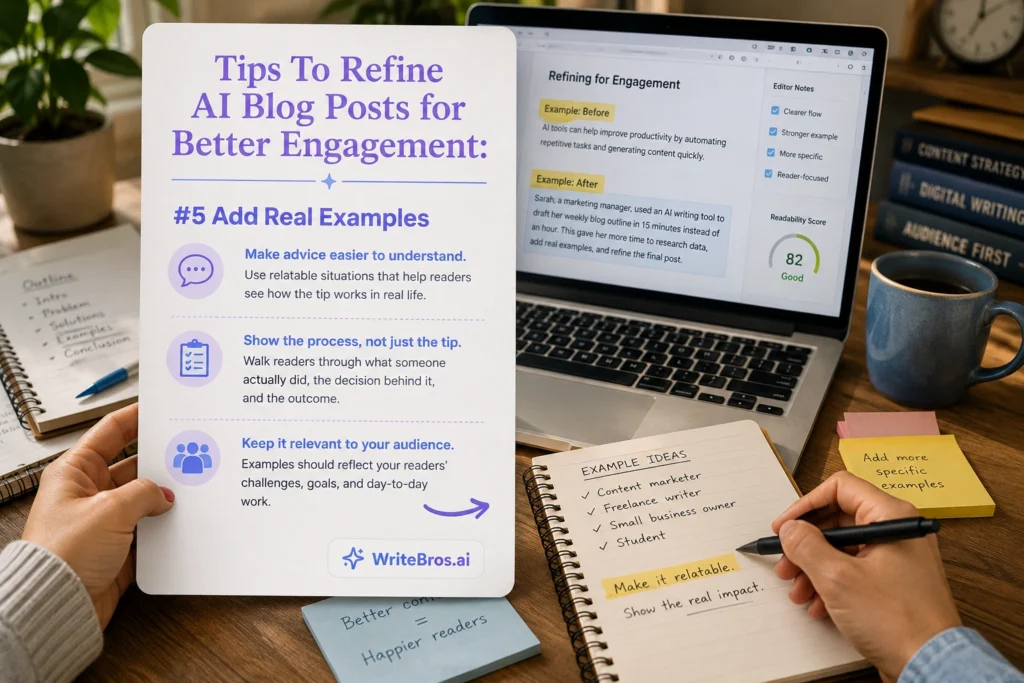
How to Refine AI Blog Posts for Better Engagement – Strategy #5: Add realistic examples
Advice becomes significantly easier to understand when readers can picture how it applies within familiar situations, which is why examples should appear throughout the article instead of being reserved for only one or two major sections near the end. Short scenarios grounded in everyday workflows help abstract recommendations become practical decisions that readers can immediately imagine using in their own projects.
For example, describing how a marketer revises an AI-generated paragraph for better flow communicates much more than simply recommending stronger editing because readers witness the reasoning behind each improvement rather than memorizing isolated suggestions without context. Examples should clarify ideas instead of distracting from them, so choose situations that feel believable, relevant, and closely connected to the audience you expect to reach.
How to Refine AI Blog Posts for Better Engagement – Strategy #6: Strengthen transitions
Strong transitions help readers understand why one section naturally follows another because they provide continuity between related ideas instead of forcing abrupt changes that interrupt concentration and reduce the sense of progression across the article. Rather than relying on repetitive transition phrases, briefly explain how the upcoming discussion builds upon the previous point so readers always understand the relationship between sections.
Even subtle connecting sentences can dramatically improve readability because they eliminate the feeling that each heading belongs to an entirely separate document assembled without a broader editorial plan guiding the conversation from beginning to end. The result is a smoother reading experience where readers continue moving forward with confidence instead of mentally reconnecting the discussion after every new heading.
How to Refine AI Blog Posts for Better Engagement – Strategy #7: Balance paragraph length
Paragraph rhythm influences readability more than many writers realize because extremely long sections can feel overwhelming while consistently short paragraphs may create an artificial pace that resembles social media instead of thoughtful editorial writing. Mixing paragraph lengths according to the complexity of each idea creates a more comfortable reading experience without sacrificing depth or clarity.
Whenever a paragraph grows unusually large, determine whether it contains multiple related ideas that deserve their own space rather than dividing it mechanically at arbitrary points that interrupt logical development and reduce cohesion. Likewise, avoid fragmenting every thought into isolated sentences because readers should experience a continuous narrative instead of an endless sequence of disconnected observations.
How to Refine AI Blog Posts for Better Engagement – Strategy #8: Simplify complex explanations
Clear writing is rarely about reducing intelligence because it is primarily about reducing unnecessary effort for readers who want to understand useful information without repeatedly interpreting complicated language or overloaded technical descriptions. Replace abstract wording with familiar language whenever accuracy remains intact, and introduce specialized concepts gradually instead of presenting everything simultaneously.
A reader who quickly understands a concept is far more likely to continue exploring additional sections than someone who becomes mentally exhausted after every paragraph, especially when the article introduces several related ideas in succession. Simplicity therefore supports engagement not by removing depth but by making valuable information consistently accessible from beginning to end.
How to Refine AI Blog Posts for Better Engagement – Strategy #9: Vary sentence patterns
AI-generated drafts frequently repeat similar sentence structures because language models naturally favor familiar construction patterns, causing even accurate information to sound predictable after several consecutive paragraphs that follow nearly identical rhythms. Deliberately combining descriptive, explanatory, and comparative sentence styles creates greater variety while maintaining a professional and approachable tone.
Readers often notice repetitive rhythm before consciously recognizing repetitive wording because identical sentence lengths gradually produce monotony even when each statement introduces new information and relevant examples. Reading the article aloud makes these patterns easier to detect, allowing you to adjust pacing before publication without changing the substance of your recommendations.
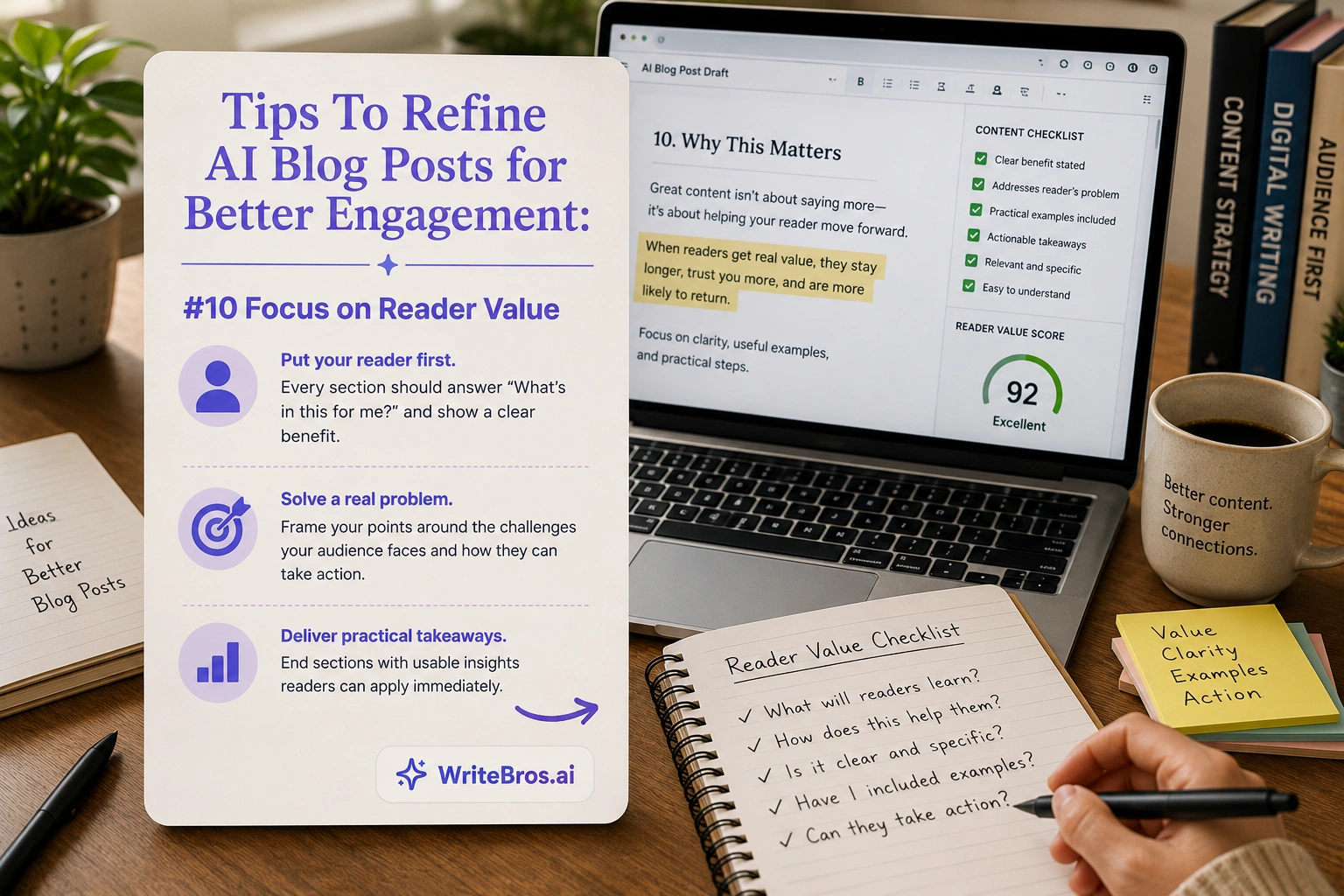
How to Refine AI Blog Posts for Better Engagement – Strategy #10: Prioritize reader value
Every section should answer an implicit question about why the information matters because readers evaluate articles according to the practical benefit they receive rather than the number of facts presented throughout the discussion. Whenever a paragraph explains what AI can do, follow that explanation by describing how the reader should interpret or apply the information in a meaningful situation.
Content becomes substantially more engaging when readers repeatedly discover useful insights that help them make better decisions, improve existing workflows, or avoid common mistakes instead of simply learning additional facts without practical direction or context. Maintaining this perspective throughout the editing process ensures the finished article consistently serves its intended audience rather than merely demonstrating subject knowledge.
How to Refine AI Blog Posts for Better Engagement – Strategy #11: Build credibility naturally
Trust develops gradually through consistent evidence, balanced explanations, and thoughtful reasoning rather than confident language alone, which means every major recommendation should demonstrate why it deserves attention instead of expecting readers to accept unsupported conclusions. Referencing realistic experiences, observable outcomes, or established practices strengthens authority without making the writing feel unnecessarily formal.
Readers appreciate confident guidance, although they also recognize when certainty replaces explanation because unsupported claims tend to weaken credibility instead of reinforcing expertise across the broader article. Whenever possible, explain the reasoning behind recommendations so readers understand both the advice itself and the principles that make it effective in real situations.
How to Refine AI Blog Posts for Better Engagement – Strategy #12: Refine the overall voice
An article should sound as though one knowledgeable person is speaking consistently from beginning to end because noticeable shifts in tone can make AI-generated writing feel assembled from unrelated sources instead of thoughtfully edited into a cohesive publication. Review the complete draft after individual edits so the overall personality remains stable across every section.
If one paragraph feels highly conversational while another suddenly becomes overly formal, readers may experience subtle friction even though both passages are technically correct and grammatically polished throughout. Consistency creates familiarity, and familiarity encourages readers to remain engaged because the writing feels reliable, comfortable, and intentionally crafted.
How to Refine AI Blog Posts for Better Engagement – Strategy #13: Improve visual scanning
Many readers scan an article before deciding whether to commit their full attention, making headings, spacing, and formatting essential components of engagement rather than decorative additions applied after the writing process has already finished. Clear visual organization allows readers to locate relevant information quickly while still encouraging them to continue reading surrounding explanations.
Instead of creating numerous headings that interrupt the flow unnecessarily, organize content into meaningful sections where each heading introduces a distinct idea supported by several connected paragraphs that develop the topic thoroughly. This balance helps readers navigate efficiently without reducing the article into fragmented snippets lacking sufficient depth.
How to Refine AI Blog Posts for Better Engagement – Strategy #14: End with intention
A conclusion should reinforce the central lesson by connecting the major ideas presented throughout the article instead of introducing completely new information that distracts readers from the primary message established across earlier sections. Summarize the broader takeaway while reminding readers how the individual improvements work together as a complete editing approach.
Strong endings provide a satisfying sense of completion because readers leave with greater clarity than they possessed when they arrived, rather than feeling as though the discussion simply stopped without thoughtful closure or reflection. This final impression often shapes whether they remember the article positively and return for future content.
How to Refine AI Blog Posts for Better Engagement – Strategy #15: Complete a final editorial review
The final review should evaluate the article from a reader’s perspective rather than an author’s perspective because familiarity with the draft often hides awkward transitions, repeated explanations, and unclear wording that fresh readers would immediately notice. Slow down, read the article in sequence, and question whether every paragraph genuinely improves the overall experience.
Many engagement problems survive until publication simply because writers focus exclusively on grammar instead of considering pacing, logical progression, and reader satisfaction across the complete article from introduction through conclusion. A careful editorial review transforms a technically correct AI draft into a polished resource that feels intentional, trustworthy, and enjoyable to read.
Common mistakes
- Leaving the AI draft almost untouched because it appears grammatically correct, even though repetitive ideas, predictable phrasing, and weak transitions quietly reduce engagement and encourage readers to leave before reaching the most valuable insights.
- Adding more information instead of improving existing information, which often creates longer articles that feel increasingly difficult to follow because clarity becomes buried beneath unnecessary explanation rather than strengthened through careful editing.
- Writing for search engines without considering the reading experience, causing headings and paragraphs to satisfy keyword goals while failing to create a natural flow that keeps people genuinely interested from beginning to end.
- Using generic examples that could apply to almost any situation, which limits credibility because readers cannot easily connect the advice with realistic scenarios that resemble their own work or challenges.
- Ignoring overall pacing by allowing every paragraph to follow the same rhythm, making the article feel mechanically generated despite containing accurate and useful information throughout its sections.
- Publishing immediately after finishing revisions without performing a complete editorial read-through, allowing inconsistencies, awkward transitions, and unnecessary repetition to remain visible in the final version readers actually experience.
Edge cases
Some technical, legal, scientific, or regulatory subjects naturally require greater precision and more detailed explanations than general educational articles, so simplifying every passage aggressively may unintentionally reduce accuracy or remove context that readers genuinely need to interpret complex material correctly. In these situations, clarity should come from organization and thoughtful explanation rather than excessive shortening.
Likewise, audiences with substantial expertise may appreciate deeper discussions than beginners, making it important to adjust examples, pacing, and supporting detail according to the expectations of the intended readership instead of applying identical editing principles to every article regardless of purpose, industry, or experience level.
Supporting tools
- Grammar and style checkers can identify overlooked consistency issues, punctuation errors, and awkward constructions, allowing your final review to focus more heavily on engagement, structure, and reader experience instead of purely mechanical corrections.
- Readability analyzers help reveal overly dense passages, lengthy sentences, and uneven paragraph distribution, making it easier to adjust pacing while preserving the complete meaning of the original discussion.
- Headline analyzers provide alternative title structures that emphasize reader benefit, helping you align the article’s opening promise with the value actually delivered throughout the remainder of the content.
- Heatmap and behavior analytics platforms reveal where readers stop scrolling or abandon articles, giving editors valuable evidence about which sections require stronger transitions, better organization, or more compelling explanations.
- Collaborative editing platforms allow multiple reviewers to comment on flow, clarity, tone, and logical progression simultaneously, making comprehensive editorial refinement significantly more efficient before publication.
- WriteBros.ai supports editorial refinement by helping writers reshape AI-generated drafts into more natural, consistent, and reader-focused content while preserving the original intent and improving overall readability across long-form articles.
Ready to Transform Your AI Content?
Try WriteBros.ai and make your AI-generated content truly human.
Conclusion
Refining AI-generated blog posts is ultimately an editorial process centered on readers rather than technology, because stronger engagement comes from clearer thinking, smoother organization, realistic examples, and writing that consistently respects the audience’s time and attention. When those improvements work together, even familiar topics become more enjoyable and memorable.
Perfection is never the objective, since every article can continue evolving through thoughtful observation and careful revision, yet intentional editing consistently produces better experiences than relying on raw AI output alone. Focus on helping readers understand, apply, and remember your ideas, and meaningful engagement will become a natural outcome of stronger editorial decisions.
Did You Know?
Readers can lose interest in a technically correct blog post when repetitive explanations, dense paragraphs, vague examples, and weak transitions make the content unnecessarily difficult to process.
Research examining readability and user engagement explains that people tend to respond more positively to messages that feel easier to understand. Editing an AI-generated draft for clearer structure, smoother pacing, stronger examples, and more natural language can therefore support attention while preserving the article’s original depth.
Ready to Transform Your AI Content?