AI Search Optimization Trends: Top 20 Ranking Insights

By mid-2026, search visibility is being split across AI Overviews, AI Mode, ChatGPT, and traditional results. The article examines adoption, click loss, citation patterns, query triggers, referral growth, and cross-platform behavior shaping how brands earn attention before, during, and after clicks.
Search visibility is being redistributed across answer engines, conventional result pages, and recommendation layers rather than disappearing in one clean shift. Teams with efficient content workflows can test this movement faster because they can update evidence, structure, and examples without rebuilding every page.
The strongest pages increasingly serve two audiences at once: readers evaluating an answer and systems deciding whether the page is safe to cite. That pressure makes guidance on structuring content for AI Overviews more operational than cosmetic, since extractable sections can influence whether useful material is surfaced.
Brand mentions are also gaining weight beside rankings, particularly when several independent sources repeat the same product claims or expertise. For non-native English writers, the practical challenge is preserving a credible voice while making language clear enough for both human readers and retrieval systems.
Current performance therefore needs ongoing assessment across citations, mentions, referral quality, and downstream conversions rather than a single position report. A weekly prompt sample is usually enough for a useful reality check, especially while interfaces and source-selection rules continue to change.
Top 20 AI Search Optimization Trends (Summary)
| # | Statistic | Key figure |
|---|---|---|
| 1 | Google AI Overviews have reached a global monthly audience measured in billions | 2 billion users |
| 2 | AI Overviews now operate across most major geographic search markets | 200+ countries |
| 3 | Google has expanded AI Overview access across a broad multilingual footprint | 40 languages |
| 4 | Query activity increases for search categories where AI Overviews are displayed | More than 10% |
| 5 | Google AI Mode reached substantial early adoption in the United States and India | 100 million users |
| 6 | Fewer than four in ten AI Overview citations also appear within the first ten result blocks | 37.9% |
| 7 | Nearly one-third of cited AI Overview URLs sit beyond the first 100 result blocks | 31.0% |
| 8 | YouTube accounts for a notable share of citations that do not rank in the top 100 | 18.2% |
| 9 | Traditional result clicks decline sharply when an AI-generated summary appears | 8% of visits |
| 10 | Traditional search pages without an AI summary produce nearly twice the click rate | 15% of visits |
| 11 | Users rarely click a source link placed directly inside a Google AI summary | 1% of visits |
| 12 | Searchers are more likely to end a browsing session after receiving an AI summary | 26% of visits |
| 13 | AI-generated summaries appeared across almost one-fifth of observed Google searches | 18% of searches |
| 14 | Long queries containing at least ten words frequently activate AI-generated summaries | 53% |
| 15 | Queries beginning with question words are especially likely to produce an AI summary | 60% |
| 16 | Average monthly visits to generative AI platforms continue to grow rapidly | 76% YoY growth |
| 17 | Generative AI app downloads are expanding faster than web-based platform visits | 319% YoY growth |
| 18 | AI platforms generated more than one billion outbound referral visits in a single month | 1.1 billion visits |
| 19 | Generative AI referrals to transactional websites convert at a measurable rate | About 7% |
| 20 | Most ChatGPT users continue using Google, reinforcing a multi-channel search journey | Approximately 95% |
Top 20 AI Search Optimization Trends and the Road Ahead
AI Search Optimization Trends #1. AI Overviews Reach Two Billion Monthly Users
Google reported that AI Overviews reached 2 billion monthly users, placing generated summaries inside a search habit used across the connected world. That scale means AI-assisted results are no longer a specialist interface. They now influence how users compare products, clarify questions, and decide whether another click feels necessary.
The number grew because Google introduced the feature through an existing search surface rather than a separate destination. Familiarity lowers the effort of trying an AI answer, while placement above conventional results gives the summary immediate attention. Publishers therefore face a larger audience that may encounter their information before recognizing the source.
A raw AI draft may mention the 2 billion monthly users and stop at reach, but human analysis asks what that reach changes. Teams should track citations, brand mentions, and qualified visits together because visibility can happen before a website session. The practical implication is that search reporting must measure influence across the answer layer, not traffic alone.
AI Search Optimization Trends #2. AI Overviews Span More Than 200 Markets
AI Overviews are available across more than 200 countries and territories, creating a geographically broad AI search environment. The expansion makes it difficult to treat generative search as a United States-only planning issue. International sites can now face similar citation opportunities and traffic pressure, even when local search behavior differs.
This footprint is possible because Google distributes the interface through established regional indexes and product infrastructure. Yet availability does not guarantee identical output, since local sources, regulations, and query patterns shape results. The same page may earn visibility in one market while remaining absent from another using similar wording.
A raw AI summary may flatten more than 200 countries and territories into one audience, while careful analysis preserves their differences. Search teams should sample prompts by country, language, and device instead of treating one successful result as universal. The practical implication is that international AI optimization needs market-level testing, not one global visibility score.
AI Search Optimization Trends #3. AI Overviews Support More Than 40 Languages
Google supports AI Overviews in more than 40 languages, widening the search journeys that can end inside a generated response. Multilingual visibility is therefore no longer limited to translating a strong English page. Each language creates its own competition for clarity, authority, and culturally appropriate wording.
The expansion reflects stronger multilingual models connected to Google’s regional web indexes. Retrieval quality can still vary when a language has fewer authoritative sources, thinner documentation, or less structured publishing. Pages using precise terminology and locally familiar explanations may outperform literal translations that preserve words but lose intent.
A raw AI workflow may treat more than 40 supported languages as a reason to translate everything, while human review identifies markets with genuine demand. Teams should prioritize languages where customer questions, source quality, commercial relevance, and local expertise overlap. The practical implication is that multilingual AI search rewards selective localization, not mechanical volume across every available market.
AI Search Optimization Trends #4. AI Overviews Increase Search Activity
Google says AI Overviews drive an over 10% increase in Google usage for displayed query types in major markets such as the United States and India. The pattern suggests generated answers can stimulate more searching rather than replace one result page. Users may ask longer follow-ups after seeing that complex questions can receive synthesized responses.
That behavior grows because an initial summary lowers the effort needed to frame the next question. The session becomes conversational, with each answer creating another possible branch instead of closing the task. Publishers may therefore gain visibility by covering connected subtopics that appear later in the journey.
A raw AI interpretation may present the over 10% increase in Google usage as platform growth, while human analysis notices the expanding chain of intent. Content should answer the immediate question and provide context for adjacent follow-ups. The practical implication is that topic depth becomes more valuable when AI interfaces encourage continued searching.
AI Search Optimization Trends #5. AI Mode Reaches 100 Million Monthly Users
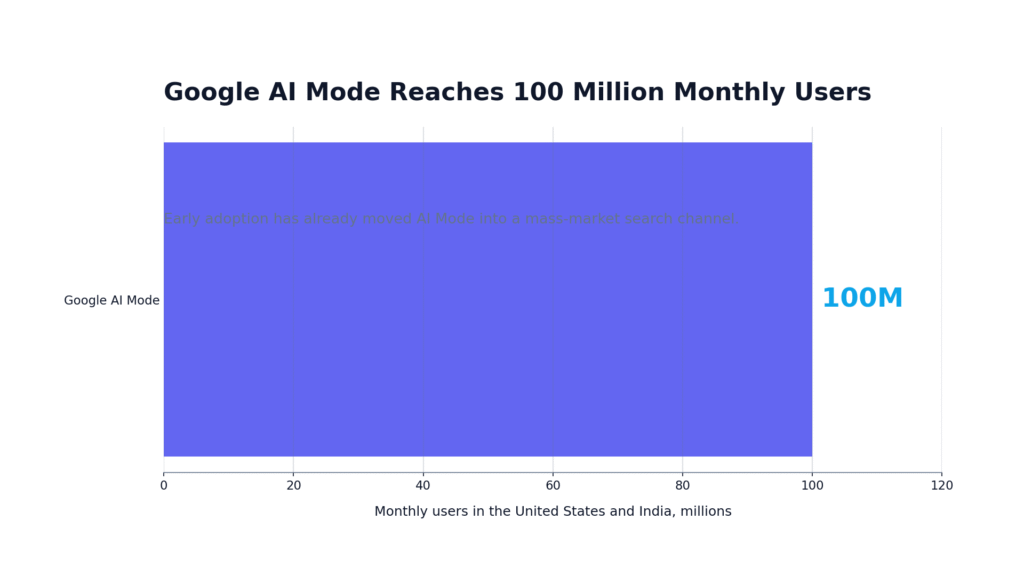
Google AI Mode reached more than 100 million monthly users in the United States and India during its early expansion. That adoption shows demand for search built around follow-up questions, synthesis, and task completion. It also moves conversational search from a limited experiment toward a channel large enough to influence planning.
The interface grows because it combines familiar Google discovery with a dialogue format for complicated needs. Query fan-out lets the system consult several related result sets before composing one response. A page can therefore become relevant through a supporting subtopic even without ranking prominently for the original wording.
A raw AI summary may celebrate more than 100 million monthly users without examining how evidence is selected, while human analysis follows the retrieval path. Teams should map the questions, comparisons, definitions, and constraints surrounding their core topic. The practical implication is that AI Mode optimization requires the whole decision journey, not one repeated phrase.
AI Search Optimization Trends #6. Top Rankings Produce Fewer Than Four in Ten Citations
Ahrefs found that 37.9% of cited AI Overview URLs also appeared within the first 10 result blocks for the same query. The figure breaks the assumption that citations mainly reward pages already dominating conventional rankings. A strong organic position still helps, but it does not describe the entire source-selection process.
The gap exists because AI Overviews can expand a query into related searches before gathering evidence. A page may answer one of those narrower subquestions better than the pages ranking for the original phrase. Citation competition therefore includes documents that are relevant to the expanded intent, not only direct search rivals.
A raw AI summary may reduce 37.9% of cited AI Overview URLs to a ranking statistic, while human analysis recognizes a wider retrieval field. Teams should compare cited pages by passage relevance, evidence, and subtopic coverage rather than position. The practical implication is that first-page rankings remain useful, but they are not a complete AI visibility strategy.
AI Search Optimization Trends #7. Nearly One-Third of Citations Sit Beyond the Top 100
Ahrefs reported that 31.0% of cited AI Overview URLs appeared beyond the first 100 result blocks for the same query. That share shows how far source selection can move from the rankings marketers inspect. Pages with weak direct-query positions can still supply a passage that fits an expanded need.
This happens because query fan-out creates several related result pools, each with its own relevance signals. Google can retrieve a document from one supporting pool even when that document performs poorly for the original search. The citation reflects usefulness within the generated answer, not a simple transfer of the main ranking order.
A raw AI reading may treat 31.0% of cited AI Overview URLs as proof that rankings no longer matter, while human judgment avoids overcorrection. Teams still need crawlability, authority, and organic discoverability, but should also build precise passages around adjacent questions. The practical implication is that optimization must widen beyond the primary keyword without abandoning SEO fundamentals.
AI Search Optimization Trends #8. YouTube Captures a Large Share of Non-Ranking Citations
Among cited pages outside Google’s top 100 results, 18.2% were YouTube URLs in Ahrefs’ analysis. Video therefore occupies a meaningful place in AI Overview sourcing even when the same URL lacks direct-query ranking visibility. The result signals that useful spoken explanations can enter generated answers through a different retrieval path.
YouTube works well because titles, descriptions, chapters, and transcripts give search systems several textual clues about a video’s subject. Demonstrations and expert commentary can also answer questions that are difficult to explain through short written passages. When those elements align, the video becomes a strong evidence candidate for a related fan-out query.
A raw AI plan may respond to 18.2% being YouTube URLs by producing more videos, while human analysis asks whether each format adds proof or clarity. Teams should create videos where demonstrations, comparisons, or firsthand explanation improve the answer. The practical implication is that multimedia visibility grows from useful format choice, not automatic channel expansion.
AI Search Optimization Trends #9. Traditional Result Clicks Fall When AI Summaries Appear
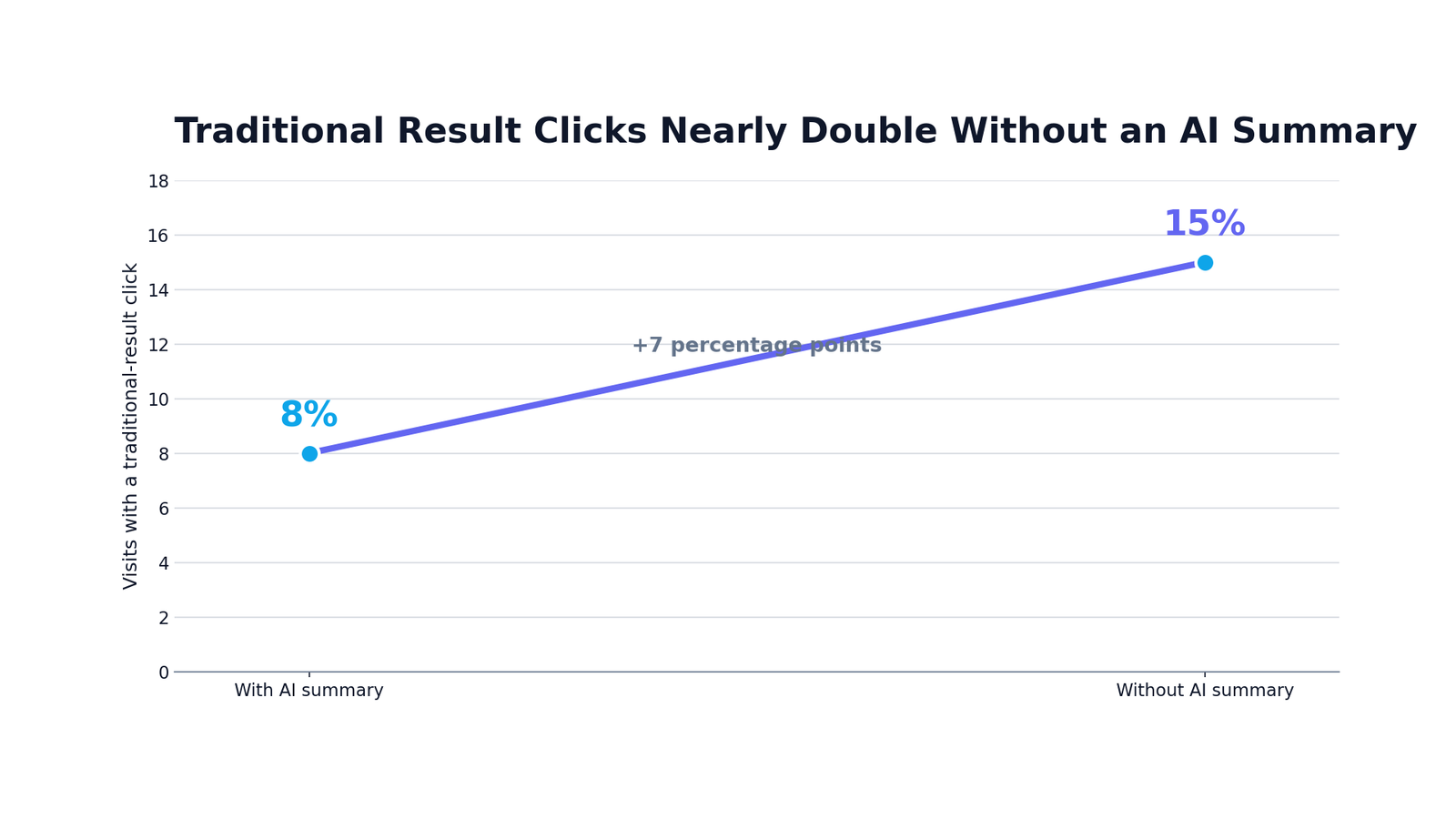
Pew observed that users clicked a traditional result in only 8% of visits with an AI summary. The low rate shows that many searchers can continue their task without selecting a conventional blue link. For publishers, exposure inside the result page can rise while measurable website traffic falls.
The decline occurs because the summary combines information from several sources and places it before the organic listings. When the response feels sufficient, the user has less reason to inspect supporting pages individually. This changes the value exchange, since source material can improve an answer without receiving a proportional visit.
A raw AI report may frame 8% of visits with an AI summary as lost traffic, while human analysis separates visibility from impact. Teams should identify queries where a click is essential and offer depth, tools, examples, or decisions the summary cannot complete. The practical implication is that content must earn the next action rather than assume a ranking will produce it.
AI Search Optimization Trends #10. Pages Without AI Summaries Earn Nearly Twice the Click Rate
Pew found traditional results received clicks in 15% of visits without an AI summary, nearly twice the rate seen when a summary appeared. The comparison shows how strongly AI summaries can alter behavior in search. Conventional listings still attract attention, but their opportunity changes when a synthesized response sits above them.
Without a summary, users must inspect individual results to assemble an answer or judge which source seems trustworthy. That extra information gap creates more reasons to click, compare, and return to the results page. AI summaries compress much of that work, reducing the number of steps between question and provisional conclusion.
A raw AI analysis may compare 15% of visits without an AI summary against the lower rate and declare organic search finished, while human judgment considers query type. Transactional, local, and high-stakes searches may still require direct evaluation. The practical implication is that teams should segment click expectations by result format and task, not apply one rate everywhere.
AI Search Optimization Trends #11. AI Summary Source Links Receive Very Few Clicks
Pew recorded a source-link click in just 1% of visits to pages with an AI summary. That figure makes citation visibility materially different from referral traffic, even when a brand earns prominent placement inside the answer. Being named can shape trust or recall without producing an immediate website session.
Users may avoid source links because the generated text already presents a coherent answer and the citations appear secondary to the main response. Some searchers also treat the links as verification signals rather than invitations to continue reading. The source contributes credibility, but the interface keeps the user’s attention within Google.
A raw AI dashboard may celebrate every citation equally, while human analysis recognizes that 1% of visits to pages with an AI summary produced a source click. Teams should connect citation tracking with branded search, assisted conversions, and later direct visits. The practical implication is that AI visibility needs influence metrics alongside referral counts.
AI Search Optimization Trends #12. AI Summaries Increase Session Endings
Pew found that browsing ended after 26% of visits with an AI summary, compared with a smaller share on traditional result pages. The pattern suggests many users considered the generated response sufficient for the immediate task. A completed session may represent satisfaction for Google but a lost evaluation opportunity for publishers.
The summary reduces friction by collecting definitions, comparisons, and supporting details into one visible block. When the question is informational and low risk, users may see little benefit in opening another page. The effect becomes stronger when competing articles repeat the same surface-level answer without offering additional utility.
A raw AI interpretation may treat 26% of visits with an AI summary as unavoidable abandonment, while human analysis looks for unfinished needs. Pages can still attract users through original data, calculators, templates, nuanced examples, or expert judgment. The practical implication is that publishers need a reason to continue the journey after the summary has handled the basics.
AI Search Optimization Trends #13. AI Summaries Appear in Almost One-Fifth of Searches
Pew detected an AI summary in 18% of observed Google searches within its March 2025 browsing dataset. The share was large enough to affect everyday search behavior but far from universal across all queries. This uneven exposure means sitewide traffic changes can hide major differences between topic groups.
AI summaries appear selectively because Google evaluates whether a generated response is useful for the particular search. Informational questions with multiple concepts offer more material for synthesis than simple navigational or direct lookup queries. A publisher’s exposure therefore depends heavily on its query mix rather than overall ranking volume alone.
A raw AI forecast may apply 18% of observed Google searches to every website, while human analysis maps the statistic to actual keyword categories. Teams should monitor which tracked queries trigger summaries and how that pattern changes over time. The practical implication is that AI search risk and opportunity must be measured at query level, not estimated from a universal average.
AI Search Optimization Trends #14. Long Queries Frequently Trigger AI Summaries
Pew found that 53% of searches containing at least 10 words produced an AI summary. Longer queries often reveal several conditions, relationships, or constraints that cannot be resolved through a single short result. The high trigger rate makes detailed natural-language searches especially important for AI visibility planning.
These queries invite synthesis because the system must interpret intent, separate subquestions, and combine information from multiple sources. They also create more opportunities for query fan-out, since each condition can lead to a related retrieval path. Pages with clearly organized passages can match one part of that complex request even without mirroring the full sentence.
A raw AI workflow may chase 53% of searches containing at least 10 words by stuffing pages with long phrases, while human analysis focuses on the underlying needs. Teams should answer realistic constraints in distinct, well-supported sections. The practical implication is that long-query visibility comes from structured completeness, not awkwardly reproducing conversational wording.
AI Search Optimization Trends #15. Question-Led Searches Commonly Produce AI Summaries
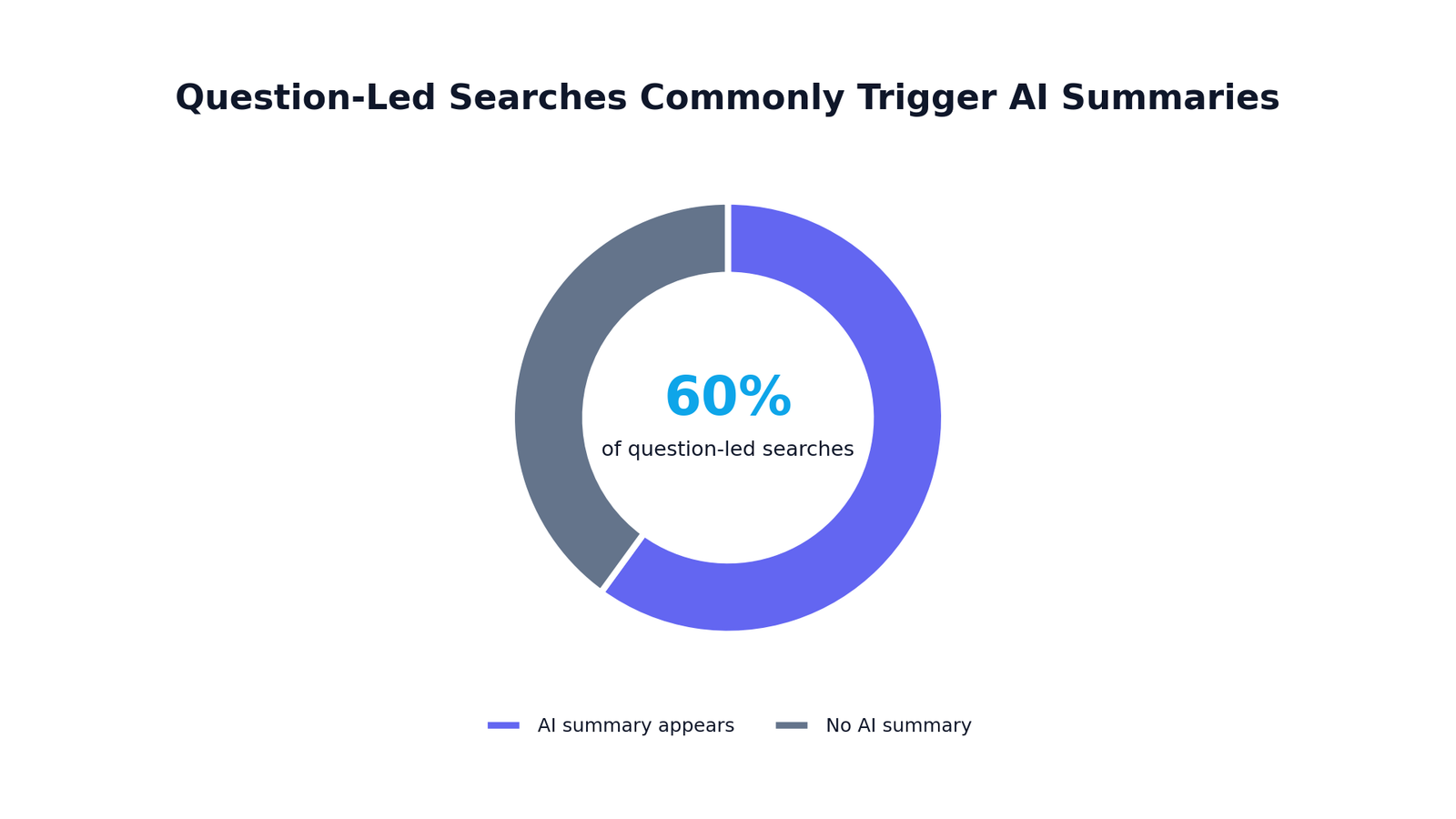
Pew reported that 60% of searches beginning with question words generated an AI summary. Queries starting with who, what, when, or why naturally ask for an explanation that can be synthesized. This makes question-led informational content especially exposed to answer-layer competition.
The format gives the system a clear task and often signals that several sources can contribute useful context. A direct question also helps retrieval models identify the type of passage needed, such as a definition, cause, comparison, or timeline. Pages that state and support the answer plainly are easier to extract than pages that delay the point.
A raw AI draft may react to 60% of searches beginning with question words by adding generic question headings everywhere, while human editing protects relevance. Teams should use questions that reflect genuine evaluation needs and answer them with evidence, limits, and context. The practical implication is that useful question structure can improve extractability, but decorative FAQs are unlikely to create durable visibility.
AI Search Optimization Trends #16. Generative AI Platform Visits Continue Rising
Similarweb reported 76% year-over-year growth in average monthly visits to generative AI platforms during the measured period. The increase shows that AI-assisted discovery is gaining routine usage rather than surviving as a temporary curiosity. More users are beginning research, comparison, and problem-solving inside assistants before reaching conventional websites.
Growth accelerates because the platforms combine search, explanation, drafting, and recommendation within one conversational interface. Each successful task gives users another reason to return with a different need, expanding usage beyond technology-focused audiences. As habits deepen, brands can influence decisions through mentions and recommendations before a referral is ever recorded.
A raw AI strategy may see 76% year-over-year growth in average monthly visits and pursue every platform equally, while human analysis considers audience fit. Teams should identify where their buyers actually ask category questions and compare the answers produced there. The practical implication is that channel expansion should follow observed demand, not headline growth alone.
AI Search Optimization Trends #17. Generative AI App Downloads Accelerate Faster
Similarweb measured 319% year-over-year growth in generative AI app downloads, outpacing the expansion of web visits. The difference points to AI becoming a persistent mobile utility rather than an occasional browser destination. An installed app can enter daily routines through voice, camera, notifications, and faster repeat access.
Mobile adoption grows quickly because the assistant is available at the moment a question, purchase need, or task appears. Users can move from curiosity to recommendation without opening a search browser or navigating several result pages. This convenience gives AI platforms more opportunities to shape preferences during short, high-frequency interactions.
A raw AI interpretation may treat 319% year-over-year growth in generative AI app downloads as a guarantee of referral traffic, while human analysis separates use from clicking. Teams should test how mobile assistants describe their brand and whether linked pages work well on small screens. The practical implication is that AI visibility and mobile experience must be evaluated together.
AI Search Optimization Trends #18. AI Platforms Generate More Than One Billion Referrals
Generative AI platforms produced 1.1 billion referral visits in June 2025, according to Similarweb data. The volume shows that assistant-driven discovery can generate substantial outbound traffic despite low click rates in some interfaces. AI referrals remain smaller than traditional search overall, but they are no longer negligible.
These visits occur when a user needs evidence, a transaction, a tool, or deeper detail beyond the generated response. Because the assistant has already interpreted the question, referred users may arrive with a clearer purpose than broad search traffic. The value of the channel therefore depends on what happens after arrival, not referral volume alone.
A raw AI report may highlight 1.1 billion referral visits in June 2025 as pure opportunity, while human analysis checks destination quality and intent. Teams should measure landing-page engagement, conversion paths, and associated prompts when available. The practical implication is that AI referral growth deserves its own view rather than being buried inside generic referral traffic.
AI Search Optimization Trends #19. Generative AI Referrals Convert at a Measurable Rate
Similarweb reported an approximately 7% conversion rate for generative AI referrals reaching transactional websites. The figure suggests that some assistant-referred visitors arrive after completing part of their comparison and consideration process. Lower traffic volume can therefore carry meaningful value when the recommendation closely matches the user’s need.
Conversational systems often ask for constraints before presenting options, which can narrow the field before a click occurs. A user who follows a recommendation may already understand the category, expected features, and likely tradeoffs. That prequalification can reduce casual browsing and increase the share of visits with commercial intent.
A raw AI forecast may apply the approximately 7% conversion rate for generative AI referrals to every business, while human analysis respects differences in product, attribution, and sample. Teams should benchmark their own assisted and last-click outcomes by platform and landing page. The practical implication is that AI traffic should be judged by conversion quality, not volume comparisons alone.
AI Search Optimization Trends #20. ChatGPT and Google Usage Strongly Overlap
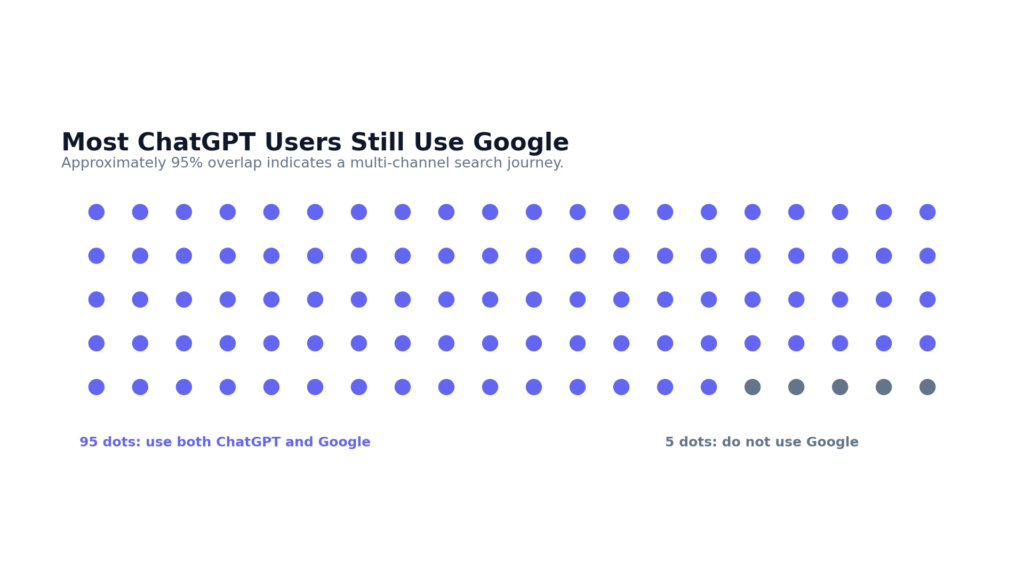
Similarweb found that approximately 95% of ChatGPT users still use Google, revealing substantial overlap between AI assistants and conventional search. The audience is adding another discovery method rather than replacing an established habit outright. A buyer may ask an assistant for options, verify claims on Google, and return through a different channel later.
This overlap persists because each interface handles different moments well. Assistants support synthesis and follow-up dialogue, while Google offers broad navigation, fresh indexing, local results, and direct access to known sites. Users move between them according to task, confidence, and the amount of verification they need.
A raw AI strategy may read approximately 95% of ChatGPT users still use Google and treat both channels as interchangeable, while human analysis studies their sequence. Teams should maintain technical SEO, authoritative content, and consistent brand claims across external sources. The practical implication is that AI search optimization should extend a strong search foundation rather than replace it.
What AI Search Optimization Now Requires
AI search is expanding the number of surfaces where a brand can influence a decision, but it is not creating one uniform replacement for conventional search. The evidence points to a layered journey in which summaries, citations, videos, organic listings, and assistant recommendations each perform a different job.
Source selection now reaches well beyond the first result page because fan-out retrieval can reward a precise supporting passage from an otherwise less visible URL. That behavior raises the value of structured explanations, original evidence, and connected subtopics while reducing the usefulness of keyword position as a standalone proxy.
Click compression remains the clearest commercial pressure because users often receive enough context to pause or finish the task before visiting a publisher. Pages can respond by offering decisions, tools, demonstrations, proprietary findings, and expert nuance that cannot be fully reproduced inside a compact generated answer.
Measurement must therefore connect AI mentions and citations with branded demand, referral quality, assisted conversion, and conventional search performance. The durable approach is to strengthen the underlying site while testing how its information travels through each emerging discovery layer.
Sources
- Google details the worldwide expansion of AI Overviews
- Google explains AI Overview and AI Mode retrieval behavior
- Google outlines optimization guidance for generative search experiences
- Google introduces AI Mode and its advanced search capabilities
- Google adoption figures for AI Overviews and AI Mode
- Ahrefs measures how AI Overview citations align with rankings
- Earlier Ahrefs research compares organic rankings with AI citations
- Ahrefs identifies the domains most frequently cited by AI Overviews
- Pew Research Center analyzes clicks after Google AI summaries
- Similarweb reports changing generative AI discovery and search behavior
- Similarweb maps generative AI platforms, pathways, and audience overlap
- Similarweb publishes updated generative AI traffic and referral statistics