How to Structure Content for AI Overviews: 15 Retrieval-Friendly Formatting Techniques

Structure pages around direct answers, focused headings, self-contained sections, nearby evidence, and strong order. A structured passage retrieval study found that using document structure improved search effectiveness and substantially reduced user effort, supporting retrieval-friendly formatting.
How to Structure Content for AI Overviews: 15 Retrieval-Friendly Formatting Techniques
Content can be accurate, useful, and well written yet still remain difficult for AI systems to retrieve and summarize. This often happens when important answers are buried inside long introductions, vague headings, or the same structural habits that explain why most AI content fails.
AI Overviews need clearly separated ideas, direct answer passages, and consistent signals that reveal what each section contributes. Even capable AI writing platforms for SEO teams cannot compensate for a page whose hierarchy makes its strongest information difficult to isolate.
The techniques below will help you organize definitions, evidence, examples, and supporting context into sections that retrieval systems can interpret without flattening the reader experience. They also reflect patterns found in current Google AI Overview citation data, giving you a practical framework for making pages easier to extract, understand, and reference.
| # | Strategy focus | Practical takeaway |
|---|---|---|
| 1 | Direct answer openings | Place the clearest response near the beginning so retrieval systems can identify the section’s main value without processing unnecessary setup. |
| 2 | Question-led headings | Use headings that reflect real search needs and make the relationship between a query and its answer immediately apparent. |
| 3 | Single-intent sections | Keep each section focused on one distinct idea so individual passages remain understandable when extracted from the wider page. |
| 4 | Front-loaded definitions | Define important concepts before adding qualifications, examples, or background that could obscure the core explanation. |
| 5 | Compact paragraph blocks | Break dense explanations into manageable units that preserve context while making specific facts easier to locate and reuse. |
| 6 | Ordered process steps | Present sequential guidance in a numbered structure so the order, dependencies, and completion path remain unmistakable. |
| 7 | Section summaries | Add brief recap passages where topics become complex, giving readers and retrieval systems a clean statement of the main conclusion. |
| 8 | Comparison tables | Organize parallel options by consistent criteria so differences can be interpreted without relying on scattered prose. |
| 9 | Claim-evidence pairing | Position supporting data, sources, or examples close to the statement they validate rather than separating proof from context. |
| 10 | Explicit entity naming | Use clear names for products, organizations, methods, and concepts instead of vague pronouns that weaken passage-level meaning. |
| 11 | Consistent heading hierarchy | Maintain a logical H2-to-H3 structure that communicates which ideas are primary, supporting, or nested beneath broader topics. |
| 12 | Self-contained examples | Write examples with enough detail to make sense independently while keeping them directly tied to the principle being demonstrated. |
| 13 | Descriptive transitions | Signal why the next point follows, helping systems interpret relationships such as cause, contrast, limitation, or consequence. |
| 14 | Visible freshness signals | Update dated facts, statistics, and recommendations so otherwise strong passages are not weakened by obsolete information. |
| 15 | Extraction review | Test whether key passages remain clear outside their original context and revise any section that depends too heavily on surrounding text. |
15 Retrieval-Friendly Formatting Techniques to Structure Content for AI Overviews
How to Structure Content for AI Overviews – Strategy #1: Direct Answer Openings
Open each major section with a direct response that resolves the heading before you add background, interpretation, or supporting detail. This placement matters because retrieval systems often evaluate early sentences to determine whether a passage contains a usable answer rather than merely introducing a topic. Good execution gives readers immediate clarity while preserving enough room afterward for nuance, evidence, and practical explanation.
Use this approach when the search intent can be answered in a sentence or two, especially for definitions, comparisons, and procedural questions. For example, a section about update frequency should state the recommended cadence first, then explain how industry volatility and editorial resources may change it. Avoid overstating certainty, because a direct answer should still acknowledge meaningful conditions that affect real-world application.
How to Structure Content for AI Overviews – Strategy #2: Question-Led Headings
Write section headings as clear questions when the underlying search intent is naturally interrogative, because the wording creates an immediate connection between the user’s need and the answer below it. A strong heading uses the language people genuinely search without forcing awkward keyword repetition or unnecessary qualifiers. Apply this technique to sections addressing definitions, reasons, methods, costs, timelines, or other specific information needs.
This format works because both readers and retrieval systems can recognize the purpose of the passage before processing its details. For instance, “How often should citation data be updated?” provides more direction than a vague label such as “Update considerations,” while still allowing a nuanced response. Keep each question narrow enough to answer directly, since broad or double-barreled headings usually produce unfocused sections.
How to Structure Content for AI Overviews – Strategy #3: Single-Intent Sections
Build every section around one primary intent, with supporting sentences that explain, qualify, or demonstrate that same idea rather than introducing several unrelated answers. This discipline matters because a passage becomes easier to retrieve when its heading, opening statement, evidence, and conclusion all point toward one purpose. Use separate sections whenever readers could reasonably search for the ideas independently or need different kinds of guidance.
In practice, a section about choosing heading depth should not suddenly expand into schema markup, citation strategy, and page-speed advice. Splitting those subjects creates smaller, self-contained units that remain meaningful when surfaced outside the full article, while also making the page easier to scan. Do not fragment closely connected details unnecessarily, however, because excessive separation can remove the context needed to understand the recommendation.
How to Structure Content for AI Overviews – Strategy #4: Front-Loaded Definitions
Place a concise definition near the beginning whenever a section introduces a technical term, named method, unfamiliar metric, or concept with competing interpretations. Defining the term first establishes a stable meaning that guides everything that follows, preventing readers and systems from guessing how the article uses it. A useful definition identifies what the concept is, what it does, and how it differs from nearby ideas.
For example, define a retrieval-friendly passage as a self-contained section whose purpose and supporting context remain clear when extracted from the page. You can then discuss ideal length, formatting, and limitations without forcing the audience to infer the central concept from scattered details. Avoid dictionary-style wording that adds little practical value, and revise definitions when industry usage has changed or remains genuinely contested.
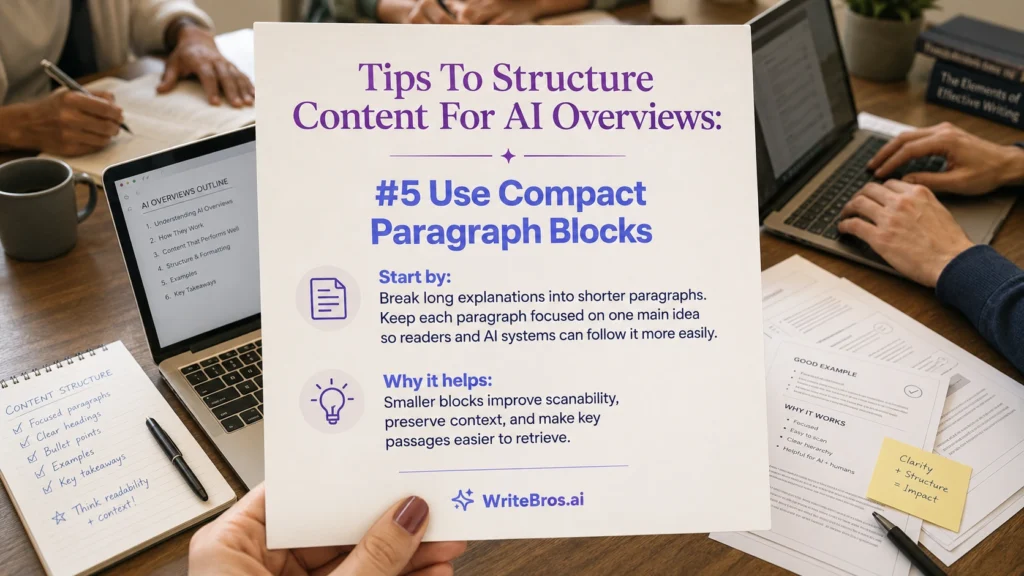
How to Structure Content for AI Overviews – Strategy #5: Compact Paragraph Blocks
Divide dense explanations into compact paragraphs that each develop one clear point, while allowing related paragraphs to build a complete argument across the section. This structure improves readability and helps retrieval systems isolate useful passages without encountering abrupt topic shifts inside a single block. Apply it whenever a paragraph contains multiple examples, several qualifications, or a conclusion that deserves its own visible space.
A practical section might use one paragraph to state the formatting principle and another to explain how that principle changes editorial decisions. The result feels easier to follow than a wall of text, yet it still preserves the connective reasoning that short, disconnected statements often lose. Do not reduce every paragraph to one sentence, because excessive brevity can make the writing feel fragmented and strip away necessary context.
How to Structure Content for AI Overviews – Strategy #6: Ordered Process Steps
Present procedures in numbered steps whenever the reader must complete actions in a particular order, because sequence is part of the answer rather than a cosmetic choice. Each step should begin with a distinct action, explain what completion looks like, and identify any dependency that affects the next stage. Use this format for audits, publishing workflows, implementation plans, diagnostic checks, and other repeatable processes.
For example, an extraction review can move from identifying target questions, to isolating answer passages, to checking whether those passages remain clear without surrounding text. Numbering preserves that progression and reduces the chance that readers skip a prerequisite or apply a later step too early. Avoid manufacturing sequences for information that is genuinely nonsequential, since forced numbering can imply dependencies that do not actually exist.
How to Structure Content for AI Overviews – Strategy #7: Section Summaries
Add a concise summary after a complex section when the explanation includes several conditions, competing considerations, or a long chain of reasoning that readers may need to consolidate. The summary should restate the practical conclusion in fresh language rather than repeating earlier sentences word for word. Use it sparingly in sections where the key takeaway could otherwise become buried beneath evidence, caveats, and examples.
This technique is particularly useful after discussing tradeoffs, such as balancing passage independence with enough surrounding context to prevent oversimplification. A closing summary can clarify that sections should stand alone without becoming shallow, giving retrieval systems a compact conclusion and readers a memorable decision rule. Do not append summaries to every section automatically, because predictable repetition adds length without improving understanding or extractability.
How to Structure Content for AI Overviews – Strategy #8: Comparison Tables
Use comparison tables when readers need to evaluate several options against the same criteria, since consistent columns reveal differences more efficiently than scattered descriptions. Choose criteria that directly influence the decision, define ambiguous labels, and keep each cell focused on comparable information. This format works well for tools, methods, content types, implementation choices, and any topic where parallel evaluation matters.
For example, a table comparing paragraph formats might include best use, retrieval advantage, reader benefit, and primary limitation rather than mixing unrelated features. The shared structure allows a system to interpret each row within the same frame while helping readers notice meaningful contrasts quickly. Avoid overly wide tables, vague ratings, or cells packed with full essays, because complexity can make the comparison harder to interpret.
How to Structure Content for AI Overviews – Strategy #9: Claim-Evidence Pairing
Place evidence immediately after the claim it supports, so readers can see the relationship without searching elsewhere on the page or guessing which statement a source validates. Relevant statistics, study findings, quotations, and examples should appear close enough to preserve that connection when the passage is extracted. Apply this principle most carefully to numerical claims, causal statements, industry trends, and recommendations presented with strong confidence.
A sentence claiming that cited passages favor a particular structure should be followed by the supporting dataset, methodology, or clearly labeled observation rather than a distant source list. This proximity strengthens credibility and gives retrieval systems a coherent claim-and-proof unit that can be understood independently. Avoid attaching one citation to a paragraph containing several unrelated claims, because the source relationship becomes ambiguous and potentially misleading.
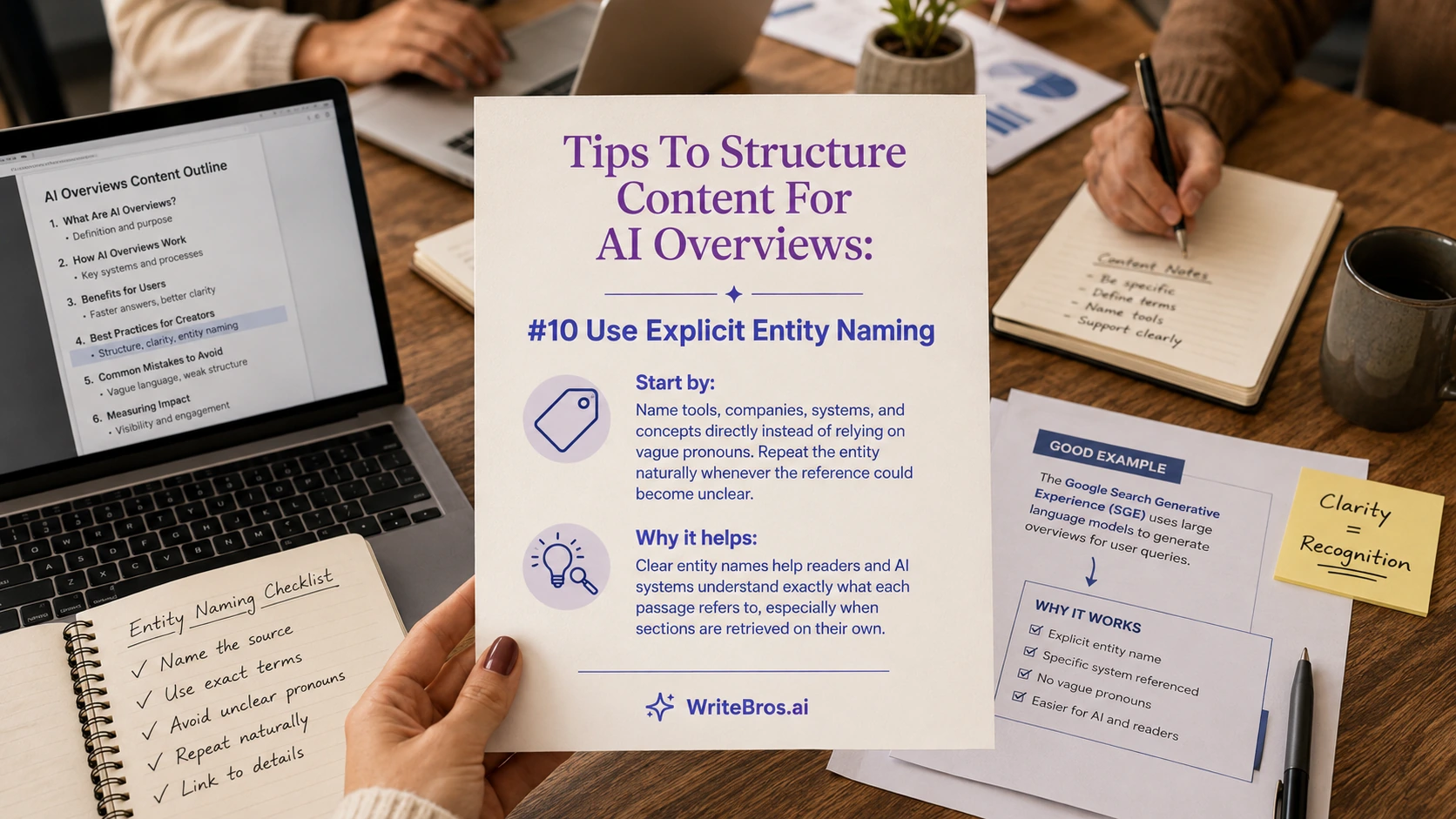
How to Structure Content for AI Overviews – Strategy #10: Explicit Entity Naming
Name important entities explicitly, including products, organizations, standards, methods, locations, and research groups, instead of relying on pronouns that require distant context. Clear naming helps each passage retain meaning when it appears outside the original section, while also reducing confusion between similar subjects. Repeat an entity naturally when several sentences separate the reference from its name or when multiple entities appear together.
For instance, write “Google AI Overviews may surface…” rather than “they may surface…” when the previous sentence also mentions search engines, publishers, and language models. The explicit wording may feel slightly repetitive in full-page reading, but it prevents ambiguity when the sentence is quoted or retrieved alone. Avoid mechanical repetition in every sentence, and use pronouns where the antecedent remains immediate, singular, and unmistakable.
How to Structure Content for AI Overviews – Strategy #11: Consistent Heading Hierarchy
Maintain a logical heading hierarchy in which each H2 introduces a major topic and each H3 develops a clearly subordinate aspect of that topic. This hierarchy communicates relationships that visual styling alone cannot reliably convey, helping readers and systems understand which ideas belong together. Plan the outline before drafting so sections progress from foundational concepts toward application, evidence, limitations, and review.
A page about retrieval-friendly formatting might use an H2 for passage design, followed by H3 sections covering openings, paragraph length, and internal context. Skipping directly from an H2 to several visually bold but unmarked labels weakens that structure and makes the page harder to interpret consistently. Do not choose heading levels based on font size, because semantic order should determine the markup before design decisions.
How to Structure Content for AI Overviews – Strategy #12: Self-Contained Examples
Write examples with enough context to make the situation, action, and outcome understandable without requiring readers to reconstruct missing details from earlier paragraphs. A self-contained example should identify who is acting, what problem exists, what change is made, and why the result demonstrates the principle. Use examples after abstract guidance, especially when a recommendation could be interpreted in several plausible ways.
For example, instead of saying “this improves extraction,” describe an editor rewriting a vague section opening so the recommended update cadence appears in the first sentence. That scenario shows the technique in action while connecting the structural change to a specific retrieval benefit. Keep examples realistic and proportionate, because elaborate fictional stories can distract from the lesson or introduce unsupported claims that readers mistake for evidence.
How to Structure Content for AI Overviews – Strategy #13: Descriptive Transitions
Use descriptive transitions to make relationships between ideas explicit, especially when the discussion moves from a general rule to an exception, consequence, contrast, or practical application. Phrases such as “in contrast,” “because of this,” and “under these conditions” clarify why the next sentence belongs in the passage. Apply them where readers might otherwise misinterpret separate facts as equivalent, contradictory, or causally connected.
A section can state that compact paragraphs support extraction, then transition with “however” before explaining that excessive fragmentation removes essential context. The transition preserves the tension between both points and helps the passage communicate a balanced recommendation rather than two disconnected claims. Avoid adding connective phrases mechanically, since transitions should reveal genuine logic and not merely decorate sentences that still lack a coherent relationship.
How to Structure Content for AI Overviews – Strategy #14: Visible Freshness Signals
Display clear freshness signals when advice depends on changing products, policies, datasets, interfaces, or search behavior, because accurate structure cannot compensate for outdated information. Include a meaningful update date, revise obsolete examples, and identify the period covered by statistics or observations. Apply this review more frequently to volatile subjects and less frequently to stable principles whose validity does not depend on recent events.
For instance, citation patterns measured during one quarter should be labeled with that timeframe rather than presented as permanent behavior across all future results. This context helps readers judge relevance and prevents retrieval systems from surfacing an old finding as though it describes the current environment. Avoid changing only the visible date while leaving stale claims untouched, because cosmetic freshness signals undermine trust when discrepancies become apparent.
How to Structure Content for AI Overviews – Strategy #15: Extraction Review
Review important sections as isolated passages before publishing, because retrieval systems may surface a few sentences without the introduction, neighboring headings, or earlier definitions. Copy each target answer into a separate document and check whether its subject, recommendation, evidence, and limitations remain understandable. Use this test for definitions, statistics, process steps, comparison conclusions, and any passage you would reasonably expect to be quoted.
If an isolated paragraph begins with “this approach” or depends on an unexplained number, revise it by naming the method and restoring the missing context. The goal is not to duplicate the entire article inside every passage, but to remove dependencies that prevent accurate interpretation. Keep necessary cross-references when topics genuinely rely on earlier material, and signal that dependency clearly rather than pretending every statement can stand alone.
Common mistakes
- Opening every section with several sentences of scene-setting delays the actual answer, usually because writers want the transition to feel polished, but the approach backfires when readers and retrieval systems cannot quickly identify the passage’s purpose.
- Using broad headings such as “Important considerations” or “What to know” feels flexible during drafting, yet those labels conceal the underlying question and make otherwise useful sections harder to classify, scan, extract, and connect with a specific search need.
- Combining definitions, procedures, comparisons, and caveats inside one oversized section often happens when writers fear repetition, but the resulting passage contains too many competing intents and becomes difficult to retrieve accurately without losing essential context.
- Separating claims from their evidence may make a page look cleaner, especially when sources are collected at the end, but it weakens credibility because readers cannot easily determine which citation supports which statement or whether the evidence truly applies.
- Repeating exact keywords unnaturally in every sentence is sometimes treated as a visibility tactic, yet it produces awkward prose, obscures entity relationships, and can make the page less useful than clear language that names subjects only where clarification is needed.
- Adding an updated date without reviewing the underlying facts creates the appearance of freshness rather than actual accuracy, and this backfires when outdated statistics, product details, or recommendations contradict newer information that readers can verify elsewhere.
- Designing tables, lists, or headings primarily for visual appeal can lead to incorrect semantic markup, because font size and styling do not communicate hierarchy reliably, leaving assistive technologies and retrieval systems with a distorted picture of the page.
- Treating every passage as completely independent can produce repetitive, bloated writing, since some ideas legitimately rely on earlier definitions or shared context, and forcing total independence may flatten nuance rather than improving accurate extraction.
Edge cases
Some subjects resist compact, self-contained answers because the correct guidance depends on jurisdiction, audience, technical environment, or rapidly changing evidence. In those cases, retrieval-friendly structure should expose the dependency clearly, using a direct conditional answer followed by the factors that change it, rather than pretending one universal recommendation will fit every situation without careful qualification.
Long-form analysis also needs room for ambiguity, especially when experts disagree or available data supports several interpretations. Preserve that nuance through clearly labeled viewpoints, dated evidence, and explicit limitations, while still giving each section a discernible purpose; the goal is not simplification at any cost, but easier access to accurately framed reasoning for readers and retrieval systems.
Supporting tools
- Google Search Console helps you identify the queries, pages, and performance shifts that deserve structural review, although it does not directly reveal why a passage was selected or omitted from an AI-generated result.
- A spreadsheet provides a practical place to map target questions, section headings, answer openings, evidence sources, update dates, and extraction-review notes, making inconsistencies easier to find across a large content library.
- Browser developer tools let you inspect heading markup, list structure, table semantics, hidden elements, and responsive behavior, which is useful when the visual page looks organized but the underlying HTML communicates a different hierarchy.
- An HTML validator catches malformed nesting, duplicate identifiers, missing table relationships, and other markup problems that can interfere with reliable interpretation, particularly after content passes through several editors, plugins, or page-building systems.
- A readability checker can flag paragraphs that have become excessively dense, repetitive, or syntactically tangled, but its score should guide human review rather than automatically forcing every sentence into the same simplified pattern.
- A schema testing tool helps confirm that supported structured data is valid and matches visible page content, preventing markup errors or unsupported claims from undermining an otherwise clear and well-organized article.
- WriteBros.ai can support the revision stage by helping reshape stiff or repetitive AI-assisted drafts into more natural prose, although editors should still verify meaning, evidence, entity references, and passage-level clarity before publishing.
Ready to Transform Your AI Content?
Try WriteBros.ai and make your AI-generated content truly human.
Conclusion
Structuring content for retrieval does not mean flattening every article into identical answer blocks or removing the depth that makes expert guidance valuable. The goal is to make each section’s purpose, conclusion, evidence, and limitations easier to recognize, so useful passages can travel beyond their original context without becoming misleading. Clear hierarchy and focused writing support machine interpretation and reading.
Treat these techniques as editorial decisions rather than rigid formulas, because different topics require different amounts of context, sequencing, comparison, and qualification. Review the passages that matter most, test whether they remain understandable when isolated, and revise where clarity improves. Consistent intention matters more than perfect uniformity, and thoughtful structure will usually outperform one built merely to satisfy a checklist.
Did You Know?
Google can use passage ranking to understand the relevance of individual sections within a longer page, so one focused passage may help a broader article surface for a specific information need when its meaning remains clear outside the surrounding discussion.
Google’s generative AI optimization guidance recommends a clear technical structure and valuable, people-first information while confirming that special AI markup or artificial content chunking is unnecessary. The practical goal is therefore to organize genuinely useful answers clearly, not divide prose into unnatural fragments merely to influence retrieval.
Ready to Transform Your AI Content?