How Teams Refine AI Drafts Before Publishing: 15 Editorial Quality Controls

AI drafts become publishable when teams verify claims, rebuild weak structure, align voice, and document decisions. A peer-reviewed study of human-AI writing shows why active human review matters at every stage before publication.
How to How Teams Refine AI Drafts Before Publishing: 15 Editorial Quality Controls
AI can produce a fast first draft, but getting that draft ready for publication is where many teams encounter the biggest challenges. Even organizations with established review processes often discover that speed alone does not guarantee accuracy, consistency, or credibility.
The problem usually appears because AI generates plausible content rather than verified editorial work, making subtle issues difficult to spot during quick reviews. Teams also rely on different editing habits and tools, which can create uneven quality without shared standards or the right AI humanizers to refine tone and readability.
Building dependable editorial quality controls helps every contributor improve the same draft with greater confidence instead of making disconnected edits. This guide explains 15 practical ways to refine AI drafts before publishing while creating a repeatable workflow supported by reliable Human-AI content workflow data that strengthens consistency over time.
| # | Strategy focus | Practical takeaway |
|---|---|---|
| 1 | Define publication standards | Establish clear expectations before anyone begins editing so every reviewer works toward the same outcome. |
| 2 | Confirm factual accuracy | Validate important claims, figures, and references before they become part of the published version. |
| 3 | Strengthen structural flow | Organize ideas into a logical sequence that improves readability from beginning to end. |
| 4 | Refine tone consistency | Make the writing sound cohesive across sections regardless of who contributed revisions. |
| 5 | Remove repetition | Eliminate duplicate ideas and unnecessary wording to improve clarity without losing meaning. |
| 6 | Improve readability | Simplify complex passages so readers can understand key points with less effort. |
| 7 | Verify supporting evidence | Ensure examples and supporting details genuinely reinforce the main argument. |
| 8 | Check editorial consistency | Apply uniform formatting, terminology, and style throughout the document. |
| 9 | Review audience alignment | Adjust language and depth so the final piece matches the intended readers. |
| 10 | Strengthen transitions | Create smoother connections that guide readers naturally between ideas. |
| 11 | Evaluate originality | Replace generic phrasing with distinctive explanations that add genuine editorial value. |
| 12 | Perform collaborative review | Gather feedback from multiple perspectives before final approval to catch overlooked issues. |
| 13 | Complete compliance checks | Confirm the draft satisfies legal, ethical, and organizational publishing requirements. |
| 14 | Finalize publication readiness | Review headlines, metadata, formatting, and presentation before release. |
| 15 | Capture workflow insights | Document lessons from each editing cycle to improve future collaboration and quality. |
15 Editorial Quality Controls to Refine AI Drafts Before Publishing
How to How Teams Refine AI Drafts Before Publishing – Strategy #1: Set Shared Standards
Before anyone edits an AI-generated draft, the team should define what publishable quality means for that specific content type, including expectations for accuracy, tone, structure, sourcing, originality, and audience usefulness. These standards work best when they are written as practical editorial criteria rather than broad instructions such as make it better or improve the writing, because reviewers need observable signals that guide consistent decisions. A strong standard might explain how claims should be verified, which terminology should remain consistent, how much detail readers require, and what kinds of generic phrasing should be rewritten before approval.
This approach matters because different reviewers naturally focus on different weaknesses, which can lead one person to polish grammar while another restructures the entire piece without knowing whether either change supports the publication goal. For example, a marketing team reviewing an AI-written product guide might require every recommendation to include a clear use case, a realistic limitation, and supporting evidence, which prevents the final article from becoming a collection of polished but vague claims. Standards should remain flexible enough to accommodate unusual assignments, yet specific enough that editors can explain why a passage passes, fails, or requires another revision.
How to How Teams Refine AI Drafts Before Publishing – Strategy #2: Verify Every Claim
Teams should treat every factual statement in an AI draft as unconfirmed until a reviewer checks it against a reliable and current source, especially when the content includes statistics, dates, technical explanations, quotations, legal information, or product capabilities. Verification should extend beyond confirming that a source exists, because AI systems can combine accurate fragments into a misleading conclusion or present outdated information with unwarranted confidence. Good execution involves tracing each important claim to its original context, checking whether the evidence actually supports the wording, and revising any statement that overstates certainty or leaves out a meaningful qualification.
This control protects the publication from errors that sound credible enough to survive a casual review, which is one of the most common risks in AI-assisted drafting. A team preparing an article about software adoption, for instance, might discover that a cited percentage refers only to surveyed enterprise users in one country rather than the entire market, requiring narrower language and clearer attribution. Reviewers should prioritize claims that influence reader decisions, while still checking smaller details that could undermine trust, and they should remove unsupported statements when verification is not possible rather than preserving them because they improve the narrative.
How to How Teams Refine AI Drafts Before Publishing – Strategy #3: Rebuild the Structure
Rather than editing each sentence in the order it appears, teams should first examine whether the draft presents ideas in a sequence that matches how readers understand the subject and make decisions. AI-generated drafts often contain individually reasonable sections that overlap, appear too early, or interrupt the central argument, so structural review should happen before detailed line editing consumes unnecessary time. Editors can improve the piece by identifying the main reader question, arranging supporting points around that question, combining repetitive sections, and moving background information to locations where it clarifies rather than delays the answer.
This method works because readers experience an article as a progression, not as a collection of isolated paragraphs, and even accurate content feels weak when its logic is difficult to follow. For example, an AI draft about choosing project management software may explain advanced integrations before establishing team size, workflow complexity, and budget, which forces readers to evaluate features without the necessary decision context. Teams should preserve useful material when possible, but they should not hesitate to reorder, merge, or remove sections when the original structure reflects the model’s generation pattern more than the reader’s actual needs.
How to How Teams Refine AI Drafts Before Publishing – Strategy #4: Align the Voice
Teams should compare the draft against the publication’s established voice and revise passages that sound more formal, enthusiastic, cautious, repetitive, or generic than the surrounding content. Voice alignment involves more than replacing a few words, because sentence rhythm, explanation depth, transitions, examples, and levels of certainty all contribute to whether the piece sounds like it belongs to the same brand or editorial team. Reviewers should look for sudden shifts in personality, inflated language, excessive signposting, and stock expressions, then rewrite those sections using the patterns that readers already associate with the publication.
This control becomes especially important when several people edit the same draft, since individual revisions can create new inconsistencies even while improving separate sections. A practical example would be a financial education article that begins with measured, plainspoken guidance but later shifts into promotional language about transforming results, which makes the article feel assembled from unrelated sources rather than written with one editorial perspective. Teams should avoid forcing every sentence into an identical pattern, however, because a consistent voice still needs natural variation, emotional range, and enough flexibility to match the seriousness or complexity of each section.
How to How Teams Refine AI Drafts Before Publishing – Strategy #5: Remove Hidden Repetition
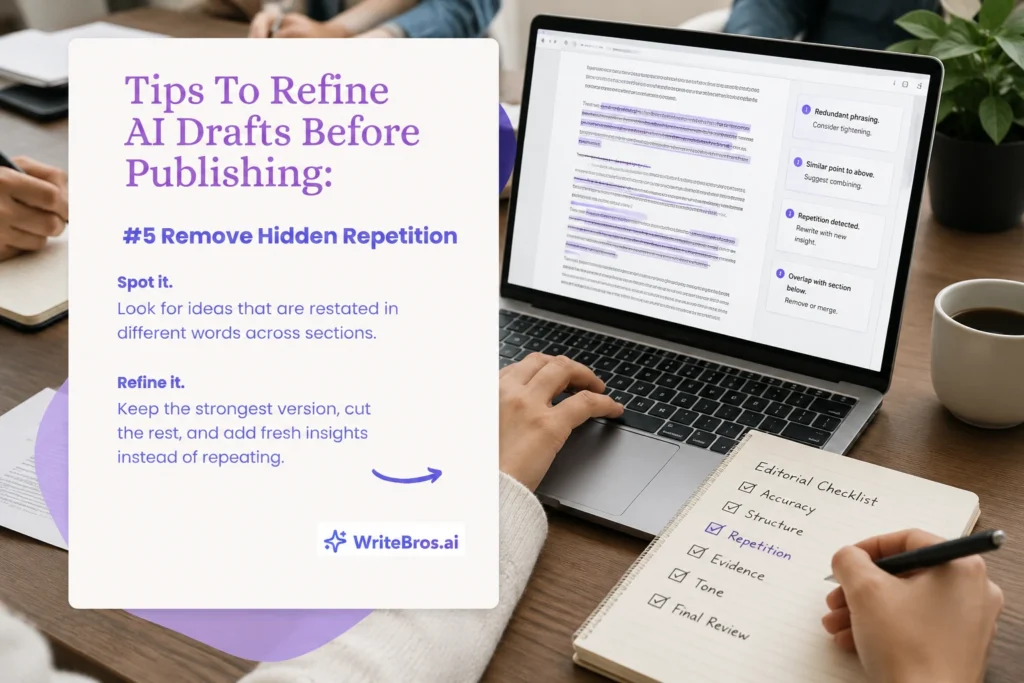
Editors should review AI drafts for repeated ideas, not merely repeated words, because generative systems often restate the same point through slightly different phrasing across introductions, section openings, examples, and conclusions. This repetition can make a piece appear comprehensive while giving readers very little new information, so teams should identify the distinct purpose of every paragraph and remove material that does not advance the explanation. Effective editing may involve combining two similar paragraphs, keeping the clearer example, shortening repeated context, or replacing a summary sentence with a more specific implication that adds depth.
The value of this control becomes clear in long-form content, where repetition accumulates gradually and may be difficult to notice when reviewers work section by section. An AI-written guide about improving customer retention might repeatedly say that personalization builds loyalty, yet never explain which customer signals matter, how teams should use them, or when personalization becomes intrusive, so the editor should trade repetition for practical detail. Teams should retain deliberate reinforcement when a complex idea genuinely needs restating, but each repetition should clarify, narrow, or extend the original point rather than merely echo it with different vocabulary.
How to How Teams Refine AI Drafts Before Publishing – Strategy #6: Improve Readability
Teams should revise dense or mechanically generated passages so readers can follow the argument without repeatedly rereading sentences, searching for missing context, or translating abstract language into practical meaning. Readability improves when editors clarify the subject of each sentence, reduce unnecessary clauses, replace vague references, vary sentence length, and break complicated explanations into a logical progression without oversimplifying the underlying idea. The goal is not to make every passage brief, but to ensure that longer sentences remain controlled, well connected, and easy to navigate because each phrase contributes a clear function.
This approach works particularly well when the subject requires technical, legal, or operational detail that cannot be reduced to surface-level advice. For example, an AI draft explaining data privacy compliance may contain accurate terminology but bury the required action beneath several layers of definitions, so an editor can introduce the practical obligation first and then explain the relevant limitations and conditions. Teams should be careful not to remove essential nuance in pursuit of simplicity, because readable content still needs accurate distinctions, and a shorter explanation can be more misleading than a longer one when important exceptions disappear.
How to How Teams Refine AI Drafts Before Publishing – Strategy #7: Test the Evidence
Teams should evaluate whether every example, statistic, quotation, and external reference genuinely strengthens the argument rather than merely making the draft appear researched. Supporting material should clarify a claim, demonstrate a real-world consequence, establish scale, or show why a recommendation is reasonable, while evidence that does none of these should be replaced or removed. Editors should also examine whether the draft relies too heavily on one type of evidence, such as broad industry surveys, when the reader would benefit from direct examples, primary documentation, expert analysis, or clearly explained limitations.
This control prevents the common problem of attaching impressive numbers to statements without showing how the two are meaningfully connected. A draft about employee productivity, for instance, may cite a study showing increased software adoption and then imply that the software improved performance, even though adoption and measurable productivity are not the same outcome. Reviewers should preserve uncertainty where the evidence is correlational, narrow claims when the source applies to a limited population, and explain why the evidence matters, because citations alone do not create a trustworthy argument unless the editorial reasoning remains visible.
How to How Teams Refine AI Drafts Before Publishing – Strategy #8: Standardize Editorial Details
Teams should perform a consistency review that covers terminology, capitalization, punctuation, heading style, number formatting, product names, abbreviations, and any publication-specific conventions that shape the reader’s experience. These details may appear minor compared with factual accuracy or structural logic, yet inconsistent treatment can make a carefully researched article feel unfinished and can create confusion when two terms appear to describe the same concept. Editors should use an accessible style guide, maintain a list of approved terms, and resolve inconsistencies systematically rather than correcting them only when they happen to stand out.
This process becomes more valuable when several contributors participate in the workflow, because each person may bring different assumptions about grammar, branding, formatting, or regional usage. For example, one reviewer might write ecommerce, another e-commerce, and another electronic commerce, leaving the final draft technically understandable but visually and editorially fragmented. Teams should avoid enforcing consistency so rigidly that natural language becomes awkward, but they should make deliberate choices and apply them throughout the piece, particularly when inconsistent terminology could affect search visibility, reader comprehension, or the interpretation of technical instructions.
How to How Teams Refine AI Drafts Before Publishing – Strategy #9: Match Reader Needs
Teams should review the draft from the perspective of the intended reader and confirm that its vocabulary, examples, depth, pacing, and assumed knowledge match what that audience is likely to need. AI systems often generate a middle-of-the-road explanation that sounds broadly accessible but may be too basic for specialists, too abstract for beginners, or too detached from the situations readers actually face. Editors can improve alignment by identifying the reader’s immediate problem, the decisions the content should support, the knowledge the reader probably already has, and the questions that remain unanswered after the first draft.
This control works because useful content depends not only on correctness but also on relevance at the moment the reader encounters it. A beginner-focused cybersecurity guide, for example, should explain what a firewall rule changes in practical terms before introducing advanced configuration logic, while a professional audience may prefer direct discussion of rule order, exceptions, logging, and operational risk. Teams should avoid inventing overly narrow audience assumptions without evidence, yet they should still make a clear editorial choice, because writing for everyone usually results in content that feels specific and useful to no one.
How to How Teams Refine AI Drafts Before Publishing – Strategy #10: Strengthen Connections
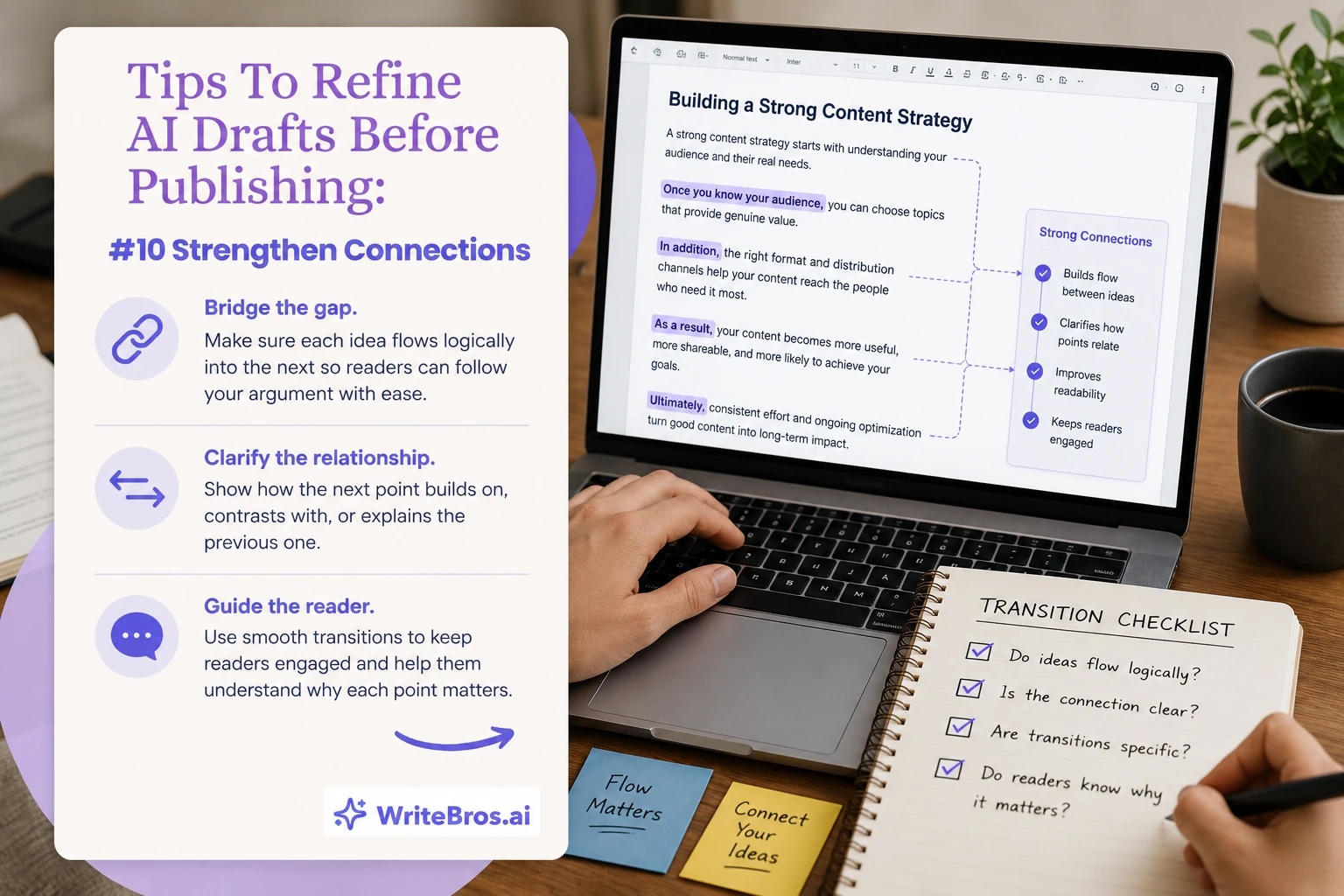
Editors should examine the transitions between sentences, paragraphs, and sections to ensure that each idea follows logically from the one before it and prepares the reader for what comes next. AI drafts often use generic connectors such as additionally, moreover, or in conclusion without establishing a meaningful relationship, so teams should clarify whether the next point expands, contrasts, qualifies, illustrates, or applies the previous one. Strong transitions can be built by carrying forward a key concept, explaining why the next issue matters, or identifying the unresolved question that the following paragraph will answer.
This strategy improves comprehension because readers rarely struggle with one isolated sentence as much as they struggle with unexplained shifts between otherwise understandable ideas. For instance, a draft about content strategy may move from audience research to publishing frequency without explaining that audience behavior should determine when and where content appears, leaving the sequence technically relevant but logically incomplete. Editors should avoid adding transitions that merely announce the next section, because the best connective language reveals the relationship between ideas and allows the article to feel continuous rather than assembled from separate generated blocks.
How to How Teams Refine AI Drafts Before Publishing – Strategy #11: Add Original Insight
Teams should identify passages that merely repeat familiar advice and replace them with analysis, examples, distinctions, or observations that reflect genuine editorial judgment. AI drafts frequently summarize what is already widely known, which can create a polished article that offers little reason for readers to trust, remember, or reference it. Editors can add originality by explaining where common advice fails, comparing competing approaches, drawing on internal experience, introducing a useful framework, or describing the tradeoffs that become visible only when a recommendation is applied in practice.
This control matters because originality is not limited to presenting a completely new discovery, and valuable content often becomes distinctive through sharper interpretation of an established subject. A draft about remote collaboration might repeat that communication is important, while an editor could add that excessive status reporting creates the appearance of coordination but reduces the uninterrupted time needed for meaningful work. Teams should avoid inserting unsupported opinions simply to sound different, because original insight still requires evidence, experience, or transparent reasoning, and a surprising claim without adequate support can weaken credibility more than conventional wording.
How to How Teams Refine AI Drafts Before Publishing – Strategy #12: Use Layered Review
Teams should divide the editorial process into distinct review passes so that accuracy, structure, voice, readability, and final presentation receive focused attention rather than competing during one overloaded review. A layered process may begin with a subject-matter review, continue with substantive editing, move into line editing, and end with proofreading and publication checks, depending on the importance and complexity of the content. Clear ownership at each stage helps reviewers understand what they are responsible for, reduces duplicated effort, and prevents major structural changes from occurring after the draft has already been polished at sentence level.
This method works because different editorial problems require different forms of attention, and reviewers are more likely to miss factual or logical weaknesses when they are simultaneously correcting punctuation and formatting. For example, a technical specialist might verify whether an AI-generated software tutorial is operationally correct, while an editor later improves sequencing and clarity without accidentally changing the technical meaning. Smaller teams can combine roles when necessary, but they should still separate the passes mentally or procedurally, because completing every type of review at once often creates fatigue, inconsistency, and false confidence.
How to How Teams Refine AI Drafts Before Publishing – Strategy #13: Check Risk and Compliance
Before publication, teams should review whether the draft creates legal, ethical, reputational, accessibility, or policy risks that ordinary copyediting may not reveal. This check should cover unlicensed material, unsupported claims, confidential information, discriminatory assumptions, inaccessible formatting, privacy concerns, regulated advice, and statements that could be interpreted as guarantees. Good execution requires reviewers to understand the risk level of the subject, involve qualified specialists when necessary, and revise language that is technically defensible but still misleading, insensitive, or inappropriate for the intended audience.
This control is particularly important when AI-generated content touches health, finance, employment, security, or other areas where small wording choices can influence consequential decisions. For example, a draft may describe a financial strategy as safe because historical returns were stable, yet an editor should replace that implication with a more accurate explanation of risk, uncertainty, and the limits of past performance. Teams should not rely on a general disclaimer to correct misleading body content, because readers form conclusions from the main explanation, and compliance language cannot repair a claim that was framed irresponsibly.
How to How Teams Refine AI Drafts Before Publishing – Strategy #14: Run Final Checks
Teams should complete a final publication-readiness review that examines every reader-facing element, including the headline, introduction, headings, links, images, captions, metadata, formatting, accessibility features, and calls to action. This stage should confirm that earlier revisions appear correctly in the publishing system and that no new errors were introduced during copying, layout changes, link insertion, or content management system formatting. Reviewers should also test whether the title accurately represents the article, whether the opening delivers on that promise, and whether the conclusion closes the discussion without repeating the introduction mechanically.
This process catches practical failures that may not exist in the editing document but can still damage the published experience. A fully reviewed article, for instance, may contain a broken source link, an outdated meta description, a missing image description, or a heading hierarchy that becomes confusing after formatting changes in the website editor. Teams should use a checklist to reduce reliance on memory, but they should also perform a final human reading in context, because technical completion does not guarantee that the page feels coherent, trustworthy, and ready for actual readers.
How to How Teams Refine AI Drafts Before Publishing – Strategy #15: Record Editorial Lessons
After publication, teams should document the recurring weaknesses found in AI drafts and use those observations to improve prompts, templates, briefing documents, review criteria, and future assignments. This feedback loop transforms editing from a repeated cleanup task into a source of operational knowledge, because patterns such as weak sourcing, repetitive introductions, generic examples, or inconsistent terminology can often be prevented earlier in the workflow. Useful documentation should identify the problem, explain how reviewers corrected it, and clarify what instruction or process change may reduce the same issue next time.
This approach works best when teams track patterns across multiple drafts rather than reacting to one unusual example as though it represents a permanent system limitation. A content team may notice that AI-generated comparison articles repeatedly describe every tool as suitable for small businesses, which signals the need for stronger audience criteria and more specific evaluation prompts before drafting begins. Teams should avoid turning every editorial preference into a rigid rule, however, because workflows must remain adaptable, and the purpose of documentation is to support better judgment rather than replace it with an expanding list of inflexible instructions.
Common mistakes
- Beginning with sentence-level polishing before checking the structure often wastes editorial time, because reviewers may carefully improve paragraphs that later need to be moved, combined, or deleted once the overall logic is examined more closely.
- Assuming that confident language signals factual accuracy happens because AI drafts often sound complete and authoritative, yet this confidence can conceal fabricated details, outdated information, or conclusions that extend far beyond what the available evidence supports.
- Using one reviewer for every kind of quality control may appear efficient, but it increases cognitive overload and makes it easier to miss technical, factual, stylistic, or compliance issues that require different expertise and different forms of attention.
- Removing every long sentence in the name of readability can flatten complex explanations, because some ideas require connected reasoning, qualifications, and examples, while excessive simplification may leave readers with a cleaner but less accurate understanding.
- Relying on automated grammar or originality scores as final approval criteria happens because scores feel objective, yet these tools cannot reliably judge whether an argument is useful, whether evidence is appropriate, or whether the writing reflects responsible editorial reasoning.
- Adding citations without examining the original source creates the appearance of research while preserving weak claims, because the cited material may address a different population, timeframe, methodology, or conclusion than the draft suggests.
- Trying to preserve most of the generated wording simply because it already exists can lead teams into unnecessary compromise, since a deeply flawed section is often faster and clearer to rewrite than to repair through a series of small edits.
- Skipping the final in-platform review causes avoidable publication errors, because formatting, links, image descriptions, metadata, and heading structure may change after the edited document is transferred into the website or publishing system.
Edge cases
Not every AI draft requires the same level of editorial control, so teams should scale the review process according to the content’s risk, reach, complexity, lifespan, and influence on reader decisions. A short internal announcement may need only accuracy and clarity checks, while a medical, financial, legal, or high-traffic evergreen article requires deeper sourcing, specialist review, compliance checks, and a documented approval process. The important distinction is not whether AI was involved, but what could happen if the published information is incomplete, misleading, outdated, or interpreted too broadly.
Teams may also encounter drafts built from expert notes, structured data, approved templates, or heavily constrained prompts, which can reduce some risks while creating others that remain easy to overlook. A template may improve consistency but preserve outdated assumptions, while expert input may ensure technical accuracy without producing an accessible explanation for non-specialist readers. Editors should therefore adapt the sequence and depth of review without abandoning core judgment, because even a strong drafting system cannot determine whether the final piece serves its audience responsibly in every context.
Supporting tools
- A shared editorial style guide gives reviewers a central reference for voice, terminology, formatting, sourcing, accessibility, and recurring language decisions, which reduces subjective disagreements and helps new contributors understand what publication-ready work looks like.
- A collaborative document editor with comments, suggestions, and revision history allows multiple reviewers to explain changes, compare versions, assign unresolved questions, and restore earlier wording when an edit unintentionally removes accuracy or useful context.
- A source-tracking spreadsheet or research database helps teams record claim locations, original references, publication dates, access dates, and verification notes, making it easier to update important facts and identify statements that remain unsupported.
- A project management platform can separate subject-matter review, substantive editing, copyediting, compliance review, and final approval into visible stages, which clarifies ownership and prevents a draft from being published before every required check is complete.
- Readability and grammar tools can highlight dense passages, repeated wording, punctuation problems, and inconsistent usage, but their recommendations should remain secondary to human judgment because automated suggestions may remove nuance or alter the intended meaning.
- Link checkers and accessibility testing tools help reviewers identify broken references, missing alternative text, weak heading structures, poor contrast, and other technical issues that may not be visible during ordinary document editing.
- WriteBros.ai can support the language-refinement stage by helping teams revise AI-generated phrasing, improve tonal consistency, and reshape mechanical passages, while editors retain responsibility for factual accuracy, evidence, structure, and final approval.
Ready to Transform Your AI Content?
Try WriteBros.ai and make your AI-generated content truly human.
Conclusion
Refining AI drafts before publication is not about disguising how the content was produced or forcing every sentence to sound unusually polished. The real goal is to create work that is accurate, coherent, useful, responsible, and clearly shaped by editorial judgment rather than accepted because the first draft appeared complete. When teams define shared standards, verify evidence, improve structure, align the voice, and review the final presentation, they turn AI output into content that genuinely serves readers.
No workflow will remove every difficult judgment, and perfection should not become an excuse for endless revisions that add little practical value. Strong editorial teams focus instead on making intentional decisions, documenting why important changes were made, and applying deeper scrutiny where the consequences of error are greater. With a repeatable process and clear ownership, teams can publish efficiently without treating speed as a substitute for trust, clarity, or thoughtful human oversight.
Did You Know?
Teams usually improve AI-generated content more by organizing a disciplined editorial review process than by trying to generate a better first draft every time.
A large meta-analysis published in Nature Human Behaviour found that human-AI collaboration delivered its most reliable benefits in content-creation tasks, while judgment-heavy decisions remained more dependent on human oversight. The strongest publishing workflows therefore assign AI to structured drafting tasks while editors retain responsibility for verification, editorial quality, contextual reasoning, policy compliance, and final publication decisions.
Ready to Transform Your AI Content?