How to Edit Writing Flagged by AI Detectors: 15 Revision Steps
Updated for 2026: Many legitimate writers still trigger AI detection alerts due to structural patterns rather than authorship. Research published in Nature Machine Intelligence highlights limits in detection reliability, making thoughtful revision strategies increasingly important.
How to Edit Writing Flagged by AI Detectors: 15 Practical Revision Steps
Seeing your work labeled as AI-generated can be frustrating, especially when you know the ideas and effort behind it are real. Writers often start questioning their process, tools, and editing habits after reading comparisons like AI humanizer vs AI rewriter vs paraphraser discussions.
The issue usually comes from patterns that automated systems interpret as machine-like, even if the writing started from genuine research or personal experience. Many writers begin experimenting with different editing workflows and even review lists of the best AI humanizer tools while trying to understand what actually changes a detector’s score.
Recent research and testing show that detection tools still make mistakes, which is why understanding the editing process matters more than simply rewriting sentences. Studies such as GPTZero false AI detection data show how frequently legitimate writing triggers alerts, making a clear revision strategy essential.
| # | Strategy focus | Practical takeaway |
|---|---|---|
| 1 | Sentence structure variation | Break repetitive sentence patterns so the writing flows with natural rhythm instead of predictable phrasing. |
| 2 | Paragraph flow adjustment | Rework transitions so ideas connect logically rather than appearing as isolated information blocks. |
| 3 | Add contextual detail | Expand sections with specific context, examples, or explanations that reflect human reasoning. |
| 4 | Reduce predictable phrasing | Replace overly uniform wording with varied expressions that match natural writing habits. |
| 5 | Introduce subtle voice cues | Add small stylistic signals that reflect human tone, perspective, or reasoning. |
| 6 | Blend short and long sentences | Mix sentence lengths so the text feels less mechanical and more conversational. |
| 7 | Strengthen transitions | Use connective language to guide readers smoothly through the argument or explanation. |
| 8 | Insert natural clarifications | Add brief clarifying statements that mirror how people naturally explain complex ideas. |
| 9 | Refine vocabulary choice | Adjust wording so the language feels deliberate rather than overly neutral or generic. |
| 10 | Break repetitive paragraph shapes | Avoid uniform paragraph lengths to create a more natural visual and structural rhythm. |
| 11 | Add realistic examples | Include relatable situations or explanations that reflect lived reasoning. |
| 12 | Clarify logical progression | Ensure each section logically builds on the previous idea instead of repeating similar points. |
| 13 | Introduce mild uncertainty | Use natural qualifiers that reflect thoughtful reasoning rather than absolute statements. |
| 14 | Adjust rhythm and pacing | Edit sections that feel overly dense so the text reads more naturally. |
| 15 | Final readability pass | Review the entire draft with a focus on clarity, tone, and human readability rather than detector scores. |
15 Practical Ways to Edit Writing Flagged by AI Detectors
How to Edit Writing Flagged by AI Detectors – Strategy #1: Sentence structure variation
Many passages that trigger detection tools follow highly predictable sentence structures, which means the first revision step is to intentionally vary how ideas are expressed across the paragraph. Instead of repeating similar sentence openings or relying on the same grammatical structure, try alternating between descriptive explanations, contextual clarifications, and reflective commentary that gradually expands the idea. This kind of structural variation introduces the type of natural rhythm that emerges when people develop thoughts over time rather than producing lines that follow identical patterns.
Detection systems frequently look for uniformity in sentence length and structure, which means paragraphs written in the same grammatical cadence can raise suspicion even if the ideas themselves are legitimate. Imagine a section that explains a research concept using six sentences that all begin with a subject followed by a verb and a short explanation, because that format quickly creates a mechanical rhythm that detectors interpret as algorithmic. When you rewrite those sentences with layered phrasing, contextual clauses, and subtle pacing changes, the text begins to resemble natural reasoning rather than structured output.
How to Edit Writing Flagged by AI Detectors – Strategy #2: Paragraph flow adjustment
Paragraphs sometimes become flagged when each one behaves like an isolated information block instead of part of a continuous line of reasoning. Revising for flow means checking whether one paragraph logically leads to the next through explanation, contrast, clarification, or continuation of the same concept. When readers can follow the movement of the argument naturally, the text develops the layered progression that human writing typically displays.
Think of a situation in which a paragraph explains a concept and the following section abruptly introduces a new idea without acknowledging the connection between them. Detectors often interpret that kind of abrupt structural shift as machine generated because the transitions feel mechanically segmented rather than thoughtfully developed. Adding bridging sentences that acknowledge the previous idea while introducing the next concept restores the natural continuity that human writing tends to produce.
How to Edit Writing Flagged by AI Detectors – Strategy #3: Add contextual detail
Writing that lacks context can appear overly generic, which is one of the patterns that automated detection systems frequently associate with generated text. Expanding the paragraph with clarifying information, situational references, or subtle background explanations gives the writing a richer informational layer. This additional context reflects the way people naturally elaborate on ideas when they want readers to understand the reasoning behind a statement.
Consider a paragraph explaining a concept without indicating when it applies, why it matters, or what situation led to the observation. Detection tools can interpret this kind of stripped explanation as formulaic because the writing contains only the core claim without surrounding perspective. Adding contextual framing such as the conditions that produced the insight or the circumstances in which the idea becomes relevant helps the text resemble authentic human reasoning.
How to Edit Writing Flagged by AI Detectors – Strategy #4: Reduce predictable phrasing
Highly predictable phrasing patterns often trigger detectors because many automated writing systems rely on repetitive language frameworks to organize information. Revising those passages means identifying repeated expressions, uniform transition phrases, or identical sentence constructions that appear throughout the draft. Rewriting them with varied language and more flexible phrasing introduces the subtle unpredictability that characterizes genuine human writing.
For instance, a paragraph might repeatedly begin explanations with similar phrases that organize information in the same mechanical sequence. Even though the ideas themselves may be valid, the repeated phrasing can create the impression of automated composition. Replacing those predictable openings with varied expressions, reflective commentary, or layered explanations helps restore the conversational variability that readers associate with human thinking.
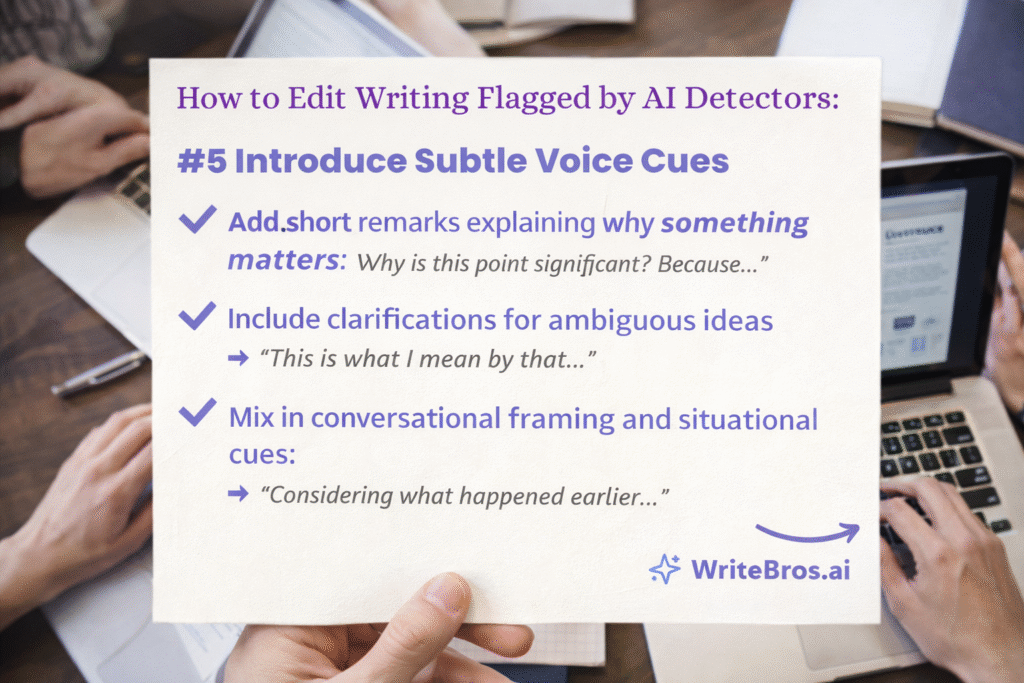
How to Edit Writing Flagged by AI Detectors – Strategy #5: Introduce subtle voice cues
Human writing usually contains small indicators of perspective, interpretation, or reasoning that emerge naturally during explanation. Adding subtle voice cues such as reflective commentary, clarifying remarks, or situational framing can make the writing feel less neutral and more thoughtful. These small elements help detectors recognize that the text reflects human interpretation rather than formulaic output.
A paragraph that simply lists facts or conclusions without acknowledging how those ideas were considered may appear overly detached. Introducing short reflective statements that explain why a concept matters or how a conclusion was reached can restore a more authentic tone. Those additions mirror the way people naturally explain their reasoning when sharing information with others.
How to Edit Writing Flagged by AI Detectors – Strategy #6: Blend short and long sentences
Natural writing rarely maintains a perfectly balanced sentence length throughout an entire section. Instead, human writers alternate between longer explanatory statements and shorter clarifying remarks that reinforce the idea being discussed. Introducing that variation prevents the text from developing the uniform cadence that automated detection systems sometimes identify as machine generated.
A paragraph composed entirely of medium length sentences can feel surprisingly mechanical even when the content itself is informative. Readers subconsciously expect the rhythm of language to fluctuate as ideas become more complex or more concise. Mixing sentence lengths introduces a pacing pattern that mirrors the organic development of thought.
How to Edit Writing Flagged by AI Detectors – Strategy #7: Strengthen transitions
Transitions play a major role in shaping how a reader experiences the movement of an argument or explanation. Without clear connective language, paragraphs may appear as separate fragments rather than parts of a coherent discussion. Revising transitions ensures that each idea grows naturally from the previous one.
Imagine reading a sequence of paragraphs that explain related ideas but never explicitly acknowledge the connection between them. That absence of connective reasoning can make the writing feel algorithmic because the structure resembles a list of separate answers. Introducing thoughtful transitions clarifies the logical relationship between ideas and creates a smoother reading experience.
How to Edit Writing Flagged by AI Detectors – Strategy #8: Insert natural clarifications
Human explanations frequently contain brief clarifications that anticipate a reader’s confusion or curiosity. Adding these clarifying remarks during revision introduces the conversational quality that many detection systems associate with authentic writing. Instead of presenting information in a rigid sequence, the text begins to reflect the natural adjustments people make while explaining complex ideas.
Consider how someone might explain a technical concept to a colleague, pausing briefly to clarify a detail that might otherwise feel ambiguous. That moment of clarification often appears as a small additional phrase or sentence that expands the explanation. Including these adjustments in written text creates the same sense of thoughtful communication.
How to Edit Writing Flagged by AI Detectors – Strategy #9: Refine vocabulary choice
Vocabulary that remains overly neutral throughout an entire document can sometimes resemble automated language patterns. Revising word choices to reflect more precise or context sensitive expressions adds personality and clarity to the text. This refinement helps the writing feel more deliberate and less formulaic.
A paragraph filled with general terms might communicate the idea adequately but still lack the specificity that readers expect from thoughtful writing. Introducing more descriptive or context aware wording can reshape the tone of the passage without changing the core message. That subtle improvement reinforces the impression that the writing was crafted carefully.
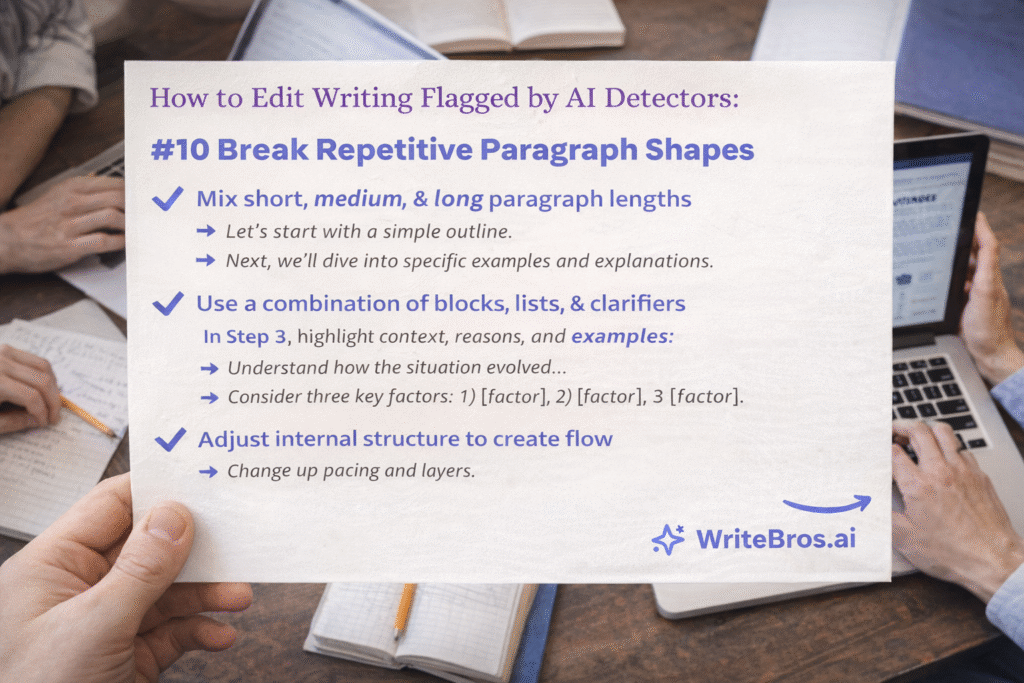
How to Edit Writing Flagged by AI Detectors – Strategy #10: Break repetitive paragraph shapes
Paragraphs that follow identical lengths and internal structures can create a visually mechanical layout on the page. Revising those sections to include different paragraph sizes or varied internal pacing helps the article feel more organic. Readers unconsciously interpret that variation as evidence of thoughtful composition.
Imagine scrolling through a document in which every paragraph contains the same number of sentences and similar line lengths. Even before reading the content, the layout itself may feel formulaic. Adjusting paragraph structure introduces the natural irregularity that appears in most human writing.
How to Edit Writing Flagged by AI Detectors – Strategy #11: Add realistic examples
Examples help transform abstract explanations into concrete situations that readers can visualize. Adding a brief real world scenario allows the writer to demonstrate how a concept operates in practice. This narrative layer often introduces nuance that automated text rarely contains.
When an explanation includes a situation, a setting, and the reasoning behind an observation, the writing begins to mirror the storytelling patterns common in human communication. Readers naturally engage with ideas that connect to familiar experiences. Detection systems often interpret this contextual richness as evidence of human authorship.
How to Edit Writing Flagged by AI Detectors – Strategy #12: Clarify logical progression
Logical progression ensures that each paragraph builds upon the previous one rather than repeating similar statements. Revising for logical flow requires examining whether every section contributes a new layer of insight or explanation. When the progression is clear, the argument feels intentional rather than mechanically assembled.
Detection tools sometimes flag writing that repeats ideas in slightly different wording without expanding the reasoning. This pattern can appear algorithmic because the structure resembles automated summarization. Strengthening the progression of ideas helps the article reflect a more thoughtful analytical process.
How to Edit Writing Flagged by AI Detectors – Strategy #13: Introduce mild uncertainty
Human writers frequently acknowledge uncertainty when discussing complex topics. Including measured qualifiers such as reflective observations or tentative interpretations can soften statements that otherwise appear overly absolute. These nuances make the writing sound more like genuine reasoning.
Statements presented as absolute conclusions without acknowledging potential limitations may appear artificial. Introducing thoughtful qualifiers demonstrates that the writer has considered multiple perspectives. That subtle shift creates a tone that aligns more closely with authentic analytical writing.
How to Edit Writing Flagged by AI Detectors – Strategy #14: Adjust rhythm and pacing
Rhythm and pacing influence how readers move through a piece of writing. Revising pacing means examining whether some sections feel rushed while others become unnecessarily dense. Adjusting that balance produces a smoother reading experience.
When the pacing reflects the natural development of ideas, readers sense that the explanation unfolded through thoughtful consideration. A consistent but flexible rhythm keeps the reader engaged while maintaining clarity. This pacing pattern mirrors the way people organize thoughts during extended explanations.
How to Edit Writing Flagged by AI Detectors – Strategy #15: Final readability pass
The final revision stage focuses on reading the entire article as a complete narrative rather than a series of individual edits. This step allows the writer to notice subtle patterns that may still feel repetitive or mechanical. Adjusting those details ensures the writing feels natural from beginning to end.
During this pass, writers often discover phrases that sound overly formal or sections that repeat the same structure. Rewriting those passages with clearer phrasing and varied pacing improves readability. The result is a document that communicates ideas smoothly while maintaining a natural voice.
Common mistakes
- Many writers attempt to lower detector scores simply by replacing words with synonyms, which may appear like revision on the surface but rarely changes the structural patterns that detectors analyze. Because the sentence structure and paragraph rhythm remain unchanged, the writing still reflects the same mechanical patterns that initially triggered the detection warning.
- Another common mistake occurs when writers rely entirely on automated rewriting tools without carefully reviewing the output for coherence and logical progression. Although these tools can modify phrasing, they often preserve the same structural organization, which means the rewritten version may still appear formulaic to advanced detection systems.
- Some writers respond to a flagged document by aggressively shortening sentences or simplifying language in an attempt to appear more natural. This reaction can backfire because excessive simplification removes nuance, context, and explanatory depth, creating a stripped structure that resembles automated summarization.
- Overediting can also create new problems, especially when writers repeatedly rewrite the same paragraph without reconsidering the overall argument or narrative flow. Excessive revision may introduce awkward transitions or inconsistent tone, which ironically increases the likelihood that detection systems will interpret the text as artificial.
- Ignoring paragraph level structure is another mistake that appears frequently in flagged drafts. Writers sometimes focus entirely on individual sentences while overlooking the broader organization of ideas, even though detection models analyze patterns across entire sections rather than isolated lines.
- Some writers assume that a single editing technique will resolve every detection issue, which leads them to repeat the same strategy throughout the article. This repetitive revision pattern can create a new form of uniformity, undermining the goal of making the writing appear naturally varied.
Edge cases
There are situations in which even well edited writing may continue to trigger detection systems despite careful revision. Academic summaries, technical explanations, and instructional documents often use structured language that resembles algorithmic patterns because the subject matter demands clarity and precision. In these cases, the goal of editing is not necessarily to eliminate every detection flag but to ensure the writing remains readable, accurate, and logically organized while minimizing overly mechanical phrasing.
Another edge case appears when large sections of text summarize research findings or standardized information, because these passages naturally follow similar sentence patterns. Revising them excessively may distort the meaning or introduce unnecessary complexity. In those circumstances, maintaining clarity and factual accuracy should remain the priority, even if the detection score does not drop dramatically.
Supporting tools
- Editing platforms that analyze readability, sentence structure, and paragraph flow can help writers identify repetitive patterns that might otherwise remain hidden during manual review. These tools highlight structural similarities across a document and make it easier to recognize when the writing rhythm becomes overly predictable.
- Grammar analysis software can reveal subtle structural patterns such as repeated clause structures or overly uniform sentence construction. Although these programs are primarily designed to correct language issues, their pattern recognition capabilities can assist writers in identifying sections that require more varied phrasing.
- Content comparison tools allow writers to review multiple drafts side by side, which helps identify whether revisions truly changed the structural rhythm of the writing. This process encourages deeper editing decisions rather than superficial word substitutions.
- Research databases and academic references can support the addition of contextual explanations and real world examples that enrich the writing. Access to reliable sources helps writers expand sections that previously lacked depth or contextual framing.
- Outline and structure planning tools help writers visualize the logical progression of their ideas before revising the final draft. When the argument develops through a clear sequence of reasoning, the resulting writing tends to reflect the natural flow of human thought.
- WriteBros.ai can assist writers during the revision process by helping reshape phrasing and tone while preserving the core meaning of the text. Used thoughtfully alongside manual editing, it can help writers refine structure, pacing, and expression without losing the original intent of the document.
Ready to Transform Your AI Content?
Try WriteBros.ai and make your AI-generated content truly human.
Conclusion
Editing writing flagged by detection systems requires more than surface level rewriting because the patterns that trigger these tools usually exist at the structural level of sentences, paragraphs, and overall argument flow. Careful revision introduces variation, contextual detail, and logical progression that reflect how human writers naturally develop ideas over time.
Perfection is not the goal of this process, because detection systems will continue evolving and occasionally misclassifying legitimate writing. The more important objective is to refine clarity, improve pacing, and create writing that feels thoughtful and deliberate to real readers.
Did You Know?
People editing writing flagged by AI detectors usually look for suspicious wording, but many systems respond to the repeated “shape” of your paragraphs more than the exact vocabulary. If each section begins with a tidy claim, follows with two evenly paced explanations, and ends with the same polished wrap up line, the rhythm can resemble machine output even when the content is accurate and genuinely authored.
Revising the architecture typically helps more than hunting for synonyms because human writing rarely lands with perfect consistency on every paragraph. Allow one paragraph to stay short and practical, let another stretch with a longer clarification woven into the middle, and let the next circle the point before landing it cleanly, since that varied pacing is a natural result of real editing and real thinking.
Ready to Transform Your AI Content?