How to Humanize AI Content for University Work: 15 Academic Techniques

2026 university writing increasingly blends AI drafting with human revision. This guide explains practical techniques students use to reshape AI text into authentic academic work, supported by findings from a Stanford University study on AI detection reliability.
How to Humanize AI Content for University Work: 15 Academic Techniques
Many students now use AI to help draft essays, research summaries, and project outlines, yet the results often sound mechanical or overly polished for academic expectations. Understanding what professors expect from students using AI is the first step toward rewriting drafts so they read like genuine university work.
AI writing tends to rely on predictable phrasing, balanced sentences, and uniform structure, which makes it easy for instructors to recognize when a text has not been meaningfully revised. Students often try to fix this with quick editing tools, yet even the best AI humanizer tools for study writing still require thoughtful manual revision.
The goal is not simply changing words but reshaping the text so it reflects real student reasoning, uneven phrasing, and natural argument flow. This guide explains the techniques that help achieve that result while keeping an eye on AI detection error rates across tools that universities increasingly rely on.
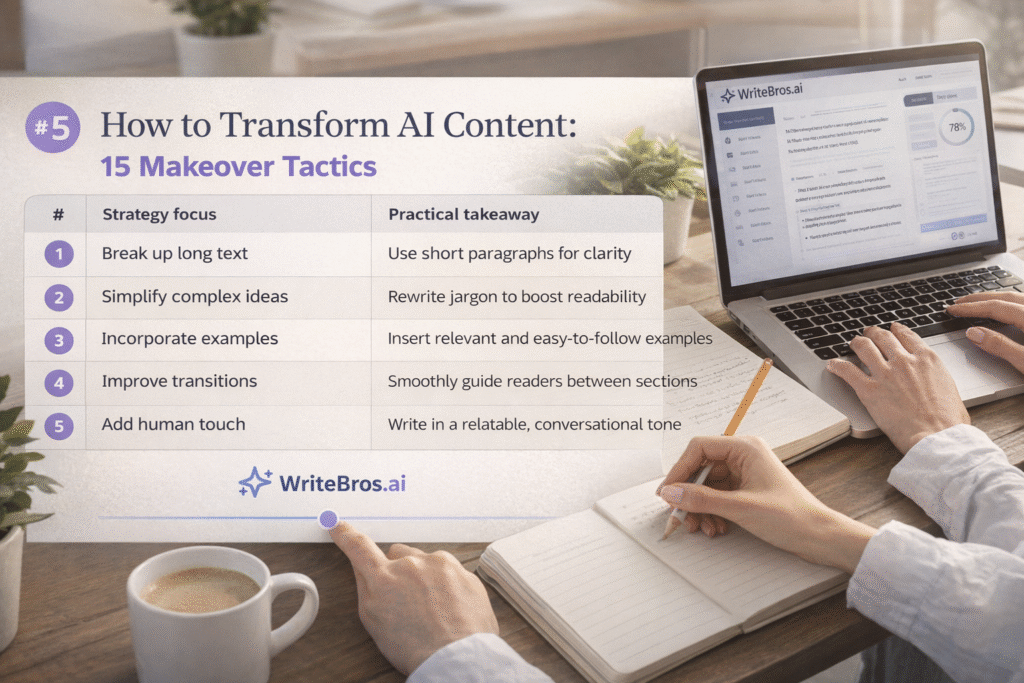
| # | Strategy focus | Practical takeaway |
|---|---|---|
| 1 | Break uniform sentence rhythm | Vary sentence length and pacing so the writing feels more like natural student reasoning instead of a polished machine draft. |
| 2 | Add imperfect transitions | Use more natural connectors that reflect how students actually move between ideas instead of perfectly balanced transitions. |
| 3 | Insert small clarifications | Include brief explanations or side notes that show the writer thinking through a point instead of presenting a finished answer. |
| 4 | Rebuild paragraph openings | Rewrite the first line of paragraphs so they introduce ideas more casually instead of sounding like formal textbook summaries. |
| 5 | Replace generic phrasing | Swap predictable wording with more specific language that reflects the topic and context of the assignment. |
| 6 | Show reasoning steps | Expand parts of the argument to reveal the thinking process instead of presenting conclusions too quickly. |
| 7 | Introduce natural repetition | Allow small overlaps in wording or ideas so the text mirrors how students reinforce points while writing. |
| 8 | Adjust overly formal tone | Slightly soften academic language so the voice reads like a thoughtful student rather than a formal research report. |
| 9 | Expand concrete examples | Add brief real-world or class-related examples that make the argument feel grounded and personal. |
| 10 | Break symmetrical structure | Avoid perfectly mirrored paragraphs or arguments so the essay develops in a more natural rhythm. |
| 11 | Revise predictable conclusions | Rewrite closing lines so they reflect reflection or interpretation rather than a formulaic summary. |
| 12 | Blend explanation with analysis | Mix descriptive sentences with interpretation to mirror how students gradually build understanding. |
| 13 | Insert brief context signals | Reference course themes, readings, or assignment framing to make the text feel connected to real coursework. |
| 14 | Reduce repetitive phrasing patterns | Identify repeated sentence structures and rewrite them so the writing feels less algorithmic. |
| 15 | Refine the overall flow | Read the draft aloud and revise sections that feel too smooth or perfectly balanced for typical student writing. |
15 Academic Techniques to Humanize AI Content for University Work
How to Humanize AI Content for University Work – Strategy #1: Break sentence rhythm
AI writing tends to produce sentences that follow a steady and predictable rhythm, which quickly makes a paragraph feel polished in a way that does not match how most university assignments are actually written by students. When revising a draft, deliberately mix shorter reflections with longer explanatory sentences so the text begins to resemble a student thinking through a topic rather than presenting a perfectly balanced explanation from the start.
This works because natural writing usually develops unevenly as ideas expand, pause, and continue in ways that reflect a person working through a concept step by step. Imagine a paragraph discussing climate policy where one sentence explores a theory in detail and the next briefly questions its limitations, since that kind of pacing mirrors how real academic reasoning tends to unfold across assignments.
How to Humanize AI Content for University Work – Strategy #2: Add imperfect transitions
Many AI generated drafts rely on transitions that sound smooth and perfectly organized, which can create a tone that feels more like a textbook than a student essay written during a semester course. Rewriting these connections so they sound slightly more conversational or reflective helps introduce a more believable flow between ideas that resembles how students naturally move from one argument to the next.
Instead of using highly formal phrases that make every section appear carefully engineered, consider transitions that acknowledge the thinking process behind the writing. A sentence might gently redirect the discussion by noting that a previous point raises a new question or invites further interpretation, which introduces the small imperfections that often appear in real academic writing.
How to Humanize AI Content for University Work – Strategy #3: Insert clarifying thoughts
AI drafts often move directly from claim to explanation without pausing to clarify how a student reached that idea, which can make the writing feel distant from the learning process. Adding short clarifying thoughts that unpack a concept or explain why a certain example matters helps the text feel grounded in actual academic reasoning.
This kind of clarification often appears when students briefly restate a concept in simpler terms before continuing their argument. A discussion of economic inequality might pause to explain why a statistic matters within the context of a course reading, which quietly introduces the sense that the writer is thinking through the material instead of presenting a finished conclusion.
How to Humanize AI Content for University Work – Strategy #4: Rework paragraph openings
Paragraph openings generated through AI frequently sound like structured summaries that announce exactly what the paragraph will prove, which can feel overly formal for many university assignments. Revising these openings so they introduce the idea more gradually creates a tone that reflects genuine student analysis rather than polished report writing.
A more natural opening might start with a reflection or observation connected to the topic before transitioning into the argument that the paragraph develops. This subtle change shifts the writing away from rigid structure and toward a tone that resembles a student gradually unpacking an idea across the course of the paragraph.
How to Humanize AI Content for University Work – Strategy #5: Replace generic wording
AI models frequently rely on safe and generic phrases that appear in thousands of essays across the internet, which quickly signals that a passage has not been deeply revised. Carefully replacing those phrases with wording that reflects the exact topic, class discussion, or research angle makes the writing feel far more specific and authentic.
When a sentence mentions a broad concept such as technological progress, expanding the phrase to describe the exact technology or context discussed in the course immediately changes the tone of the writing. Readers begin to sense that the author understands the material and is working through it thoughtfully rather than repeating generalized academic language.
How to Humanize AI Content for University Work – Strategy #6: Show reasoning steps
One of the most noticeable patterns in AI writing is how quickly it moves from explanation to conclusion without revealing the reasoning that connects those ideas. Humanizing a draft often means expanding the middle of the argument so readers can see how the writer arrived at the final claim.
This expansion introduces the gradual thinking process that appears in many university essays, where students compare ideas, reconsider evidence, and refine their interpretation as the paragraph develops. A discussion might explore several interpretations of a theory before settling on one explanation, which naturally makes the writing feel less mechanical.
How to Humanize AI Content for University Work – Strategy #7: Allow natural repetition
Perfectly optimized writing rarely repeats words or concepts, yet real academic writing often revisits key ideas as a student builds an argument. Allowing a small amount of repetition, especially when emphasizing a central concept, helps the writing resemble the natural rhythm of a developing essay.
For example, a paragraph discussing social media influence may briefly repeat the main idea while examining different perspectives from course readings. This repetition creates continuity while also showing that the writer is circling around the concept in order to understand it more fully.
How to Humanize AI Content for University Work – Strategy #8: Adjust formal tone
AI generated drafts frequently sound extremely formal, which can make an essay feel distant from the tone that many university instructors expect from student work. Slightly softening the language while maintaining academic clarity helps produce a voice that feels reflective rather than overly polished.
Instead of presenting every point with authoritative certainty, the writing might acknowledge interpretation or uncertainty while still developing a clear argument. This subtle shift often mirrors how students present ideas during coursework, especially when they are still exploring complex topics.
How to Humanize AI Content for University Work – Strategy #9: Expand examples
AI often provides brief examples that illustrate a concept but do not fully explore why the example matters within the discussion. Expanding those moments with additional explanation helps the writing feel more thoughtful and grounded in real academic reasoning.
Consider a paragraph discussing digital marketing ethics that briefly mentions data privacy concerns and then expands on how a specific case changed public trust. That extra context gives the impression that the writer is engaging with the topic in a meaningful way instead of simply listing supporting evidence.
How to Humanize AI Content for University Work – Strategy #10: Break perfect structure
AI writing frequently produces paragraphs that mirror one another in length and structure, which can make an essay feel artificially balanced. Revising the draft so paragraphs develop ideas at slightly different speeds introduces a more natural academic rhythm.
A paragraph exploring historical context might become longer and more detailed than the following paragraph that interprets the significance of those events. This uneven development reflects how real essays often evolve as certain ideas require more explanation than others.
How to Humanize AI Content for University Work – Strategy #11: Rewrite conclusions
AI conclusions often summarize earlier points in a neat and predictable way that resembles the closing section of a formal report. Humanizing the ending of an essay usually requires shifting the focus from repetition toward reflection or interpretation.
A more natural conclusion might consider the broader implications of the argument or raise a question that encourages further thought about the topic. This reflective tone aligns more closely with how students typically conclude analytical essays in university settings.
How to Humanize AI Content for University Work – Strategy #12: Blend analysis and explanation
AI writing tends to separate explanation and analysis into clearly defined segments, which can create a rigid structure that feels less natural for academic essays. Integrating explanation with interpretation allows ideas to develop more fluidly within each paragraph.
A paragraph discussing a literary theme might describe a scene and immediately interpret its meaning within the context of the course discussion. This combination mirrors the way students often move between description and analysis while developing an argument.
How to Humanize AI Content for University Work – Strategy #13: Add course context
Essays that feel authentic often reference the context of the class itself, including readings, lectures, or discussions that shaped the writer’s understanding of the topic. Integrating subtle references to these elements helps anchor the essay within the academic environment.
A student writing about political theory might briefly mention how a particular reading influenced their interpretation of a concept, which signals engagement with the course material. These references add credibility while making the essay feel less generic.
How to Humanize AI Content for University Work – Strategy #14: Reduce structural patterns
AI generated drafts often repeat similar sentence structures throughout a paragraph, which can make the writing feel algorithmic even when the ideas themselves are strong. Revising these patterns so sentences vary in construction helps restore a more natural rhythm.
One sentence might begin with a contextual observation while another starts with the central idea of the argument, and a third might expand on the implications of that claim. This variation reflects how human writers naturally shift sentence structure as they explore a topic.
How to Humanize AI Content for University Work – Strategy #15: Review the overall flow
After revising individual paragraphs, it becomes important to step back and examine how the entire essay moves from introduction to conclusion. Reading the draft slowly or aloud helps reveal sections that feel too smooth or mechanically structured.
When those sections appear, rewriting them with slightly more reflective language or additional explanation can restore a natural flow. The final result should resemble a thoughtful academic essay that develops ideas gradually rather than a perfectly optimized AI draft.
Common mistakes
- Students often assume that running AI text through a single rewriting tool will immediately make the content sound human, which rarely produces convincing academic writing. These tools typically change vocabulary while leaving the deeper structure of the paragraph intact, meaning instructors can still recognize the uniform reasoning patterns that signal automated drafting.
- A frequent mistake involves replacing individual words rather than revising the logic and pacing of the argument itself. When only vocabulary changes while sentence rhythm, transitions, and paragraph structure remain identical to the AI draft, the text continues to read like a machine generated response rather than authentic student work.
- Many students also overlook the importance of adding their own interpretation or reasoning into the essay. AI generated drafts often present balanced explanations without showing how a student arrived at a particular conclusion, which can make the writing appear detached from the learning process expected in university assignments.
- Another common problem occurs when writers attempt to overcorrect the AI tone by forcing overly casual language into an academic essay. While the goal is to soften mechanical phrasing, pushing the tone too far toward conversational writing can make the assignment appear informal and weaken the credibility of the argument.
- Some students rely too heavily on perfectly structured paragraphs that mirror one another in length and style, because that structure often appears in AI generated drafts. Instructors sometimes recognize these patterns quickly, since human writing rarely maintains such consistent symmetry across multiple sections of an essay.
- A final mistake appears when writers skip the step of reviewing the entire draft after editing individual sentences. Even if small sections sound more natural, the essay may still reveal mechanical patterns in its broader structure, which is why reviewing flow and argument development remains essential.
Edge cases
Some academic disciplines expect writing that remains highly structured and formal, which can make the process of humanizing AI assisted drafts more delicate. In fields such as law, philosophy, or advanced scientific reporting, instructors may prefer clear logical sequencing and precise terminology, meaning revisions should focus on reasoning clarity rather than dramatically altering the tone of the writing.
There are also situations in which AI generated drafts are used only for outlining ideas rather than producing full paragraphs. In those cases, the humanizing process happens naturally during the writing stage itself, since the student expands each outline point into original sentences while integrating course readings, examples, and interpretation.
Supporting tools
- Grammar and editing platforms help students identify repetitive sentence patterns and mechanical phrasing that often appear in AI drafts. Reviewing these suggestions can highlight areas where the text needs more variation in tone, rhythm, and explanation.
- Academic citation managers make it easier to integrate references and course readings into essays, which helps anchor the writing in real academic material. Adding these references naturally increases the authenticity of the argument.
- Outline planning tools allow students to reorganize AI generated ideas before rewriting them into full paragraphs. This extra step ensures the final essay reflects the student’s reasoning rather than the exact structure of the initial draft.
- Plagiarism and originality checkers help verify that the rewritten text does not closely mirror common AI outputs or widely used online phrasing. Reviewing those reports can guide further revisions before submitting an assignment.
- Read aloud or text to speech tools help reveal sections of an essay that sound mechanical or overly symmetrical. Hearing the text spoken often exposes unnatural phrasing that might not be obvious during silent reading.
- WriteBros.ai can help adapt AI generated drafts so they better match a student’s tone and writing style before the final revision process. The platform focuses on adjusting structure, rhythm, and phrasing so the content reads more naturally while still allowing students to review and refine the work themselves.
Ready to Transform Your AI Content?
Try WriteBros.ai and make your AI-generated content truly human.
Conclusion
Humanizing AI assisted academic writing is less about disguising technology and more about restoring the natural reasoning patterns that appear in genuine student work. Essays become more convincing when they show gradual thinking, imperfect transitions, and detailed explanations that reveal how the writer developed their ideas.
The goal is not perfection but authenticity, because university writing often reflects a process of exploration rather than a finished product delivered in flawless form. When students revise drafts with intention and attention to their own voice, the final result feels far more believable and aligned with academic expectations.
Did You Know?
Students learning how to humanize AI content for university work often begin with word swaps, synonym changes, and quick sentence rewrites, yet those edits rarely change the deeper feel of the draft. When the argument still unfolds in the same tidy rhythm and the paragraphs still sound equally balanced from start to finish, the writing can continue to feel algorithmic even after heavy revision.
The bigger improvement usually comes from adjusting how the ideas develop across the page, because authentic student writing rarely moves with perfect symmetry. Adding a brief clarification, stretching one explanation where the reasoning needs more room, and allowing the conclusion to sound more reflective than formulaic can make the final draft feel far closer to genuine university work.
Ready to Transform Your AI Content?