How to Humanize AI Email Campaigns: 15 Audience-Centered Edits

In 2026, AI emails that feel human consistently outperform generic campaigns, as shown in a study on personalization and engagement in the Journal of Marketing Research, proving tone and context directly impact open and response rates.
How to Humanize AI Email Campaigns: 15 Audience-Centered Edits
Your AI email campaigns might look polished, but they still feel off to readers. That disconnect is exactly what shows up in signs marketing teams know AI content isnt working.
The issue is not that AI writes poorly, it is that it writes without context, emotion, or timing that matches real inbox behavior. Even with the best ai humanizer tools, the output still needs thoughtful edits to feel personal.
Most teams overlook how readers skim, hesitate, and react to tone in email, which leads to messages that feel generic or slightly distant. With growing reliance on AI shown in teacher use of ai writing tools statistics, refining these emails becomes even more important.
| # | Strategy focus | Practical takeaway |
|---|---|---|
| 1 | Natural subject lines | Write subject lines that sound like a person, not a campaign, to improve open rates. |
| 2 | Conversational openings | Start emails in a way that feels like a real message rather than a scripted introduction. |
| 3 | Audience-aware tone | Adjust wording based on who is reading instead of relying on default AI phrasing. |
| 4 | Specific language choices | Replace vague phrases with clear, concrete wording that feels grounded and real. |
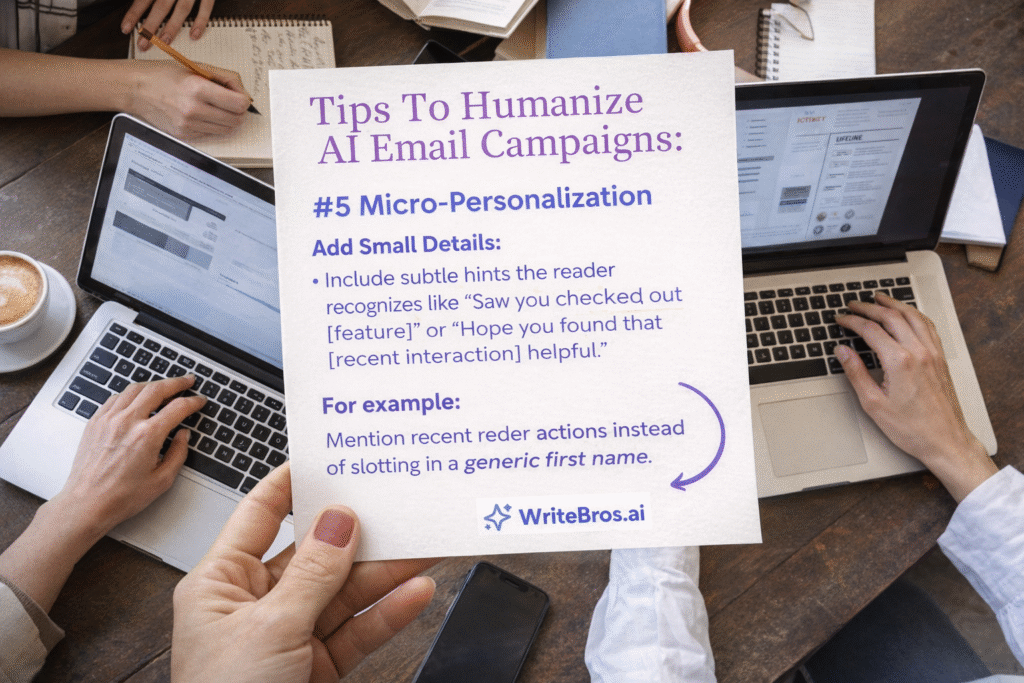
| 5 | Micro-personalization | Include small, relevant details that reflect reader behavior or context. |
| 6 | Sentence rhythm variation | Break predictable patterns to make the message feel more natural to read. |
| 7 | Softened transitions | Connect ideas smoothly so the email flows like a conversation. |
| 8 | Clear intent framing | Make it obvious why the email exists without sounding pushy or scripted. |
| 9 | Relatable examples | Use simple scenarios readers can recognize to make content feel familiar. |
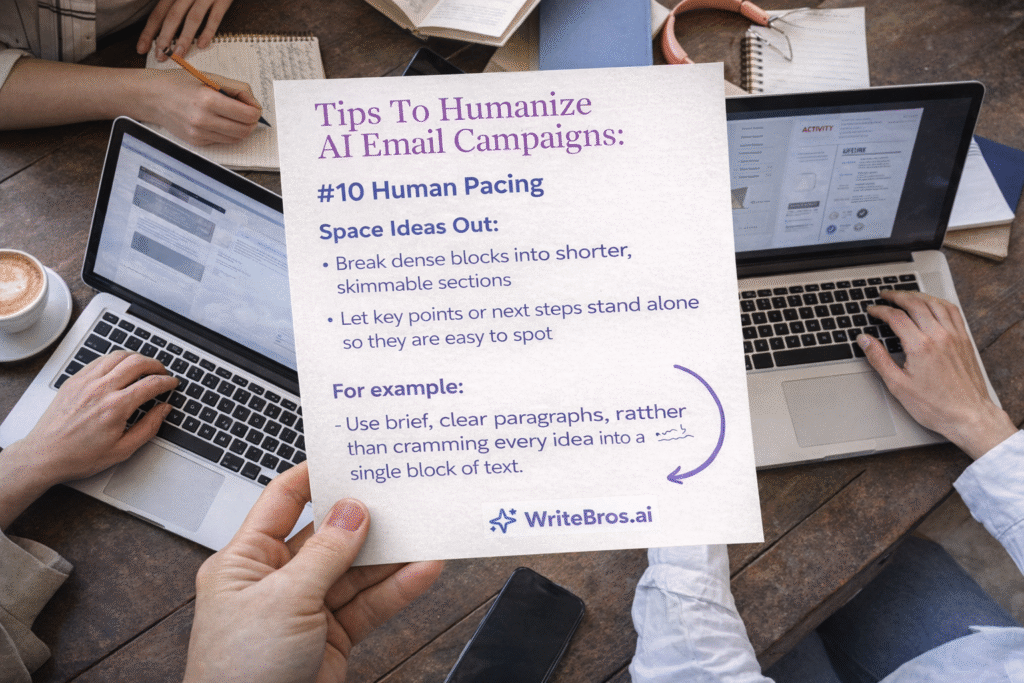
| 10 | Human pacing | Space ideas in a way that matches how people skim emails quickly. |
| 11 | Subtle emotional cues | Add light emotion without exaggeration to make the message feel sincere. |
| 12 | Authentic calls to action | Phrase next steps in a natural way instead of using heavy sales language. |
| 13 | Reduced filler language | Cut unnecessary words that make the email feel robotic or repetitive. |
| 14 | Contextual timing cues | Reference timing or relevance so the email feels current and intentional. |
| 15 | Final human review | Always refine AI output with a quick human pass before sending. |
15 Audience-Centered Edits to How to Humanize AI Email Campaigns
How to Humanize AI Email Campaigns – Strategy #1: Natural subject lines
Writing subject lines that feel natural begins with removing anything that sounds like a promotion template and instead focusing on how a real person would summarize a message in a quick, casual way. This means choosing phrasing that mirrors everyday communication, such as something you would actually send to a colleague or friend, rather than relying on exaggerated hooks or overly structured formats that feel engineered. When you apply this approach, the subject line becomes less about grabbing attention through tactics and more about earning attention through familiarity and clarity.
This works because inboxes are crowded with messages that already follow predictable patterns, so anything that feels slightly more human tends to stand out without trying too hard. For example, a subject like “Quick note on your last signup” feels more grounded than something that pushes urgency or hype without context. The main constraint is avoiding the temptation to over-correct into vagueness, since clarity still matters and the subject line must give enough reason for the reader to open the email.
How to Humanize AI Email Campaigns – Strategy #2: Conversational openings
Starting emails with conversational openings requires stepping away from formal greetings that feel copied across campaigns and instead writing as though you are continuing an existing exchange. This often means acknowledging a recent action, a shared context, or even a simple observation that aligns with the reader’s likely situation, which immediately lowers resistance. When done well, the opening line feels less like the start of a broadcast and more like the beginning of a one-on-one message.
This approach works because readers subconsciously assess tone within the first few seconds, and anything that feels scripted creates distance before the message even unfolds. For instance, replacing “We are excited to announce” with something like “You might have noticed” changes the entire emotional entry point of the email. The key limitation is ensuring that the conversational tone still aligns with the brand voice, so it does not feel inconsistent or forced across different campaigns.
How to Humanize AI Email Campaigns – Strategy #3: Audience-aware tone
Adjusting tone based on the audience means thinking beyond generic segmentation and focusing on how different groups interpret language, pacing, and intent. A message sent to a long-time customer should naturally sound more familiar and relaxed than one sent to a new subscriber, even if the content is similar. This requires reviewing AI output and refining it to match the expected relationship between sender and reader.
This works because tone acts as a signal of awareness, and readers can quickly tell whether a message understands their position or treats them as part of a broad group. For example, a returning user might respond better to a message that references previous interactions rather than repeating introductory explanations. The challenge lies in maintaining consistency across segments without creating disjointed messaging that feels fragmented across the broader campaign.
How to Humanize AI Email Campaigns – Strategy #4: Specific language choices
Replacing vague wording with specific language requires actively identifying phrases that could apply to any audience and refining them into something more concrete and situational. This often means adding detail that reflects real use cases, outcomes, or scenarios that readers can immediately picture without needing to interpret generic statements. When executed properly, the email becomes easier to follow and more believable.
This works because specificity reduces cognitive effort and increases trust, as readers can connect the message to something tangible rather than abstract promises. For example, saying “improve your workflow in two steps” feels more grounded than a broad claim that lacks context. The limitation is avoiding excessive detail that slows down reading, since emails still need to remain concise enough for quick scanning.
How to Humanize AI Email Campaigns – Strategy #5: Micro-personalization
Micro-personalization focuses on subtle details that reflect user behavior or context without relying on obvious placeholders like names or locations. This could include referencing a recent action, timing, or content interaction that signals the message was shaped with the reader in mind. The goal is to make the email feel considered rather than automatically generated.
This approach works because small signals of relevance often matter more than large but generic personalization efforts that feel mechanical. For example, mentioning a recently viewed feature creates a stronger connection than simply inserting a first name into a template. The challenge is ensuring that these details remain accurate and do not feel intrusive, which requires careful data use and thoughtful phrasing.
How to Humanize AI Email Campaigns – Strategy #6: Sentence rhythm variation
Varying sentence rhythm involves breaking away from uniform structures that AI tends to produce, where sentences often follow similar lengths and patterns. Introducing a mix of longer, more detailed sentences alongside shorter clarifications creates a flow that feels more natural and less mechanical. This variation helps maintain reader attention and prevents the email from sounding repetitive.
This works because natural writing reflects how people actually think and communicate, which includes pauses, emphasis, and shifts in pacing. For example, alternating between explanation and quick clarification mirrors spoken conversation more closely than a steady, predictable structure. The main consideration is ensuring that variation does not lead to confusion, as clarity should remain consistent throughout the message.
How to Humanize AI Email Campaigns – Strategy #7: Softened transitions
Softening transitions means connecting ideas in a way that feels fluid rather than abrupt, avoiding rigid phrases that signal formulaic writing. This involves using natural connectors that guide the reader from one point to another without drawing attention to the structure itself. When done effectively, the email reads as a continuous thought rather than a series of segmented ideas.
This works because readers prefer content that flows smoothly, especially in email where attention is limited and interruptions are frequent. For example, replacing formal transition phrases with subtle connectors creates a more seamless reading experience. The challenge is maintaining clarity while softening structure, ensuring that the message remains easy to follow without becoming overly loose.
How to Humanize AI Email Campaigns – Strategy #8: Clear intent framing
Framing the intent of an email clearly involves stating why the message exists in a way that feels straightforward and respectful of the reader’s time. This does not mean being overly direct or transactional, but rather ensuring that the purpose is evident early on. When the intent is clear, readers can quickly decide how to engage with the content.
This works because ambiguity often leads to disengagement, as readers may not immediately understand the value of continuing. For example, an email that clearly outlines its purpose within the first few lines tends to retain attention more effectively. The limitation is avoiding overly blunt phrasing that removes nuance, as the message should still feel thoughtful and considerate.
How to Humanize AI Email Campaigns – Strategy #9: Relatable examples
Using relatable examples involves grounding abstract ideas in everyday scenarios that readers can recognize without effort. This requires thinking about common situations the audience experiences and weaving them into the message in a natural way. When done correctly, examples act as anchors that make the content more accessible.
This works because familiarity reduces friction, allowing readers to connect with the message without needing to interpret unfamiliar concepts. For instance, referencing a common workflow challenge makes the content feel immediately relevant. The challenge is ensuring that examples remain simple and do not distract from the main point of the email.
How to Humanize AI Email Campaigns – Strategy #10: Human pacing
Human pacing focuses on structuring content in a way that aligns with how people naturally skim emails, rather than presenting dense blocks of text. This includes spacing ideas, using shorter paragraphs, and allowing for natural pauses within the message. The result is an email that feels easier to navigate and less overwhelming.
This works because readers rarely engage with emails in a linear, uninterrupted way, often scanning for key points before committing to a full read. For example, breaking content into manageable sections increases the likelihood that important details are noticed. The key limitation is balancing brevity with completeness, ensuring that essential information is still communicated effectively.
How to Humanize AI Email Campaigns – Strategy #11: Subtle emotional cues
Adding subtle emotional cues involves introducing small touches of feeling that align with the message without becoming exaggerated or overly expressive. This can include acknowledging challenges, expressing appreciation, or highlighting shared experiences in a restrained way. When used thoughtfully, these cues make the email feel more sincere.
This works because emotion helps establish connection, even in professional communication, without requiring dramatic language or strong persuasion tactics. For example, a simple acknowledgment of effort can make the message feel more personal. The challenge is maintaining balance, ensuring that emotional cues remain appropriate for the context and audience.
How to Humanize AI Email Campaigns – Strategy #12: Authentic calls to action
Crafting authentic calls to action requires moving away from generic prompts and instead framing next steps in a way that feels natural within the flow of the message. This often means aligning the call to action with the reader’s perspective rather than focusing solely on conversion goals. When done well, the transition to action feels logical and unobtrusive.
This works because readers are more likely to engage when the request feels aligned with their interests and context. For example, suggesting a next step that builds on what has already been discussed creates continuity. The limitation is ensuring that the call to action remains clear and actionable, even while maintaining a softer tone.
How to Humanize AI Email Campaigns – Strategy #13: Reduced filler language
Reducing filler language involves identifying phrases that add little value and removing them to create a cleaner, more direct message. AI often introduces repetitive or generic wording that can dilute the overall impact of the email. Editing these elements out results in content that feels sharper and more intentional.
This works because readers tend to disengage when messages feel padded or unnecessarily long, especially in email formats. For example, trimming redundant phrases allows the main idea to stand out more clearly. The challenge is ensuring that necessary context is preserved, so the message does not become too abrupt or incomplete.
How to Humanize AI Email Campaigns – Strategy #14: Contextual timing cues
Including contextual timing cues means referencing when or why the email is relevant at a specific moment, helping readers understand its immediacy. This can involve tying the message to recent actions, events, or time-sensitive situations. When done properly, the email feels timely and purposeful.
This works because relevance increases engagement, especially when readers can immediately see why the message matters now. For example, referencing a recent interaction creates a sense of continuity. The limitation is ensuring accuracy, as incorrect timing cues can reduce trust and credibility.
How to Humanize AI Email Campaigns – Strategy #15: Final human review
Conducting a final human review involves stepping back and reading the email as a recipient rather than as the creator. This means checking for tone, clarity, and overall flow, while identifying anything that feels slightly off or overly structured. Even small adjustments at this stage can significantly improve the final output.
This works because human intuition can catch nuances that automated systems may overlook, especially in tone and phrasing. For example, a quick read-through often reveals subtle inconsistencies that can be corrected with minimal effort. The main constraint is ensuring that this step is not skipped, as it is essential for refining AI-generated content.
Common mistakes
- Relying entirely on AI-generated text without reviewing tone or context often leads to emails that feel slightly detached, because the content may be technically correct but lacks the subtle adjustments needed to match real reader expectations.
- Overusing personalization tokens such as names or locations can make emails feel mechanical rather than thoughtful, especially when the surrounding content remains generic and does not reflect meaningful context.
- Writing overly long emails without considering how readers skim content can reduce engagement, since dense formatting makes it harder to quickly identify the main point or value of the message.
- Using overly formal language in casual email contexts creates distance between the sender and reader, which can reduce trust and make the message feel less approachable.
- Ignoring audience segmentation results in messages that fail to align with different reader expectations, leading to content that feels too broad and less relevant to individual recipients.
- Skipping the final review stage increases the likelihood of sending emails that contain subtle inconsistencies, awkward phrasing, or tonal mismatches that could have been easily corrected.
Edge cases
There are situations where highly structured or formal language is necessary, such as compliance-related communications or official updates that require precision and consistency. In these cases, humanization should be applied carefully, ensuring that clarity and accuracy are not compromised in favor of conversational tone.
Additionally, certain audiences may prefer more direct communication styles, especially in technical or time-sensitive contexts where efficiency is prioritized. Understanding these nuances helps ensure that humanization enhances the message without conflicting with audience expectations.
Supporting tools
- Email testing platforms help evaluate how messages appear across different devices and clients, ensuring that formatting, spacing, and readability remain consistent before sending campaigns to a broader audience.
- Analytics dashboards provide insights into open rates, click patterns, and engagement behavior, allowing teams to refine messaging based on real performance data rather than assumptions.
- Customer data platforms enable better segmentation and contextual messaging by organizing user behavior and interaction history into actionable insights for more tailored email content.
- Content editing tools assist in refining tone, grammar, and clarity, helping teams polish AI-generated drafts into more natural and reader-friendly emails before distribution.
- A/B testing tools allow teams to experiment with variations in subject lines, tone, and structure, identifying which approaches resonate most effectively with different audience segments.
- WriteBros.ai helps refine AI-generated email content into more natural, audience-aware messaging, making it easier to adjust tone, clarity, and flow without losing the original intent of the campaign.
Ready to Transform Your AI Content?
Try WriteBros.ai and make your AI-generated content truly human.
Conclusion
Humanizing AI email campaigns is about aligning content with how people actually read, interpret, and respond to messages in real inbox environments. Small adjustments in tone, structure, and clarity can transform generic outputs into communication that feels intentional and relevant.
Focusing on thoughtful edits rather than perfection helps create emails that feel more natural and engaging over time. Consistent practice and awareness of audience expectations will lead to stronger connections and better overall results.
Did You Know?
AI email campaigns often feel polished because they rely on predictable structure and safe wording. Even so, they can miss the natural tone and reader context that make inbox messages feel personal.
Adjusting subject lines, openings, and calls to action can improve clarity faster than most teams expect. These small edits help emails feel more human, timely, and easier to trust.
Ready to Transform Your AI Content?