How to Humanize AI Product Descriptions at Scale: 15 Ecommerce Editing Methods
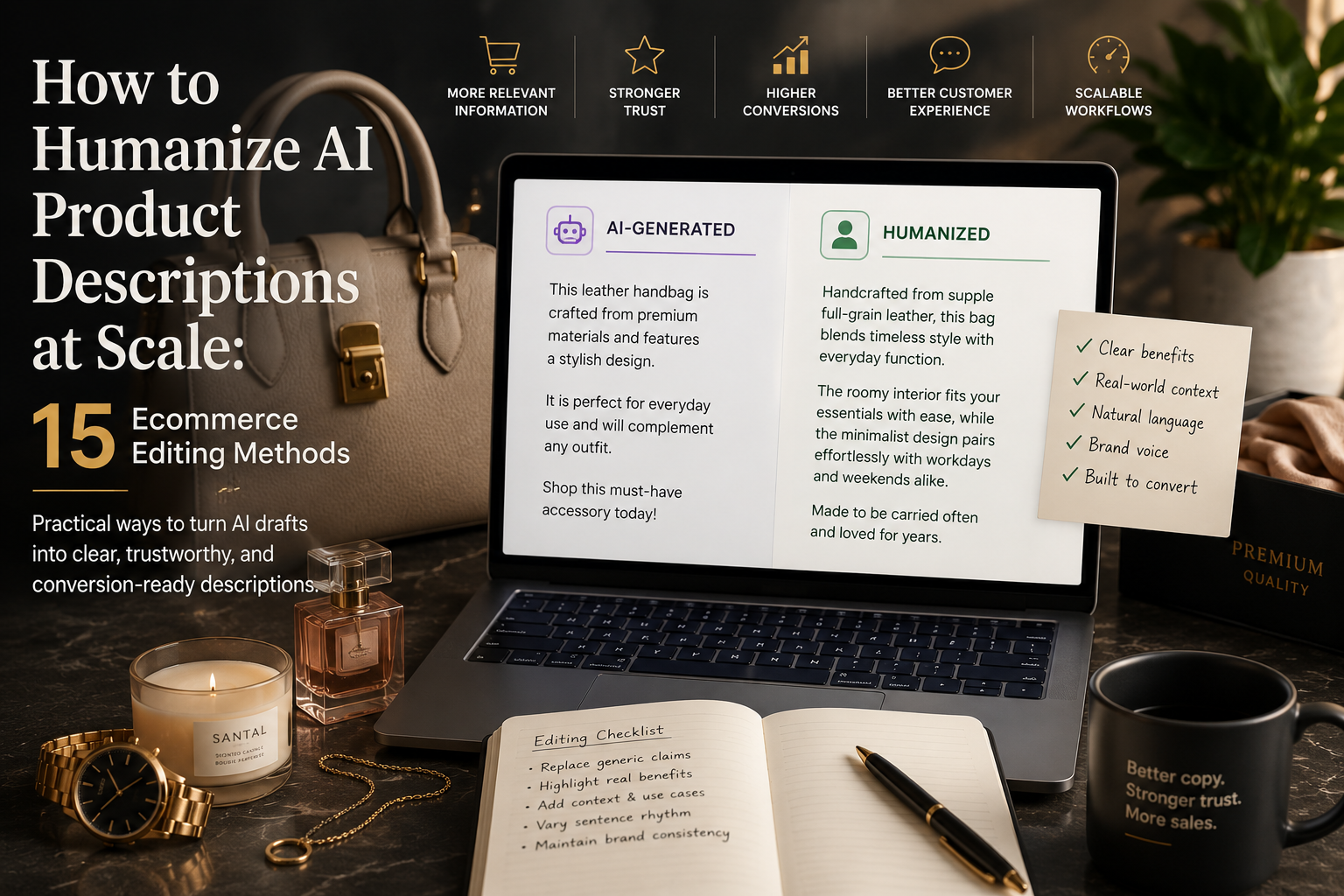
2026 ecommerce teams are discovering that scalable AI editing succeeds when every description sounds credible, useful, and brand-consistent. Learn 15 practical methods to humanize product copy, supported by findings from research published in the Journal of Retailing showing that narrative-based product descriptions can improve purchase intentions.
How to Humanize AI Product Descriptions at Scale: 15 Ecommerce Editing Methods
Publishing large volumes of AI-generated product descriptions can save time, but the results often feel repetitive, generic, or disconnected from what shoppers actually want to know. Learning how to rewrite AI product descriptions for conversions is often the first step toward making catalog copy feel more persuasive without starting from scratch.
Many ecommerce teams rely on the same prompts and workflows across hundreds or thousands of products, which gradually creates content that blends together instead of helping each listing stand out. Consistent review processes supported by leading AI editors for AI draft cleanup make it easier to catch repetitive phrasing while preserving efficiency.
Scaling authentic product copy is less about replacing AI and more about building editing habits that introduce clarity, specificity, and a recognizable brand voice throughout your catalog. The methods below show how to humanize AI product descriptions at scale while maintaining production speed, drawing on lessons reflected in multi-brand AI content workflow trends that balance consistency with individuality.
| # | Strategy focus | Practical takeaway |
|---|---|---|
| 1 | Start with buyer intent | Match each listing to the questions and motivations shoppers actually have before refining the wording. |
| 2 | Replace generic claims | Swap vague marketing language for concrete details that make products feel more credible and useful. |
| 3 | Strengthen brand voice | Apply consistent editorial standards so every description sounds like it belongs to the same business. |
| 4 | Highlight real benefits | Focus on outcomes customers care about instead of repeating technical specifications alone. |
| 5 | Vary sentence rhythm | Introduce natural pacing to reduce repetitive patterns commonly found in automated drafts. |
| 6 | Add contextual details | Include realistic usage scenarios that help shoppers imagine the product in everyday life. |
| 7 | Remove unnecessary filler | Trim repetitive phrases so important information stands out more clearly. |
| 8 | Balance emotion and facts | Blend practical information with approachable language to improve trust and readability. |
| 9 | Improve scanability | Organize information so shoppers can quickly identify the value without reading every sentence. |
| 10 | Personalize by category | Adjust editing standards according to the product type instead of using one universal style. |
| 11 | Maintain catalog consistency | Keep terminology, formatting, and messaging aligned across thousands of listings. |
| 12 | Protect factual accuracy | Verify every claim before publication to avoid introducing persuasive but incorrect information. |
| 13 | Build scalable workflows | Create repeatable editing processes that preserve quality as publishing volume grows. |
| 14 | Use structured reviews | Apply standardized quality checks so multiple editors produce dependable results. |
| 15 | Refine continuously | Review performance data and update editorial practices as customer behavior and catalogs evolve. |
15 Ecommerce Editing Methods to Humanize AI Product Descriptions at Scale
How to Humanize AI Product Descriptions at Scale – Strategy #1: Start with buyer intent
Before editing a single sentence, identify the reason someone would search for, compare, and ultimately purchase the product because that underlying motivation should shape every description that follows rather than allowing the draft to revolve around features alone. When editors understand whether shoppers prioritize convenience, durability, comfort, style, or value, they can naturally emphasize information that answers real buying questions instead of simply polishing AI-generated wording.
This approach works consistently because people respond more positively when descriptions acknowledge their priorities instead of reading like generic catalog entries, which is especially important across large ecommerce inventories where repetitive language quickly becomes noticeable. For example, a travel backpack should speak to organization and long days of use rather than merely listing compartments, while editors should remain careful not to invent benefits that the product specifications cannot genuinely support.
How to Humanize AI Product Descriptions at Scale – Strategy #2: Replace generic claims
Many AI drafts rely on broad statements that sound impressive but communicate very little, so the editing process should replace those vague expressions with concrete observations that help shoppers understand what makes the product genuinely useful in everyday situations. Rather than repeating familiar promotional phrases, expand on measurable qualities, practical applications, and meaningful distinctions that create confidence without sounding exaggerated.
Descriptions become more believable because readers can connect specific details to real purchasing decisions instead of interpreting the copy as empty marketing language that could describe almost anything. A blanket advertised as exceptionally comfortable becomes much more persuasive when the editor explains how its fabric feels during extended use, while remaining careful to stay faithful to verified product information instead of making unsupported promises.
How to Humanize AI Product Descriptions at Scale – Strategy #3: Strengthen brand voice
Scaling content successfully requires every product description to sound like it belongs to the same company even when multiple editors, prompts, or AI systems contribute to production over time, which means voice guidelines should influence every revision. Consistent vocabulary, sentence flow, and personality help customers recognize the brand while preventing catalogs from feeling like disconnected collections of unrelated writing styles.
This consistency builds familiarity because shoppers often browse several products before purchasing, and a recognizable voice reinforces professionalism throughout the entire experience instead of making each page feel isolated. An outdoor retailer may consistently sound adventurous yet practical across every listing, although editors should avoid forcing identical phrasing into every description because consistency should never become monotony.
How to Humanize AI Product Descriptions at Scale – Strategy #4: Highlight real benefits
Features certainly matter, but customers usually care more about what those features enable in practical situations, so every editing pass should translate technical specifications into meaningful everyday outcomes that are easier to imagine and evaluate. This subtle shift encourages descriptions to feel conversational and customer-centered rather than resembling specification sheets copied directly from manufacturer documents.
People naturally picture themselves using products when benefits are clearly connected to ordinary routines, making purchase decisions easier because the value becomes tangible instead of abstract. A stainless-steel bottle becomes more compelling when its insulation is connected to keeping drinks cold during long commutes, provided the explanation remains accurate and does not stretch beyond documented capabilities.
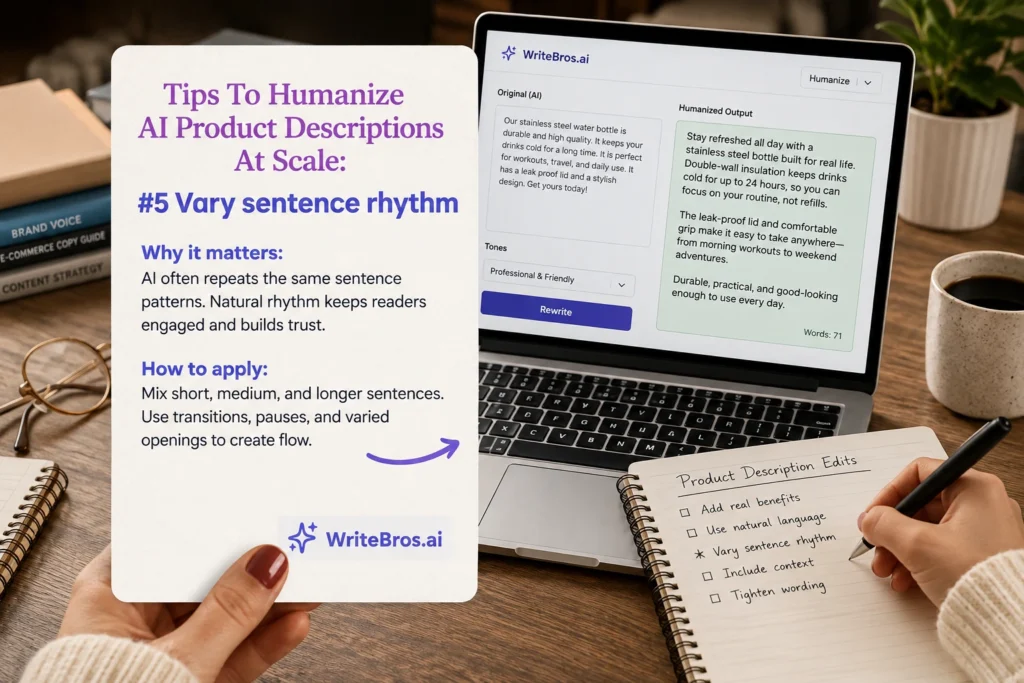
How to Humanize AI Product Descriptions at Scale – Strategy #5: Vary sentence rhythm
AI-generated descriptions frequently reveal predictable writing patterns through repeated sentence lengths and nearly identical structures, so editors should intentionally introduce variation that creates a smoother and more natural reading experience from beginning to end. Mixing descriptive explanations with shorter transitions and longer contextual observations helps the content resemble thoughtful human writing without sacrificing clarity.
Readers rarely notice intentional rhythm when it is done well, yet they quickly recognize repetitive construction because every paragraph begins to feel mechanically assembled despite containing accurate information. An editor reviewing hundreds of listings can often improve readability simply by restructuring repetitive openings and transitions, while ensuring that stylistic variety never reduces comprehension or introduces unnecessary complexity.
How to Humanize AI Product Descriptions at Scale – Strategy #6: Add contextual details
Context transforms product descriptions from isolated collections of facts into helpful buying guidance because it demonstrates where, when, and how an item naturally fits into everyday life without becoming overly promotional. Editors should weave realistic situations into the copy so shoppers can visualize ownership while still keeping the emphasis on verified product characteristics rather than imagined marketing scenarios.
Someone shopping for kitchen storage, for example, benefits more from understanding how containers simplify meal preparation than from reading another generic statement about quality construction alone. The strongest examples remain believable because they reflect ordinary experiences, allowing the description to become informative instead of theatrical or overly dramatic.
How to Humanize AI Product Descriptions at Scale – Strategy #7: Remove unnecessary filler
Scaling AI content often introduces repeated modifiers, duplicate ideas, and unnecessary promotional wording that collectively make descriptions longer without making them more persuasive, which is why disciplined editing should focus on purposeful simplification. Every sentence should contribute something new so readers move naturally through the information without encountering the same message expressed several different ways.
Cleaner writing improves trust because shoppers can identify meaningful details more quickly instead of sorting through decorative language that delays important information about the product itself. Editors should trim redundancy carefully rather than aggressively shortening everything, since removing useful context can be just as harmful as leaving excessive filler behind.
How to Humanize AI Product Descriptions at Scale – Strategy #8: Balance emotion and facts
Excellent ecommerce writing combines factual accuracy with approachable language so descriptions remain informative while still feeling welcoming and relatable to prospective customers throughout the buying process. Editors should preserve specifications, dimensions, and verified claims while presenting them in a way that reflects genuine human communication rather than mechanical documentation.
This balance allows shoppers to feel informed without becoming overwhelmed by technical detail or discouraged by overly emotional messaging that lacks supporting evidence. A premium notebook can communicate craftsmanship and everyday satisfaction while still providing paper weight, binding style, and material information that buyers expect before purchasing.
How to Humanize AI Product Descriptions at Scale – Strategy #9: Improve scanability
Many visitors skim product pages before deciding whether to continue reading, which means editors should organize information logically so important details appear where readers naturally expect to find them rather than hiding them inside dense paragraphs. Better structure supports comprehension without requiring dramatic rewriting or major design changes across large catalogs.
Descriptions that flow from value to supporting details help shoppers evaluate products efficiently because each section builds naturally on the previous one instead of jumping unpredictably between unrelated topics. Editors should preserve smooth transitions while ensuring every paragraph contributes a distinct purpose within the overall narrative.
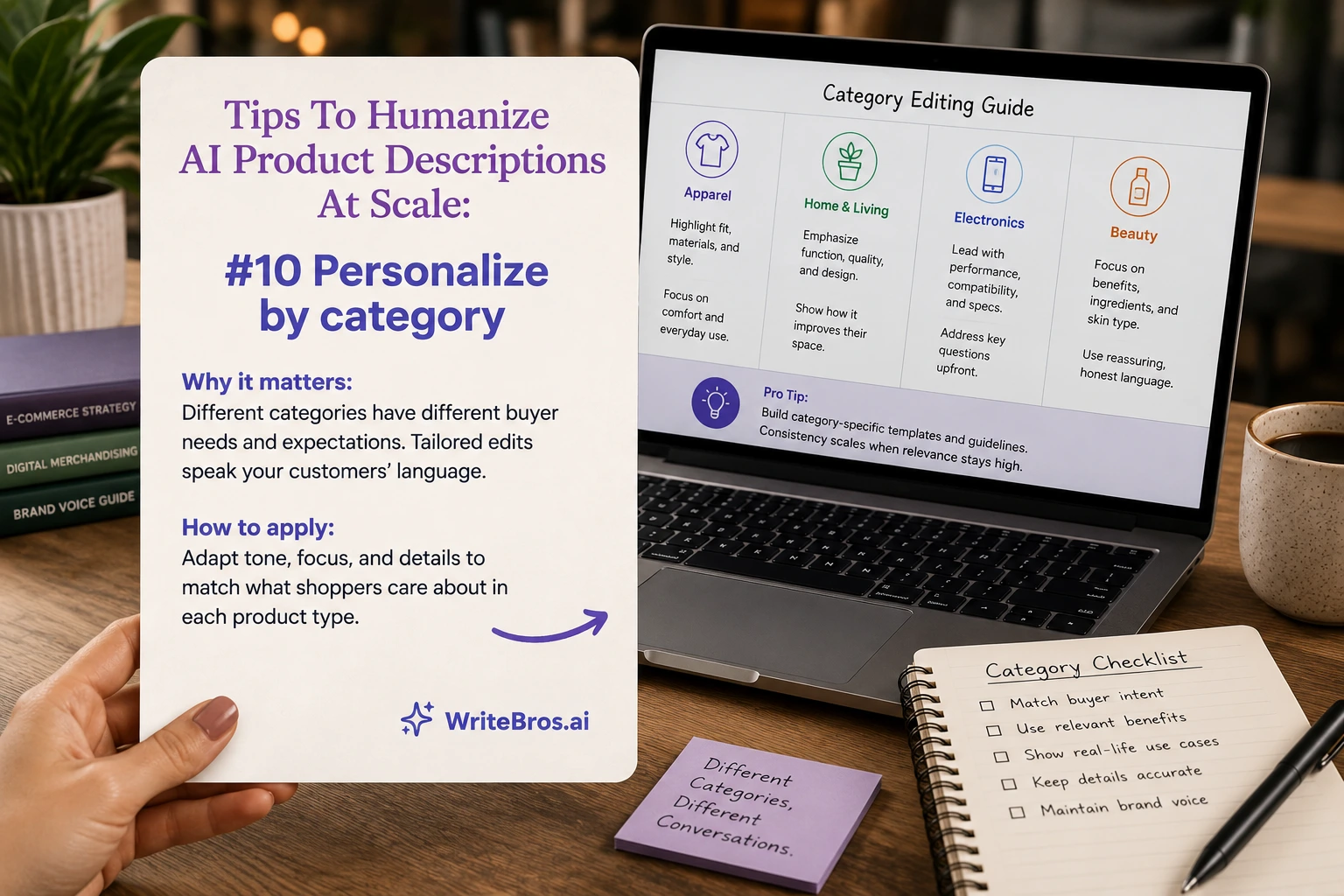
How to Humanize AI Product Descriptions at Scale – Strategy #10: Personalize by category
Different products deserve different editorial priorities because customers evaluate electronics, skincare, apparel, furniture, and household essentials through completely different expectations and purchasing criteria that should influence the writing. Applying one universal editing formula across every category often produces descriptions that technically read well yet fail to address category-specific concerns.
A moisturizer should emphasize ingredients, texture, and daily routines differently than a power drill emphasizes durability, control, and performance under demanding conditions, illustrating why contextual editing matters at scale. Editors should therefore build category playbooks that preserve efficiency while leaving enough flexibility for individual products to retain their own identity.
How to Humanize AI Product Descriptions at Scale – Strategy #11: Maintain catalog consistency
Large ecommerce operations often publish thousands of listings across multiple collections, making consistency just as important as creativity because customers should encounter familiar terminology, formatting, and presentation throughout the browsing experience. Editorial standards help prevent gradual drift that naturally occurs when many contributors participate in content production over extended periods.
Consistency creates confidence because shoppers interpret organized catalogs as signals of professionalism and attention to detail, even when they never consciously think about editorial quality. The objective is not identical wording but dependable presentation that makes every product feel like part of the same carefully managed storefront.
How to Humanize AI Product Descriptions at Scale – Strategy #12: Protect factual accuracy
No amount of engaging writing can compensate for inaccurate product information, which makes verification one of the most important responsibilities within any large-scale editing workflow regardless of how advanced the AI generation process becomes. Editors should compare every important claim against approved specifications before publication instead of assuming generated content is automatically correct.
Trust is difficult to earn and remarkably easy to lose because even small factual mistakes may create customer dissatisfaction, unnecessary returns, or avoidable support requests after purchase. Building verification directly into editorial workflows reduces those risks while preserving the credibility of every published description.
How to Humanize AI Product Descriptions at Scale – Strategy #13: Build scalable workflows
Successful teams rarely depend on individual editing talent alone because repeatable systems make quality sustainable as product catalogs expand and publishing demands continue increasing throughout the year. Templates, review checklists, editorial guidelines, and clearly defined approval stages allow different contributors to produce dependable results without sacrificing efficiency.
Scalable workflows also simplify onboarding because new editors can understand expectations quickly rather than relying on guesswork or inconsistent feedback from different reviewers across separate projects. The result is a process that grows alongside the business instead of becoming increasingly difficult to manage.
How to Humanize AI Product Descriptions at Scale – Strategy #14: Use structured reviews
Review sessions become considerably more effective when editors evaluate content against consistent criteria rather than making subjective decisions that vary according to individual preferences or temporary impressions during busy publishing cycles. A structured checklist encourages balanced attention to clarity, accuracy, tone, readability, and customer value before descriptions move into production.
This disciplined approach reduces overlooked issues because reviewers develop reliable habits instead of improvising with every new product they encounter throughout the catalog. Although structured reviews require initial planning, they usually save time later by preventing repeated corrections after publication.
How to Humanize AI Product Descriptions at Scale – Strategy #15: Refine continuously
Humanizing product descriptions should remain an ongoing editorial practice rather than a one-time cleanup project because customer expectations, search behavior, and product assortments naturally evolve over time. Teams should regularly revisit existing listings to identify patterns that deserve improvement instead of assuming previously published content will remain equally effective forever.
Performance insights gathered from customer behavior can reveal opportunities to clarify messaging, simplify explanations, or strengthen value communication across entire categories without rebuilding every description from the beginning. Continuous refinement encourages steady improvement while keeping large ecommerce catalogs aligned with changing customer needs and business priorities.
Common mistakes
- Editing only for grammar while leaving the underlying message untouched, because polished wording cannot compensate for descriptions that still fail to answer the practical questions shoppers ask before making purchasing decisions, ultimately resulting in content that feels smoother but remains unhelpful.
- Allowing every product to follow the exact same structure regardless of category, since excessive uniformity gradually makes listings blend together and weakens opportunities to emphasize the unique qualities that genuinely influence purchasing decisions.
- Adding emotional language without supporting facts, which often happens when editors focus heavily on persuasion, although unsupported enthusiasm can reduce credibility instead of strengthening trust with careful buyers.
- Removing too much detail in pursuit of brevity, because simplifying descriptions without preserving meaningful context frequently leaves shoppers with unanswered questions that encourage hesitation rather than confident purchasing.
- Publishing AI-generated copy without structured human review, since even accurate drafts may contain repetitive phrasing, awkward transitions, or inconsistent tone that slowly erode the overall quality of large catalogs.
- Changing brand voice from one listing to another, often because different editors make isolated decisions, creating an inconsistent browsing experience that weakens brand recognition across the wider product catalog.
Edge cases
Some products naturally require more technical language than others, particularly in regulated industries or categories where precise terminology directly affects customer understanding and compliance. In those situations, humanization should improve clarity and flow without removing necessary specificity or replacing established terminology with conversational alternatives that might reduce accuracy.
Luxury products, highly specialized equipment, and business-focused catalogs may also require a more restrained editorial style than lifestyle-oriented consumer goods because the expectations of those audiences differ considerably. The objective remains consistent across every category, namely helping readers understand products more naturally while respecting the information standards that those particular markets require.
Supporting tools
- A centralized editorial style guide keeps terminology, tone, formatting, and messaging aligned across thousands of listings, making it substantially easier for multiple editors to produce consistent work without relying entirely on memory.
- Product information management platforms help organize specifications, approved attributes, and category data so editors always have verified information available before refining AI-generated descriptions.
- Content review checklists provide repeatable quality standards for readability, factual accuracy, customer focus, and consistency, reducing subjective decision-making during high-volume publishing cycles.
- Grammar and readability software can identify structural issues that deserve attention, although editorial judgment should always determine whether suggested changes genuinely improve the customer experience.
- Performance analytics platforms reveal which descriptions contribute to stronger engagement or conversions, allowing teams to refine editorial practices using measurable customer behavior instead of assumptions alone.
- WriteBros.ai helps teams reshape AI-generated product descriptions into more natural, brand-consistent copy while fitting into broader editorial workflows that still prioritize careful human review before publication.
Ready to Transform Your AI Content?
Try WriteBros.ai and make your AI-generated content truly human.
Conclusion
Humanizing AI product descriptions at scale is not about making every listing sound dramatic or unusually creative. It is about ensuring every product communicates clearly, answers meaningful customer questions, reflects a consistent brand voice, and provides enough context for confident purchasing decisions across an expanding catalog.
Perfection is neither realistic nor necessary when managing large ecommerce inventories because thoughtful editorial systems consistently outperform isolated one-time improvements. With structured workflows, careful review, and continuous refinement, teams can publish product descriptions that feel genuinely helpful while maintaining the efficiency that makes AI valuable in the first place.
Did You Know?
Product descriptions can gradually lose their usefulness when the same prompts, benefit statements, sentence structures, and promotional phrases are repeated across hundreds of listings, even when each individual draft appears polished at first glance.
Peer-reviewed research examining product-description content found that textual elements, including sentiment, can influence customers’ purchase intentions. Combining scalable AI production with factual verification, category-aware editing, varied language, and realistic customer context helps descriptions remain informative and persuasive without sacrificing consistency across the wider catalog.
Ready to Transform Your AI Content?