Multi-Brand AI Content Workflow Trends: Top 20 Scalability Insights

2026 is separating AI adoption from AI maturity. These Multi-Brand AI Content Workflow Trends reveal where organizations are succeeding, where governance still lags behind deployment, and how personalization, training, workflow design, and brand consistency are shaping scalable content operations across multiple brands.
Managing several brand identities through one content operation is becoming less about producing more material and more about controlling how decisions travel through the workflow. Teams are increasingly adopting reliable tools for managing multi-brand content because disconnected prompts, files, and approval systems make subtle identity errors difficult to trace.
Shared AI infrastructure can reduce repetitive work, but it also increases the chance that language, positioning, or audience assumptions will leak from one account into another. Stronger operations therefore separate reusable production logic from the voice rules, evidence standards, and commercial priorities assigned to each brand.
Editing has become a larger part of the process as teams learn that fast generation does not automatically produce conversion-ready or channel-appropriate material. Methods used to edit AI-generated website copy for conversions are now influencing broader review systems, particularly where several brands depend on the same writers or AI platforms.
Tool selection is also shifting from isolated writing features toward brand memory, permissions, workflow visibility, and controlled reuse across campaigns. Even AI rewriting platforms for sales pages are being evaluated by how well they preserve distinctions between offers, which is a useful practical test when a portfolio starts becoming difficult to supervise.
Top 20 Multi-Brand AI Content Workflow Trends (Summary)
| # | Statistic | Key figure |
|---|---|---|
| 1 | B2B marketing organizations using AI-powered applications | 95% |
| 2 | B2B teams still developing their AI marketing implementation | 48% |
| 3 | B2B marketers operating at an advanced or leading AI stage | 8% |
| 4 | Enterprise marketers experimenting with AI agents | 34% |
| 5 | Enterprise marketers making AI agents central to strategy | 3% |
| 6 | Marketers using AI to meet growing personalization demands | 75% |
| 7 | Marketers needing more personalized content than they can produce | 78% |
| 8 | Marketers recognizing the move toward personalized two-way communication | 83% |
| 9 | Marketers satisfied with how their data supports personalized interactions | 25% |
| 10 | B2B marketing teams using generative AI tools | 81% |
| 11 | B2B teams with AI formally integrated into daily workflows | 19% |
| 12 | B2B teams taking an ad hoc approach to AI adoption | 54% |
| 13 | B2B marketers reporting high trust in generative AI output | 4% |
| 14 | B2B marketers rating AI-generated content as excellent or very good | 17% |
| 15 | Marketers who do not know how to use generative AI safely | 39% |
| 16 | Marketers who do not know how to extract maximum value from generative AI | 43% |
| 17 | Marketers who consider generative AI training important | 54% |
| 18 | Marketers whose employers do not provide generative AI training | 70% |
| 19 | Technology marketers reporting improved AI-assisted content quality | 53% |
| 20 | Technology marketers reporting improved AI-assisted content performance | 35% |
Top 20 Multi-Brand AI Content Workflow Trends and the Road Ahead
Multi-Brand AI Content Workflow Trends #1. AI Application Use Has Become Nearly Universal
95% of B2B marketers say their organizations use AI-powered applications, showing how quickly the technology has entered ordinary planning, writing, optimization, and production work. The figure rises because AI functions are increasingly embedded inside platforms teams already use rather than introduced as separate experimental systems. Across several brands, that widespread access makes coordinated standards more important because the same employees may be generating material for different audiences each day.
Yet 95% adoption should not be interpreted as evidence that most organizations have achieved dependable operational maturity. Adoption can spread much faster than governance, training, measurement, and documented ownership, leaving important decisions to individual judgment. That imbalance gives teams capable tools but uneven rules for applying them when deadlines tighten, campaign priorities change, or several brands require content simultaneously.
A human editor can recognize language borrowed from the wrong identity, while raw AI may accept both voices as plausible because each version is grammatically sound. The contrast matters because one unnoticed wording decision can travel into campaigns, templates, future prompts, and customer-facing channels. The practical implication is to separate shared production systems from brand-specific instructions, references, and approvals, which protects identity while preserving the efficiency of common infrastructure.
Multi-Brand AI Content Workflow Trends #2. Most Implementation Remains Under Development
48% of B2B teams remain in the developing stage of AI implementation, suggesting that many organizations have begun using the technology without redesigning the surrounding workflow. Tools often arrive before governance, training, measurement, and clear ownership can be established across the content operation. In multi-brand teams, that sequence creates isolated prompts, undocumented shortcuts, and inconsistent review habits that become harder to reconcile as output grows.
The 48% developing-stage share shows that access commonly precedes the routines needed to make AI use dependable across several accounts. Teams may have working subscriptions and enthusiastic users while still lacking agreed processes for sources, revisions, approvals, or performance feedback. This middle stage can feel productive because more drafts are appearing, even though editors are spending additional time correcting problems generated earlier in the process.
A human lead can connect a weak draft to an incomplete brief or missing brand rule, while raw AI will usually generate another variation without diagnosing that operational cause. That difference matters because repeated prompting can conceal a structural problem rather than resolve it. The practical implication is to document how inputs, revisions, approvals, and results move through each brand’s production cycle, which turns scattered experimentation into a workflow the wider team can evaluate.
Multi-Brand AI Content Workflow Trends #3. Advanced AI Maturity Is Still Rare
8% of B2B marketers describe their organizations as advanced or leading in AI implementation, revealing how uncommon mature execution remains despite broad access. Advanced use requires reliable data, integrated systems, repeatable responsibilities, and evaluation methods that continue working after campaigns or personnel change. Those requirements become more demanding when one operation supports brands with different audiences, offers, evidence standards, and tolerances for reputational risk.
The 8% advanced-or-leading share separates ownership of AI tools from the ability to use them consistently across everyday work. A team can generate content quickly without having a stable way to preserve brand distinctions or trace why one output performed better than another. Mature operations reduce that uncertainty by making expectations visible before generation begins and by carrying editorial feedback back into future assignments.
A human operator understands why the same efficiency target may suit a volume-led brand but damage the perceived value of a premium one, while raw AI may treat both as similar production tasks. That distinction becomes more important as automation expands across campaigns. The practical implication is to judge maturity through controlled outcomes, reliable handoffs, and preserved brand identity rather than through subscription counts, which keeps strategic capability separate from tool accumulation.
Multi-Brand AI Content Workflow Trends #4. AI Agent Experimentation Is Expanding
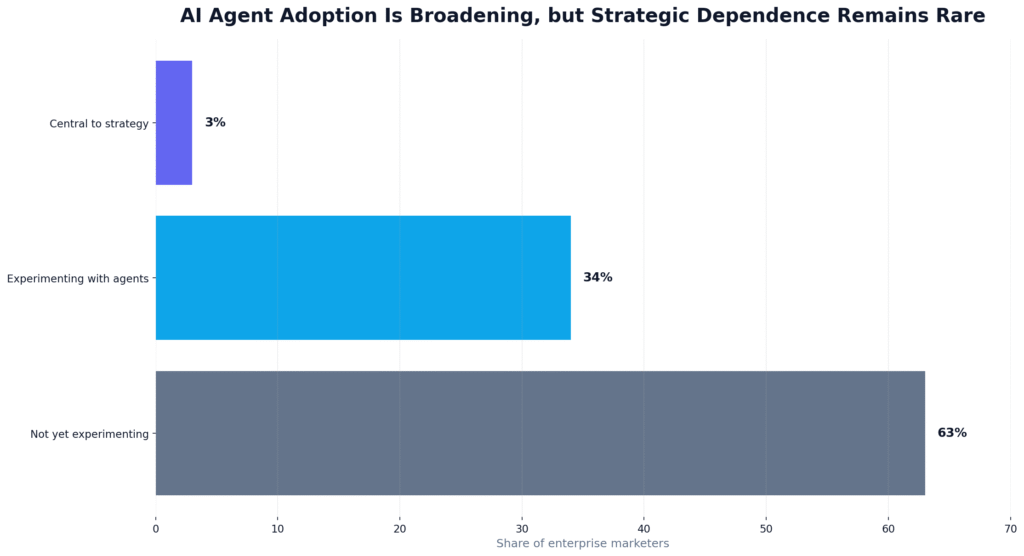
34% of enterprise marketers are experimenting with AI agents, reflecting interest in systems that can coordinate several production steps rather than respond to one prompt. Marketing workflows contain repeated handoffs involving research, drafting, adaptation, routing, approval, and performance reporting. Multi-brand teams see particular value in agents that can manage these sequences without requiring employees to rebuild the same administrative process for every account.
The 34% experimentation rate still describes testing rather than trusted delegation across business-critical marketing work. Agents require permissions, reliable source access, visible logs, and clear escalation rules before teams can understand how individual decisions were made. Without those safeguards, an efficient agent can move an incorrect assumption through several stages before a reviewer sees the resulting customer-facing asset.
A human manager can pause when an agent applies one client’s campaign logic to another brand, while raw automation may continue because every technical step has been completed successfully. The difference shows why task completion alone is an incomplete measure of agent quality. The practical implication is to begin with bounded activities, brand-specific permissions, and observable decision histories, which allows teams to test operational value without granting premature control over the entire content supply chain.
Multi-Brand AI Content Workflow Trends #5. Strategic Dependence on AI Agents Remains Limited
3% of enterprise marketers make AI agents central to their strategy, showing that very few organizations are ready to build marketing execution around autonomous systems. Strategic deployment requires dependable data access, security controls, escalation procedures, and confidence that repeated decisions will remain within approved boundaries. These conditions are especially demanding when agents operate across brands with separate claims, assets, customer promises, and approval authorities.
The 3% strategy-level adoption rate illustrates how far operational enthusiasm remains from enterprise trust. Organizations may test agents for contained tasks while hesitating to let them choose priorities, modify messaging, or move assets toward publication without close supervision. That hesitation is rational because the cost of a mistake is not limited to rewriting a draft when the system has already influenced several connected stages.
A human strategist can recognize that a technically correct action conflicts with a brand promise, while raw AI may optimize the requested metric without understanding the reputational tradeoff. That contrast becomes more consequential as systems receive broader authority. The practical implication is to treat agents as supervised workflow participants until evidence shows they can preserve brand boundaries under routine pressure, which makes strategic adoption a result of demonstrated reliability rather than enthusiasm.
Multi-Brand AI Content Workflow Trends #6. Personalization Is Driving AI Adoption
75% of marketers use AI to help meet growing personalization demands, making tailored communication one of the clearest operational reasons for adoption. Manual teams cannot produce enough audience, channel, lifecycle, and campaign variations at the speed modern marketing plans increasingly require. A multi-brand portfolio multiplies those combinations because each organization may serve several customer groups while maintaining a different voice, offer structure, and commercial objective.
The 75% AI-assisted personalization share does not reveal whether the resulting content feels meaningfully relevant to the recipient. AI can vary examples, calls to action, and product emphasis, but it can also create shallow personalization that simply changes names or surface details. The production advantage becomes valuable only when teams define which customer signals should influence the message and which brand principles should remain stable.
A human marketer can distinguish genuine relevance from cosmetic customization, while raw AI may generate many polished variations without understanding which differences matter to the audience. That contrast explains why higher output does not always create a better customer experience. The practical implication is to establish approved personalization variables, source data, and brand limits before scaling generation, which ensures that tailored content reflects customer context rather than automated variation alone.
Multi-Brand AI Content Workflow Trends #7. Personalized Content Demand Exceeds Capacity
78% of marketers say they need more personalized content than they can currently produce, revealing a persistent gap between customer expectations and operational capacity. Audiences encounter brands across more channels, stages, and moments, creating pressure for content that reflects immediate needs rather than broad demographic assumptions. Multi-brand teams feel that pressure more sharply because limited editorial attention must be divided across several customer journeys and publishing calendars.
The 78% personalization shortfall explains why AI is often introduced first as a volume solution. Faster variation can reduce production delays, but it can also encourage teams to personalize every available touchpoint without deciding which interactions deserve deeper attention. When personalization expands without prioritization, reviewers face more assets while customers receive differences that may be technically accurate but strategically unimportant.
A human strategist can identify the moments where tailored guidance changes a decision, while raw AI may scale low-value variations simply because the task is easy to automate. That distinction separates useful personalization from additional content volume. The practical implication is to rank customer journeys by commercial value, information need, and brand sensitivity before generating more assets, which directs limited human review toward the interactions where personalization can influence behavior most meaningfully.
Multi-Brand AI Content Workflow Trends #8. Customers Increasingly Expect Two-Way Communication
83% of marketers recognize that customers increasingly expect two-way conversations with brands rather than one-directional campaigns. Digital service channels and conversational interfaces have normalized immediate responses that acknowledge the customer’s question, history, and current intent. For multi-brand teams, this expectation creates a difficult balance because response systems may be shared even though each brand needs a distinct tone, service promise, and escalation approach.
The 83% expectation level changes content operations because messaging can no longer be designed only as a finished asset sent into the market. Teams also need reusable knowledge, response boundaries, and data connections that help systems continue the interaction accurately. Without that context, AI may provide a fast answer while overlooking previous purchases, unresolved complaints, eligibility conditions, or language that does not fit the brand.
A human representative can consider tone, history, urgency, and commercial sensitivity together, while raw AI may answer the immediate question without understanding the wider relationship. That difference becomes visible when several brands share customer-service infrastructure. The practical implication is to connect conversational workflows with complete customer context and brand-specific response rules, which allows speed to support the relationship instead of replacing the judgment needed to maintain it.
Multi-Brand AI Content Workflow Trends #9. Data Readiness Limits Personalization
25% of marketers are satisfied with how their data supports personalized interactions, showing that information quality remains a larger constraint than generation capacity. Customer context is often fragmented across sales, commerce, service, email, analytics, and account-management systems that were not designed to work together. Multi-brand structures add another layer because data ownership, permissions, identifiers, and customer definitions may differ across separate business units.
The 25% data-satisfaction rate helps explain why sophisticated AI systems can still produce generic or poorly timed content. Personalization depends on accurate signals about the customer, but incomplete access forces models and marketers to work from partial context. Increasing content volume under those conditions can amplify irrelevant assumptions rather than improve the experience, particularly when audiences interact with more than one brand in the portfolio.
A human reviewer can notice that missing information makes a personalized recommendation unsafe, while raw AI may fill contextual gaps with assumptions that sound fluent and convincing. The numeric gap therefore represents a governance and infrastructure issue, not merely a creative limitation. The practical implication is to improve data completeness, permissions, and shared definitions before expanding automated personalization, which ensures that content decisions are based on reliable customer context rather than confidence generated from incomplete records.
Multi-Brand AI Content Workflow Trends #10. Generative AI Use Is Mainstream in B2B Teams
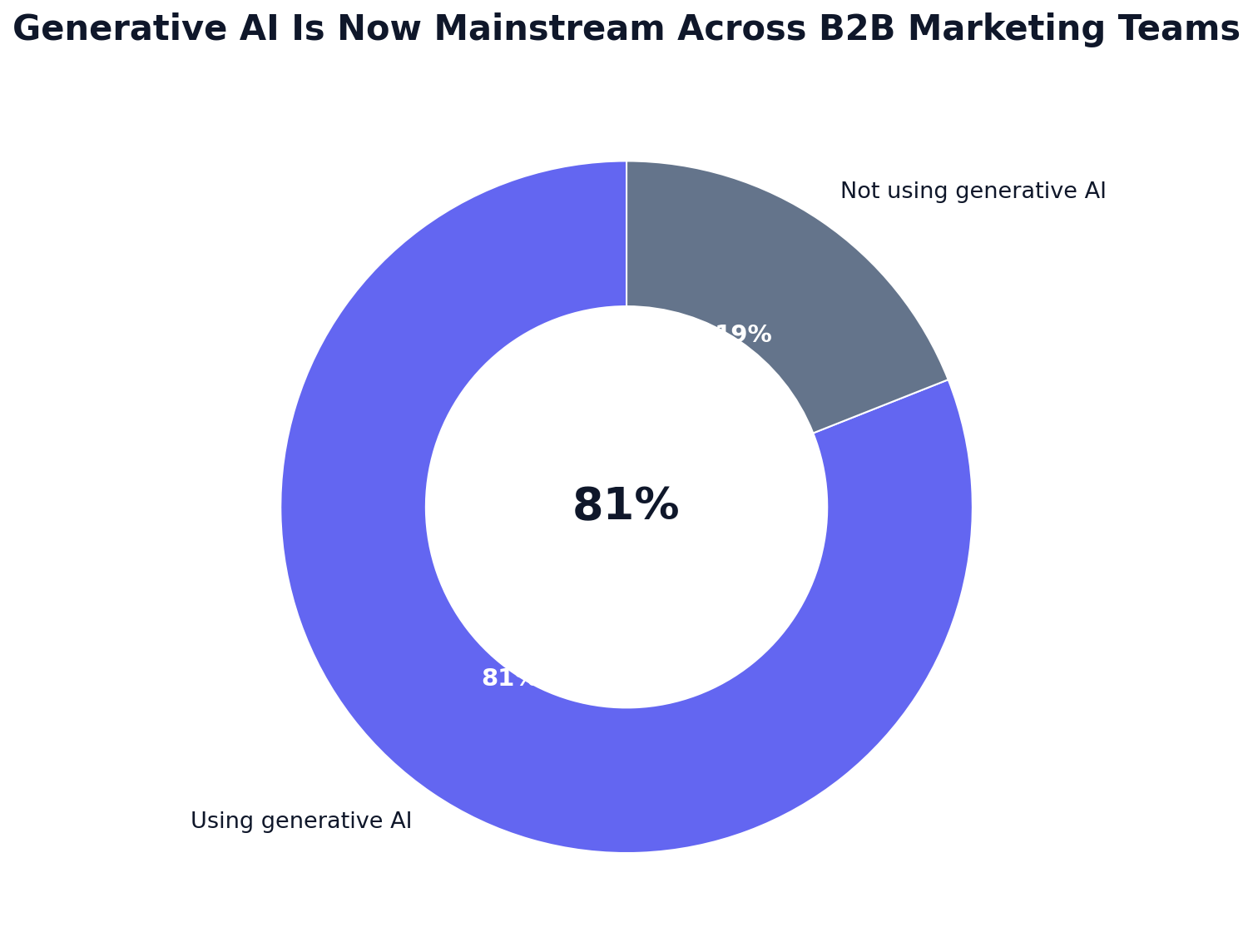
81% of B2B marketing teams use generative AI tools, confirming that assisted drafting, ideation, research, and optimization have moved into mainstream content work. Low entry costs and accessible interfaces allow individual contributors to test the technology without waiting for a large implementation program. Within multi-brand operations, that ease of adoption means tools can spread across accounts before the team has agreed on shared briefing, sourcing, or quality standards.
The 81% generative AI usage rate measures participation rather than consistency, safety, or commercial effectiveness. Two writers using the same model may provide different instructions, references, and levels of human review, producing outputs that vary more than managers realize. That hidden variation becomes difficult to diagnose when drafts move quickly and the final asset no longer shows which assumptions came from the original prompt.
A human editor can compare a draft against the brand’s actual publishing history, while raw AI may judge fluent language as sufficient evidence of fit. This contrast explains why widespread use can coexist with uneven confidence in output quality. The practical implication is to standardize briefs, evidence requirements, review criteria, and brand context across users, which makes generative AI a visible part of the workflow rather than an untracked personal shortcut.
Multi-Brand AI Content Workflow Trends #11. Daily Workflow Integration Trails Tool Adoption
19% of B2B teams have formally integrated AI into daily workflows, showing that routine operational use remains far behind general experimentation. Integration requires more than opening a tool because responsibilities, inputs, checkpoints, and expected outputs must be defined clearly enough for repeated use. In multi-brand environments, those expectations must also account for the different evidence rules, approval paths, voice standards, and commercial risks attached to each account.
The 19% daily-integration rate reveals how difficult it is to move from individual convenience to an organizational process. A repeatable workflow needs ownership, training, measurable quality criteria, and a clear response when the system produces uncertain or unsuitable material. Without those elements, AI remains an optional shortcut used differently by each employee rather than a dependable production capability the wider organization can inspect.
A human manager can trace an error to a weak input, missing source, or skipped review stage, while raw AI may treat every unsatisfactory result as another prompting problem. That contrast matters because prompt revisions cannot repair unclear accountability. The practical implication is to embed AI only in stages where responsibilities, expected outputs, and escalation paths are visible, which allows daily integration to improve the full workflow rather than simply increase the number of generated drafts.
Multi-Brand AI Content Workflow Trends #12. Ad Hoc AI Use Still Dominates
54% of B2B teams take an ad hoc approach to AI, indicating that experimentation remains more common than coordinated deployment. Individual employees naturally adopt tools that remove friction from their own tasks, especially when formal processes have not yet caught up with available technology. In a multi-brand operation, those personal methods create different prompting styles, source practices, editing thresholds, and storage habits across work produced by the same team.
The 54% ad hoc share can produce visible short-term gains while making long-term quality harder to manage. A writer may save time on one assignment, but the organization gains little reusable knowledge when the process is undocumented and results are not connected to performance. Managers then see more output without being able to determine which practices should be repeated, corrected, or prohibited across other brands.
A human editor can recognize that inconsistency comes from fragmented production methods, while raw AI may continue creating acceptable drafts that preserve the hidden variation. That difference makes ad hoc success difficult to scale safely. The practical implication is to replace personal workarounds with documented, brand-aware workflows and shared review standards, which turns isolated productivity improvements into an operational capability that can survive staff changes, campaign pressure, and portfolio growth.
Multi-Brand AI Content Workflow Trends #13. Trust in Generative AI Output Remains Low
4% of B2B marketers report high trust in generative AI output, revealing a wide separation between frequent use and confidence in the resulting material. Accuracy, source quality, originality, context, and strategic fit can vary considerably even when the language appears polished. Multi-brand teams face additional uncertainty because a statement that is acceptable for one organization may be unsupported, legally sensitive, or inconsistent with the positioning of another.
The 4% high-trust rate suggests that most marketers still treat AI output as material requiring substantial human judgment. This caution is not necessarily resistance because fluent generation can be valuable while remaining unsuitable for direct publication. Trust develops when teams can understand the source of claims, reproduce successful processes, and observe that corrections are incorporated into later work rather than repeatedly rediscovered.
A human reviewer can question a polished statement that lacks evidence, while raw AI may present uncertainty with the tone and structure of a verified fact. That contrast becomes costly when unsupported language moves across several brands. The practical implication is to require verification for claims, comparisons, positioning statements, and sensitive language, which allows AI to accelerate drafting without asking editors or audiences to treat fluency as proof of reliability.
Multi-Brand AI Content Workflow Trends #14. Strong Quality Ratings Remain Uncommon
17% of B2B marketers rate AI-generated content as excellent or very good, showing that most teams do not consider raw output publication-ready. Generative systems can create coherent structures quickly, but they often rely on predictable phrasing, broad explanations, and familiar arguments that require strategic refinement. Multi-brand teams notice this limitation more clearly when several accounts begin producing similar introductions, transitions, examples, and conclusions despite serving different markets.
The 17% positive-quality rating reflects the difference between readable content and content that earns attention, trust, or action. A draft may be technically complete while lacking proprietary insight, audience specificity, emotional judgment, or the distinct point of view associated with the brand. Editors therefore spend less time constructing sentences from nothing but more time deciding which ideas deserve emphasis and which generic sections should be removed.
A human editor can reshape the structure around audience intent and brand memory, while raw AI may repeat common patterns because those patterns resemble complete professional writing. That distinction explains why generation speed and editorial quality move differently. The practical implication is to measure the percentage of drafts that become usable after review rather than the quantity produced, which gives teams a more honest picture of whether AI is reducing work or merely relocating it.
Multi-Brand AI Content Workflow Trends #15. Safe AI Use Is Not Widely Understood
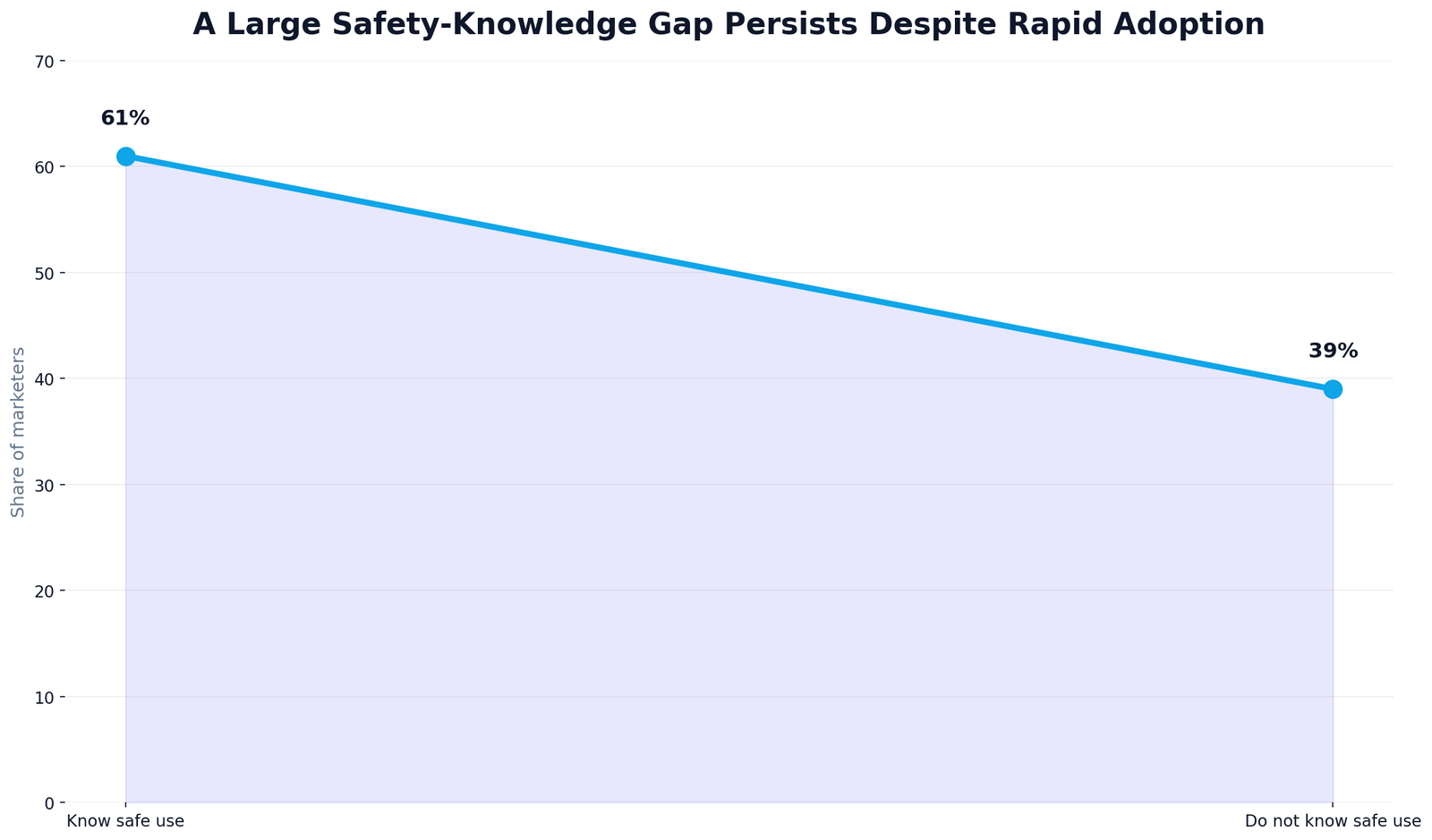
39% of marketers say they do not know how to use generative AI safely, indicating that practical access has advanced faster than risk literacy. Safe use includes decisions about privacy, copyright, factual verification, confidential information, disclosure, bias, and the retention of material entered into third-party systems. Multi-brand teams must navigate different thresholds because clients and business units may have separate contracts, regulatory exposure, data policies, and reputational sensitivities.
The 39% safety-knowledge gap creates risk even when employees are acting with productive intentions. A writer may provide detailed source material to improve accuracy without realizing that the document contains protected customer, campaign, or commercial information. Informal experimentation becomes more difficult to supervise when organizations have not translated broad AI principles into specific rules employees can apply during ordinary assignments.
A human governance lead can identify when confidential context should remain outside a tool, while raw AI will process the information without understanding the organization’s contractual obligations. That contrast makes safety an operational responsibility rather than a model feature. The practical implication is to publish clear boundaries for approved tools, permitted data, verification, and escalation, which gives employees practical guidance before uncertainty becomes an avoidable brand or client problem.
Multi-Brand AI Content Workflow Trends #16. Teams Struggle to Capture Full AI Value
43% of marketers say they do not know how to gain maximum value from generative AI, suggesting that basic prompting knowledge has not translated into workflow improvement. Sustainable value depends on choosing suitable tasks, supplying dependable context, preserving human judgment, and connecting lessons from one assignment to the next. Multi-brand teams must also decide which processes can be shared and which require separate treatment because each account carries different commercial priorities.
The 43% value-knowledge gap explains why visible activity can increase without producing proportional gains in time, quality, or performance. Teams often automate drafting because generation is easy to observe, while leaving research bottlenecks, approval delays, asset retrieval, and duplicated revisions untouched. The organization then produces first drafts faster but continues losing time in the less visible stages that determine whether those drafts reach publication successfully.
A human operations lead can see where AI removes friction without removing necessary judgment, while raw AI only completes the task assigned to it. That contrast makes workflow design more important than isolated tool capability. The practical implication is to evaluate complete production cycles, including review time and revision quality, which helps teams identify where AI creates measurable value rather than merely accelerating the most obvious step.
Multi-Brand AI Content Workflow Trends #17. Marketers Recognize the Need for Training
54% of marketers consider generative AI training important, indicating that users understand access alone does not create dependable capability. Effective use requires judgment about prompting, evidence, editing, privacy, disclosure, workflow placement, and the circumstances where AI should not be used. Multi-brand operations add another learning requirement because employees must understand how shared principles change when applied to different audiences, offers, and reputational contexts.
The 54% training-priority share reflects a move away from treating AI proficiency as an individual technical interest. Informal experimentation can teach useful shortcuts, but it rarely produces consistent decisions across a team unless examples, expectations, and feedback are shared. Training becomes more valuable when it is connected to actual work rather than limited to generic demonstrations of what a model can generate.
A human trainer can explain why one prompting method works for a conversational consumer brand but fails for a regulated professional audience, while raw AI may reuse the successful pattern without recognizing changed constraints. That distinction makes contextual practice essential. The practical implication is to teach through real brand assignments, supervised reviews, and documented corrections, which helps employees connect tool capability with the editorial and commercial judgment their roles still require.
Multi-Brand AI Content Workflow Trends #18. Employer-Provided Training Remains Scarce
70% of marketers say their employers do not provide generative AI training, revealing a substantial gap between organizational adoption and organizational support. Many companies allow or encourage employees to use AI while expecting informal learning, online advice, or personal experimentation to fill the capability gap. In multi-brand teams, that approach creates inconsistent methods because each employee develops different assumptions about accuracy, confidentiality, acceptable revision, and brand fit.
The 70% employer-training shortfall transfers operational risk to individuals who may not have enough information to make policy or governance decisions. Employees can become efficient at generating output without understanding how their choices affect legal exposure, client agreements, or long-term consistency. Managers also struggle to enforce standards that have never been translated into examples, approved processes, or practical guidance for daily assignments.
A human employee can improve through feedback tied to real business consequences, while raw AI may repeat the same error because no shared process explains what should change. That contrast makes training part of quality control rather than an optional professional benefit. The practical implication is to integrate training with governance, onboarding, and review, which creates a common operating language across brands instead of leaving every user to construct one alone.
Multi-Brand AI Content Workflow Trends #19. Technology Marketers Report Better Content Quality
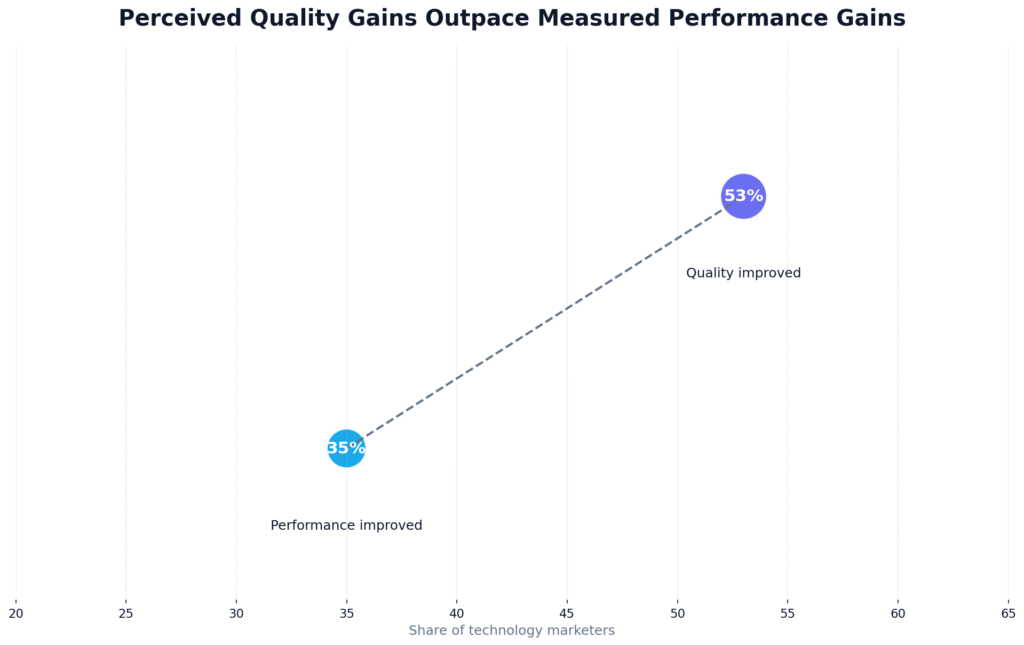
53% of technology marketers report that AI-assisted content creation has improved content quality, showing that practical gains are achievable when systems receive useful direction. AI can strengthen ideation, structural editing, consistency checks, and the translation of complex product information into more accessible language. Technology brands may benefit from structured product documentation and specialist knowledge that gives models stronger source material than a vague creative prompt.
The 53% quality-improvement rate still means a large portion of marketers do not observe clear improvement or believe quality has declined. Better output depends on the relationship between source material, workflow design, editorial standards, and human intervention rather than on model access alone. Multi-brand teams must also prevent strong technical language from becoming uniform corporate language that removes meaningful distinctions between products and companies.
A human editor can balance technical accuracy with reader clarity, relevance, and brand tone, while raw AI may improve surface polish without understanding which nuance supports trust. That difference explains why assistance performs better than unsupervised generation. The practical implication is to pair strong product knowledge with human editorial judgment and brand-specific examples, which gives AI enough context to improve quality without replacing the distinctions audiences use to evaluate competing organizations.
Multi-Brand AI Content Workflow Trends #20. Content Performance Gains Lag Behind Quality Gains
35% of technology marketers report improved performance from AI-assisted content, showing that measurable business results trail perceived improvements in content quality. Better prose does not automatically create stronger relevance, distribution, search visibility, engagement, lead quality, or conversion because performance depends on several connected decisions. Multi-brand teams must link each asset to a distinct audience, offer, channel, and commercial goal rather than assuming improved wording will produce the same effect everywhere.
The 35% performance-improvement rate reveals the limitation of evaluating AI mainly through speed or editorial appearance. Content can become clearer and easier to produce while still addressing the wrong question, reaching the wrong audience, or competing with stronger established material. Performance also takes time to observe, and weak measurement systems can prevent teams from identifying which part of the workflow contributed to the result.
A human strategist can interpret weak performance through audience intent, offer strength, timing, and channel context, while raw AI may attribute the outcome to content quality alone. That contrast prevents simple conclusions from becoming useful operational learning. The practical implication is to connect AI workflows with testing, analytics, and brand-specific objectives, which allows teams to improve the system based on business outcomes rather than the appearance of individual drafts.
Building Workflows That Preserve Brand Boundaries
AI adoption is no longer the difficult threshold for most marketing teams because the tools are already present across writing, personalization, optimization, and campaign production. The harder work is converting widespread access into processes that remain understandable, measurable, and dependable when several brands compete for the same people and infrastructure.
The gap between experimentation and integration shows why output volume is an incomplete measure of progress. Teams create durable value when brand knowledge, customer data, review criteria, and escalation rules move through the workflow as deliberately as the generated draft.
Personalization and conversational marketing increase the need for scalable systems, but they also expose weaknesses in fragmented data and generic brand guidance. Human oversight becomes more valuable in this environment because judgment determines which differences matter, which claims require verification, and when automation should pause.
The strongest multi-brand operations will treat AI as a governed production capability rather than a collection of personal shortcuts. That approach links training, permissions, editorial standards, and performance measurement so efficiency supports distinct brand outcomes instead of gradually making every account sound and behave alike.
Sources
- Content Marketing Institute research on B2B artificial intelligence implementation
- B2B content marketing benchmarks and generative AI workflow findings
- Technology marketing research on AI-assisted content quality and performance
- Salesforce research on AI adoption and personalized customer communication
- Salesforce survey on generative AI safety, value, and training
- SAS report examining marketer adoption of generative and agentic AI
- McKinsey global survey on AI adoption and scaled organizational impact
- OECD analysis of organizational AI adoption and workforce capability gaps
- Gartner consumer research on generative AI and perceived content quality
- Enterprise framework for evaluating agent reliability, assurance, and operational stability
- Research on user-centered AI agents for enterprise decision-making workflows
- Research examining how data quality affects machine learning performance