How to Humanize AI Study Notes: 15 Learning-Focused Edits

Students increasingly rely on AI to generate study notes, yet memory improves when learners actively edit and explain material themselves. Evidence from research on retrieval practice published in Psychological Science by Purdue University researchers shows why rewriting notes improves retention.
How to Humanize AI Study Notes: 15 Learning-Focused Edits
AI-generated notes can look polished at first glance, yet they often feel oddly detached from the way students actually learn and review material. Many learners start with automated outlines or summaries using tools like ChatGPT prompts for essays, only to realize the notes lack personal clarity and recall cues.
The problem usually appears when AI organizes information too neatly, flattening nuance and stripping away the context that helps ideas stick. Even when rewriting tools exist, selecting from the best AI humanizer tools for lesson plans still requires thoughtful editing to turn structured text into something students can actually remember.
This gap matters more than it seems, especially as AI becomes a routine part of academic workflows and note-taking habits. Recent research summarized in student use of AI writing statistics shows just how quickly automated drafting tools are entering classrooms and study routines.
| # | Strategy focus | Practical takeaway |
|---|---|---|
| 1 | Replace generic summaries | Rewrite flat AI summaries with clearer explanations that mirror how you would naturally explain the topic during review. |
| 2 | Add context cues | Include short reminders that connect ideas to lectures, examples, or assignments so the material feels grounded. |
| 3 | Use conversational phrasing | Turn overly formal wording into language that feels closer to how students speak and think while studying. |
| 4 | Break long explanations | Split dense AI paragraphs into smaller ideas that are easier to scan during quick review sessions. |
| 5 | Highlight reasoning steps | Insert short logical bridges that explain why a concept matters or how one idea connects to the next. |
| 6 | Embed memory triggers | Add quick prompts or mental cues that help the brain recall the concept during tests or discussions. |
| 7 | Reintroduce examples | Replace vague explanations with short examples that show how the concept appears in real study situations. |
| 8 | Adjust tone for learning | Remove robotic phrasing and reshape sentences so the notes sound like guidance rather than encyclopedia text. |
| 9 | Add mini explanations | Clarify unfamiliar terms in a few extra words so future review sessions require less re-reading. |
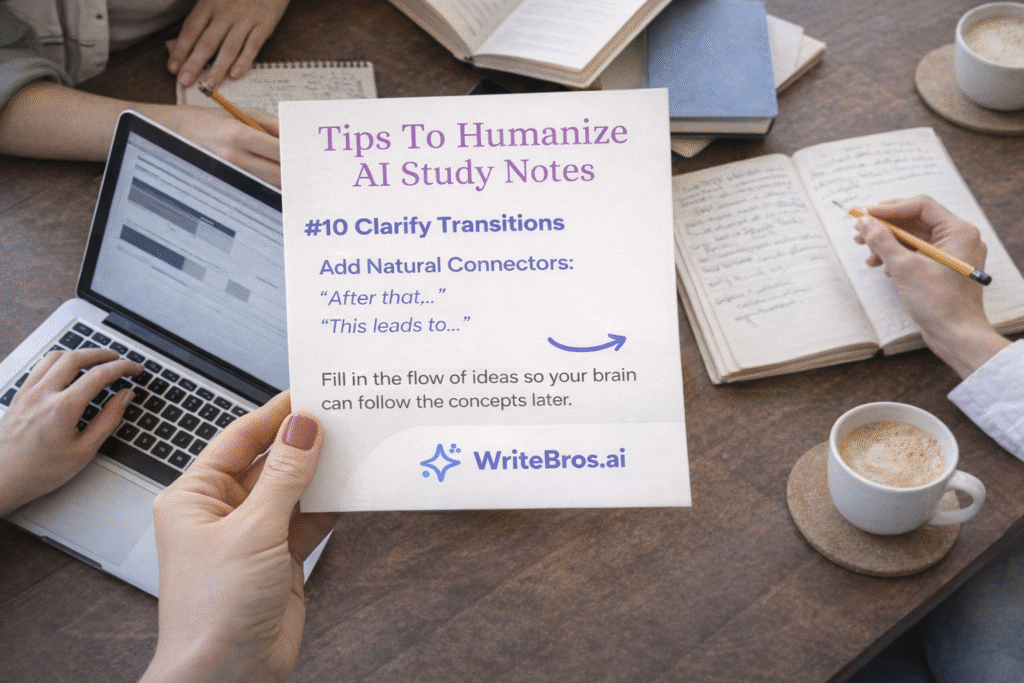
| 10 | Clarify transitions | Insert simple transition phrases that help the flow of ideas make sense when scanning notes later. |
| 11 | Reframe abstract ideas | Turn theoretical language into practical explanations that connect with how the concept appears in coursework. |
| 12 | Introduce comparison cues | Add short comparisons that help distinguish similar concepts often confused during exams. |
| 13 | Reorder for clarity | Move sections into a more logical sequence so the notes match how a topic naturally builds. |
| 14 | Insert quick review prompts | Include small questions or reminders that encourage active recall during study sessions. |
| 15 | Finalize readability pass | Read through the notes once more to smooth wording and ensure the material feels natural to study from. |
15 Learning-Focused Edits to Humanize AI Study Notes
How to Humanize AI Study Notes – Strategy #1: Replace generic summaries
AI-generated summaries often compress complex ideas into neutral, polished statements that read smoothly yet fail to support active learning. When students review these notes later, the information may feel detached from the context in which it was learned, which makes recall harder than expected. Rewriting summaries in your own explanatory language transforms static text into material that reflects your interpretation of the topic.
A useful method is to imagine explaining the concept to a classmate who missed the lecture and needs a quick but meaningful overview. In practice, this means expanding brief AI summaries with small clarifications that capture how the idea appeared in the lesson or reading. The result is a set of notes that feel less mechanical and more like a guide written by someone who genuinely worked through the material.
How to Humanize AI Study Notes – Strategy #2: Add context cues
Context cues reconnect ideas to the environment in which they were learned, which is something AI-generated notes frequently remove during summarization. A short phrase referencing a lecture example, a classroom discussion, or a diagram from a textbook can anchor a concept in memory. These cues make the notes feel less like abstract definitions and more like reminders of a real learning experience.
Students who revisit notes weeks later often struggle because the original context disappears from memory, leaving only isolated facts behind. Adding contextual hints such as “this appeared in the case study from week three” or “the professor emphasized this during the lab example” helps rebuild those mental connections. Over time, these small reminders transform the notes into a structured memory map rather than a detached information list.
How to Humanize AI Study Notes – Strategy #3: Use conversational phrasing
AI writing systems tend to default to neutral academic language that sounds formal but lacks the rhythm of natural explanation. When study notes read like a condensed textbook entry, students may skim them without fully processing the ideas. Rephrasing sections in a slightly conversational tone helps the brain treat the material as an explanation rather than a static reference.
One practical approach is to imagine narrating the concept aloud while studying and then adjusting the sentence structure to match that flow of thought. In many cases, this simply means replacing rigid phrasing with wording that sounds closer to how you would explain the topic in discussion. The resulting notes remain academically accurate while feeling more approachable and easier to revisit during review sessions.
How to Humanize AI Study Notes – Strategy #4: Break long explanations
AI systems frequently produce dense paragraphs that combine multiple ideas into a single block of explanation, which can make revision sessions unnecessarily difficult. When a student scans notes under time pressure, large blocks of text slow down comprehension and hide the logical steps within the concept. Dividing these explanations into clearer segments allows each part of the idea to stand out.
Breaking long passages into smaller conceptual units also encourages the brain to process each component individually rather than rushing through the entire section. During revision, this structure allows the eye to quickly locate key ideas without rereading everything from the beginning. Over time, well-separated explanations create notes that feel organized around understanding rather than compression.
How to Humanize AI Study Notes – Strategy #5: Highlight reasoning steps
Many AI-generated explanations jump directly from concept to conclusion without showing the reasoning that connects the two. While the information remains technically correct, the absence of intermediate logic can make the topic harder to grasp. Adding brief reasoning steps fills in those gaps and clarifies how the concept actually works.
This type of editing might involve inserting phrases that explain why a definition matters or how a principle leads to a certain outcome. In academic subjects such as science or economics, these connections are essential because they show the progression of ideas rather than isolated facts. Once the reasoning becomes visible in the notes, students can follow the logic more naturally during review.

How to Humanize AI Study Notes – Strategy #6: Embed memory triggers
Memory triggers are short cues that activate recall pathways in the brain, which can dramatically improve the usefulness of study notes. AI-generated content rarely includes these cues because it focuses on summarizing information rather than reinforcing memory. Introducing small prompts or associations gives each concept a recognizable mental hook.
A memory trigger might reference a striking example from class, a comparison that simplifies the idea, or even a short phrase that captures the concept’s essence. When the brain encounters these cues during revision, it quickly reconstructs the surrounding explanation. Over time, this technique transforms notes into a set of reminders that actively support recall rather than passive reading.
How to Humanize AI Study Notes – Strategy #7: Reintroduce examples
Examples are essential for learning because they demonstrate how a concept operates outside abstract definitions. AI summaries often remove these examples to produce concise text, which can leave the notes feeling incomplete. Reintroducing practical illustrations helps anchor theoretical ideas in familiar situations.
A strong example does more than repeat the definition, since it shows how the concept appears in practice and clarifies its boundaries. When students revisit their notes later, these examples often serve as shortcuts for recalling the larger explanation. The notes therefore evolve from a list of definitions into a learning tool that reflects how the topic behaves in real situations.
How to Humanize AI Study Notes – Strategy #8: Adjust tone for learning
The tone of study notes affects how easily the material can be revisited during revision sessions. AI-generated text tends to maintain a neutral informational voice that resembles a reference guide more than a learning aid. Adjusting the tone slightly toward explanation makes the notes feel more supportive and easier to follow.
This editing process usually involves softening rigid sentence structures and adding brief clarifications that mirror the way a teacher might guide a discussion. Instead of presenting facts in isolation, the notes begin to guide the reader through the idea step by step. As a result, reviewing the material feels less like reading documentation and more like revisiting a lesson.
How to Humanize AI Study Notes – Strategy #9: Add mini explanations
Specialized terminology often appears in AI-generated notes without sufficient explanation, which can create confusion during later study sessions. A term that felt obvious during the lecture may become unclear once the surrounding context fades from memory. Adding short explanatory phrases helps maintain clarity long after the original lesson.
These mini explanations do not need to be lengthy, yet they should clarify the meaning or significance of the term within the topic. A single sentence that describes how the concept functions can prevent unnecessary re-reading of textbooks or slides. Over time, these additions build notes that remain understandable even after long gaps between study sessions.
How to Humanize AI Study Notes – Strategy #10: Clarify transitions
Transitions connect ideas in a way that reveals the logical flow of a topic, which is something AI-generated notes sometimes overlook. Without these connections, the notes may appear as a sequence of statements rather than a coherent explanation. Clarifying transitions helps readers understand how each concept leads to the next.
This often involves inserting phrases that indicate progression, contrast, or cause and effect within the topic. When students scan their notes during revision, these transitions guide them through the structure of the material without confusion. The notes begin to resemble a narrative of ideas rather than a disconnected collection of points.
How to Humanize AI Study Notes – Strategy #11: Reframe abstract ideas
Abstract explanations can appear clear when first generated by AI, yet they often remain difficult to internalize during later review sessions. Concepts expressed only in theoretical language may fail to connect with the practical situations students remember from class. Reframing these ideas into more tangible explanations strengthens understanding.
This editing technique typically involves translating theoretical wording into examples or interpretations that reflect coursework experiences. A definition might remain technically accurate while gaining additional clarity through familiar scenarios or comparisons. Over time, these reframed explanations transform abstract material into knowledge that feels usable rather than distant.
How to Humanize AI Study Notes – Strategy #12: Introduce comparison cues
Many subjects contain similar concepts that students frequently confuse, especially when the differences appear subtle in AI-generated summaries. Comparison cues highlight those distinctions and clarify how each concept relates to the others. Adding these cues ensures that the notes capture the nuances necessary for deeper understanding.
A comparison cue might explain how two theories approach the same problem from different perspectives or how two formulas produce different results in practice. When students revisit the notes later, these comparisons help reconstruct the conceptual landscape of the topic. The notes therefore function not only as summaries but also as guides for distinguishing closely related ideas.
How to Humanize AI Study Notes – Strategy #13: Reorder for clarity
AI-generated notes frequently preserve the order in which information appeared in source material, which may not reflect the most logical learning sequence. When ideas appear before their underlying explanations, the notes can feel confusing during revision. Reordering sections helps create a progression that mirrors how understanding actually develops.
This might involve moving foundational definitions earlier in the notes and placing more advanced insights afterward. When the structure aligns with the natural build of the topic, reviewing the notes becomes far more intuitive. Students can move through the material step by step without repeatedly jumping backward for clarification.
How to Humanize AI Study Notes – Strategy #14: Insert quick review prompts
Quick review prompts encourage active recall, which strengthens learning far more effectively than passive rereading. AI-generated notes rarely include such prompts because they focus primarily on summarizing content. Introducing small questions or reminders transforms the notes into interactive study tools.
A prompt might ask the reader to restate a concept in their own words or to recall the example discussed during class. These brief interruptions encourage the brain to reconstruct the idea rather than simply recognize it on the page. Over time, this habit converts ordinary notes into a framework for continuous reinforcement.
How to Humanize AI Study Notes – Strategy #15: Finalize readability pass
The final editing step ensures that the entire set of notes flows naturally from beginning to end. AI-generated drafts may contain awkward phrasing, repeated patterns, or transitions that feel abrupt when read consecutively. A careful readability pass smooths these inconsistencies and strengthens the overall clarity of the notes.
This process involves reading through the material slowly while adjusting sentences that interrupt the flow of explanation. Minor wording changes can dramatically improve how the notes feel during revision sessions. By the end of this pass, the notes should resemble a cohesive explanation written specifically for learning rather than a stitched collection of generated text.
Common mistakes
- Students often leave AI-generated notes almost untouched because the text appears polished and organized at first glance. This mistake happens because fluent writing creates the illusion of understanding, yet the notes may lack the contextual cues and reasoning steps needed for genuine recall during later study sessions.
- Another frequent mistake occurs when learners shorten AI summaries even further in an attempt to create concise revision material. Although brevity feels efficient, excessive compression removes the explanations that help ideas stick in memory, which can make revision sessions feel frustrating and disconnected from the original lesson.
- Some students rely entirely on AI-generated wording without adapting the language to their own style of thinking. Because learning depends heavily on personal interpretation and explanation, notes written entirely in generic phrasing often fail to trigger meaningful recall when the student revisits them later.
- Many learners forget to reconnect notes with lecture examples or classroom discussions, which removes the narrative context that originally helped them understand the material. Without those connections, the notes may appear technically correct but lack the subtle reminders that guide memory during exam preparation.
- Another common problem appears when students organize notes strictly according to the AI output structure instead of reorganizing the information logically. This approach can produce a confusing sequence in which advanced ideas appear before foundational concepts, forcing readers to jump back and forth during revision.
- Some learners attempt to memorize AI-generated notes exactly as written rather than transforming them into tools for understanding. This mistake often leads to surface-level familiarity with the wording while leaving deeper comprehension underdeveloped, which becomes evident during exams or written responses.
Edge cases
There are situations in which AI-generated study notes already contain strong explanations, especially when the system has been prompted with detailed lecture context or structured outlines. In these cases, the goal is not to rewrite every sentence but to selectively add cues that strengthen memory and comprehension. Editing becomes more about refining clarity than replacing entire sections.
Another edge case appears in highly technical subjects where definitions must remain precise and cannot be paraphrased freely. Here, humanizing the notes focuses on adding contextual explanations around the formal wording rather than altering the definitions themselves. This balanced approach preserves accuracy while still making the notes easier to review and understand.
Supporting tools
- Note-taking platforms such as Notion allow students to reorganize AI-generated notes into clearer learning structures with headings, contextual comments, and embedded examples. These features make it easier to add reasoning steps and reminders without rewriting entire sections from scratch.
- Digital flashcard systems like Anki support active recall by turning study notes into spaced repetition prompts. When combined with edited notes that contain clear explanations and memory cues, these tools help reinforce concepts gradually across multiple review sessions.
- Annotation tools within PDF readers or document editors allow students to layer clarifications directly onto AI-generated summaries. These annotations can capture lecture insights or textbook explanations that restore the context removed during automated summarization.
- Mind-mapping applications help visualize how concepts relate to one another, which is particularly helpful when AI notes flatten complex relationships. Transforming linear notes into visual connections can reveal logical structures that improve comprehension and retention.
- Collaborative note platforms allow classmates to expand and clarify AI-generated summaries together. Shared edits often introduce additional examples, clarifications, and explanations that mirror classroom discussions more closely than individual notes alone.
- WriteBros.ai provides rewriting support that helps transform AI-generated notes into clearer explanations tailored to human reading patterns. Instead of leaving generated text untouched, students can refine tone, add reasoning steps, and produce notes that feel natural to revisit during study sessions.
Ready to Transform Your AI Content?
Try WriteBros.ai and make your AI-generated content truly human.
Conclusion
Humanizing AI-generated study notes is less about rewriting everything and more about restoring the thinking process that helps ideas stay memorable. When notes include context cues, examples, reasoning steps, and conversational explanations, they become tools that support learning rather than simple summaries of information.
Students who take time to refine automated notes gradually transform them into personal learning resources shaped around their own understanding. The goal is not perfection but clarity, which emerges through thoughtful editing and consistent review. Over time, this practice turns AI-generated drafts into study materials that genuinely support long-term comprehension.
Did You Know?
AI generated study notes can look clear and well structured, yet they frequently remove the context and explanation that help ideas stick in memory. This is why students sometimes reread AI summaries several times and still struggle to recall the concept later.
The strongest study notes usually appear after students reshape the material themselves. Rewriting explanations, adding examples from lectures, and inserting short recall prompts turns AI generated notes into something that actually supports long term learning.
Ready to Transform Your AI Content?