How to Humanize DeepSeek AI Content: 15 Natural Language Fixes
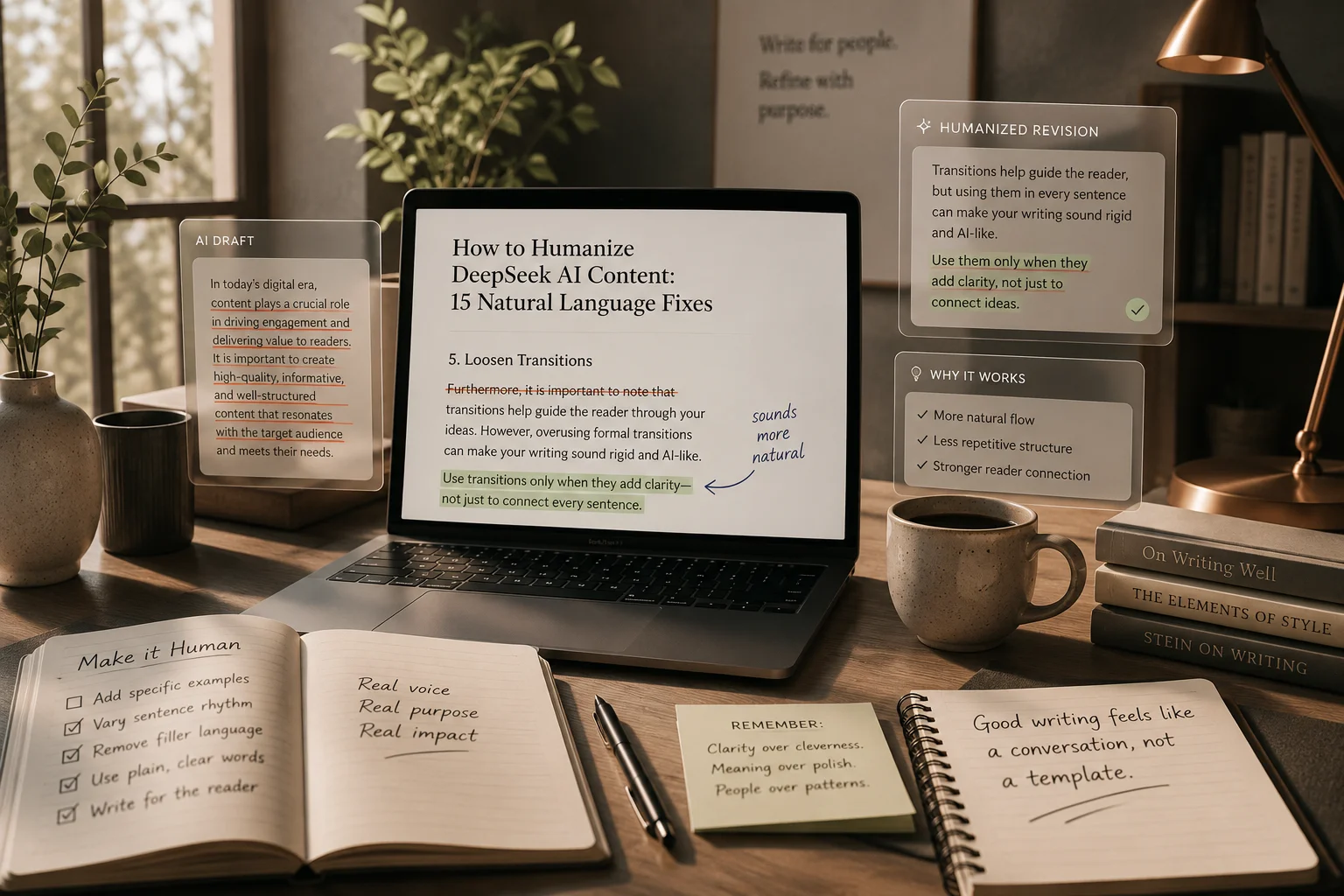
2026 editing standards make AI drafts compete on clarity, rhythm, and reader trust. This guide shows how to humanize DeepSeek AI content with sentence variety, plain wording, specific examples, and readability choices supported by plain language research for stronger, more natural final web copy.
How to Humanize DeepSeek AI Content: 15 Natural Language Fixes
DeepSeek can produce useful drafts quickly, but the final copy can still feel a little too polished, flat, or distant from the way real people write. When the wording needs to sound authentic, small language choices matter more than broad rewrites.
This usually happens because AI drafts lean on balanced phrasing, predictable transitions, and explanations that move too neatly from one idea to the next. Even strong AI writing editors can miss the subtle rhythm, judgment, and uneven texture that make content feel naturally written.
This guide walks through practical fixes that help DeepSeek content read with more clarity, variation, and human intent. You will also see how tone, structure, and readability data can work together when refining AI-generated content for real readers.
| # | Strategy focus | Practical takeaway |
|---|---|---|
| 1 | Reader-first opening | Start with the reader’s real situation before explaining the topic, so the draft feels grounded instead of mechanically introduced. |
| 2 | Sentence rhythm | Vary length, pacing, and structure to avoid the overly even cadence that often makes AI writing feel synthetic. |
| 3 | Plain wording | Replace polished but generic phrasing with simpler language that sounds closer to how a thoughtful person would actually explain the idea. |
| 4 | Specific examples | Add concrete scenarios, details, and use cases so the content feels informed by real situations rather than abstract advice. |
| 5 | Natural transitions | Use connective phrases only when they help the reader move forward, instead of forcing every paragraph into a predictable sequence. |
| 6 | Balanced tone | Adjust enthusiasm, certainty, and formality so the writing feels useful and confident without sounding exaggerated or stiff. |
| 7 | Human judgment | Include practical tradeoffs and limits to show discernment, especially when a topic has more than one reasonable answer. |
| 8 | Paragraph shape | Break up dense blocks and overly symmetrical sections so the page feels easier to read and less obviously generated. |
| 9 | Audience context | Tune the explanation around who will read it, what they already know, and what they need to do next. |
| 10 | Original phrasing | Rewrite repeated stock expressions into fresher, more precise language that still keeps the meaning clear. |
| 11 | Evidence placement | Use supporting details where they clarify the point, not as decorative proof that interrupts the reader’s flow. |
| 12 | Controlled imperfection | Allow small variations in rhythm and emphasis so the content feels edited by a person, not smoothed into sameness. |
| 13 | Sharper verbs | Strengthen weak constructions by choosing verbs that show action, responsibility, and movement more clearly. |
| 14 | Ending clarity | Close sections with a useful takeaway instead of a generic summary that repeats what the reader already understood. |
| 15 | Final read-through | Review the piece aloud or line by line to catch robotic flow, repeated patterns, and places where the voice still feels distant. |
15 Natural Language Fixes to Humanize DeepSeek AI Content
How to Humanize DeepSeek AI Content – Strategy #1: Start with context
Begin by naming the reader’s actual situation before you explain the idea, because DeepSeek drafts often open with clean but generic framing that could belong to almost any article. This works best when the topic is practical, decision-based, or instructional, since the reader needs to feel that the piece understands why they are reading. Good execution feels specific without being dramatic, with the first few lines pointing to a real tension, task, frustration, or goal.
This approach works because people trust writing that seems aware of their circumstances, not just writing that defines a topic accurately. For example, instead of opening with a broad statement about AI writing becoming common, you might mention the exact problem of a useful DeepSeek draft still sounding too even, formal, or detached. The main caveat is that context should not turn into a long setup, because the reader still expects the article to move quickly into useful guidance.
How to Humanize DeepSeek AI Content – Strategy #2: Vary sentence rhythm
Look for stretches where every sentence has a similar length, structure, or level of emphasis, because that sameness is one of the fastest ways AI writing starts to feel mechanical. This matters most in introductions, explanations, and list-based sections, where DeepSeek can produce tidy lines that technically read well but feel strangely predictable. Strong revision mixes longer explanatory sentences with medium-length clarifications, while still keeping the page easy to follow.
The reason this works is that natural writing usually has movement, with some sentences carrying the idea forward and others slowing down to qualify, explain, or connect. For example, a paragraph about editing AI copy might combine one longer sentence about the editing goal with a more direct sentence that names the reader’s next action. The risk is overcorrecting into choppy variation, so the goal is not randomness, but a rhythm that feels guided by meaning.
How to Humanize DeepSeek AI Content – Strategy #3: Replace polished filler
Scan the draft for phrases that sound smooth but do not add much meaning, because DeepSeek can lean on polished wording that makes a paragraph feel professional while also making it vague. This is especially useful in business, education, marketing, and how-to content, where terms like “unlock,” “leverage,” “seamless,” or “comprehensive” can appear without saying anything concrete. Good editing keeps the useful point and replaces the filler with language that a careful person would actually use.
This works because readers often sense empty polish even when they cannot name what feels off, and that weakens trust over time. For example, instead of saying a tool “empowers users to create optimized content,” you might explain that it helps writers tighten paragraphs, remove repetition, and match the audience’s level of knowledge. The caveat is that not every formal phrase is bad, so remove the words that blur meaning rather than stripping away all professional tone.
How to Humanize DeepSeek AI Content – Strategy #4: Add concrete examples
Use examples that show where the advice would actually appear, because DeepSeek often explains concepts in a general way that feels reasonable but not lived-in. This strategy is useful whenever a paragraph gives advice, names a principle, or claims that something improves readability, credibility, engagement, or tone. A strong example does not need to be long, but it should include enough detail for the reader to recognize the situation and understand the choice being made.
Examples work because they turn abstract guidance into something the reader can picture, test, and adapt to their own draft. For instance, if you are explaining how to soften robotic tone, you might show how a product description, student essay, or customer support answer needs different levels of warmth. The constraint is relevance, because random examples can make the content feel padded, while precise examples make the article feel more experienced and useful.
How to Humanize DeepSeek AI Content – Strategy #5: Loosen transitions
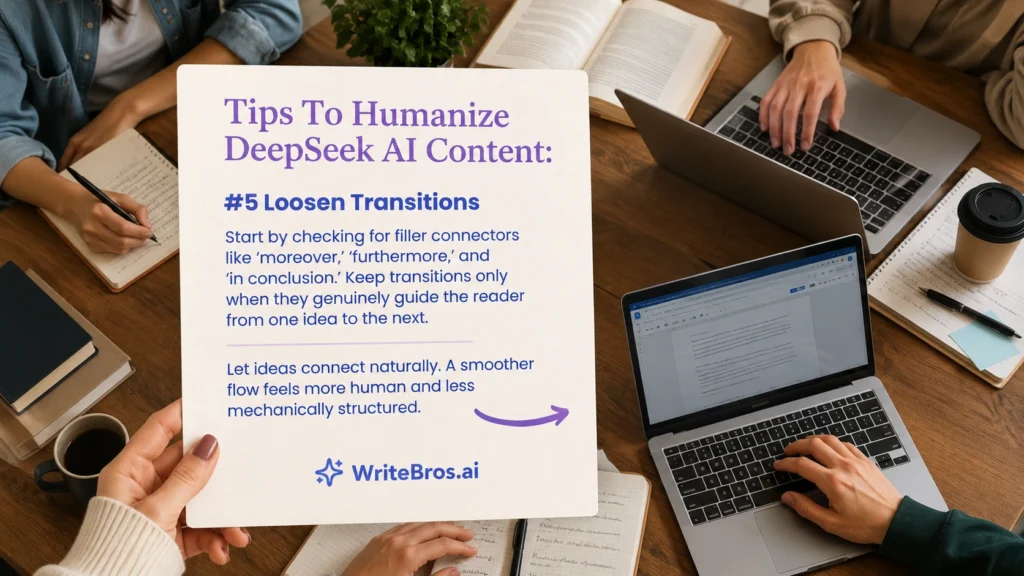
Review every transition and remove the ones that make the article sound too orderly, because DeepSeek can overuse phrases that announce each move instead of letting the ideas connect naturally. This matters when paragraphs begin with predictable signals like “Furthermore,” “Moreover,” “In conclusion,” or “It is important to note,” especially when the relationship between ideas is already clear. Good execution uses transitions only where the reader needs help understanding contrast, sequence, cause, or emphasis.
This works because human writing often moves through ideas with a lighter touch, using context and sentence flow instead of formal signposts every few lines. For example, a section can move from identifying robotic phrasing to explaining revision choices without announcing every step as a separate logical event. The caution is that removing too many transitions can make the draft feel abrupt, so keep the connective language that genuinely improves orientation and cut the rest.
How to Humanize DeepSeek AI Content – Strategy #6: Balance the tone
Adjust the tone so it matches the reader’s expectations, because DeepSeek can sound either too formal, too enthusiastic, or too neutral depending on the prompt and topic. This is important when the content is meant for real audiences, since a casual blog, a SaaS guide, and a student-facing explanation should not all sound the same. Good execution means choosing a level of warmth, certainty, and directness that fits the subject without making the writing feel forced.
This works because tone is often what readers judge before they consciously evaluate the substance, especially when the information itself is familiar. For example, a guide about editing AI drafts can sound calm and practical rather than excited about every small improvement, while a product walkthrough might allow slightly more energy. The caveat is that tone should support the content, not distract from it, so avoid adding jokes, slang, or personality where clarity matters more.
How to Humanize DeepSeek AI Content – Strategy #7: Include judgment
Add small moments of judgment where the draft currently sounds too absolute, because DeepSeek often presents advice as if one method works cleanly in every situation. This strategy is useful when the content includes recommendations, comparisons, best practices, or claims about what readers should do next. Good execution acknowledges tradeoffs, explains when advice applies, and shows that the writer understands practical limits rather than simply delivering a neat answer.
This works because real readers usually deal with constraints, such as time, audience expectations, brand rules, SEO requirements, or the need to preserve the original meaning. For example, you might explain that shortening a DeepSeek paragraph can improve flow, but cutting too aggressively may remove context that helps the reader trust the point. The risk is becoming hesitant, so the goal is not to weaken every statement, but to make certainty feel earned.
How to Humanize DeepSeek AI Content – Strategy #8: Reshape paragraphs
Look at the paragraph structure before editing individual words, because DeepSeek can produce blocks that are technically clear but too symmetrical across the page. This matters in long articles, comparison posts, and instructional content, where repeated paragraph shapes can make the reader feel as if they are moving through a template. Good execution varies paragraph length, places emphasis where it naturally belongs, and breaks dense explanations before the reader starts to lose momentum.
This works because readers experience structure visually before they process every sentence, especially on mobile screens where long uniform blocks feel heavier than they are. For example, a paragraph that explains the problem, the fix, and the caveat may need to become two paragraphs if the idea has too much weight. The caveat is that paragraph breaks should follow meaning, not decoration, because overly fragmented writing can feel just as artificial as overly uniform writing.
How to Humanize DeepSeek AI Content – Strategy #9: Match audience knowledge
Revise the draft according to what the reader already knows, because DeepSeek can either overexplain basic points or skip context that a specific audience still needs. This is especially important for niche topics, product education, technical explainers, and content written for beginners who may not share the writer’s assumptions. Good execution removes unnecessary definitions, adds missing context where confusion might appear, and keeps the explanation moving at the reader’s actual pace.
This works because natural language is not only about sounding human, but also about sounding appropriately aware of who is being addressed. For example, a beginner audience may need a short explanation of why AI text feels repetitive, while an experienced editor may only need the specific revision pattern to watch for. The caution is that audience targeting should be consistent, because switching between beginner explanations and advanced shorthand can make the article feel stitched together.
How to Humanize DeepSeek AI Content – Strategy #10: Rewrite stock phrases
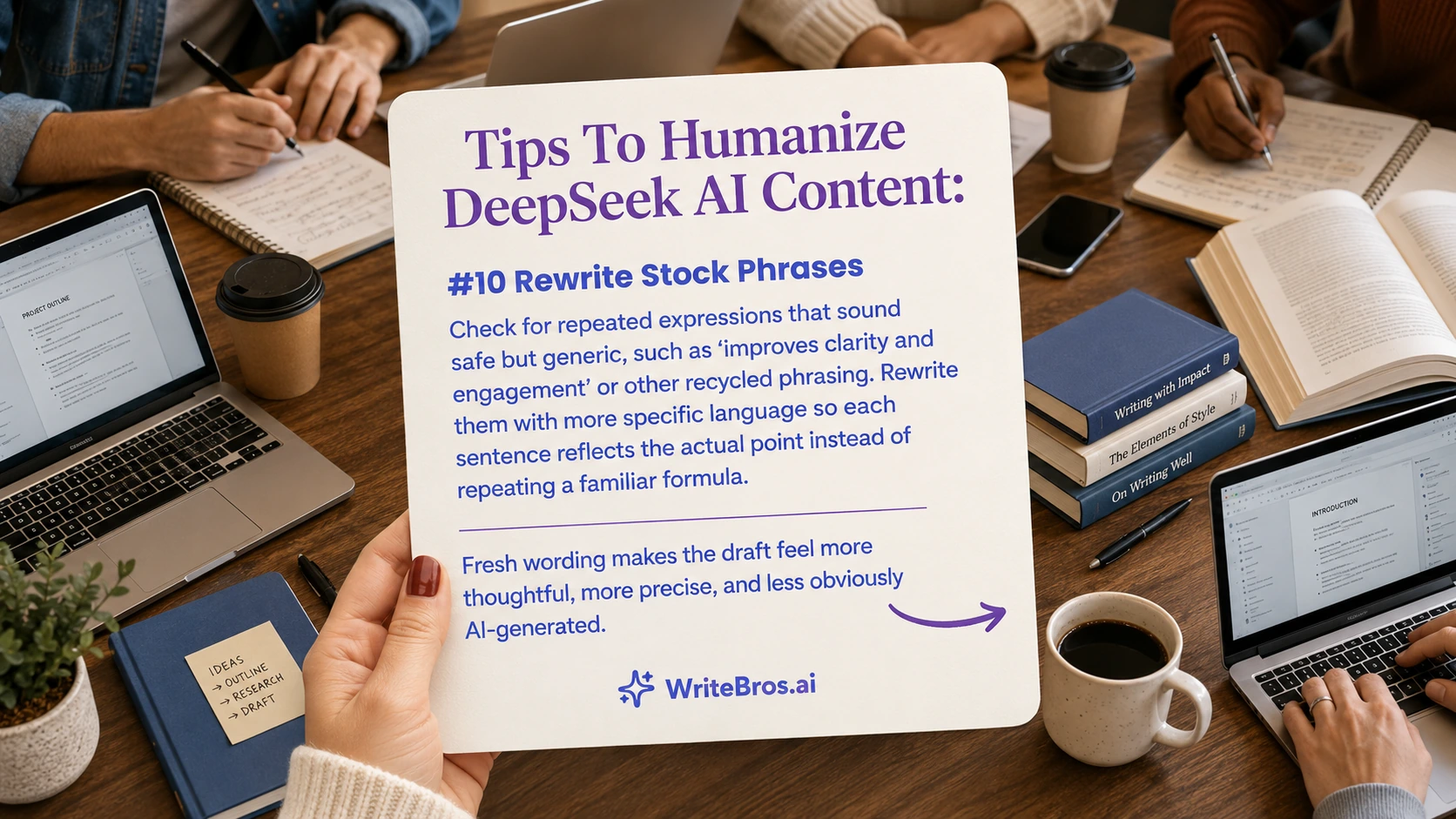
Identify repeated phrases that appear across the draft and replace them with more precise wording, because DeepSeek can rely on familiar expressions that make the content feel generated even when the ideas are useful. This matters when multiple sections use the same verbs, conclusions, openings, or value statements. Good execution keeps the meaning intact while giving each sentence a reason to exist in its own wording, rather than repeating a safe phrase with minor changes.
This works because readers notice pattern before they notice intent, and repeated phrasing can make a thoughtful article feel assembled from reusable parts. For example, if every section says a fix “improves clarity and engagement,” revise each instance to explain the actual improvement, such as reducing friction, sharpening the point, or making the next step easier. The caveat is that some repetition is useful for consistency, so change phrases that feel lazy, not terms that need to stay stable.
How to Humanize DeepSeek AI Content – Strategy #11: Place evidence carefully
Add evidence only where it helps the reader understand or trust the point, because DeepSeek can make support feel decorative when every claim receives the same kind of explanation. This strategy is useful for data-backed articles, tool comparisons, research summaries, and practical guides that need credibility without becoming heavy. Good execution places examples, observations, statistics, or references close to the claim they support, so the reader sees why they matter.
This works because evidence feels more natural when it answers a question the reader might actually have at that moment. For example, after explaining that repetitive structure hurts readability, you might bring in a small before-and-after comparison rather than dropping a broad statistic that does not affect the editing decision. The caution is that too much proof can slow the article down, so use evidence as a guidepost rather than a pile of supporting material.
How to Humanize DeepSeek AI Content – Strategy #12: Keep useful unevenness
Avoid smoothing every sentence until the draft loses its texture, because DeepSeek content often becomes more artificial when every line is equally polished, balanced, and complete. This matters when editing personal essays, opinion pieces, brand content, or any article where voice should feel present rather than invisible. Good execution allows slight variation in emphasis, sentence shape, and paragraph movement while still correcting unclear wording, repetition, and awkward phrasing.
This works because human writing usually carries traces of priority, where some ideas receive more space and others pass quickly because they are supporting details. For example, a paragraph might linger on the reader’s actual frustration before moving more briskly through a simple editing instruction. The constraint is control, because useful unevenness should feel intentional and readable, not messy, careless, or inconsistent with the article’s purpose.
How to Humanize DeepSeek AI Content – Strategy #13: Strengthen weak verbs
Replace vague verbs and passive constructions when they make the sentence feel distant, because DeepSeek can produce wording that describes action without showing who or what is actually doing the work. This is useful in explanations, process guides, and persuasive content where the reader needs clear movement from problem to fix. Good execution uses verbs that clarify responsibility, change, or cause, while still keeping the tone natural and not overly forceful.
This works because stronger verbs reduce the need for extra explanation, which often makes a sentence cleaner and more confident. For example, instead of saying a sentence “is able to be improved through editing,” you might say that editing “tightens the sentence and removes the repeated setup.” The caveat is that strong verbs should not exaggerate, because words like “transform,” “dominate,” or “guarantee” can create a different kind of artificial tone.
How to Humanize DeepSeek AI Content – Strategy #14: End with usefulness
Revise the last sentence of each section so it gives the reader something useful to carry forward, because DeepSeek often ends paragraphs with generic summaries that repeat the main point. This matters in how-to articles, list posts, and educational pages where each section should feel like it earns its place. Good execution closes with a practical reminder, a caveat, or a clear next consideration rather than a broad statement about importance.
This works because readers often remember the final line of a section as the point of the whole section, even when the earlier explanation was stronger. For example, after describing sentence rhythm, the ending might remind the reader to revise according to emphasis rather than simply alternating long and short sentences. The caution is that every ending does not need to sound profound, because a simple useful close is better than a polished line that says nothing new.
How to Humanize DeepSeek AI Content – Strategy #15: Read it aloud
Read the revised draft aloud or move through it line by line, because many AI-like patterns are easier to hear than to see on the screen. This strategy is especially helpful after heavier edits, when the wording may look cleaner but still carry repeated rhythms, stiff transitions, or unnatural emphasis. Good execution means listening for places where the sentence sounds too formal, too balanced, too long, or too unlike something a person would comfortably say.
This works because reading aloud forces the writer to experience the draft as a reader would, rather than only checking whether the ideas are technically correct. For example, a sentence that looks professional may feel awkward when spoken because it delays the main point or stacks too many abstract nouns together. The caveat is that not all written content should sound conversational, so use the aloud test to find friction, not to erase the article’s intended style.
Common mistakes
- Editing only for grammar is a common mistake because DeepSeek drafts are often grammatically clean from the start, which can make the content look finished before it actually feels natural. This backfires because the robotic quality usually comes from rhythm, structure, tone, and vague phrasing, not obvious correctness issues.
- Making the draft overly casual can also weaken the final article, especially when writers assume that sounding human means adding slang, jokes, contractions, or loose phrasing everywhere. This backfires because the piece may lose authority, confuse the intended audience, or feel performative instead of naturally clear.
- Removing too much structure can create a different problem, because some writers overcorrect when they notice that DeepSeek organized the draft too neatly. This backfires because readers still need a logical path through the article, and a more human tone does not excuse confusing order or missing transitions.
- Keeping every useful-sounding sentence is risky because AI drafts often include lines that seem reasonable on their own but repeat ideas already covered elsewhere. This backfires because the article becomes longer without becoming more helpful, and readers start to feel the drag before they can explain why.
- Adding examples without making them specific can make the draft feel even more artificial, because vague scenarios often resemble the same generic explanation in a different wrapper. This backfires because examples should prove practical understanding, and weak examples only confirm that the article is staying safely abstract.
- Trying to preserve every original sentence can slow down the editing process, especially when the draft has a useful idea trapped inside stiff phrasing. This backfires because humanization sometimes requires rebuilding the sentence around the reader’s experience, not merely swapping a few words while keeping the same machine-like shape.
- Ignoring the audience is another common issue because a sentence can sound natural for one reader and completely wrong for another. This backfires when the article shifts between expert language, beginner explanations, and promotional claims, leaving the final piece feeling inconsistent even if each sentence is technically readable.
Edge cases
Some DeepSeek drafts should stay more formal, especially when the content deals with legal, technical, academic, medical, or policy-related topics where precision matters more than conversational ease. In those cases, the goal is not to make the writing casual, but to remove needless stiffness while keeping terms, qualifications, and careful explanations intact.
There are also cases where a brand intentionally uses a polished editorial voice, so humanizing the draft should not erase that style. The better approach is to keep the brand’s level of formality while adding clearer examples, more varied rhythm, and more reader-aware phrasing that prevents the content from feeling generated.
Supporting tools
- A basic document editor helps during the first cleanup pass because it makes repeated words, long paragraphs, and awkward sentence shapes easier to notice. It is especially useful when you need to separate structural edits from deeper tone work before making more subjective revisions.
- A readability checker can show where sentences are becoming too dense, but it should be used as a diagnostic tool rather than a strict scoring system. The most useful result is not a perfect grade level, but a clearer sense of where readers may slow down.
- A text-to-speech tool can help catch robotic rhythm because it forces the draft to move at the pace of spoken language. When a sentence sounds stiff, overloaded, or strangely balanced aloud, it usually deserves another revision even if it looks acceptable on the page.
- A style guide gives the editing process a stable reference point, especially when several writers or editors are working on the same site. It helps decide how formal the writing should be, which phrases to avoid, and how much personality belongs in the content.
- A plagiarism or originality checker can be useful when the draft covers familiar topics, because AI-generated text may lean toward common phrasing even without directly copying a source. It should not replace human judgment, but it can flag passages that need fresher wording.
- An outlining tool can help reorganize sections before sentence-level editing begins, which is useful when the draft contains strong points in a weak order. It allows you to check whether the article moves from problem to explanation to application without repeating itself.
- WriteBros.ai can support the final humanization pass when the draft already has a clear structure but still needs better rhythm, more natural phrasing, and a less machine-like finish. It is most useful when paired with human review, because the best results still come from knowing the reader and the purpose of the piece.
Ready to Transform Your AI Content?
Try WriteBros.ai and make your AI-generated content truly human.
Conclusion
Humanizing DeepSeek content is not about hiding that AI helped with the draft, and it is not about making every sentence sound casual. The better goal is clarity with a human sense of judgment, where the article understands the reader, uses specific examples, and moves through ideas with rhythm that feels intentional.
Perfection is less useful than direction, especially when the draft already contains a solid idea that simply needs better expression. Focus on the places where readers may feel distance, repetition, or vague polish, then revise with enough care to make the writing sound considered, grounded, and genuinely useful.
Did You Know?
DeepSeek drafts can sound polished while still feeling generated, because human writing depends on rhythm, judgment, and reader-aware phrasing.
The strongest humanization often comes from reshaping sentence movement, examples, transitions, and tone before polishing individual words.
Ready to Transform Your AI Content?