How to Humanize Writing for Sapling AI: 15 Editorial Techniques

Updated for 2026, this guide explains how editorial techniques help writing appear more natural to detection systems like Sapling AI. Research from the Stanford Human-Centered AI study on AI text detector false positives shows why human writing patterns often confuse automated tools.
How to Humanize Writing for Sapling AI: 15 Editorial Techniques
Plenty of writers run their drafts through Sapling AI only to watch perfectly reasonable sentences get flagged as artificial. Learning AI humanizer tips for human writing becomes essential when polished content suddenly reads as machine-generated.
Much of the problem comes from patterns that look too tidy: uniform sentence structure, predictable phrasing, and ideas that arrive in perfectly spaced sequences. Writers dealing with repeated flags often start experimenting with reliable AI humanizer tools to help break those patterns before submission.
This guide walks through practical editorial moves that make writing feel less mechanical and more like something shaped through real thought. Along the way, understanding AI detection reliability can also clarify why certain writing styles trigger automated systems in the first place.
| # | Strategy focus | Practical takeaway |
|---|---|---|
| 1 | Sentence rhythm variation | Mix short and long sentences so the text feels less uniform and more conversational. |
| 2 | Natural phrasing | Rewrite stiff or formulaic lines into language that sounds closer to everyday writing. |
| 3 | Human pacing | Allow ideas to unfold at slightly uneven speeds instead of perfectly balanced paragraphs. |
| 4 | Editorial transitions | Use softer transitions that mimic how real writers move between thoughts. |
| 5 | Sentence restructuring | Rearrange sentence openings and endings to reduce predictable patterns. |
| 6 | Selective specificity | Add concrete details that feel grounded rather than generic. |
| 7 | Imperfect symmetry | Avoid paragraphs that mirror each other too closely in length or structure. |
| 8 | Context layering | Introduce small clarifications or side notes that feel naturally human. |
| 9 | Voice modulation | Adjust tone slightly across sections so the writing does not sound mechanically consistent. |
| 10 | Idea expansion | Develop key points with small elaborations instead of compact summaries. |
| 11 | Paragraph breathing room | Let paragraphs stretch or compress naturally instead of forcing identical lengths. |
| 12 | Subtle opinion cues | Introduce mild perspective markers that suggest human interpretation. |
| 13 | Realistic emphasis | Highlight certain ideas more than others rather than treating every point equally. |
| 14 | Editorial smoothing | Remove rigid or overly formal phrasing that can resemble automated writing. |
| 15 | Revision layering | Apply a second editing pass that focuses on tone and flow instead of grammar alone. |
15 Editorial Techniques to Humanize Writing for Sapling AI
How to Humanize Writing for Sapling AI – Strategy #1: Sentence rhythm variation
One of the easiest ways to humanize writing for Sapling AI is to intentionally vary sentence rhythm so the text stops sounding like it came from a perfectly balanced generator. Human writers naturally move between longer explanations and shorter clarifying statements as their thoughts develop, which creates an uneven cadence that feels authentic rather than algorithmically tidy. When every sentence follows a similar length or pacing pattern, automated detectors often interpret that uniformity as synthetic structure rather than organic reasoning.
A helpful technique is reading a paragraph aloud and noticing whether the pacing feels mechanical or conversational, because overly consistent rhythm tends to stand out immediately when spoken. If you notice several sentences that mirror each other in length or structure, rewriting one with additional context and trimming another can restore the irregular flow that readers expect from real editorial writing. This subtle adjustment works well because Sapling AI frequently responds to patterns, and breaking predictable rhythm patterns helps the writing feel closer to natural human composition.
How to Humanize Writing for Sapling AI – Strategy #2: Natural phrasing
Learning how to humanize writing for Sapling AI also requires replacing rigid phrasing with language that resembles the way people naturally explain ideas during conversation. AI generated text often relies on safe, predictable constructions that feel technically correct but slightly detached from real editorial voice, which is why passages sometimes appear smooth yet oddly impersonal. Reworking those sentences with everyday wording and contextual nuance introduces the kind of small irregularities that appear when people think through ideas rather than assembling them mechanically.
Writers can start this process by identifying sentences that sound overly polished or textbook-like and asking how they might explain the same idea to a colleague or reader in a discussion. Often the revised version contains a slightly different structure, an extra clarifying phrase, or a small qualification that makes the reasoning feel more grounded in real thought. These subtle adjustments shift the tone away from algorithmic neutrality and toward the conversational clarity that Sapling AI tends to associate with authentic human writing.
How to Humanize Writing for Sapling AI – Strategy #3: Human pacing
Another reliable way to humanize writing for Sapling AI is to allow ideas to develop with uneven pacing instead of compressing every concept into symmetrical paragraphs. Real writers sometimes linger on a point that deserves extra explanation, then move more quickly through supporting context once the core idea becomes clear. When every paragraph unfolds with the same structural rhythm and identical informational density, automated systems may interpret that precision as a signal of machine generated composition.
Introducing human pacing simply means letting the structure reflect how a thought would realistically develop during editing or reflection. A paragraph might begin with a longer explanatory sentence that sets up the idea, followed by a clarifying sentence and then a reflective expansion that explores a practical implication. This gradual movement through the idea mirrors the way humans refine thoughts during revision, which helps reduce the structured uniformity that Sapling AI detection models sometimes flag.
How to Humanize Writing for Sapling AI – Strategy #4: Editorial transitions
Editorial transitions also play a meaningful role in how to humanize writing for Sapling AI because they shape how ideas connect across sentences and paragraphs. AI produced text often uses highly predictable linking phrases that move mechanically from one point to the next, which creates the impression of formulaic structure rather than reflective reasoning. Human writing tends to contain softer transitions that acknowledge context, clarify intent, or gently reposition the discussion before introducing the next thought.
Revising transitions can dramatically improve authenticity because it shifts the flow of the piece from rigid sequencing to editorial storytelling. Instead of moving directly into the next claim, writers might briefly reference the previous point or frame the upcoming idea as a continuation of the earlier discussion. These small connective moments mimic the natural thought process of a writer guiding readers through a developing argument, which often reduces the structured signals Sapling AI associates with automated text.
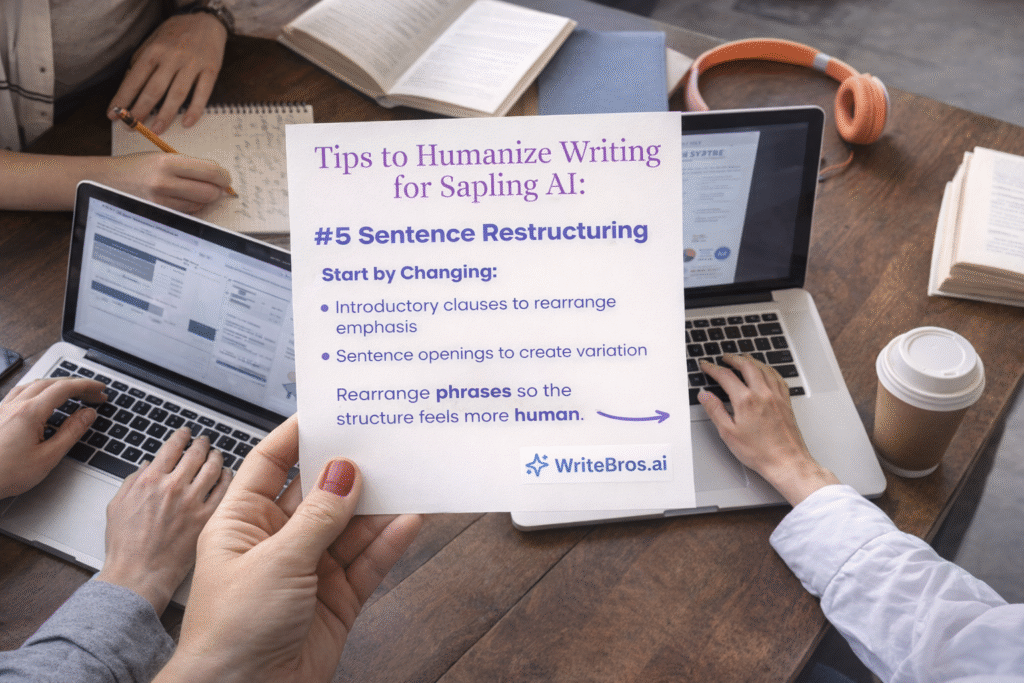
How to Humanize Writing for Sapling AI – Strategy #5: Sentence restructuring
Sentence restructuring is a powerful technique when learning how to humanize writing for Sapling AI because AI systems frequently rely on predictable sentence openings and grammatical templates. Many automated drafts repeatedly begin with similar subject structures or explanatory phrasing, which creates recognizable patterns that detection tools can identify across longer passages. Altering those patterns by rearranging clauses or shifting emphasis within the sentence helps disrupt the structural consistency that machines tend to produce.
One effective approach is rewriting sentences so that key ideas appear in different positions throughout the paragraph rather than always appearing at the beginning. A sentence might open with contextual framing before revealing the main point, or it might begin with an observation that gradually leads to the conclusion. This variation mirrors the exploratory structure of real editorial writing, where ideas evolve through revision rather than emerging in perfectly formatted sequences.
How to Humanize Writing for Sapling AI – Strategy #6: Selective specificity
Selective specificity is an important component of how to humanize writing for Sapling AI because human writers rarely rely entirely on generalized language when explaining a concept. Real writing often includes small contextual details that make the explanation feel grounded in observation rather than assembled through statistical prediction. When text contains only broad, universally safe phrasing, detection systems sometimes interpret that neutrality as a sign of automated generation.
Adding specificity does not require dramatic storytelling or personal anecdotes, but it does mean introducing meaningful context that clarifies how an idea appears in practice. A writer might describe a common editorial scenario, explain how a sentence changed during revision, or clarify the reasoning behind a stylistic adjustment. These contextual additions introduce subtle complexity into the writing, which helps Sapling AI perceive the text as reflective analysis rather than formulaic generation.
How to Humanize Writing for Sapling AI – Strategy #7: Imperfect symmetry
Imperfect symmetry is another valuable principle when exploring how to humanize writing for Sapling AI because human writing rarely follows perfectly balanced structural patterns. AI systems frequently generate paragraphs that contain identical sentence counts, evenly spaced explanations, and mirrored phrasing that appears unusually tidy across an entire section. That level of symmetry may appear polished on the surface, yet it can signal algorithmic generation to detection systems.
Breaking that symmetry can be as simple as allowing one paragraph to explore an idea more deeply while the next paragraph provides a concise clarification. Writers might expand on a concept with additional explanation or briefly pause to acknowledge nuance before continuing the discussion. These structural variations introduce the slight irregularities that emerge naturally when a writer revises content thoughtfully rather than constructing it through predictable templates.
How to Humanize Writing for Sapling AI – Strategy #8: Context layering
Context layering helps humanize writing for Sapling AI because authentic editorial writing rarely presents ideas in isolation without surrounding explanation. Writers typically introduce background context, clarify why the idea matters, and then connect the point to broader implications or practical scenarios. When a paragraph jumps directly from claim to claim without those contextual layers, the result can feel compressed and mechanically efficient.
Adding layered context means briefly expanding the reasoning behind a statement so readers can understand the thought process guiding the explanation. A writer might explain why a certain stylistic pattern appears frequently in AI generated text before discussing how to correct it during editing. This layered structure mirrors the reflective pacing of human writing, which gradually builds understanding rather than presenting ideas as isolated informational blocks.
How to Humanize Writing for Sapling AI – Strategy #9: Voice modulation
Voice modulation is another practical method for understanding how to humanize writing for Sapling AI because human writing rarely maintains exactly the same tonal register across an entire article. Writers naturally adjust tone as they explain complex ideas, introduce examples, or summarize observations, which produces subtle variation in language and emphasis. AI generated content often maintains a consistent neutral tone from beginning to end, which can appear unnaturally uniform.
Adjusting voice across sections introduces the gentle tonal movement that readers expect from thoughtful editorial work. One section might sound slightly analytical while another becomes more explanatory or reflective as the argument develops. These tonal shifts mimic the evolving perspective of a writer guiding readers through a topic, which helps reduce the rigid tonal consistency that detection systems sometimes interpret as machine produced writing.
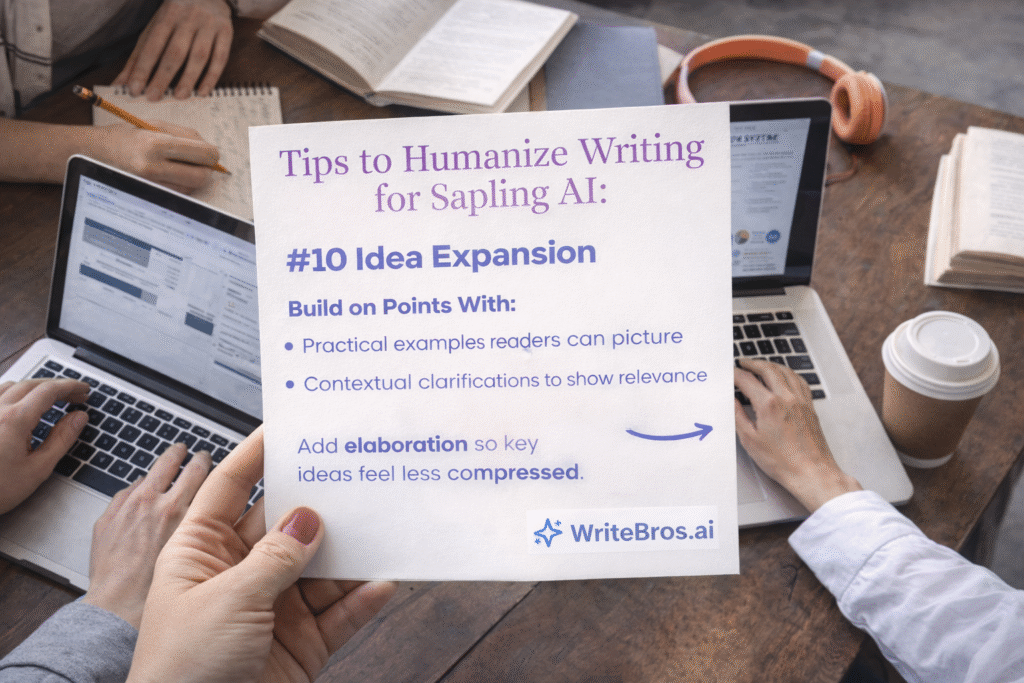
How to Humanize Writing for Sapling AI – Strategy #10: Idea expansion
Idea expansion plays a key role in how to humanize writing for Sapling AI because AI generated passages often summarize ideas quickly instead of gradually exploring their implications. Human writers tend to expand on important points by clarifying the reasoning behind them, describing how they appear in real writing situations, or connecting them to related observations. When every idea appears in a tightly compressed format, the text can appear algorithmically efficient rather than thoughtfully developed.
Expanding ideas encourages writers to slow the pace of explanation and explore the reasoning behind a statement with greater depth. A paragraph might begin with the main point, then gradually unpack the reasoning and consequences that follow from that observation. This expanded reasoning mirrors the analytical process that occurs during human editing, which helps the writing feel reflective rather than mechanically generated.
How to Humanize Writing for Sapling AI – Strategy #11: Paragraph breathing room
Paragraph breathing room is an understated but effective tactic when learning how to humanize writing for Sapling AI because human writers rarely compress ideas into tightly structured informational blocks. Real editorial writing tends to allow concepts space to develop gradually as the explanation unfolds through reflection and clarification. When every paragraph appears densely packed with evenly distributed information, the structure can resemble algorithmic efficiency rather than thoughtful communication.
Allowing breathing room means giving the paragraph space to guide the reader through the idea instead of presenting all details simultaneously. A writer might introduce a concept, pause to clarify its significance, and then return to the main argument with additional context. This pacing reflects the natural rhythm of human reasoning, which typically unfolds through gradual explanation rather than perfectly condensed information delivery.
How to Humanize Writing for Sapling AI – Strategy #12: Subtle opinion cues
Subtle opinion cues help humanize writing for Sapling AI because authentic editorial writing frequently contains small signals of interpretation or perspective. Writers often frame ideas with cautious qualifiers, reflective observations, or clarifying commentary that acknowledges nuance in the discussion. AI generated text tends to avoid these interpretive signals in favor of neutral statements that appear consistently objective.
Introducing subtle perspective cues allows the writing to reflect the analytical thinking behind the explanation. A writer might briefly note why a certain stylistic pattern appears convincing or clarify why a particular editing technique tends to produce better results. These understated cues reveal the presence of human judgment within the text, which adds interpretive depth that automated systems rarely reproduce naturally.
How to Humanize Writing for Sapling AI – Strategy #13: Realistic emphasis
Realistic emphasis is an essential technique in how to humanize writing for Sapling AI because human writers naturally highlight certain ideas more strongly than others. During the editing process, some points receive extended explanation while supporting ideas remain shorter and more concise. AI generated content often treats every point with identical structural importance, which can produce an unnaturally balanced presentation.
Adjusting emphasis involves expanding on the most meaningful observations while allowing smaller supporting points to remain brief. This creates a hierarchy of importance that mirrors the way human reasoning prioritizes ideas during writing. The resulting variation in emphasis helps break the evenly distributed structure that automated detection tools sometimes associate with machine generated text.
How to Humanize Writing for Sapling AI – Strategy #14: Editorial smoothing
Editorial smoothing is a practical step in how to humanize writing for Sapling AI because AI generated drafts sometimes contain phrasing that feels overly rigid or technically precise. While grammatically correct, these phrases can sound slightly detached from the conversational clarity that characterizes human writing. Revising those passages with smoother language often restores the natural flow readers expect from editorial content.
This process involves identifying sections that read more like documentation than explanation and rewriting them with greater narrative fluidity. A writer might combine ideas into a more natural sequence or clarify relationships between sentences so the logic unfolds gradually. These refinements introduce the organic rhythm that develops during human editing, helping the writing feel less like a generated output and more like a thoughtful revision.
How to Humanize Writing for Sapling AI – Strategy #15: Revision layering
Revision layering represents the final stage of how to humanize writing for Sapling AI because authentic writing rarely emerges fully formed in a single draft. Most human authors refine their work through multiple editing passes that gradually improve clarity, tone, and structural balance. AI generated text often lacks this layered revision process, which can leave subtle patterns intact across the entire passage.
Applying a second editorial pass that focuses purely on flow and tone can dramatically improve authenticity. During this pass, writers examine sentence rhythm, transition clarity, and contextual depth rather than grammar alone. This layered revision process reflects the way real writing evolves through reflection and adjustment, which helps reduce the structural patterns Sapling AI detection models sometimes identify.
Common mistakes
- Many writers attempting to humanize text focus only on replacing a few words rather than examining the deeper structural patterns that Sapling AI detection systems analyze. When the overall rhythm, paragraph structure, and sentence symmetry remain unchanged, the text still carries the statistical patterns that automated models associate with generated writing.
- Another frequent mistake occurs when writers try to make the text sound human by inserting exaggerated conversational language or unnecessary filler phrases. Instead of improving authenticity, this approach often creates an unnatural tone that feels forced and inconsistent with the rest of the article’s editorial style.
- Some writers mistakenly believe that shortening sentences will automatically make their writing appear more human, which leads to overly fragmented paragraphs filled with abrupt statements. Real editorial writing typically relies on longer explanatory sentences that connect ideas smoothly, so excessive brevity can actually reduce authenticity.
- A common problem appears when writers rely entirely on automated rewriting tools without performing manual editorial review afterward. These tools may change wording but often preserve the same structural patterns that Sapling AI detection systems analyze when evaluating whether content appears machine generated.
- Another mistake happens when writers attempt to disguise AI generated text by adding unrelated details or loosely connected sentences. Instead of improving realism, these additions often interrupt the logical flow of the argument and make the overall structure appear inconsistent or artificially expanded.
- Writers sometimes focus exclusively on vocabulary changes while ignoring paragraph structure, which is one of the strongest signals detection systems evaluate. If each paragraph still follows identical length patterns and balanced sentence structures, the text can remain statistically similar to machine generated content.
Edge cases
There are situations where even well edited writing may still appear slightly algorithmic to Sapling AI detection systems, especially when the topic requires clear technical explanation or structured instructional language. In these contexts the writing naturally becomes more systematic because the author must present steps, definitions, or logical sequences in a precise format that resembles machine generated structure.
Another edge case appears in highly edited professional publications where writers intentionally smooth every sentence to maintain a consistent editorial tone. While this level of polish improves readability, it can sometimes remove the natural irregularities that detection systems interpret as signals of human authorship, which means the writing may benefit from subtle rhythm variation even in formal contexts.
Supporting tools
- Grammar and editing platforms such as Grammarly can help writers identify rigid sentence structures and overly formal phrasing that might make text appear mechanical. While these tools primarily focus on grammar and clarity, their suggestions often highlight areas where the writing could benefit from more natural phrasing.
- Advanced paraphrasing tools provide an additional editing layer by offering alternative sentence structures that break predictable patterns across paragraphs. Used carefully, they can help writers experiment with phrasing variations before refining the final version through manual editing.
- Readability analysis tools allow writers to evaluate sentence complexity, pacing, and paragraph structure across a document. Observing how readability scores fluctuate across sections can reveal overly uniform patterns that may contribute to automated detection signals.
- Document comparison tools are useful for reviewing how a revised draft differs from an earlier version of the text. Writers can examine structural changes across revisions to confirm that sentence rhythm and paragraph patterns have become more varied.
- AI detection testing platforms allow writers to review how different revisions perform under automated evaluation systems. Running drafts through multiple testing tools provides insight into which structural adjustments reduce the patterns detection models typically flag.
- WriteBros.ai provides specialized rewriting and editing features designed to help writers refine AI generated drafts into more natural editorial prose. Its tools focus on improving flow, sentence variation, and contextual depth so the final text reads like thoughtfully edited writing rather than algorithmic output.
Ready to Transform Your AI Content?
Try WriteBros.ai and make your AI-generated content truly human.
Conclusion
Learning how to humanize writing for Sapling AI ultimately comes down to restoring the subtle irregularities that appear naturally when people think through ideas during writing and revision. Sentence rhythm, contextual depth, and structural variation all contribute to writing that feels reflective rather than mechanically generated.
Perfection is rarely the goal in authentic editorial writing, because real authors revise gradually while refining clarity and tone. Approaching the editing process with intention and patience helps the writing evolve into something that reflects human reasoning rather than predictable patterns.
Did You Know?
When people attempt to humanize writing for Sapling AI, they often focus on rewriting vocabulary or running the text through a paraphrasing tool, yet detectors typically measure structural patterns across the entire page rather than evaluating single sentences. If each paragraph follows the same rhythm, repeats similar transitions, and presents ideas in identical structures, the writing can appear algorithmically consistent.
Edits that reshape how ideas unfold tend to work better because they mimic the irregular pacing of real editorial writing. Allow one paragraph to introduce a concept briefly while the next expands with clarification or nuance, instead of giving every section the same amount of explanation and the same sentence flow. Once the structure becomes less symmetrical, Sapling’s pattern analysis often interprets the writing as more human.
Ready to Transform Your AI Content?