How to Lower GPTZero AI Score: 15 Responsible Revisions

Lower your GPTZero AI score responsibly with structured, voice-preserving revisions that reduce uniform patterns and improve authenticity. Research published in Science shows AI-generated text carries detectable linguistic signatures, reinforcing the value of human variation and contextual detail.
How to Lower GPTZero AI Score: 15 Responsible Revisions
You submit your draft, run it through GPTZero, and suddenly your confidence drops when the score comes back higher than expected. Understanding AI detection accuracy helps explain why thoughtful, original writing can still trigger automated flags.
Patterns, predictability, and overly polished phrasing can quietly inflate your score, even when the ideas are genuinely yours. That’s why many writers look into most reliable AI humanizer tools for GPTZero false positives to see how structure and rhythm influence detection systems.
The good news is that you don’t need shortcuts or gimmicks to bring that number down. With a clear understanding of Turnitin AI detection trends and a set of responsible revisions, you can lower your GPTZero score while keeping your voice and credibility intact.
| # | Strategy focus | Practical takeaway |
|---|---|---|
| 1 | Sentence rhythm variation | Break predictable cadence patterns so your draft reads more naturally and less mechanically. |
| 2 | Specific detail layering | Replace broad statements with concrete examples that reflect lived experience or real context. |
| 3 | Personal voice calibration | Adjust tone and phrasing so the writing reflects how you actually speak and think. |
| 4 | Structural unpredictability | Rework formulaic paragraph shapes so ideas unfold in a less templated way. |
| 5 | Transitional softening | Swap rigid connectors for smoother transitions that feel less scripted. |
| 6 | Concept reframing | Restate key points in your own language instead of echoing common phrasing. |
| 7 | Contextual anchoring | Tie arguments to specific situations so the content feels grounded rather than generic. |
| 8 | Micro-editing for nuance | Introduce subtle qualifiers and clarifications that reflect real uncertainty. |
| 9 | Active revision passes | Review the draft multiple times with different focuses instead of relying on one sweep. |
| 10 | Length modulation | Adjust sentence and paragraph length to avoid uniform blocks of text. |
| 11 | Example-driven clarity | Illustrate abstract claims with brief, realistic scenarios. |
| 12 | Logical flow checks | Ensure each idea builds naturally on the last rather than following a rigid template. |
| 13 | Intentional imperfection | Allow natural phrasing and minor asymmetry instead of over-polishing every line. |
| 14 | Voice consistency audit | Confirm the entire piece sounds like the same person throughout. |
| 15 | Final validation pass | Run a measured recheck and adjust only where patterns remain obvious. |
15 Responsible Revisions to How to Lower GPTZero AI Score
How to Lower GPTZero AI Score – Strategy #1: Vary sentence rhythm
To lower your GPTZero AI score responsibly, begin by examining the rhythm of your sentences and noticing whether they follow a predictable, evenly spaced cadence that feels almost mechanically timed. When every line lands at roughly the same length and structure, detection systems can interpret that uniformity as machine-assisted composition, even if the ideas are entirely your own. Intentionally mixing shorter reflections with longer, layered explanations introduces a natural rise and fall that mirrors how people actually think through complex ideas in real time.
This works because human writing rarely maintains perfect balance; it stretches, compresses, and occasionally lingers on a point longer than strictly necessary. Imagine revising a draft where every sentence contains two clauses joined neatly with a comma, then deliberately breaking that pattern by inserting a brief aside or expanding one section into a more detailed explanation. The goal is not randomness but thoughtful variation, ensuring your prose feels lived-in rather than engineered.
How to Lower GPTZero AI Score – Strategy #2: Add specific detail
Generic phrasing is one of the fastest ways to inflate a detection score, because broad statements often resemble patterns found across large training datasets. To lower your GPTZero AI score, replace abstract claims with grounded, concrete detail that reflects a real scenario, a particular setting, or a specific constraint you encountered. When readers can visualize what you describe, whether it is a late-night editing session or a deadline-driven rewrite, the writing becomes less formulaic and more distinctly yours.
This strategy works because specificity introduces irregularity that algorithms struggle to categorize as templated language. Consider revising a line such as “many writers face challenges” into a description of a graduate student revising a thesis at midnight while refreshing the detection dashboard. That layered context reshapes the sentence into something less predictable and more authentically human.
How to Lower GPTZero AI Score – Strategy #3: Calibrate your voice
Lowering your GPTZero AI score often requires adjusting tone so that the writing aligns with how you genuinely communicate rather than how you assume formal prose should sound. Many drafts become artificially polished, smoothing away hesitations and personality in favor of overly refined phrasing that inadvertently mirrors model outputs. Reintroducing subtle qualifiers, personal phrasing habits, and natural transitions restores a voice that feels recognizably individual.
This matters because detection systems frequently flag text that sounds uniformly neutral and overly balanced in tone. If your natural style includes reflective pauses or slightly conversational phrasing, allowing those traits to remain in the draft can reduce mechanical uniformity. Authentic voice, even in academic or professional contexts, tends to include texture that algorithms do not replicate perfectly.
How to Lower GPTZero AI Score – Strategy #4: Break structural templates
Another responsible way to lower your GPTZero AI score is to review the overall structure of your paragraphs and ask whether each one follows an identical formula. When every paragraph opens with a claim, expands with two supporting lines, and closes with a tidy summary, the consistency may appear algorithmic. Rearranging the order of explanation, embedding clarification mid-paragraph, or allowing a point to unfold gradually disrupts that uniform blueprint.
This approach works because human reasoning does not always present itself in symmetrical blocks. A paragraph might circle back to an earlier idea, introduce a clarifying example halfway through, or conclude with an open-ended reflection instead of a neat wrap-up. That organic movement signals authentic composition rather than systematic generation.
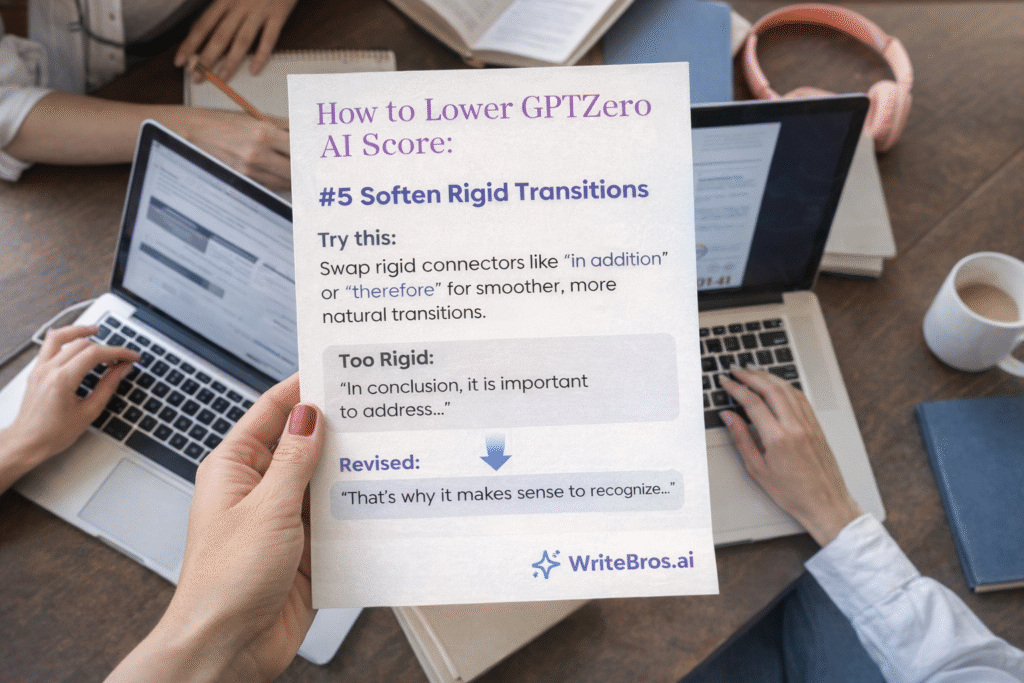
How to Lower GPTZero AI Score – Strategy #5: Soften rigid transitions
Rigid connectors such as “in conclusion” or “furthermore” repeated throughout a draft can contribute to elevated detection patterns. To lower your GPTZero AI score, replace formulaic transitions with more fluid phrasing that grows naturally out of the previous sentence. Rather than announcing every shift in argument, allow the ideas to flow through contextual cues and subtle continuation.
This works because algorithmic text often leans heavily on standardized transition markers. Revising a paragraph so that the next idea emerges through reflection or contrast, instead of a labeled signpost, introduces unpredictability in how the narrative advances. Over time, these micro-adjustments reshape the entire piece into something less template-driven.
How to Lower GPTZero AI Score – Strategy #6: Reframe core concepts
Lowering your GPTZero AI score can require revisiting central ideas and expressing them in language that feels personally constructed rather than commonly circulated. When key points rely on widely used phrasing, even unintentionally, they may resemble patterns embedded in large training corpora. Reframing the concept in your own syntax, perhaps by shifting emphasis or redefining the terms, introduces distinctiveness that signals human authorship.
This is effective because algorithms often identify repeated linguistic structures more than original thought. Imagine taking a standard explanation of algorithmic bias and recasting it through a real classroom discussion you once observed. The altered framing transforms familiar content into uniquely structured prose.
How to Lower GPTZero AI Score – Strategy #7: Anchor arguments in context
Contextual anchoring means situating your ideas within a specific time, place, or circumstance instead of presenting them in isolation. To lower your GPTZero AI score, describe when the issue surfaced, who was involved, or what constraint shaped your decision-making process. These contextual layers add irregularity that disrupts overly generalized patterns.
Human writing frequently ties abstract reasoning to lived experience, even subtly. A reflection that references a particular workshop discussion or client feedback session immediately diverges from standardized phrasing. The more naturally embedded the context, the less predictable the linguistic footprint becomes.
How to Lower GPTZero AI Score – Strategy #8: Introduce nuanced qualifiers
Overly absolute language can contribute to mechanical impressions because it lacks the hesitation that characterizes real thought. Lower your GPTZero AI score by incorporating nuanced qualifiers that reflect uncertainty, evolving understanding, or situational limits. Phrases that acknowledge complexity add dimension and break rigid certainty patterns.
This approach works because authentic reasoning often contains careful distinctions rather than sweeping declarations. When a statement notes that a method works in most cases but falters under tight deadlines, the added nuance creates texture. That subtle complexity is harder to replicate in uniform model outputs.
How to Lower GPTZero AI Score – Strategy #9: Revise in focused passes
Rather than attempting a single comprehensive edit, lower your GPTZero AI score through multiple revision passes, each dedicated to a different dimension such as rhythm, specificity, or tone. This layered process encourages deeper refinement and reduces the likelihood of uniform phrasing slipping through. Each focused review invites fresh adjustments that collectively reshape the draft.
In practice, you might spend one session lengthening compressed ideas and a later session trimming excess symmetry. This staggered attention mirrors authentic writing habits, where clarity emerges gradually rather than instantaneously. The cumulative variation strengthens the human signature of the text.
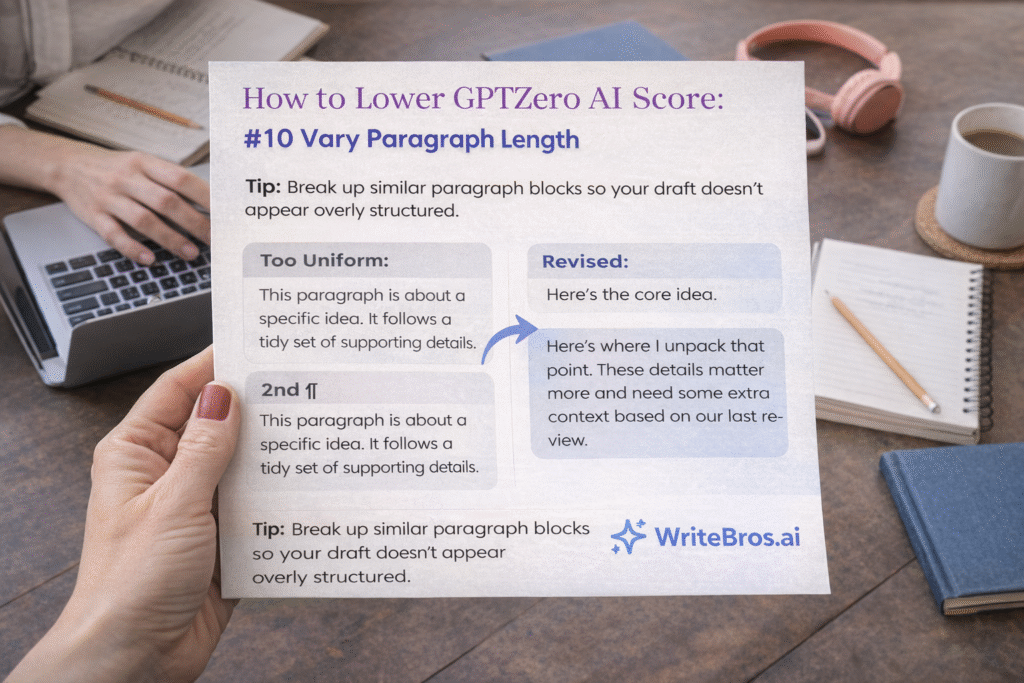
How to Lower GPTZero AI Score – Strategy #10: Adjust paragraph length
Uniform paragraph blocks can resemble automated composition because they suggest strict structural symmetry. To lower your GPTZero AI score, vary paragraph length so that some sections expand thoughtfully while others remain concise yet complete. The visual and cognitive diversity interrupts mechanical regularity.
This works because natural writing adapts to the density of the idea being expressed. A complex explanation may require sustained elaboration, whereas a clarifying note might stand alone. Allowing that imbalance reflects authentic reasoning patterns.
How to Lower GPTZero AI Score – Strategy #11: Use illustrative scenarios
Abstract reasoning can inflate detection patterns when it lacks grounding in lived or plausible experience. Lower your GPTZero AI score by weaving short illustrative scenarios into your explanation, clarifying how the principle unfolds in practice. These narrative touches introduce asymmetry and detail.
A brief depiction of a writer revising under deadline pressure adds nuance that generalized advice cannot capture. The specificity reshapes the prose into something textured and situational. Algorithms struggle with the variability introduced through contextual storytelling.
How to Lower GPTZero AI Score – Strategy #12: Review logical flow organically
Lowering your GPTZero AI score also involves ensuring that ideas connect organically rather than through rigid sequencing. Instead of forcing a predetermined outline, allow the reasoning to evolve in a way that mirrors authentic thought progression. Transitional logic should feel discovered, not imposed.
This can mean revisiting earlier sentences and weaving clarifications into later sections rather than isolating them. Such integration produces layered coherence instead of formulaic step-by-step exposition. The result feels more reflective than procedural.
How to Lower GPTZero AI Score – Strategy #13: Allow minor asymmetry
Perfection can sometimes signal artificial polish, especially when every clause aligns neatly. To lower your GPTZero AI score, permit small asymmetries in phrasing or emphasis that mirror natural drafting habits. Thoughtful imperfection can humanize otherwise balanced prose.
That does not mean accepting careless writing, but rather resisting the urge to standardize every rhythm. A slightly longer clarification tucked into one paragraph, or an unexpected pivot mid-sentence, can reduce structural predictability. Subtle variation often carries greater authenticity than flawless symmetry.
How to Lower GPTZero AI Score – Strategy #14: Audit voice consistency
Lower your GPTZero AI score by reviewing the entire piece for tonal consistency, ensuring it reflects a single coherent perspective. Sudden stylistic shifts may resemble stitched segments and trigger detection concerns. Harmonizing vocabulary and pacing strengthens the sense of unified authorship.
Read the draft aloud and notice where the voice feels unfamiliar or overly refined. Those sections often require gentle recalibration rather than wholesale rewriting. Consistency grounded in genuine expression reinforces credibility.
How to Lower GPTZero AI Score – Strategy #15: Validate thoughtfully
After revision, lower your GPTZero AI score through a measured validation pass rather than reactive over-editing. Review flagged sections calmly and ask whether patterns remain repetitive or overly uniform. Adjust only where necessary, preserving authentic structure.
Responsible validation recognizes that no draft achieves absolute unpredictability. The aim is credibility and clarity, not evasion. Thoughtful moderation prevents unnecessary distortion of your original voice.
Common mistakes
- Over-editing flagged sections in a panic, which often leads to awkward phrasing and distorted meaning that ultimately undermines clarity and weakens the authenticity you were trying to protect in the first place.
- Relying entirely on automated rewriting tools without reviewing the output carefully, resulting in text that may appear even more uniform and detached from your original perspective.
- Removing all personal nuance in an attempt to sound more formal, which can ironically increase uniformity and make the prose resemble standardized model responses.
- Ignoring structural repetition across paragraphs, focusing only on individual sentences rather than the broader patterns that detection systems evaluate.
- Substituting synonyms mechanically without reconsidering sentence logic, which can create unnatural phrasing that feels inconsistent and forced.
- Chasing a perfect score instead of prioritizing clarity and coherence, leading to unnecessary revisions that dilute meaning.
Edge cases
Some highly technical or data-heavy writing may naturally resemble structured patterns, even when authored independently. In these situations, lowering your GPTZero AI score may require focusing more on contextual explanation and interpretive commentary rather than altering technical terminology.
Similarly, collaborative documents with multiple contributors can display tonal shifts that resemble stitched outputs. A careful harmonization pass that aligns voice and pacing can address this without rewriting substantive content.
Supporting tools
- Grammar review software that highlights sentence length distribution, helping you identify overly uniform patterns before running detection checks.
- Read-aloud applications that surface rhythm issues and repetitive cadence when you listen to your draft rather than scanning silently.
- Revision tracking tools that allow you to compare structural changes across drafts and monitor how patterns evolve.
- Outline visualization platforms that reveal paragraph symmetry and structural repetition at a glance.
- Peer review sessions that introduce human feedback focused on tone authenticity rather than numerical scores.
- WriteBros.ai for structured, responsible revisions that preserve voice while improving natural variation.
Ready to Transform Your AI Content?
Try WriteBros.ai and make your AI-generated content truly human.
Conclusion
Lowering your GPTZero AI score responsibly is less about evasion and more about restoring the natural variability that defines human writing. Through deliberate revisions that enhance specificity, rhythm, and contextual grounding, your work can reflect genuine authorship without sacrificing clarity.
Perfection is not the objective; thoughtful expression is. When you focus on intention, coherence, and authentic voice, the numerical score becomes a byproduct rather than the central concern.
Did You Know?
If you are working on How to Lower GPTZero AI Score, it helps to know that detection systems tend to quantify consistency more than they judge one-off vocabulary choices, so a draft can be fully original and still look suspicious if it keeps the same rhythm throughout, with evenly sized sentences, similarly balanced clauses, and paragraphs that never change pace even when the topic becomes more complex. That steady sameness is easy for an algorithm to measure, even though a human reader might interpret it as clean writing and never consciously notice the repeating structure. When your text reads like it was carefully polished in one uninterrupted sweep, you can unintentionally create the exact kind of uniform pattern that pushes scores upward.
Revisions that deepen explanation, add context tied to your purpose, and allow your reasoning to evolve inside a paragraph tend to matter more, because real writing often contains clarifying phrases, small course corrections, and an uneven distribution of attention that reflects what was genuinely hard to explain versus what was easy to say. Think of the difference between a draft that repeats three points in the same structure each time, and a draft that pauses to qualify a claim, gives a specific detail that anchors it, and then reconnects that point to the main argument in a slightly different voice. When your writing shows those natural variations, the statistical signals often move closer to what detectors expect from human drafting, which can lower the score without compromising your intent.
Ready to Transform Your AI Content?