How to Reduce Turnitin AI Score: 15 Responsible Editing Steps

In 2026, reducing AI detection flags requires structured, human-centered editing grounded in evidence. Research published in Computers and Education: Artificial Intelligence by Elsevier confirms that AI detection systems produce measurable false positives, supporting careful revision over shortcuts.
How to Reduce Turnitin AI Score: 15 Responsible Editing Steps
If you are trying to figure out how to reduce Turnitin AI score, you are likely staring at a report that does not match the work you actually wrote. That frustration grows fast, especially when AI detection accuracy is still an evolving area and not a perfect science.
The confusion usually happens because structured, polished writing can resemble predictable AI patterns. Many writers then panic and rely on random fixes instead of understanding what Turnitin AI detection accuracy statistics actually suggest about how these systems interpret text.
This guide breaks down how to reduce Turnitin AI score using practical, responsible editing steps rather than shortcuts. You will learn how to revise thoughtfully, apply insights from best AI rewriter tools without overcorrecting, and strengthen your writing so it reflects your own thinking clearly.
| # | Strategy focus | Practical takeaway |
|---|---|---|
| 1 | Audit flagged sections | Start by reviewing highlighted passages closely so you know what actually needs revision instead of rewriting everything blindly. |
| 2 | Strengthen your thesis voice | Clarify your core argument so the paper reflects your reasoning rather than a generic, evenly structured tone. |
| 3 | Vary sentence rhythm | Adjust pacing and structure to sound more natural and less mechanically balanced. |
| 4 | Add specific examples | Ground abstract claims in concrete situations that show personal understanding and applied thinking. |
| 5 | Refine transitions | Replace predictable connectors with smoother, context-aware transitions that match your logic. |
| 6 | Clarify citations | Make sure sources are properly introduced and discussed instead of dropped in without commentary. |
| 7 | Adjust paragraph flow | Break up uniform blocks of text so ideas unfold in a more organic progression. |
| 8 | Personalize analysis | Insert interpretation and reasoning to demonstrate your thought process rather than summary alone. |
| 9 | Reduce formulaic phrasing | Identify repeated academic templates and rewrite them in language that feels more like your own. |
| 10 | Check tone consistency | Align voice, level of formality, and vocabulary so the paper reads as a cohesive whole. |
| 11 | Rework introductions | Move beyond broad opening statements and focus on precise framing that reflects your real angle. |
| 12 | Deepen explanations | Expand thin sections with reasoning and clarification so the argument shows depth. |
| 13 | Trim over-polished lines | Simplify overly perfect sentences that sound generated instead of thoughtfully revised. |
| 14 | Read aloud for flow | Use vocal review to catch unnatural phrasing and rhythm that automated tools might miss. |
| 15 | Final integrity check | Do a last pass focused on clarity, citations, and authenticity before submitting. |
15 Responsible Editing Steps to Reduce Turnitin AI Score
How to Reduce Turnitin AI Score – Strategy #1: Audit flagged sections carefully
Begin by reviewing the sections that Turnitin highlights, but resist the urge to immediately rewrite everything in a rush of anxiety, because not every flagged sentence is actually problematic or inauthentic. Instead, study patterns across the highlighted passages and look for similarities in structure, tone, or phrasing that may be contributing to the elevated score. This focused review helps you understand what the system is reacting to, which allows you to respond strategically rather than emotionally.
When you approach the report analytically, you often discover that clusters of sentences share similar rhythm or overly polished phrasing, which can unintentionally resemble generated text. For example, three consecutive paragraphs that follow identical sentence construction may trigger scrutiny even if the ideas are original. By isolating those patterns and revising them thoughtfully, you address the root issue rather than applying scattered edits that dilute your voice.
How to Reduce Turnitin AI Score – Strategy #2: Strengthen your thesis voice
A clearly defined thesis written in your own natural tone anchors the entire paper and reduces the risk of sounding mechanically balanced or overly neutral. When your central claim reflects a specific perspective, complete with nuance and limitations, it signals genuine reasoning rather than generic summarization. This stronger foundation shapes every paragraph that follows, creating cohesion that feels distinctly human.
Writers sometimes default to broad, textbook-style thesis statements that sound polished but impersonal, which can subtly elevate AI indicators. Reworking your thesis to include precise framing, context, or conditional language demonstrates ownership of the argument. That clarity then guides your revisions elsewhere, making the entire document feel grounded in authentic thought.
How to Reduce Turnitin AI Score – Strategy #3: Vary sentence rhythm intentionally
Uniform sentence length and structure can unintentionally mimic algorithmic writing patterns, especially when every idea is presented in evenly balanced clauses. Introducing variation in pacing, including longer reflective sentences alongside more concise clarifications, creates a more organic reading experience. This rhythmic diversity mirrors how people naturally communicate complex ideas in academic settings.
For instance, if several paragraphs rely heavily on compound sentences connected with similar transitional words, the overall flow may feel overly engineered. Adjusting structure by combining, splitting, or rearranging ideas changes the cadence without altering meaning. That subtle shift in rhythm often lowers detection signals because the writing begins to reflect human inconsistency and nuance.
How to Reduce Turnitin AI Score – Strategy #4: Add specific, grounded examples
Abstract analysis that remains detached from concrete detail can resemble generalized AI output, particularly when it lacks contextual anchors. Strengthening your work with specific scenarios, case references, or classroom discussions demonstrates lived engagement with the material. These grounded details make your reasoning more layered and individualized.
Consider integrating a brief explanation of how a theory applies within a particular situation or academic debate rather than presenting it in isolation. When readers can see how you connect ideas to tangible contexts, the writing reflects interpretive effort rather than surface-level explanation. That added specificity signals depth, which supports a more authentic tone overall.
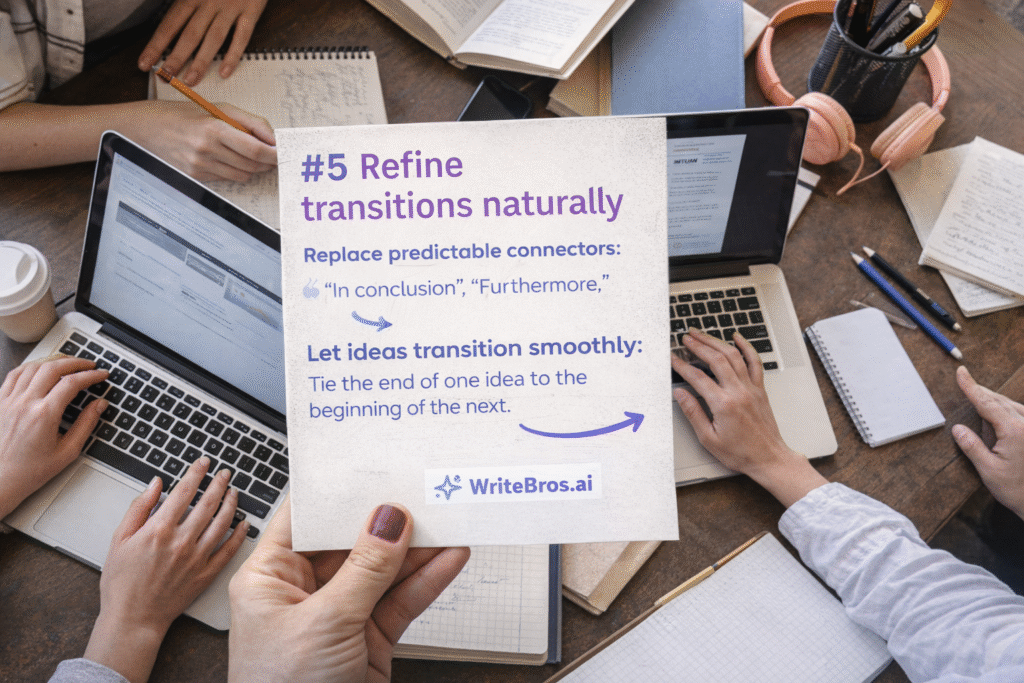
How to Reduce Turnitin AI Score – Strategy #5: Refine transitions naturally
Predictable transitions such as overly formal linking phrases can create a repetitive flow that feels algorithmically optimized instead of thoughtfully constructed. Revising connectors so they reflect the precise relationship between ideas adds subtle complexity to your argument. This nuanced linking strengthens coherence without relying on formulaic cues.
If multiple paragraphs begin with nearly identical transitional structures, the overall effect can appear templated. Reworking those openings to match the logic of the specific point you are making helps restore authenticity. The result is smoother progression that feels earned rather than mechanically assembled.
How to Reduce Turnitin AI Score – Strategy #6: Clarify and contextualize citations
Simply inserting citations without interpretation can resemble automated summarization, especially when sources are presented in a uniform, detached manner. Introducing each source with context, explaining why it is relevant, and briefly evaluating its contribution shows intellectual engagement. This additional framing distinguishes your analysis from surface-level compilation.
When you explain how a study informs your specific claim, rather than merely repeating its findings, the writing reflects synthesis instead of replication. Readers can see how you weigh evidence, which demonstrates critical thinking. That interpretive layer makes your work appear unmistakably human.
How to Reduce Turnitin AI Score – Strategy #7: Adjust paragraph flow
Paragraphs that follow identical structural patterns, such as topic sentence followed by two evenly sized explanations, can appear algorithmically organized. Introducing subtle shifts in how ideas unfold allows your reasoning to feel more spontaneous and reflective. This variation enhances readability and reduces mechanical symmetry.
For example, allowing one paragraph to begin with a contextual statement and another to open with a contrast can diversify structure. Rearranging supporting points to reflect emphasis rather than formula creates natural variation. These adjustments signal authentic composition rather than template adherence.
How to Reduce Turnitin AI Score – Strategy #8: Personalize analytical language
While academic tone should remain formal, it does not require emotional distance that strips away your intellectual presence. Integrating measured analytical language that reflects your reasoning process shows active engagement with the subject. This personalization maintains credibility without sounding mechanical.
Rather than presenting conclusions as universally settled, you might acknowledge limitations or competing perspectives. That balanced reasoning mirrors genuine scholarly reflection. The nuance demonstrates thoughtful authorship rather than automated output.
How to Reduce Turnitin AI Score – Strategy #9: Reduce formulaic phrasing
Overused academic templates can unintentionally resemble AI-generated structures because they rely on predictable framing. Identifying repetitive patterns such as identical introductory clauses allows you to replace them with more tailored expressions. This refinement preserves clarity while increasing originality of tone.
Even small adjustments, like reordering clauses or varying introductory wording, can meaningfully change how a sentence reads. These micro-edits accumulate across the paper, producing noticeable shifts in style. The cumulative effect supports a lower AI probability assessment.
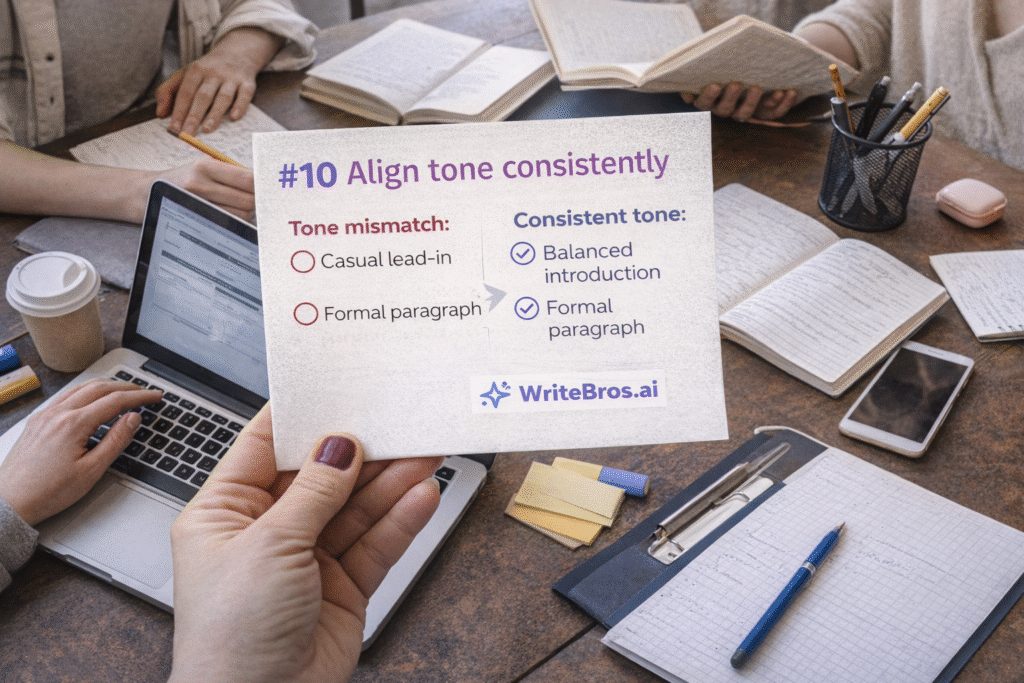
How to Reduce Turnitin AI Score – Strategy #10: Align tone consistently
Sudden changes in vocabulary level or formality can raise red flags because they suggest inconsistent authorship. Reviewing the entire paper for tonal alignment ensures that your voice remains stable from introduction to conclusion. Consistency reinforces credibility and coherence.
If one section sounds conversational while another sounds hyper-formal, blending those extremes into a balanced academic tone improves authenticity. Smooth tonal continuity mirrors how individuals naturally sustain their voice across extended writing. That cohesion can positively influence detection outcomes.
How to Reduce Turnitin AI Score – Strategy #11: Rework introductions thoughtfully
Introductions that rely on broad, universally applicable statements often resemble automated drafting because they lack distinctive framing. Revising the opening to focus directly on your specific argument and context establishes ownership from the outset. This targeted framing sets a more personal trajectory for the entire piece.
Instead of beginning with sweeping generalizations, consider foregrounding a tension, debate, or focused question that shapes your thesis. That approach signals intentional design rather than generic exposition. A precise introduction can immediately lower the impression of template-driven writing.
How to Reduce Turnitin AI Score – Strategy #12: Deepen explanations
Thin analysis that moves quickly from claim to conclusion can resemble AI summaries, particularly when reasoning steps are implied rather than articulated. Expanding your explanations to show how and why ideas connect demonstrates genuine cognitive processing. This added depth strengthens both clarity and authenticity.
When you unpack assumptions or clarify implications, readers see evidence of deliberate thinking. That transparency distinguishes thoughtful revision from automated expansion. The richer reasoning supports a more credible and human presentation.
How to Reduce Turnitin AI Score – Strategy #13: Trim over-polished phrasing
Sentences that are excessively symmetrical or stylistically pristine can unintentionally resemble optimized machine output. Simplifying certain lines and allowing natural variation in phrasing can make the writing feel more lived-in and realistic. Imperfect rhythm, when intentional, contributes to authenticity.
Revising overly elaborate constructions into clearer, straightforward expressions preserves meaning while softening mechanical polish. The goal is not to reduce quality but to remove artificial uniformity. That balance maintains academic rigor without triggering unnecessary flags.
How to Reduce Turnitin AI Score – Strategy #14: Read aloud for flow
Reading your paper aloud reveals subtle rhythm issues that silent review often misses, including unnatural repetition or overly balanced clauses. Hearing the cadence allows you to detect sections that sound rehearsed rather than reflective. This auditory check provides insight beyond visual editing.
When a sentence feels awkward or overly smooth in speech, it may benefit from restructuring. Adjusting phrasing until it flows naturally enhances clarity and authenticity. The spoken test reinforces that the writing aligns with how you genuinely communicate ideas.
How to Reduce Turnitin AI Score – Strategy #15: Conduct a final integrity review
A comprehensive final review ensures that revisions have strengthened clarity without compromising accuracy or attribution. Carefully verifying citations, argument progression, and tone alignment protects both integrity and coherence. This step consolidates earlier edits into a unified whole.
Approaching this review calmly, rather than reactively, helps you assess the paper as a complete narrative. Confirm that each paragraph reflects intentional reasoning rather than patchwork correction. That holistic evaluation supports a confident and responsible submission.
Common mistakes
- Rewriting the entire paper impulsively after seeing a high score, which often strips away your original structure and replaces it with uneven edits that create tonal inconsistencies across sections.
- Using automated rewriting tools repeatedly without reviewing the output carefully, which can introduce unnatural phrasing and increase detection signals rather than reduce them.
- Removing citations or simplifying analysis excessively in an attempt to appear less structured, which weakens academic integrity and harms clarity.
- Focusing only on sentence-level edits while ignoring paragraph flow and overall argument coherence, leading to fragmented reasoning.
- Overcorrecting into an overly casual tone that does not match academic expectations, which can create stylistic imbalance.
- Ignoring feedback from instructors and relying solely on detection percentages, which prevents meaningful improvement in writing quality.
Edge cases
Some disciplines, particularly technical or scientific fields, require standardized phrasing and structured reporting that may naturally resemble algorithmic patterns. In these contexts, responsible citation and methodological clarity should remain the priority, even if stylistic flexibility is limited.
Additionally, collaborative writing or heavy editorial input can create tonal variation that appears inconsistent. Reviewing for unified voice and consistent reasoning across contributors helps maintain authenticity while preserving academic standards.
Supporting tools
- Turnitin draft submissions, which allow you to preview similarity and AI indicators before final submission so that revisions can be made responsibly.
- Grammar and clarity tools that highlight awkward phrasing without rewriting content automatically, supporting controlled edits.
- Read-aloud software, which assists in identifying unnatural rhythm or repetition through auditory review.
- Reference management tools that ensure citations are formatted correctly and integrated clearly into analysis.
- Peer review feedback platforms that provide human insight into tone, clarity, and argument flow.
- WriteBros.ai, which can support structured revision while allowing you to maintain control over tone and reasoning.
Ready to Transform Your AI Content?
Try WriteBros.ai and make your AI-generated content truly human.
Conclusion
Learning how to reduce Turnitin AI score responsibly requires more than surface-level edits, because meaningful revision strengthens clarity, coherence, and intellectual ownership at every level of your writing. When you focus on depth, rhythm, and thoughtful argument development, your work naturally reflects authentic reasoning rather than formulaic patterns.
Perfection is not the goal, and chasing a zero score can distract from the real purpose of academic writing, which is to demonstrate understanding and critical engagement. By approaching revisions with intention and integrity, you build confidence in both your process and your final submission.
Did You Know?
If you are focused on How to Reduce Turnitin AI Score, surface-level paraphrasing rarely changes outcomes when paragraph symmetry, repeated topic-sentence scaffolds, and uniform transitions remain consistent across the document, because evaluation systems rely on cumulative structural patterns rather than individual word swaps.
Introducing variation in pacing, reshaping how claims are framed, and adjusting how evidence develops from one section to the next can significantly influence the overall profile of a submission, since natural irregularity tends to resemble genuine academic cognition more than evenly balanced formatting that repeats the same logical arc throughout.
Ready to Transform Your AI Content?