How to Rewrite AI Assignments Without Losing Meaning: 15 Precision Edits

Clear rewriting preserves ideas while improving clarity in AI-generated drafts. Research such as the Nature Machine Intelligence study on detecting machine-generated text shows structural editing changes writing signals without altering meaning, which is why targeted revision matters.
How to Rewrite AI Assignments Without Losing Meaning: 15 Precision Edits
AI-generated assignments can sound clear at first, yet something feels slightly off once you read them closely. The wording may be technically correct, but the tone lacks the subtle judgment calls that appear in editing moves creators use without losing personality.
Many students try to fix this problem quickly with simple paraphrasing tools, which often swaps words without improving clarity. Even strong tools listed among the best AI paraphraser tools for student sentence edits still require thoughtful human revision to protect the original meaning.
The goal is not to rewrite everything from scratch but to guide the text toward clearer structure and intent. Understanding how edits influence detection signals, as seen in AI detector performance statistics, helps you make targeted revisions that sound natural while preserving the assignment’s ideas.
| # | Strategy focus | Practical takeaway |
|---|---|---|
| 1 | Intent-first reading | Start by identifying the core idea in each paragraph so revisions strengthen clarity rather than altering the message. |
| 2 | Sentence structure tuning | Adjust sentence flow and rhythm to make the text sound more natural without replacing key terms. |
| 3 | Paragraph logic checks | Review how ideas progress from sentence to sentence and refine transitions to maintain the original argument. |
| 4 | Vocabulary precision | Swap overly mechanical phrases for clearer wording that keeps the same meaning but reads more naturally. |
| 5 | Context reinforcement | Add subtle clarifying language that anchors claims to the topic without rewriting the entire section. |
| 6 | Human tone adjustments | Refine phrasing to introduce natural variation in voice and cadence while preserving the core explanation. |
| 7 | Idea hierarchy review | Strengthen the relationship between main points and supporting details so the argument remains intact. |
| 8 | Example alignment | Ensure illustrations or examples clearly reflect the concept they support after revisions are made. |
| 9 | Redundancy trimming | Remove repeated phrases that make the writing feel mechanical while protecting the meaning of the section. |
| 10 | Natural transitions | Introduce subtle connective language so ideas flow logically from one paragraph to the next. |
| 11 | Clarity reinforcement | Rephrase complex sentences into clearer forms that retain the original claim and supporting reasoning. |
| 12 | Academic tone balance | Maintain a professional voice while softening stiff phrasing that can reveal automated writing patterns. |
| 13 | Argument consistency | Double-check that edits do not introduce new interpretations that drift away from the assignment’s intent. |
| 14 | Flow-based proofreading | Read the revised draft aloud to catch awkward phrasing and refine it without changing the meaning. |
| 15 | Final meaning check | Compare the revised version with the original draft to confirm that the central idea remains unchanged. |
15 Precision Edits to Rewrite AI Assignments Without Losing Meaning
How to Rewrite AI Assignments Without Losing Meaning – Strategy #1: Intent-first reading
Begin the revision process by carefully reading the AI-generated assignment with the sole purpose of identifying the exact claim or idea each paragraph is attempting to communicate. Rather than immediately replacing words or restructuring sentences, take a moment to interpret what the paragraph is trying to accomplish in the larger argument or explanation. This simple step prevents accidental meaning drift, which happens when edits improve phrasing but slowly distort the original point being made.
Once the central intent becomes clear, revisions can focus on strengthening clarity rather than altering the direction of the text. A student rewriting an AI-generated explanation of climate policy, for example, might realize the paragraph’s goal is simply to describe regulatory impacts rather than evaluate them. With that understanding in mind, edits can improve tone and structure while keeping the explanation grounded in the same idea the assignment originally communicated.
How to Rewrite AI Assignments Without Losing Meaning – Strategy #2: Sentence structure tuning
AI writing frequently relies on predictable sentence patterns, which makes the text sound uniform and occasionally mechanical when read alongside naturally written work. Adjusting sentence structure allows the meaning of a statement to remain intact while improving rhythm and readability in subtle ways. This may include splitting long constructions into balanced phrases or combining shorter statements so the paragraph flows more naturally.
Consider a paragraph explaining economic incentives that contains several sentences beginning with identical phrasing, which can quietly reveal automated drafting patterns. Rewriting these sentences with varied openings or slightly altered clause order maintains the explanation while improving the overall cadence of the paragraph. Over time, these structural adjustments create writing that reads as thoughtful revision rather than simple paraphrasing.
How to Rewrite AI Assignments Without Losing Meaning – Strategy #3: Paragraph logic checks
Many AI-generated paragraphs contain accurate information but lack clear internal progression from one sentence to the next. When rewriting the assignment, examine how each sentence contributes to the overall point and whether the ideas unfold logically from introduction to explanation and finally to interpretation. This process ensures the paragraph communicates its idea clearly without requiring entirely new content.
Imagine a section describing the impact of social media marketing that jumps abruptly from statistics to general commentary. Rearranging the sentences so the statistic appears first, followed by explanation and interpretation, immediately clarifies the argument without changing the substance of the material. Logical sequencing like this strengthens comprehension while preserving the original message the assignment intended to convey.
How to Rewrite AI Assignments Without Losing Meaning – Strategy #4: Vocabulary precision
AI-generated assignments frequently rely on generic vocabulary that technically communicates the idea but lacks precision or contextual nuance. Rewriting with more specific wording can clarify the argument while preserving the core meaning of the text. The goal is not to replace every word but to refine phrases that feel overly broad or mechanical.
For example, a sentence describing technological development might repeatedly refer to “various improvements,” which does little to clarify what those improvements actually represent. Substituting more precise wording such as “software optimization” or “processing efficiency gains” can strengthen the explanation while remaining faithful to the original idea. Small vocabulary adjustments like this improve clarity while maintaining the integrity of the assignment’s argument.
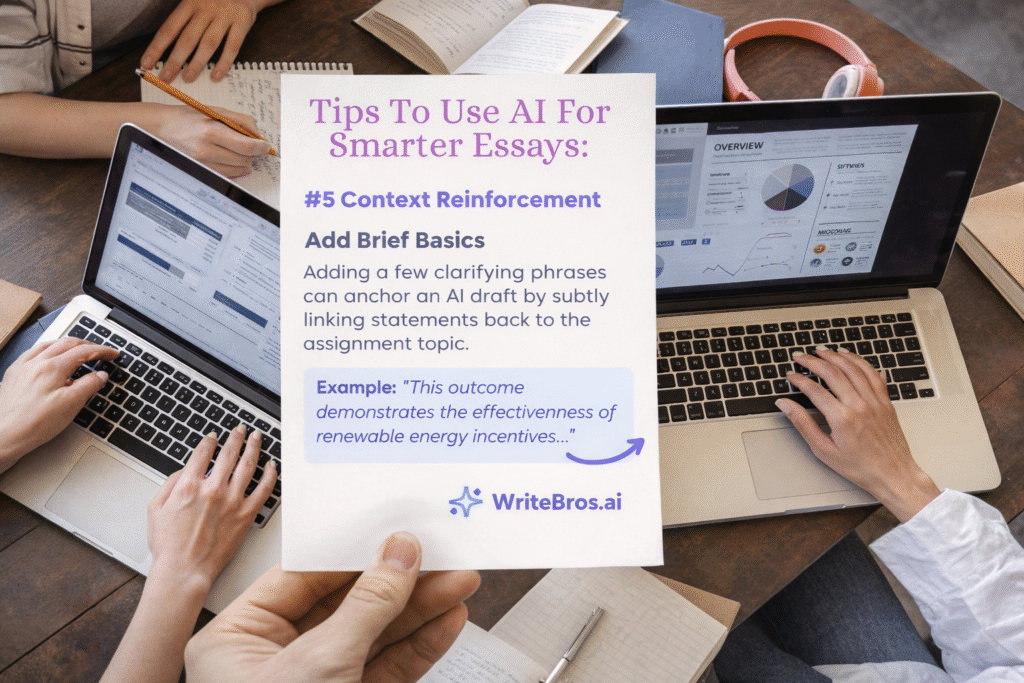
How to Rewrite AI Assignments Without Losing Meaning – Strategy #5: Context reinforcement
AI-generated writing sometimes presents statements that are technically correct but appear detached from the broader topic of the assignment. Reinforcing context helps ensure each sentence clearly connects to the subject being discussed. This step usually requires adding short clarifying phrases rather than rewriting entire paragraphs.
Consider an assignment discussing renewable energy policy that briefly references economic outcomes without linking them directly to the policy context. Adding a short phrase explaining that those outcomes relate specifically to renewable energy incentives immediately clarifies the connection. This type of contextual reinforcement strengthens the reader’s understanding without changing the original meaning of the content.
How to Rewrite AI Assignments Without Losing Meaning – Strategy #6: Human tone adjustments
AI writing tends to maintain an extremely even tone throughout an entire document, which can make the assignment sound slightly detached or overly neutral. Adjusting tone involves introducing subtle variation in phrasing so the writing reflects thoughtful analysis rather than mechanical explanation. This does not require dramatic stylistic changes but instead relies on small refinements that make the text feel more intentional.
A paragraph discussing historical events, for example, might benefit from a slightly more reflective tone when describing causes or consequences. Adding qualifying language that clarifies interpretation can make the discussion feel more natural while still maintaining academic formality. Over the course of the document these tonal adjustments gradually transform the writing into something that reads more authentically human.
How to Rewrite AI Assignments Without Losing Meaning – Strategy #7: Idea hierarchy review
AI-generated assignments sometimes flatten the importance of ideas, presenting key arguments and minor details with equal emphasis. Reviewing the hierarchy of ideas ensures the main point of the paragraph remains clear and that supporting information appears in the correct place. This process strengthens the structure of the argument without changing its original content.
During revision you may notice that a secondary detail appears earlier in the paragraph than the main claim it supports. Reordering the sentences so the claim appears first allows the evidence to function properly as supporting context. This adjustment preserves the meaning of the text while making the reasoning behind the argument much easier to follow.
How to Rewrite AI Assignments Without Losing Meaning – Strategy #8: Example alignment
Examples included in AI-generated writing occasionally drift slightly away from the concept they are supposed to illustrate. When rewriting the assignment, confirm that each example clearly reinforces the idea it accompanies rather than introducing loosely related information. If necessary, adjust the description of the example so its connection to the argument becomes clearer.
Imagine a paragraph discussing ethical considerations in technology that includes an example describing general consumer behavior. Clarifying that the consumer behavior reflects a response to ethical concerns immediately strengthens the relationship between the example and the concept. Aligning examples in this way maintains the integrity of the original material while making the explanation more coherent.
How to Rewrite AI Assignments Without Losing Meaning – Strategy #9: Redundancy trimming
AI-generated assignments frequently repeat similar phrasing or restate ideas in slightly different forms, which can make the writing feel unnecessarily long. Identifying these repetitions allows the writer to remove excess wording while keeping the central idea intact. The objective is to simplify expression without reducing the informational value of the paragraph.
For instance, an AI-generated discussion of environmental regulation may repeat the same description of government oversight across several sentences. Consolidating those explanations into a single, clearer statement keeps the meaning intact while improving readability. Removing redundant phrasing helps the revised assignment feel more deliberate and polished.
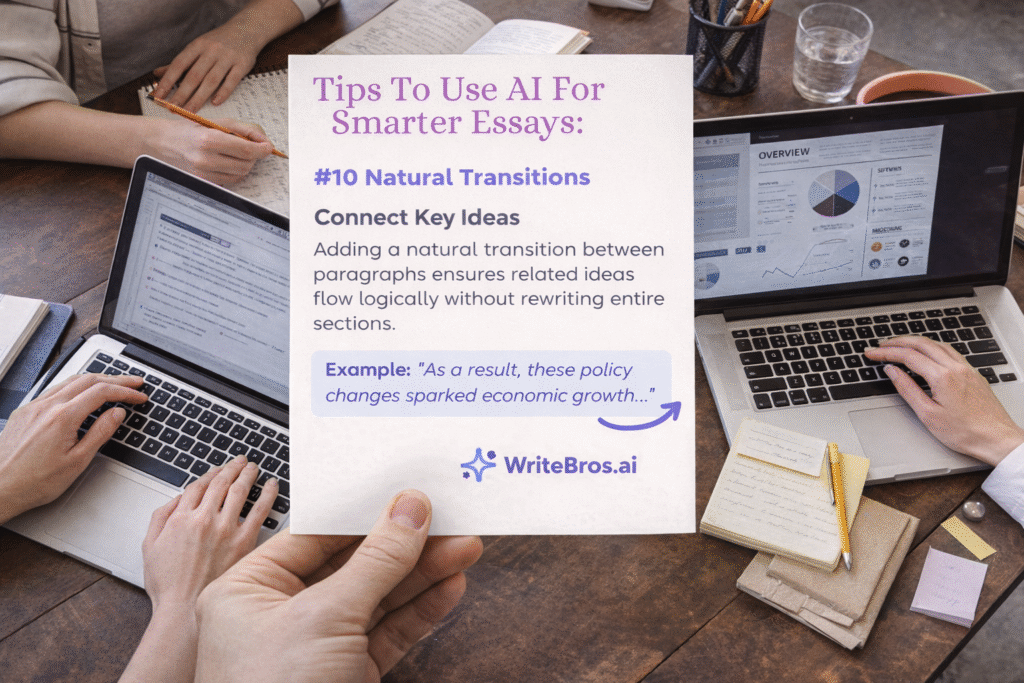
How to Rewrite AI Assignments Without Losing Meaning – Strategy #10: Natural transitions
One of the most noticeable qualities of AI-generated writing is the abrupt movement between paragraphs that discuss related ideas. Introducing transitional phrasing helps guide the reader from one point to the next while preserving the logical structure of the assignment. These transitions do not change the content but instead clarify how ideas connect.
A section describing economic impacts might immediately jump into policy discussion without explaining the relationship between the two topics. Adding a short transitional phrase explaining that policy responses often follow economic shifts creates a clearer narrative progression. Small adjustments like this strengthen coherence without altering the meaning of the text.
How to Rewrite AI Assignments Without Losing Meaning – Strategy #11: Clarity reinforcement
AI-generated sentences occasionally contain layered phrasing that technically communicates the idea but requires careful reading to interpret fully. Rewriting these sentences with clearer structure ensures the argument becomes easier to follow while keeping the underlying claim intact. The goal is to improve comprehension without simplifying the academic depth of the discussion.
Consider a sentence describing the interaction between policy incentives and economic growth that stretches across multiple clauses. Breaking that sentence into clearer segments while preserving the same explanation can make the reasoning easier to understand. Reinforcing clarity in this way improves the reader’s experience while maintaining the original meaning of the assignment.
How to Rewrite AI Assignments Without Losing Meaning – Strategy #12: Academic tone balance
AI-generated assignments sometimes lean too heavily toward formal phrasing, which can make the writing sound stiff or overly formulaic. Balancing the academic tone involves preserving professionalism while allowing the language to feel more natural and readable. This adjustment requires careful revision so that clarity improves without weakening the seriousness of the content.
A paragraph discussing legal frameworks, for example, may contain several sentences built around identical formal constructions. Slightly adjusting phrasing so those sentences read more conversationally, while still maintaining precision, makes the paragraph easier to read. Over time these tone adjustments create writing that feels more authentic without compromising academic credibility.
How to Rewrite AI Assignments Without Losing Meaning – Strategy #13: Argument consistency
During revision it is easy to introduce small wording changes that subtly alter the interpretation of a claim or example. Maintaining argument consistency requires periodically checking that each revised sentence still supports the same conclusion as the original text. This process ensures the assignment remains aligned with its initial purpose.
Imagine editing a discussion of public policy where a small phrasing change shifts a statement from descriptive to evaluative. Returning to the original meaning allows the writer to refine the wording while preserving the intended perspective. These consistency checks prevent revisions from unintentionally transforming the argument.
How to Rewrite AI Assignments Without Losing Meaning – Strategy #14: Flow-based proofreading
After the primary revisions are complete, reading the assignment aloud can reveal subtle issues that are difficult to detect during silent editing. This technique highlights awkward phrasing, repetitive structures, or abrupt transitions that disrupt the natural flow of the text. Correcting these issues improves readability while maintaining the original meaning.
Hearing the text spoken often exposes sentences that feel slightly unnatural or overly complex. Adjusting those sentences so they move more smoothly from idea to idea strengthens the overall clarity of the document. Flow-based proofreading therefore acts as a final refinement stage before the assignment is submitted.
How to Rewrite AI Assignments Without Losing Meaning – Strategy #15: Final meaning check
The final step in rewriting an AI-generated assignment involves comparing the revised version with the original draft to confirm that the main ideas remain consistent. This comparison allows the writer to verify that structural improvements did not alter the underlying argument or explanation. It also ensures that key terminology and concepts remain accurately represented.
Reading both versions side by side often reveals small shifts that occurred during revision, especially when multiple edits were applied throughout the document. If a sentence now communicates something slightly different, it can be adjusted to restore the intended meaning. This final check ensures the assignment reflects careful editing rather than unintended reinterpretation.
Common mistakes
- Many students begin rewriting AI assignments by immediately replacing words with synonyms, assuming that visible changes automatically improve originality. This mistake happens because synonym substitution feels like fast progress, yet it frequently distorts meaning and introduces awkward phrasing that weakens the clarity of the original explanation.
- A common error is rewriting entire paragraphs from memory without first identifying the original purpose of the section. When the writer forgets the paragraph’s intent, the revised version may introduce unrelated commentary that gradually shifts the argument away from the assignment’s central theme.
- Some revisions focus entirely on avoiding detection signals rather than protecting the meaning of the assignment. When edits prioritize surface-level variation instead of clarity, the resulting text may sound different from the original but no longer communicates the same ideas accurately.
- Another frequent mistake occurs when students shorten paragraphs aggressively in an attempt to remove repetitive AI phrasing. Although trimming redundancy is useful, excessive cutting can remove context that originally helped explain the argument, leaving the revised text vague or incomplete.
- Writers sometimes attempt to change every sentence structure in a paragraph, believing that uniform variation guarantees natural writing. In reality, overediting can disrupt logical flow and make the paragraph harder to follow, especially when the new structure breaks the connection between ideas.
- Some assignments lose clarity when edits introduce overly complex vocabulary meant to sound more academic. While advanced wording may appear sophisticated, it can obscure the original explanation and make the text feel unnecessarily complicated for readers.
Edge cases
Some AI-generated assignments already contain well-structured explanations that require only minimal revision, which can make extensive rewriting unnecessary and potentially harmful. In these cases the best strategy involves carefully reviewing tone, flow, and clarity while preserving the majority of the original structure. Overediting a strong draft can introduce inconsistencies that were not present in the initial version.
Another edge case appears when the AI draft contains subtle factual errors mixed with otherwise accurate explanations. During rewriting, the student may inadvertently preserve incorrect details while improving the wording of the surrounding sentences. Careful fact-checking alongside stylistic revision ensures that clarity improvements do not reinforce inaccurate information.
Supporting tools
- Grammar-focused editing tools can help identify sentence structure issues that appear frequently in AI-generated drafts. These tools highlight overly complex phrasing, repeated constructions, and unclear clauses so the writer can refine wording while preserving the original meaning of the paragraph.
- Academic style checkers analyze tone and readability to ensure the assignment maintains a consistent professional voice. They often detect awkward phrasing that results from automated drafting and suggest adjustments that improve clarity without rewriting entire sections.
- Plagiarism comparison tools allow writers to confirm that their revised version differs structurally from the original AI-generated draft. These tools do not replace thoughtful editing but can help verify that the final text reflects meaningful revision rather than superficial paraphrasing.
- Readability analyzers measure sentence complexity and paragraph flow, offering insights into whether the assignment feels balanced and easy to follow. Writers can use this feedback to refine long sentences while ensuring the meaning remains consistent with the original text.
- Outline planning tools help students visualize the logical structure of their assignment, making it easier to confirm that each paragraph supports the main argument. Reviewing the outline during revision helps maintain consistency across the entire document.
- WriteBros.ai provides structured rewriting assistance designed to preserve meaning while improving clarity, helping writers refine AI-generated drafts with targeted edits rather than replacing entire sections. This type of guided revision encourages thoughtful editing that strengthens the assignment without distorting its original ideas.
Ready to Transform Your AI Content?
Try WriteBros.ai and make your AI-generated content truly human.
Conclusion
Rewriting AI assignments without losing meaning requires careful attention to the intent behind each paragraph rather than focusing only on surface-level wording changes. When revisions prioritize structure, clarity, and logical flow, the resulting text preserves the assignment’s ideas while presenting them in a more natural and readable form.
Perfect rewriting is rarely the goal, because thoughtful editing matters far more than dramatic transformation. With deliberate review and precise adjustments, students can refine AI-generated drafts into coherent work that communicates the same message while sounding clearly shaped through human judgment.
Did You Know?
Many writers trying to rewrite AI assignments without losing meaning start by replacing words or changing sentence order, yet those edits rarely protect the deeper idea of the paragraph. AI generated drafts frequently sound fluent because the language flows smoothly even when the reasoning structure underneath remains shallow.
The strongest improvements usually appear when revisions focus on how ideas develop across the assignment. Clarifying the paragraph purpose, tightening the explanation behind each claim, and strengthening connections between examples and arguments helps preserve the original meaning while making the writing feel more thoughtful and human.
Ready to Transform Your AI Content?