How to Rewrite AI Content for Multiple Client Brands: 15 Workflow Strategies

For agencies managing accounts in 2026, rewriting AI content requires more than swapping tone cues. Clear brand profiles, separated workflows, and documented review rules protect each client’s identity, a principle reinforced by research on maintaining brand authenticity through consistent behavior.
How to Rewrite AI Content for Multiple Client Brands: 15 Workflow Strategies
Managing AI-generated content across multiple client brands becomes increasingly difficult as every company expects its own voice, messaging priorities, and editorial standards. Without a structured process and the right reliable tools for managing multi-brand content, even strong writers can accidentally blur brand identities.
The challenge usually isn’t the first draft but the repeated revisions required to separate one client’s personality from another while maintaining quality and speed. Studying best AI rewriting platforms for sales pages also reveals that successful teams rely on consistent workflows instead of rewriting every piece from scratch.
Fortunately, a repeatable editing framework makes it easier to switch between brands without sacrificing consistency or efficiency. This guide explains 15 practical workflow strategies that help you rewrite AI content confidently while applying insights supported by broader AI blog engagement statistics and real editorial practices.
| # | Strategy focus | Practical takeaway |
|---|---|---|
| 1 | Build dedicated brand profiles | Create a clear reference for each client so every rewrite begins with consistent messaging, tone, and positioning. |
| 2 | Separate client workspaces | Keep assets, prompts, and revisions isolated to reduce accidental crossover between brands. |
| 3 | Start from strategic goals | Define the business objective before editing so every revision supports the intended outcome. |
| 4 | Standardize briefing templates | Collect the same essential information for every assignment to reduce guesswork and revision cycles. |
| 5 | Reuse proven prompt frameworks | Develop repeatable prompting patterns that improve consistency without forcing identical writing. |
| 6 | Customize the editorial voice | Replace generic AI phrasing with language that genuinely reflects each client’s communication style. |
| 7 | Review factual accuracy first | Verify claims before polishing language so attractive writing never spreads incorrect information. |
| 8 | Maintain terminology libraries | Keep approved vocabulary and prohibited wording readily available for faster editorial decisions. |
| 9 | Adapt content by audience | Adjust complexity, examples, and messaging according to who will actually read the finished piece. |
| 10 | Create reusable quality checks | Apply the same review process to every project before delivery to improve reliability at scale. |
| 11 | Track revision decisions | Document recurring edits so future projects become faster and more predictable. |
| 12 | Collaborate with clear ownership | Assign responsibilities for drafting, reviewing, and approving to prevent duplicated work. |
| 13 | Measure workflow performance | Monitor efficiency and quality trends to identify bottlenecks before they become recurring problems. |
| 14 | Continuously refine processes | Update workflows based on feedback instead of relying on habits that no longer serve the team. |
| 15 | Scale without losing consistency | Expand production using documented systems that preserve quality across every client relationship. |
15 Workflow Strategies to Rewrite AI Content for Multiple Client Brands
How to Rewrite AI Content for Multiple Client Brands – Strategy #1: Build Brand Profiles
Create a dedicated brand profile before editing any draft, because writers need one reliable place that explains the client’s voice, audience, positioning, preferred language, prohibited terms, and recurring communication priorities. Use this profile whenever a new assignment begins, especially when several clients operate in related industries where their messages can easily start sounding interchangeable. Strong execution means documenting practical examples rather than relying on broad labels such as professional, friendly, or authoritative.
This approach works because it turns subjective brand preferences into visible editorial guidance that can be applied consistently by different writers, editors, and reviewers. For example, one financial client may prefer reassuring explanations for first-time investors, while another expects concise commentary written for experienced portfolio managers who already understand technical terminology. Review the profile regularly, because audience expectations, product positioning, approved claims, and leadership preferences can change as the client’s business develops.
How to Rewrite AI Content for Multiple Client Brands – Strategy #2: Separate Client Workspaces
Keep every client’s briefs, source materials, prompts, drafts, feedback, and approved examples inside a clearly separated workspace so information from one account does not accidentally influence another. Apply this structure from the moment a client is onboarded, rather than waiting until the volume of assignments becomes difficult to manage. A well-organized workspace should make the latest instructions easy to locate without requiring writers to search through unrelated conversations or folders.
Separation reduces brand crossover because each project begins inside the correct editorial environment, where relevant references are visible and competing instructions remain out of sight. A writer handling two software companies, for instance, is less likely to reuse the wrong feature names, customer descriptions, or tone preferences when each account has its own organized folder and prompt library. Maintain clear naming conventions, version histories, and archive rules so outdated guidance does not remain active by accident.
How to Rewrite AI Content for Multiple Client Brands – Strategy #3: Define Content Goals
Identify the specific business goal behind each piece before rewriting, because brand voice alone cannot determine which ideas deserve emphasis, removal, expansion, or stronger explanation. Use this strategy whenever a draft could support several outcomes, such as educating readers, generating leads, improving product understanding, or strengthening credibility around a complex subject. Good execution connects every major section to one primary objective while preserving enough supporting context to keep the piece useful.
This works because the same brand may communicate differently depending on whether the reader is discovering a problem, comparing alternatives, or preparing to purchase. For example, a cybersecurity client’s educational guide may require patient explanations and neutral examples, while its product page should communicate urgency, differentiation, and measurable operational value more directly. Avoid forcing every article into a conversion framework, since some assignments are designed primarily to inform, reassure, or build long-term trust.
How to Rewrite AI Content for Multiple Client Brands – Strategy #4: Standardize Client Briefs
Use a consistent briefing template that captures the audience, objective, content format, required sources, key messages, examples, restrictions, and approval expectations before rewriting begins. Apply the template across every client account so writers receive comparable information even when the underlying brands, industries, and deliverables are very different. The best briefs provide enough direction to prevent guesswork without prescribing every sentence so tightly that the final copy feels rigid.
A standardized brief improves quality because missing information becomes easier to notice before the draft reaches the editing stage, where corrections usually take more time. For instance, a healthcare article may require clinical sourcing and cautious claims, while a retail campaign may depend more heavily on product benefits, seasonal timing, and customer language. Customize optional fields for specialized accounts, but keep the core structure stable enough that teams can review assignments quickly and consistently.
How to Rewrite AI Content for Multiple Client Brands – Strategy #5: Create Prompt Frameworks
Develop reusable prompt frameworks that guide the AI through brand context, audience needs, content goals, structural expectations, and prohibited habits without producing identical output for every client. Use these frameworks when your team handles recurring formats such as blog posts, landing pages, email sequences, or product descriptions across several accounts. Effective frameworks contain flexible fields that writers can update for each assignment rather than one fixed instruction copied into every project.
This method works because it reduces repetitive setup while still requiring deliberate choices about the client, reader, message, and desired outcome before generation begins. A sales-page framework, for example, might ask for approved value propositions, proof points, objections, and calls to action, while a thought-leadership framework would prioritize original perspective, evidence, and industry context. Test prompts against real outputs, because instructions that sound thorough may still encourage repetition, vague claims, or overly polished language.

How to Rewrite AI Content for Multiple Client Brands – Strategy #6: Customize Brand Voice
Rewrite generic AI phrasing by adjusting sentence rhythm, vocabulary, level of formality, perspective, humor, emotional intensity, and preferred ways of explaining difficult ideas. Use this strategy after the draft’s factual structure is stable, because polishing voice too early can waste time when larger sections still need to be replaced. Good execution creates recognizable differences between clients without exaggerating their personalities or turning every paragraph into a performance of the brand.
This works because readers often recognize a brand through recurring communication habits rather than isolated slogans, taglines, or lists of approved adjectives. One client may use calm, measured explanations with few contractions, while another may speak more directly, acknowledge frustration openly, and rely on conversational transitions throughout the piece. Avoid superficial substitutions, because replacing a few words without changing pacing, emphasis, and perspective rarely produces an authentically distinct voice.
How to Rewrite AI Content for Multiple Client Brands – Strategy #7: Verify Facts First
Check statistics, product details, names, dates, technical explanations, legal claims, and source interpretations before spending significant time refining tone and style. Apply this step whenever the AI draft introduces information that was not explicitly provided in the client brief or supported by an approved reference. A reliable review separates confirmed facts from assumptions, promotional interpretations, and unsupported statements that merely sound plausible within the surrounding prose.
This order works because an elegant sentence still creates risk when its underlying claim is inaccurate, outdated, overstated, or attributed to the wrong source. For example, an AI draft may describe a software feature that has been renamed, limited to a higher pricing tier, or removed since the source material was published. Keep a record of verified references, and flag uncertain claims for client review rather than quietly rewriting them into more confident language.
How to Rewrite AI Content for Multiple Client Brands – Strategy #8: Maintain Terminology Libraries
Create a terminology library for every client that records approved product names, capitalization rules, preferred industry terms, customer labels, banned phrases, and recurring explanations of complex concepts. Use it during drafting and editing, particularly when several clients discuss similar products but define their audiences, services, or outcomes differently. A useful library includes examples in context so writers understand not only which term is preferred, but also when and why it should appear.
This system works because small terminology inconsistencies can make polished content feel disconnected from the client’s website, sales materials, documentation, and customer communications. A software company may call users members, teams, administrators, or account holders, and choosing the wrong label can subtly change the relationship being described. Update the library whenever stakeholders correct wording, because repeated feedback should become durable guidance rather than remain buried in individual revision threads.
How to Rewrite AI Content for Multiple Client Brands – Strategy #9: Adapt to Audience
Rewrite the content according to the reader’s existing knowledge, priorities, objections, vocabulary, and likely reason for engaging with the material at that moment. Apply this strategy whenever a brand serves several customer groups, because one general explanation rarely supports beginners, specialists, buyers, and existing customers equally well. Strong audience adaptation changes examples, pacing, assumptions, depth, and emphasis while keeping the client’s central identity consistent across every version.
This works because readers judge clarity based on whether the content meets them at the right level, not merely whether each sentence is grammatically correct. For instance, an accounting platform may explain automation through everyday administrative tasks for small-business owners, while addressing audit trails, controls, and system integration when speaking to finance teams. Avoid oversimplifying expert audiences or overwhelming newcomers with details that do not help them make the next decision.
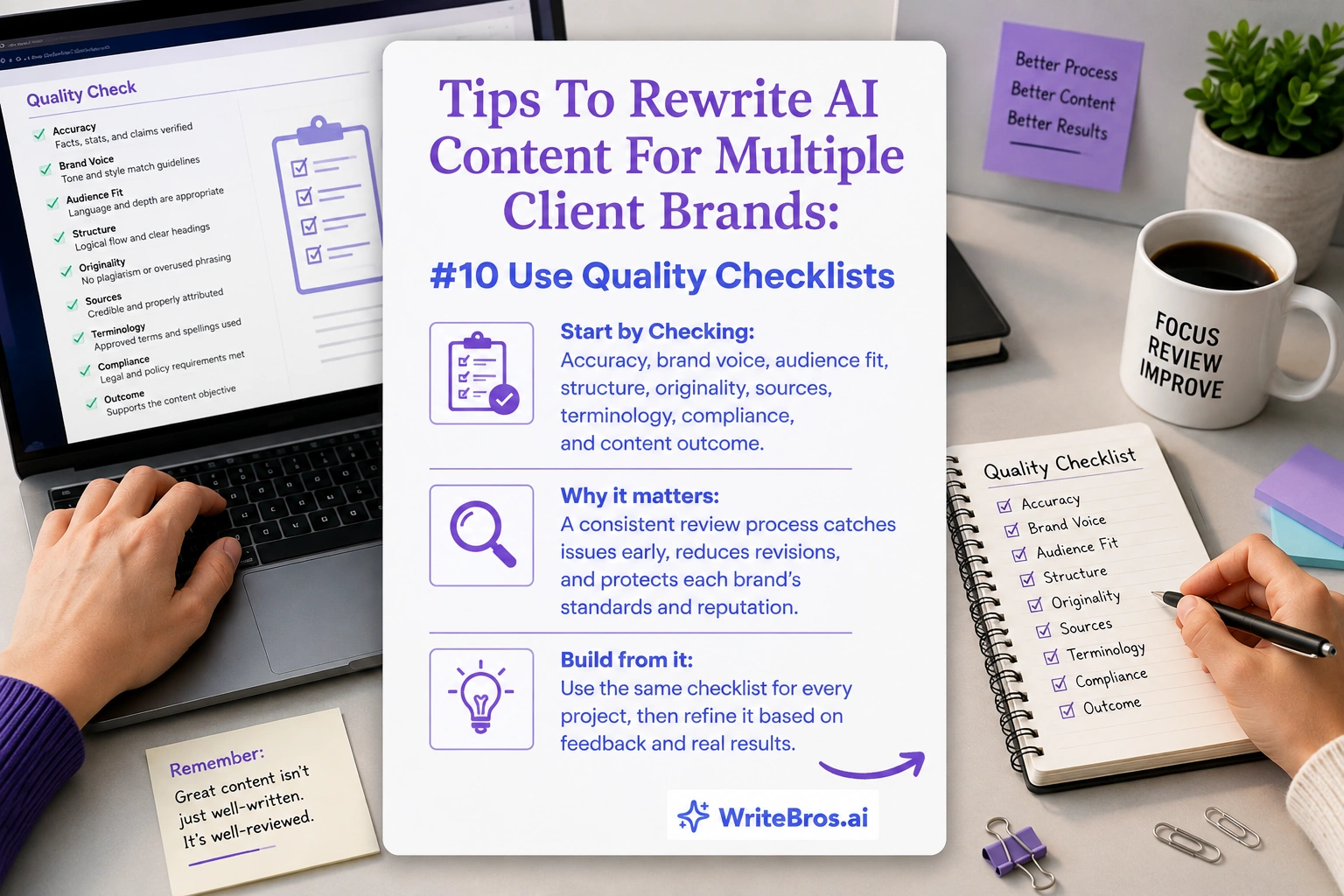
How to Rewrite AI Content for Multiple Client Brands – Strategy #10: Use Quality Checklists
Create a reusable quality checklist that covers factual accuracy, brand voice, audience fit, structure, originality, formatting, sourcing, terminology, compliance, and the assignment’s intended outcome. Use the checklist before internal review and again before delivery, especially when deadlines encourage editors to focus only on the most visible problems. Effective checklists are specific enough to guide real decisions but short enough that teams will actually use them consistently.
This approach works because memory becomes unreliable when editors move quickly between clients with different standards, restrictions, and approval processes. A checklist might remind the team that one client requires source dates, another prohibits competitor comparisons, and another expects every product claim to match approved documentation. Review the checklist periodically, removing items that no longer add value and adding recurring issues identified through client feedback, corrections, or post-publication reviews.
How to Rewrite AI Content for Multiple Client Brands – Strategy #11: Track Editorial Decisions
Document meaningful revision decisions, including why certain phrases were replaced, which examples were approved, how stakeholders interpreted the brand voice, and what changes repeatedly appeared during review. Use this strategy after substantial feedback rounds, particularly when multiple people contribute to the same account over several months. Good documentation captures patterns that will improve future work rather than recording every minor grammatical adjustment or isolated personal preference.
This works because client feedback often contains valuable guidance that disappears once the final draft is approved and the conversation moves to another assignment. For example, repeated requests to soften urgency may reveal that the brand prioritizes reassurance over pressure, even when its original style guide never states that preference directly. Summarize recurring decisions inside the brand profile, and distinguish durable rules from one-time changes caused by a specific campaign or stakeholder.
How to Rewrite AI Content for Multiple Client Brands – Strategy #12: Assign Clear Ownership
Define who is responsible for briefing, drafting, fact-checking, brand review, final approval, and client communication before the work moves through the production process. Apply this structure whenever several contributors share an account, because unclear ownership creates duplicated edits, conflicting revisions, and long periods where everyone assumes someone else will act. Strong workflows identify one accountable owner for each stage while still allowing specialists to provide targeted support.
This system works because collaboration becomes more efficient when contributors understand both their responsibilities and the limits of their authority. A subject-matter reviewer, for example, may verify technical accuracy without rewriting the entire article’s tone, while the brand editor can preserve voice without changing approved factual explanations. Keep responsibilities flexible enough for small teams, but do not let flexibility become ambiguity when deadlines, approvals, or high-risk claims require clear accountability.
How to Rewrite AI Content for Multiple Client Brands – Strategy #13: Measure Workflow Performance
Track practical indicators such as editing time, revision rounds, recurring client corrections, approval speed, factual errors, and the percentage of drafts requiring major structural changes. Use these measurements over several assignments rather than judging the process from one unusually easy or difficult project. Good analysis looks for patterns that reveal where instructions, prompts, resources, or review responsibilities consistently fail to support efficient work.
This approach works because workflow problems often appear as repeated small delays that remain invisible when teams focus only on whether each deliverable was eventually completed. For instance, frequent terminology corrections may indicate that the brand library is outdated, while repeated structural rewrites may point to weak briefs or poorly designed prompt frameworks. Avoid treating speed as the only measure, because faster production has little value when quality problems create additional reviews or damage client trust.
How to Rewrite AI Content for Multiple Client Brands – Strategy #14: Refine the Process
Review the workflow regularly and adjust templates, prompts, checklists, approval stages, and brand documentation according to actual problems observed during production. Use this strategy after major campaigns, onboarding periods, repeated client feedback, or noticeable changes in assignment volume and team composition. Effective refinement focuses on removing friction while preserving the safeguards that keep quality, accuracy, and brand separation intact.
This works because a process designed for two clients may become unnecessarily slow or dangerously informal when the team begins managing ten accounts with different requirements. A growing agency, for example, may need formal version control and designated reviewers even though shared folders and informal messages were sufficient during its early stage. Change one element at a time when possible, because simultaneous adjustments make it difficult to identify which improvement actually produced better results.
How to Rewrite AI Content for Multiple Client Brands – Strategy #15: Scale Through Documentation
Build scalable documentation that allows new writers and editors to understand each client without relying entirely on verbal explanations from one experienced team member. Apply this strategy before production expands significantly, because undocumented knowledge becomes a serious bottleneck when assignments increase or key contributors become unavailable. Strong documentation combines concise rules, approved examples, workflow steps, decision histories, and links to current source materials in one accessible system.
This approach works because growth becomes safer when quality depends on shared systems rather than individual memory, personal habits, or constant supervision from senior editors. For example, a new contributor can compare an AI draft against approved samples and terminology rules before submitting work, reducing the burden placed on the account lead. Keep documentation practical and current, since an enormous library of outdated instructions can create more confusion than a smaller collection of reliable guidance.
Common mistakes
- Using one universal prompt for every client usually happens because teams want to save time, but it removes the distinctions that make each brand recognizable and eventually produces content with the same pacing, vocabulary, structure, and emotional tone across unrelated accounts.
- Relying on broad voice labels such as professional, friendly, or bold often happens when brand documentation is rushed, yet these descriptions are too subjective to guide consistent revisions and leave each writer interpreting the client’s personality according to personal preference.
- Polishing sentences before verifying claims is common because stylistic problems are easier to notice than factual weaknesses, but the approach wastes editing time when inaccurate sections must later be removed and increases the risk of delivering confident language built on unsupported information.
- Keeping client feedback inside scattered email threads and comments happens when teams treat each correction as an isolated event, but recurring preferences remain invisible and the same mistakes return because future writers cannot easily access the reasoning behind earlier editorial decisions.
- Allowing too many reviewers to edit without defined authority often comes from a desire for collaboration, but overlapping responsibilities create contradictory instructions, duplicated work, delayed approvals, and final drafts that reflect internal compromise rather than a coherent brand voice.
- Measuring success only by production speed happens when teams face growing deadlines, but faster delivery can conceal rising revision rounds, weaker sourcing, inconsistent terminology, and greater dependence on senior editors who must repeatedly repair problems that the workflow should prevent.
Edge cases
Some clients intentionally operate several sub-brands, regional identities, or product lines that share a parent voice while addressing different audiences, so complete separation may not be appropriate. In those cases, document which qualities remain constant across the organization and which elements change according to market, channel, customer group, or campaign.
Highly regulated or technical accounts may also require accuracy and compliance to take precedence over stylistic distinctiveness, particularly when approved language cannot be freely rewritten. The goal is still to preserve a recognizable brand, but the workflow should clearly identify where writers have creative flexibility and where exact terminology, disclaimers, or reviewed claims must remain unchanged.
Supporting tools
- Brand guideline repositories provide one central place for voice principles, visual standards, approved claims, audience definitions, and current messaging, which helps contributors avoid relying on outdated attachments or personal interpretations of earlier client conversations.
- Project management platforms help teams separate client assignments, assign ownership, record deadlines, track approval stages, and maintain visible accountability, particularly when several drafts move through research, editing, fact-checking, and stakeholder review at the same time.
- Terminology databases make approved product names, capitalization rules, customer labels, restricted phrases, and industry definitions searchable, reducing small inconsistencies that can make content feel disconnected from the client’s broader website, documentation, or sales materials.
- Version-control systems preserve earlier drafts, reviewer comments, and approved changes, allowing editors to understand how a piece evolved while preventing accidental overwrites or confusion about which file represents the latest client-approved direction.
- Content quality checkers can flag readability problems, repetition, unsupported patterns, formatting issues, and stylistic inconsistencies, although their suggestions should remain secondary to the client’s documented preferences, audience needs, and subject-matter requirements.
- WriteBros.ai can support the rewriting stage by helping teams refine AI-generated drafts while applying clearer stylistic direction, although the final content should still pass through brand-specific fact-checking, terminology review, and human editorial judgment.
Ready to Transform Your AI Content?
Try WriteBros.ai and make your AI-generated content truly human.
Conclusion
Rewriting AI content for several clients is not simply a matter of changing vocabulary or inserting different product names into the same draft. The real goal is to create a dependable editorial system that preserves each brand’s audience, priorities, evidence, voice, and business purpose while giving writers enough structure to move efficiently between accounts.
Consistency comes from intentional choices repeated through clear briefs, separated workspaces, verified sources, documented terminology, and thoughtful review rather than from chasing a perfect first draft. As the workflow develops, focus on learning from feedback, refining weak stages, and protecting the distinctions that make every client recognizable, credible, and useful to the people they serve.
Did You Know?
Multiple client brands can gradually begin sounding alike when writers reuse the same prompts, sentence patterns, examples, and review habits, even when each draft appears polished when assessed on its own.
Research examining marketing communication consistency found a strong direct connection between consistent communication and both brand trust and loyalty. Building separate editorial systems for each client helps preserve the distinctive terminology, tone, priorities, and audience expectations that make a brand recognizable.
Ready to Transform Your AI Content?