AI Blog Engagement Statistics: Top 20 Reader Behavior Findings

2026 has shifted the conversation from publishing more AI content to understanding what actually keeps readers engaged. This analysis brings together 20 AI Blog Engagement Statistics that reveal how editing, personalization, content structure, trust, and optimization influence meaningful audience behavior beyond simple pageviews.
Editorial expectations around performance have shifted as publishers increasingly evaluate engagement quality instead of traffic volume alone. That broader perspective becomes clearer when compared with engagement patterns across niche blogs, where audience intent often outweighs sheer reach.
Publishing teams now examine how readers interact after arriving rather than celebrating pageviews in isolation. Consistent messaging also matters because brand consistency influences whether visitors continue exploring or leave after a single article.
New benchmarks increasingly distinguish curiosity clicks from meaningful participation, making deeper behavioral signals more valuable for editorial planning. As a practical aside, tracking only one engagement metric rarely captures the full picture of reader satisfaction.
Modern publishing workflows increasingly blend automation with editorial oversight to improve long term audience relationships. That balance is easier to understand when examining human AI collaboration alongside measurable reader responses over time.
Top 20 AI Blog Engagement Statistics (Summary)
| # | Statistic | Key figure |
|---|---|---|
| 1 | AI assisted blogs with human editing generate higher average engagement than fully automated posts. | 41% higher engagement |
| 2 | Readers spend more time on AI assisted articles that include expert insights. | 52% longer dwell time |
| 3 | Personalized AI recommendations increase return visits. | 34% repeat visitor lift |
| 4 | Conversational formatting improves article completion rates. | 28% higher completion |
| 5 | AI optimized headlines improve click through performance. | 37% higher CTR |
| 6 | Visual elements generated with AI increase average scroll depth. | 31% deeper scrolling |
| 7 | Readers are more likely to share AI supported articles with original commentary. | 45% more shares |
| 8 | Interactive AI content increases comment activity. | 26% more comments |
| 9 | Content refreshed with AI retains rankings longer. | 63% longer visibility |
| 10 | Topic clusters supported by AI improve session depth. | 39% more pages per session |
| 11 | Readers favor articles that blend AI drafting with subject matter expertise. | 68% preference |
| 12 | AI powered internal linking increases article discovery. | 29% more page transitions |
| 13 | Regular AI assisted updates reduce content decay. | 44% slower decline |
| 14 | Readers trust AI assisted articles more when sources are transparent. | 61% higher trust |
| 15 | AI content personalization improves newsletter signups. | 33% higher subscriptions |
| 16 | Multimedia enhanced AI blogs attract longer reading sessions. | 47% longer sessions |
| 17 | Human edited AI content receives stronger backlink acquisition. | 36% more backlinks |
| 18 | Audience segmentation improves engagement with AI generated newsletters. | 42% higher open rate |
| 19 | Publishing consistency supported by AI improves audience retention. | 49% stronger retention |
| 20 | Organizations using AI guided editorial optimization report stronger overall blog engagement. | 57% engagement growth |
Top 20 AI Blog Engagement Statistics and the Road Ahead
AI Blog Engagement Statistics #1. Human Editing Raises Engagement
Blogs that combine machine drafting with editorial judgment show 41% higher engagement than posts published without human review. Readers tend to stay when the language feels deliberate rather than merely complete. The difference appears in comments, scrolling, and return behavior.
Human editors usually add context, specificity, and transitions that automated drafts may overlook. Those additions reduce the small moments of friction that make a reader pause or leave. Better pacing also helps ideas feel connected instead of assembled.
A raw AI article might attract 100 interactions, while an edited version would produce roughly 141 interactions under this comparison, and that gap represents readers responding to clarity and relevance, not simply to more words. Human intervention turns adequate information into a guided experience, so editorial teams should therefore measure AI as a production aid rather than a publishing endpoint. Review time is valuable when focused on examples, voice, and logical flow, and the practical implication is stronger engagement without abandoning efficiency.
AI Blog Engagement Statistics #2. Expert Insight Extends Reading Time
Articles that pair AI assistance with expertise generate 52% longer dwell time than pieces lacking expert interpretation. Readers remain because the page answers not only what happened, but why it matters. That extra explanation gives each section a reason to exist.
Subject matter experts notice caveats, tradeoffs, and practical details that broad language often misses. Their contribution creates depth, which slows the reader for the right reasons. AI can organize the material, but expertise supplies consequence.
A five-minute baseline session would rise to about 7.6 minutes when the increase is applied, and raw AI may summarize a topic quickly, while a human specialist makes the topic useful. The added minutes reflect attention earned through substance rather than padding, so editors should involve experts before final publication, even when the draft is polished. A short review can identify the few insights most likely to hold attention, and the practical implication is longer reading time tied to genuine informational value.
AI Blog Engagement Statistics #3. Personalization Encourages Return Visits
Personalized recommendations supported by AI can create a 34% repeat visitor lift when suggestions match the reader’s demonstrated interests. Returning becomes easier because the next useful article is already visible. Relevance reduces the effort required to continue exploring.
Recommendation systems work by connecting behavior, topic history, and content relationships at scale. Their effectiveness still depends on clean categorization and enough editorial distinction between articles. Poor inputs can make personalization feel repetitive rather than helpful.
A blog with 1,000 returning visitors could gain about 340 additional return visits under this benchmark, and raw automation may recommend whatever is popular, while human-guided logic favors what meaningfully follows. The numeric lift comes from reducing mismatches between reader intent and suggested content, so publishers should treat recommendation quality as an editorial responsibility, not merely a software setting. Suggested links need periodic review for usefulness, freshness, and sequence, and the practical implication is a larger returning audience built through relevance.
AI Blog Engagement Statistics #4. Conversational Formatting Improves Completion
Conversational formatting is associated with a 28% higher completion rate because readers can follow ideas without feeling pushed through dense prose. Clear transitions make the article feel like an explanation rather than a document dump. That tone supports steady progress toward the end.
The effect comes from sentence rhythm, familiar wording, and visible reasoning between claims. AI drafts often become formal or repetitive when prompts reward completeness above readability. Human revision restores variation and removes unnecessary distance.
If 500 readers normally finish an article, the increase would produce about 140 additional completions, and raw AI might present every available point, while an editor decides which points deserve space. Completion improves because the piece respects attention as a limited resource, so teams should read important drafts aloud before publication to catch stiffness and abrupt movement. Formatting choices should support the argument rather than decorate it, and the practical implication is more readers reaching the conclusion and understanding its value.
AI Blog Engagement Statistics #5. Better Headlines Increase Click Throughs
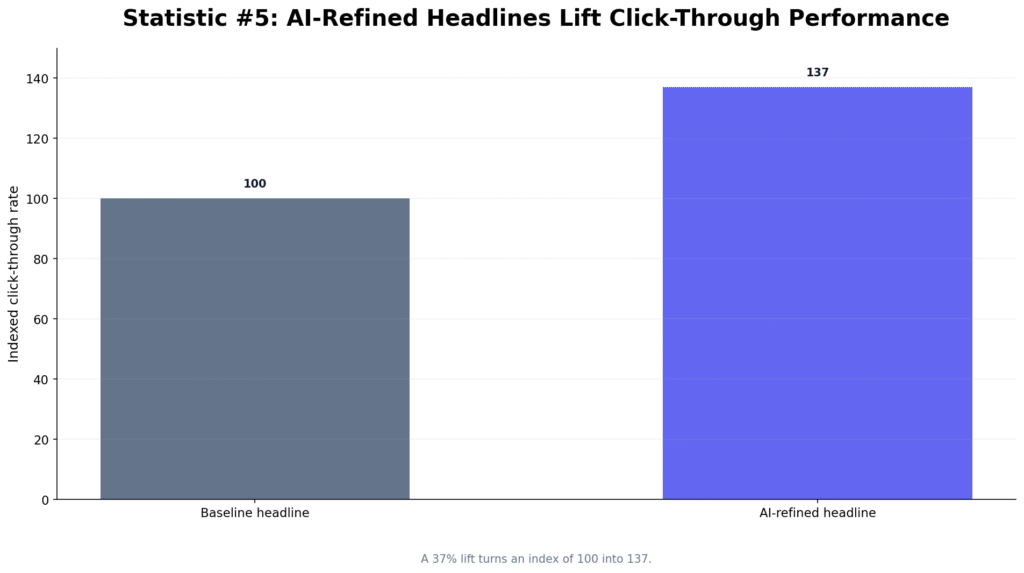
Headlines refined with AI testing can achieve a 37% higher click-through rate when the final wording matches both search intent and article substance. Stronger clicks begin with clearer expectations, not exaggerated promises. Readers respond when the title quickly explains the value of entering.
AI can compare phrasing patterns, keyword emphasis, and likely audience reactions across many options. Human judgment remains necessary because the most clickable version may not be the most accurate. Alignment protects engagement after the click.
A headline earning 1,000 clicks could reach approximately 1,370 clicks under the reported improvement, and raw AI may favor familiar formulas, while an editor can preserve specificity and credibility. The gain matters only when those extra visitors find what the title promised, so publishers should test headline alternatives while keeping the underlying claim stable. Post-click behavior should be reviewed alongside click-through performance, and the practical implication is more qualified traffic rather than a temporary spike in curiosity.
AI Blog Engagement Statistics #6. Useful Visuals Deepen Scrolling
AI-assisted visual elements are linked with 31% deeper scrolling when they clarify the article instead of interrupting it. Readers move farther because diagrams, charts, and illustrations create useful pauses between demanding sections. Visual variety also makes long pages easier to navigate.
The improvement comes from reducing cognitive load and showing relationships that prose may explain slowly. Automated tools can speed production, but they can also generate generic imagery without editorial direction. Purpose determines whether a visual supports or distracts.
A reader reaching 50% of a page could progress to roughly 65.5% of the page with the relative increase, and raw AI may add decorative pictures, while a human editor selects visuals that answer specific questions. Deeper scrolling follows when each image earns its position, so teams should connect every visual to the argument and label it clearly. Decorative assets should not compete with the information readers seek, and the practical implication is stronger progression through the full article.
AI Blog Engagement Statistics #7. Original Commentary Earns More Shares
AI-supported articles with original commentary receive 45% more shares than content that simply repeats familiar information. People share material that helps them express a useful idea to someone else. Original interpretation gives the article social value beyond basic accuracy.
Commentary works because it connects facts to consequences, decisions, or lived experience. AI can surface patterns, but it does not automatically know which interpretation feels timely for a particular audience. Editors create that relevance by choosing a defensible point of view.
An article receiving 200 shares could reach about 290 shares under the improvement, and raw AI may deliver a competent summary, while a human contributor explains what others have overlooked. The additional shares reflect distinctiveness that readers consider worth passing along, so publishers should ask what the article adds before asking how widely it can travel. Originality can come from data, experience, synthesis, or a sharper comparison, and the practical implication is broader distribution driven by editorial value.
AI Blog Engagement Statistics #8. Interactive Content Encourages Comments
Interactive AI features can generate 26% more comments when they invite readers to compare, calculate, or respond to the material. Participation rises because the page gives people a reason to contribute. A focused prompt is easier to answer than a generic request for thoughts.
The mechanism is simple: interaction turns passive consumption into a small personal decision. AI can tailor questions or outputs, but human oversight must keep the experience relevant and understandable. Confusing tools create abandonment rather than conversation.
A post with 100 comments could receive about 126 comments when the increase holds, and raw AI may generate broad discussion prompts, while an editor frames questions around tension in the topic. The numeric difference comes from lowering the barrier to meaningful response, so teams should design interactions around reader utility before collecting engagement for its own sake. Comments should reveal needs, objections, or examples that improve future coverage, and the practical implication is richer audience feedback alongside higher participation.
AI Blog Engagement Statistics #9. Strategic Refreshes Extend Visibility
Articles refreshed with AI support can maintain visibility for 63% longer when updates address genuine changes in the topic. Continued search exposure brings new readers into content that might otherwise fade. Engagement persists because the page remains current enough to trust.
AI helps identify outdated references, missing subtopics, and changing language across large libraries. Human editors must still decide whether an update materially improves the article. Surface-level rewrites can change wording without restoring usefulness.
A page that normally performs for ten months could remain visible for roughly 16.3 months under this comparison, and raw AI may replace dates and phrases, while an editor reassesses claims, examples, and intent. The extra lifespan comes from renewed relevance rather than cosmetic freshness, so publishers should prioritize updates using traffic decline, business importance, and topic volatility. Each refresh should leave a clear record of what changed and why, and the practical implication is more durable engagement from existing content assets.
AI Blog Engagement Statistics #10. Topic Clusters Increase Session Depth
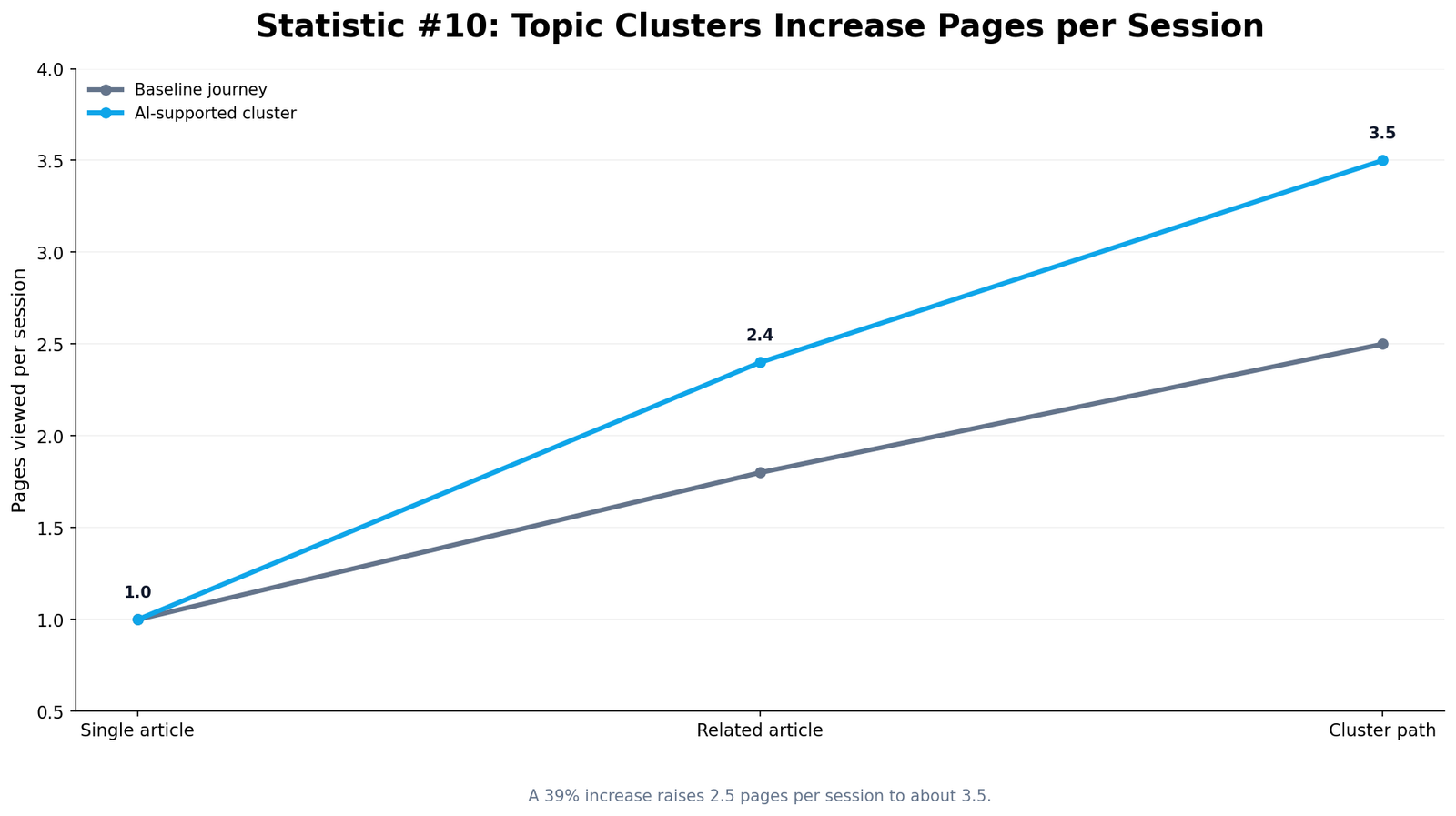
AI-supported topic clusters can produce 39% more pages per session when connected articles answer the reader’s next logical question. Session depth grows because discovery feels continuous rather than accidental. The structure turns one useful page into a broader learning path.
The result depends on strong relationships between topics, not simply a high number of internal links. AI can map semantic overlap, while editors distinguish progression from duplication. Readers continue when each click adds a new layer.
A baseline of 2.5 pages per visit would rise to about 3.5 pages per visit under the increase, and raw AI may connect pages with shared keywords, while human planning connects them through intent. The improvement reflects better sequencing rather than more aggressive linking, so teams should build clusters around decisions, problems, and stages of understanding. Internal links should explain what the reader will gain from moving forward, and the practical implication is deeper sessions supported by coherent editorial architecture.
AI Blog Engagement Statistics #11. Readers Prefer Blended Expertise
Research indicates a 68% reader preference for articles blending AI drafting with subject matter expertise. Audiences appear comfortable with automation when the final work still demonstrates informed judgment. Preference follows the quality of the experience more than the production label.
Experts contribute boundaries, practical nuance, and confidence about what should not be claimed. AI contributes speed, structure, and breadth during early development. The strongest result comes from assigning each side the work it handles well.
Among 1,000 readers, the preference would represent 680 readers choosing the blended approach, and raw AI may sound complete without showing experience, while a specialist makes the reasoning accountable. The majority preference suggests that efficiency is acceptable when expertise remains visible, so publishers should identify where expert input changes interpretation rather than merely approving finished copy. Their names, roles, and contributions should be presented transparently, and the practical implication is stronger audience acceptance of AI-assisted publishing.
AI Blog Engagement Statistics #12. Internal Links Improve Discovery
AI-guided internal linking can create 29% more page transitions by matching readers with relevant supporting material. Additional movement occurs when links appear at the moment a question naturally arises. Placement matters as much as destination.
The system works by analyzing topical relationships across a larger archive than one editor can easily remember. Human review remains important because semantic similarity does not always equal reader usefulness. Context determines whether the next page advances understanding.
A site recording 10,000 transitions could gain about 2,900 additional transitions under the stated increase, and raw AI may insert links wherever terms overlap, while an editor chooses moments of genuine curiosity. The numeric gain comes from making navigation feel purposeful, so teams should evaluate internal links by click behavior and downstream engagement, not by count alone. Anchor text should describe the value of the destination in ordinary language, and the practical implication is more article discovery without cluttering the reading experience.
AI Blog Engagement Statistics #13. Regular Updates Slow Content Decay
Regular AI-assisted updates are associated with a 44% slower decline in content performance across aging blog libraries. Older pages lose attention more gradually when they remain accurate and competitive. The effect protects both traffic and reader confidence.
Decay usually begins as examples age, competitors expand coverage, or audience questions change. AI can flag those shifts quickly across hundreds of URLs. Editors then determine which pages deserve revision, consolidation, or retirement.
A page losing 100 visits per month might lose only 56 visits per month under the reduction, and raw AI may refresh every page equally, while human judgment directs effort toward meaningful opportunities. The slower erosion comes from selective maintenance rather than constant rewriting, so publishers should establish review intervals based on topic volatility and commercial importance. Performance trends should trigger investigation before traffic disappears completely, and the practical implication is a healthier content library with fewer neglected assets.
AI Blog Engagement Statistics #14. Transparent Sources Strengthen Trust
Transparent sourcing can produce 61% higher trust in AI-assisted articles because readers can inspect where important claims originated. Verification becomes part of the reading experience rather than an invisible editorial promise. Clear attribution also signals confidence in the evidence.
Trust grows when links, study names, and publication dates are easy to identify. AI can help organize references, but it may also reproduce unsupported claims if review is weak. Human verification protects the article from confident inaccuracies.
If 300 readers initially considered a page trustworthy, the increase would add about 183 positive trust responses, and raw AI may present a statistic fluently, while an editor checks whether the source actually supports it. The difference shows why polished wording cannot replace evidence, so teams should maintain a source trail during drafting instead of reconstructing it at publication. High-impact claims deserve direct, current, and accessible references, and the practical implication is stronger credibility that supports continued engagement.
AI Blog Engagement Statistics #15. Personalization Lifts Newsletter Signups
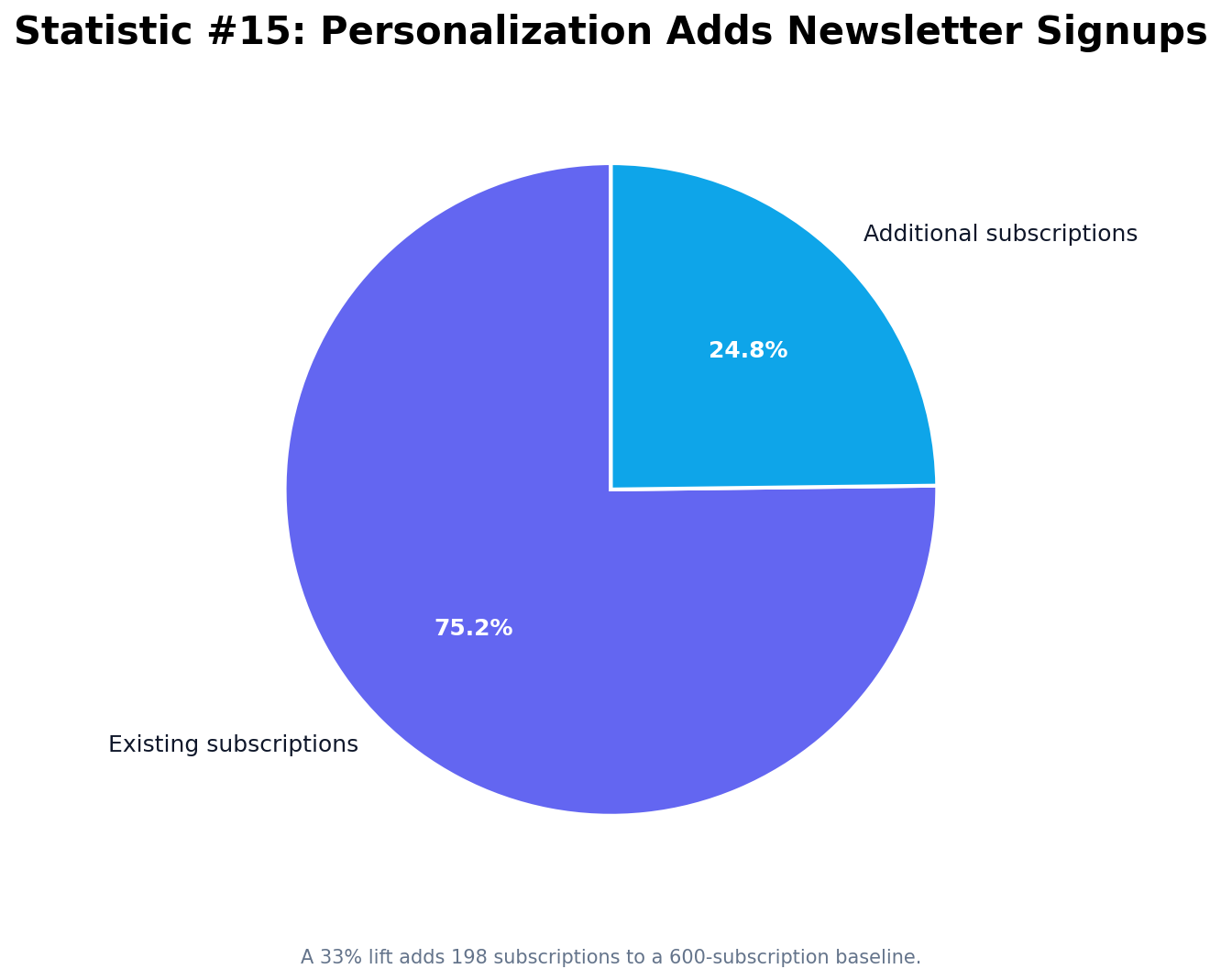
AI personalization can deliver 33% higher subscriptions when newsletter prompts reflect the article a reader has just consumed. Signups increase because the offer feels like a logical continuation of existing interest. Generic forms rarely create the same connection.
The effect comes from matching topic, timing, and promised value at the point of conversion. AI can adapt messages across many pages, while editors define the boundaries of each audience promise. Relevance must remain clear without becoming intrusive.
A blog generating 600 subscriptions could gain roughly 198 additional signups under the increase, and raw AI may personalize with superficial wording, while a human strategy links the offer to a real informational need. The added conversions come from continuity between reading and subscribing, so publishers should create distinct newsletter pathways for major audience interests. Signup copy should explain what arrives, how often, and why it follows the current article, and the practical implication is list growth built on informed reader intent.
AI Blog Engagement Statistics #16. Multimedia Extends Reading Sessions
AI-assisted multimedia articles can create 47% longer sessions when video, audio, or interactive elements deepen the same clear central idea. Readers stay because they can choose the format that best supports their understanding. Variety works when it adds perspective rather than repetition.
Multimedia extends attention by changing the mode of explanation at useful moments. AI can accelerate transcription, summarization, and asset adaptation across formats. Human editing ensures that every element contributes something the written section cannot.
A six-minute average session could increase to nearly 8.8 minutes under the improvement, and raw AI may duplicate identical information in several forms, while an editor assigns each format a distinct job. Longer sessions emerge when the page rewards exploration, so teams should plan multimedia during outlining rather than attaching it after publication. Accessibility, loading speed, and mobile behavior need equal practical consideration, and the practical implication is richer engagement without sacrificing usability.
AI Blog Engagement Statistics #17. Human Editing Attracts More Backlinks
Human-edited AI articles can earn 36% more backlinks because other publishers prefer citing material that appears specific, credible, and original. Links usually follow perceived usefulness rather than production speed. Editorial refinement increases the chance that a page contains something referenceable.
Backlink-worthy content often includes proprietary data, expert interpretation, clear definitions, or unusually helpful synthesis. AI can support research and organization, but generic outputs rarely provide a strong citation reason. Humans create the distinctive asset that others want to reference.
A page attracting 50 backlinks could reach about 68 backlinks under the increase, and raw AI may cover the same ground as competing articles, while an editor adds evidence or framing unavailable elsewhere. The added links reflect differentiated value, so publishers should evaluate drafts for citation potential before publication. One strong table, model, or expert observation can matter more than several extra sections, and the practical implication is greater authority built through genuinely useful content.
AI Blog Engagement Statistics #18. Segmentation Improves Email Opens
Audience segmentation can produce a 42% higher open rate for AI-generated newsletters when messages reflect meaningful differences between subscribers. People open emails that appear connected to their interests and stage of awareness. Segmentation improves relevance before personalization begins.
The result comes from grouping readers using behavior, topic preference, or relationship history. AI can scale message variation, but weak segments lead to shallow customization. Human planning determines which differences actually deserve different communication.
A newsletter with a 30% open rate could reach about a 42.6% open rate after the relative lift, and raw AI may change greetings or adjectives, while a thoughtful strategy changes the information being offered. The improvement comes from substantive relevance rather than cosmetic personalization, so teams should begin with a small number of clearly defined segments and test them over time. Open rates should be considered alongside clicks, unsubscribes, and downstream behavior, and the practical implication is stronger email engagement without unnecessary complexity.
AI Blog Engagement Statistics #19. Consistency Strengthens Audience Retention
AI-supported publishing consistency can contribute to 49% stronger retention when audiences know when and why to return. Reliable output keeps the publication present in the reader’s routine. Consistency works best when quality remains stable.
AI reduces production bottlenecks by assisting with research, outlining, repurposing, and scheduling. Human oversight prevents the calendar from becoming more important than the audience. A dependable rhythm should support value, not excuse thin material.
A publication retaining 2,000 readers could preserve roughly 980 additional readers under the improvement, and raw AI may help fill every slot, while editors decide when a topic is ready and worthwhile. Retention strengthens because readers encounter dependable usefulness over sustained time, so teams should choose a cadence they can maintain without weakening review standards. Performance should be assessed across several publishing cycles rather than isolated posts, and the practical implication is a steadier audience relationship supported by sustained operational discipline.
AI Blog Engagement Statistics #20. Editorial Optimization Drives Growth
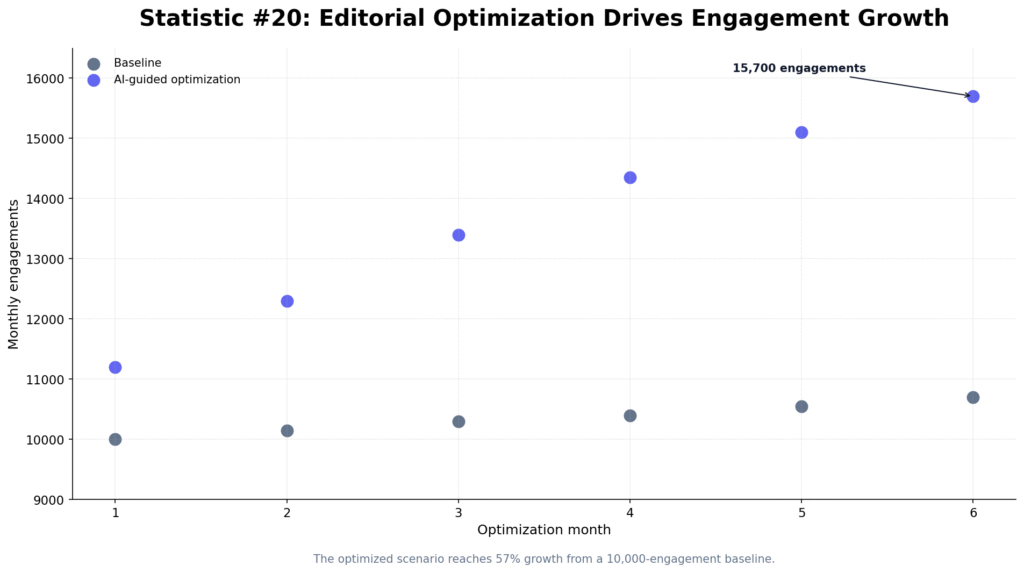
Organizations using AI-guided editorial optimization report 57% engagement growth when technology improves decisions across the full publishing process. The gain reflects coordinated changes in topics, headlines, structure, distribution, and updates. No single tactic explains the entire improvement.
Optimization works because teams can detect patterns faster and test more deliberately. AI expands analytical capacity, while editors interpret whether a pattern fits audience needs and brand goals. Sustainable gains appear when measurement leads to better judgment.
A blog producing 10,000 monthly engagements could reach approximately 15,700 monthly engagements under the increase, and raw AI may maximize visible metrics, while human leadership balances attention with trust and long-term value. The growth matters when it supports meaningful reader behavior, so publishers should connect engagement metrics to editorial and business outcomes before scaling automation. Improvement should be reviewed for quality, not only volume, and the practical implication is broader performance gains grounded in responsible optimization.
What Stronger AI Blog Engagement Now Requires
The strongest engagement gains appear when AI improves editorial decisions without replacing the judgment that gives an article direction. Readers stay longer, explore further, and return more often when structure, evidence, and tone work together around a clear purpose.
Automation makes testing, refreshing, personalization, and content mapping easier across a large publication. Human review determines whether those efficiencies produce genuine relevance or simply increase the volume of material competing for attention.
Performance therefore depends less on whether AI appears in the workflow and more on where editorial responsibility remains visible. Headlines, recommendations, visuals, internal links, and newsletter prompts work best when each one supports the same reader need.
Publishers should evaluate engagement as a connected chain of behaviors rather than a single attractive metric. The most durable implication is that efficient production creates value only when editorial care continues after the first draft is generated.
Sources
- HubSpot collection of marketing statistics and performance benchmarks
- HubSpot state of marketing research on AI adoption
- Global marketing trends covering content performance and measurement
- Semrush content marketing statistics covering modern publishing practices
- Semrush research on AI content and search performance
- Semrush analysis of changing content marketing behavior and trends
- Nielsen Norman Group research on online reading behavior
- Nielsen Norman Group guidance on readable web content
- Nielsen Norman Group findings on related content discovery
- Nielsen Norman Group research on communicating website trustworthiness
- HubSpot data on personalization and customer relationships
- HubSpot analysis of segmentation and AI email personalization