How to Stop Turnitin Flagging Human Writing: 15 Preventive Measures

In 2026, concerns around AI misclassification continue to grow as human-written work gets flagged by detection systems. Research published in the Nature journal Scientific Reports confirms measurable false positives in AI-text detection, reinforcing why structured prevention strategies matter.
How to Stop Turnitin Flagging Human Writing: 15 Preventive Measures
How to Stop Turnitin Flagging Human Writing has become a pressing concern for students and professionals who know their work is original yet still receive unexpected AI alerts. It’s frustrating to see authentic effort questioned, especially when AI detectors disagree and produce inconsistent results.
Part of the confusion stems from how detection systems analyze patterns rather than intent, which means structured, polished writing can resemble machine-generated text. Even careful sentence refinement or use of best AI paraphraser tools for Copyleaks sentence edits can unintentionally influence how algorithms score your work.
Understanding how detection thresholds operate, including data behind Turnitin false positive rate statistics, helps explain why legitimate writing sometimes gets flagged. In this guide, you’ll learn 15 preventive measures that protect authentic work without compromising clarity, structure, or academic integrity.
| # | Strategy focus | Practical takeaway |
|---|---|---|
| 1 | Vary sentence rhythm | Blend short and long sentences to avoid uniform patterns that trigger automated scoring. |
| 2 | Use natural transitions | Replace formulaic connectors with organic flow that reflects genuine thought progression. |
| 3 | Add specific examples | Ground ideas in lived or contextual detail to reduce generic phrasing signals. |
| 4 | Break predictable structure | Avoid rigid five-paragraph symmetry that resembles templated output. |
| 5 | Reflect personal reasoning | Show how you reached conclusions rather than presenting polished summaries alone. |
| 6 | Limit over-optimization | Avoid excessive smoothing that removes natural human variation in tone. |
| 7 | Cite sources thoughtfully | Integrate references in your own voice instead of stacking neutral summaries. |
| 8 | Adjust vocabulary density | Balance advanced terms with plain language to avoid unnatural consistency. |
| 9 | Include mild imperfections | Allow subtle stylistic quirks that signal authentic authorship. |
| 10 | Diversify paragraph length | Mix compact and expanded sections to prevent uniform formatting signals. |
| 11 | Avoid generic conclusions | End with specific reflection instead of polished summary statements. |
| 12 | Write in stages | Draft naturally before refining to preserve original voice markers. |
| 13 | Check detection previews | Review risk indicators early so you can revise before submission. |
| 14 | Maintain consistent authorship | Keep tone steady across drafts to avoid abrupt stylistic shifts. |
| 15 | Document your process | Save drafts and notes to demonstrate original development if questioned. |
15 Preventive Measures to How to Stop Turnitin Flagging Human Writing
How to Stop Turnitin Flagging Human Writing – Strategy #1: Vary sentence rhythm
One of the most reliable ways to protect your work is to intentionally vary your sentence rhythm so your writing reflects natural cognitive flow rather than mechanical uniformity. When every sentence follows a similar length and structure, detection systems may interpret that consistency as machine-generated patterning rather than authentic expression. Introducing a blend of compound, complex, and occasionally shorter reflective sentences creates subtle variation that mirrors how real people think, revise, and refine ideas as they write.
This works because human drafting rarely produces perfectly balanced syntax across entire paragraphs, especially when ideas build gradually through clarification and nuance. A student explaining a difficult concept will naturally alternate between explanation, qualification, and emphasis, and that organic pacing becomes visible in sentence structure. Maintaining this variation does not weaken clarity; instead, it signals authorship that evolves line by line rather than being generated in a single polished sweep.
How to Stop Turnitin Flagging Human Writing – Strategy #2: Use natural transitions
Instead of relying on rigid transitional phrases that appear in predictable academic templates, aim to connect ideas in ways that reflect how your reasoning genuinely unfolds. Overused connectors that appear at the start of every paragraph can create a formulaic pattern that algorithms recognize as structured output rather than spontaneous development. Allow transitions to emerge from context, expanding on a previous point with clarification or contrast instead of defaulting to stock phrasing.
Natural transitions tend to reference prior reasoning directly, weaving continuity into the paragraph rather than signaling it mechanically. For example, when you elaborate on an earlier claim, you might revisit a key term and reshape it with added nuance rather than inserting a predictable bridge phrase. That layered continuity signals active engagement with your own argument and reduces the risk of stylistic repetition that resembles automated construction.
How to Stop Turnitin Flagging Human Writing – Strategy #3: Add specific examples
Abstract summaries often read smoothly but can resemble generalized AI output when they lack grounded detail and lived context. Adding specific examples, whether drawn from coursework, research experience, or realistic scenarios, introduces texture that makes your writing feel distinctly human. Specificity forces the narrative to deviate from generic phrasing, which in turn reduces structural predictability across multiple paragraphs.
Detection systems analyze patterns of abstraction and uniform explanation, so inserting situational detail interrupts that uniformity in subtle but measurable ways. When you describe a classroom discussion, a research hurdle, or a drafting mistake you corrected, you introduce irregular phrasing that reflects genuine experience. That irregularity is not disorderly; it is simply the imprint of authentic cognitive engagement.
How to Stop Turnitin Flagging Human Writing – Strategy #4: Break predictable structure
Highly symmetrical essays that follow identical paragraph lengths and mirrored topic sentence construction can appear templated even when the ideas are entirely original. While structure is important, over-precision in formatting sometimes resembles generated composition more than organic drafting. Introducing variation in paragraph depth and allowing certain ideas more space than others creates a realistic distribution of emphasis.
Human reasoning rarely unfolds in perfectly even blocks, because some arguments require elaboration while others function as supporting clarification. Allowing one section to extend further, while another remains concise yet reflective, demonstrates proportional thinking rather than automated balance. This measured asymmetry helps signal authentic authorship without sacrificing coherence or logical progression.
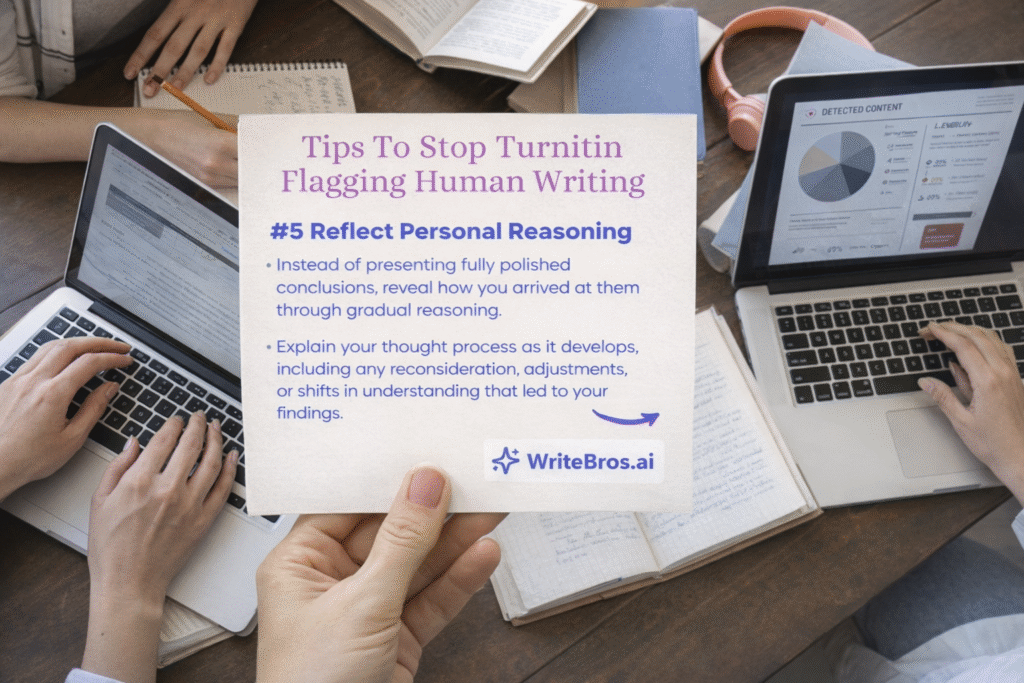
How to Stop Turnitin Flagging Human Writing – Strategy #5: Reflect personal reasoning
Rather than presenting conclusions as fully formed and polished from the outset, consider revealing how you arrived at them through gradual reasoning. When your writing shows the progression of thought, including reconsideration or refinement, it mirrors how individuals actually analyze complex material. That transparency of reasoning distinguishes authentic authorship from output that appears instantly optimized and finalized.
Explaining why you initially interpreted a concept one way before refining your understanding introduces subtle shifts in tone and structure. Those shifts reflect intellectual movement, which is difficult to replicate through purely automated patterning. By documenting that progression in language, you create a visible trail of analysis that reinforces originality.
How to Stop Turnitin Flagging Human Writing – Strategy #6: Limit over-optimization
Excessive polishing can unintentionally smooth away the natural variation that signals authentic drafting. When every sentence is refined to identical clarity and tone, the result may appear engineered rather than organically developed. Allowing small stylistic differences to remain, provided they do not obscure meaning, preserves the individuality of your voice.
Human writing contains subtle tonal fluctuations that reflect evolving focus and emphasis. If you revise repeatedly until every paragraph mirrors the same cadence, you risk introducing uniformity that detection systems identify as patterned output. Balanced refinement maintains clarity while protecting the subtle inconsistencies that indicate personal authorship.
How to Stop Turnitin Flagging Human Writing – Strategy #7: Cite sources thoughtfully
Integrating research into your own explanatory framework helps differentiate authentic analysis from neutral aggregation. When citations appear as layered interpretation rather than detached summaries, your voice remains central to the argument. That interpretive presence reduces the impression of compiled or automated synthesis.
Thoughtful citation involves framing evidence through your perspective, clarifying why it matters and how it modifies your reasoning. This contextualization introduces individualized phrasing that varies from standardized reporting language. As a result, the overall structure reflects engagement rather than extraction.
How to Stop Turnitin Flagging Human Writing – Strategy #8: Adjust vocabulary density
Maintaining a consistent academic tone is important, yet overly dense vocabulary across every sentence can resemble algorithmic construction. Human writers naturally alternate between technical terminology and simpler clarifications depending on emphasis and audience. That fluctuation creates dynamic texture that distinguishes authentic prose from uniformly elevated diction.
When complex terms are balanced with explanatory language, the writing demonstrates adaptive reasoning rather than mechanical consistency. This balance mirrors how individuals process information, occasionally pausing to restate or simplify an idea for clarity. Such adjustments create subtle stylistic variation that supports originality signals.
How to Stop Turnitin Flagging Human Writing – Strategy #9: Include mild imperfections
Perfection is not the goal when demonstrating authorship, because genuine drafting contains minor irregularities in emphasis and pacing. Allowing slight stylistic quirks to remain, provided they maintain readability, preserves authenticity. Completely eliminating variation can unintentionally create polished uniformity that appears synthetic.
These imperfections might include uneven sentence expansion or a moment of reflective phrasing that diverges from strict academic tone. Such elements indicate cognitive presence rather than automated completion. Maintaining measured imperfection signals that the text evolved through real thought processes.
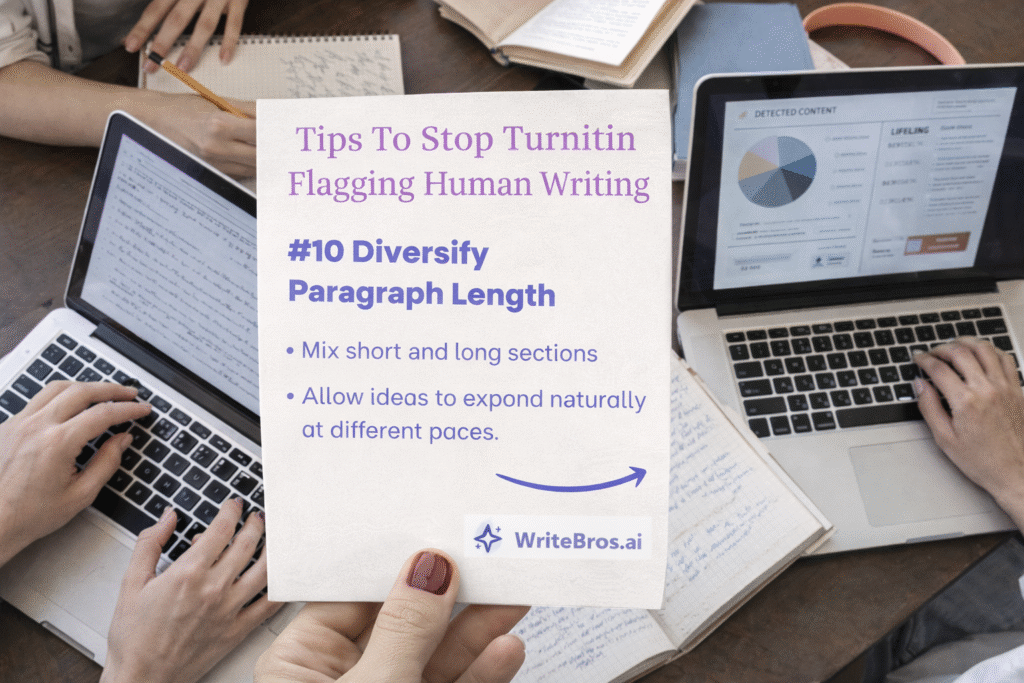
How to Stop Turnitin Flagging Human Writing – Strategy #10: Diversify paragraph length
Paragraphs that all span identical word counts can resemble output generated under formatting constraints. Allowing certain arguments to unfold more expansively while keeping others succinct reflects realistic emphasis distribution. This variation aligns with how people prioritize different sections of an argument.
Diversifying paragraph length also affects rhythm across the entire document, creating shifts that resemble authentic drafting. When the visual and structural pattern varies naturally, detection models encounter less repetitive formatting. The overall composition feels developed rather than assembled.
How to Stop Turnitin Flagging Human Writing – Strategy #11: Avoid generic conclusions
Generic closing paragraphs often summarize earlier content in language that mirrors introductory phrasing, creating structural symmetry that can appear templated. Crafting a conclusion that extends insight or reframes a specific point demonstrates continued reasoning rather than repetition. This forward-looking reflection reinforces originality.
When you revisit a nuanced detail introduced earlier and expand its implications, you introduce variation that distinguishes the ending from the beginning. That asymmetry reflects authentic synthesis instead of formulaic closure. Such refinement helps reduce predictable structural looping.
How to Stop Turnitin Flagging Human Writing – Strategy #12: Write in stages
Drafting in stages preserves the raw structure of your initial thinking before refinement occurs. Early versions often contain uneven phrasing and exploratory transitions that signal authentic composition. Revising gradually rather than rewriting entirely at once maintains that developmental trace.
When drafts evolve incrementally, subtle linguistic fingerprints remain embedded in the final text. Those fingerprints differentiate natural authorship from uniform generation. Saving versions also provides documentation if authorship is questioned.
How to Stop Turnitin Flagging Human Writing – Strategy #13: Check detection previews
Reviewing detection previews before submission allows you to identify patterns that may appear overly uniform. Instead of reacting after a flag, you can adjust phrasing strategically while preserving meaning. This proactive review prevents abrupt stylistic overhauls.
Small refinements based on preview feedback, such as adjusting repetitive syntax, often reduce scoring sensitivity. Making these edits gradually avoids introducing new uniformity. The goal remains clarity supported by authentic variation.
How to Stop Turnitin Flagging Human Writing – Strategy #14: Maintain consistent authorship
Switching tone abruptly between sections can raise questions about authorship consistency. Keeping a steady voice throughout drafting ensures that stylistic patterns evolve gradually rather than shifting suddenly. Consistency supports credibility.
When sections are written at different times, review them together to align tone without erasing individuality. Harmonizing phrasing gently avoids stark contrasts. This balance protects authenticity while preserving cohesion.
How to Stop Turnitin Flagging Human Writing – Strategy #15: Document your process
Saving outlines, drafts, and revision notes provides tangible evidence of development. Process documentation demonstrates that ideas were built progressively rather than generated instantly. This record strengthens academic transparency.
If questions arise, being able to reference earlier versions clarifies authorship without requiring defensive rewriting. Documentation supports integrity and reinforces confidence. The existence of developmental stages underscores originality.
Common mistakes
- Over-editing until every sentence mirrors identical structure, which creates polished uniformity that detection systems may interpret as patterned output rather than natural drafting.
- Relying on rigid essay templates without adjusting flow, leading to symmetrical paragraph construction that appears mechanically organized.
- Replacing authentic phrasing with overly formal vocabulary throughout the entire document, producing tonal consistency that lacks variation.
- Submitting a final draft without reviewing stylistic repetition, which allows unnoticed structural patterns to remain concentrated.
- Copying structural phrasing from study guides, even when ideas are original, resulting in recognizable formatting sequences.
- Ignoring process documentation, leaving no evidence of incremental drafting if authorship is questioned.
Edge cases
In highly technical disciplines, writing may naturally appear structured due to standardized terminology and methodological reporting conventions. In such contexts, variation should occur in explanation and reflection rather than altering required formatting.
Similarly, multilingual writers may produce consistent phrasing patterns as they prioritize clarity, which can inadvertently resemble uniform construction. Gradual stylistic expansion through practice helps introduce organic variation without compromising precision.
Supporting tools
- Draft management platforms that preserve revision history and timestamped edits, allowing you to demonstrate progressive authorship if needed.
- Read-aloud software that highlights repetitive cadence patterns so you can adjust rhythm naturally before submission.
- Style analysis tools that measure sentence length variation and structural distribution across paragraphs.
- Reference managers that integrate citations smoothly into your own explanatory voice.
- Version comparison tools that display incremental changes between drafts to verify developmental progression.
- WriteBros.ai for structured revision support that helps maintain authentic tone while refining clarity.
Ready to Transform Your AI Content?
Try WriteBros.ai and make your AI-generated content truly human.
Conclusion
How to Stop Turnitin Flagging Human Writing ultimately centers on preserving the natural signals of authentic authorship throughout drafting and revision. By introducing variation, documenting process, and refining thoughtfully, writers can protect originality without sacrificing clarity.
The objective is not perfection but intention, ensuring that each sentence reflects deliberate reasoning rather than automated symmetry. With consistent practice and measured refinement, authentic writing remains both credible and confidently defensible.
Did You Know?
If you are focused on How to Stop Turnitin Flagging Human Writing, surface-level edits rarely change outcomes when paragraph symmetry, repeated topic-sentence scaffolds, and evenly spaced analytical expansion remain consistent across the entire draft, because detection systems evaluate structural patterns across the full document rather than reacting to single word substitutions.
Introducing uneven emphasis between sections, adjusting how evidence unfolds from one claim to the next, and allowing reasoning to evolve instead of maintaining identical paragraph architecture can significantly influence the overall detection profile, since natural structural irregularity tends to resemble genuine academic cognition more than carefully balanced formatting repeated throughout.
Ready to Transform Your AI Content?