Hybrid Human-AI Writing Statistics: Top 20 Collaboration Findings

2026 has made hybrid writing a measurable business workflow rather than an emerging experiment. These 20 hybrid human-AI writing statistics reveal how organizations balance AI speed with human judgment, showing where productivity improves, where editorial oversight remains essential, and why collaboration is becoming the long-term operating model.
Editorial teams are steadily redefining how people and machines contribute to the same draft, making balance more valuable than automation alone. Many publishers now evaluate how much AI text is ultimately revised by people before considering a workflow successful.
Writing quality increasingly depends on judgment rather than generation, especially as search ecosystems reward originality and context. Keeping pace with content visibility in AI search has become part of the editorial process rather than a final optimization step.
Different organizations also measure collaboration differently, creating meaningful variation across industries and content formats. As a practical aside, comparing several benchmarks often provides a clearer picture than relying on a single survey.
Decision makers are shifting attention from raw AI adoption toward measurable editorial outcomes that influence trust and long-term performance. The growing role of AI content editors for natural marketing copy reflects how refinement increasingly determines whether human and machine collaboration delivers lasting value.
Top 20 Hybrid Human-AI Writing Statistics (Summary)
| # | Statistic | Key figure |
|---|---|---|
| 1 | Organizations using AI in at least one business function | 78% |
| 2 | Marketers using generative AI for content creation | Over 80% |
| 3 | Professionals who edit AI generated drafts before publishing | 91% |
| 4 | Average productivity gain from generative AI writing assistance | 40% |
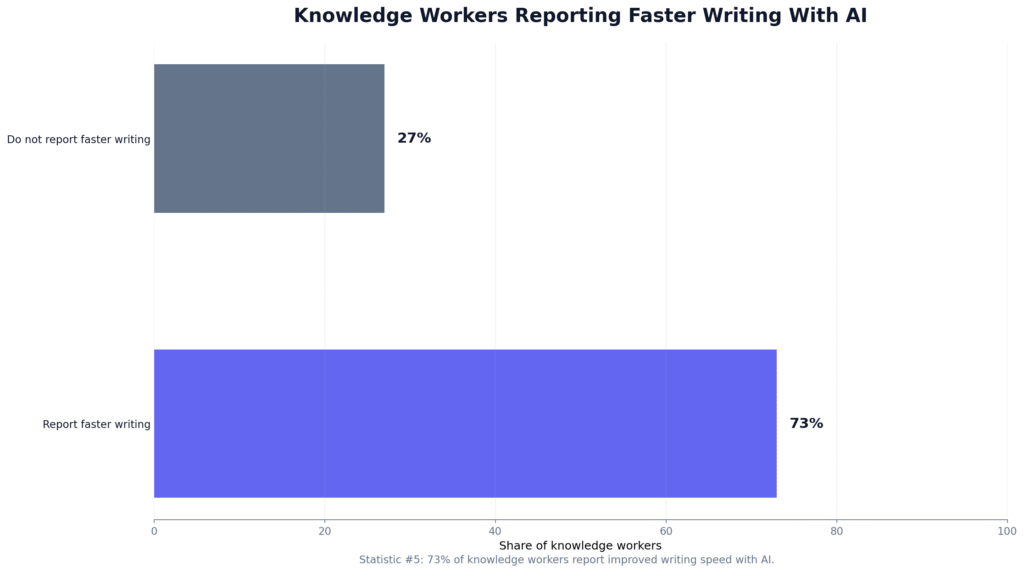
| 5 | Knowledge workers reporting improved writing speed with AI | 73% |
| 6 | Consumers expecting human oversight of AI generated content | 81% |
| 7 | Organizations requiring human review for public AI content | 68% |
| 8 | Business leaders citing quality control as top AI writing priority | 72% |
| 9 | Editors who rewrite AI generated introductions | 64% |
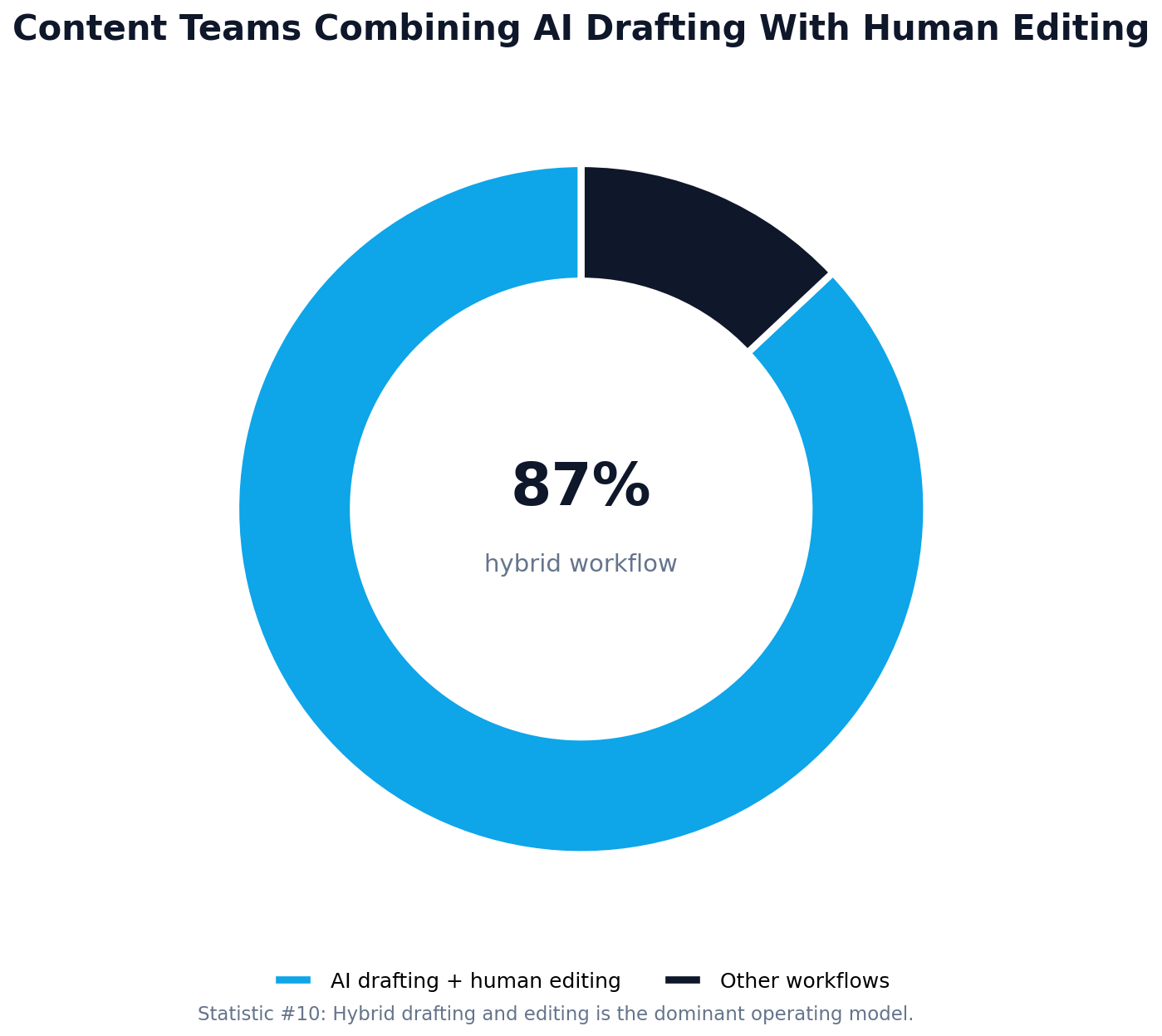
| 10 | Content teams combining AI drafting with human editing | 87% |
| 11 | Businesses increasing investment in generative AI | 92% |
| 12 | Employees believing AI improves document quality | 75% |
| 13 | Organizations establishing AI governance policies | 63% |
| 14 | Marketing teams using AI for first draft generation | 76% |
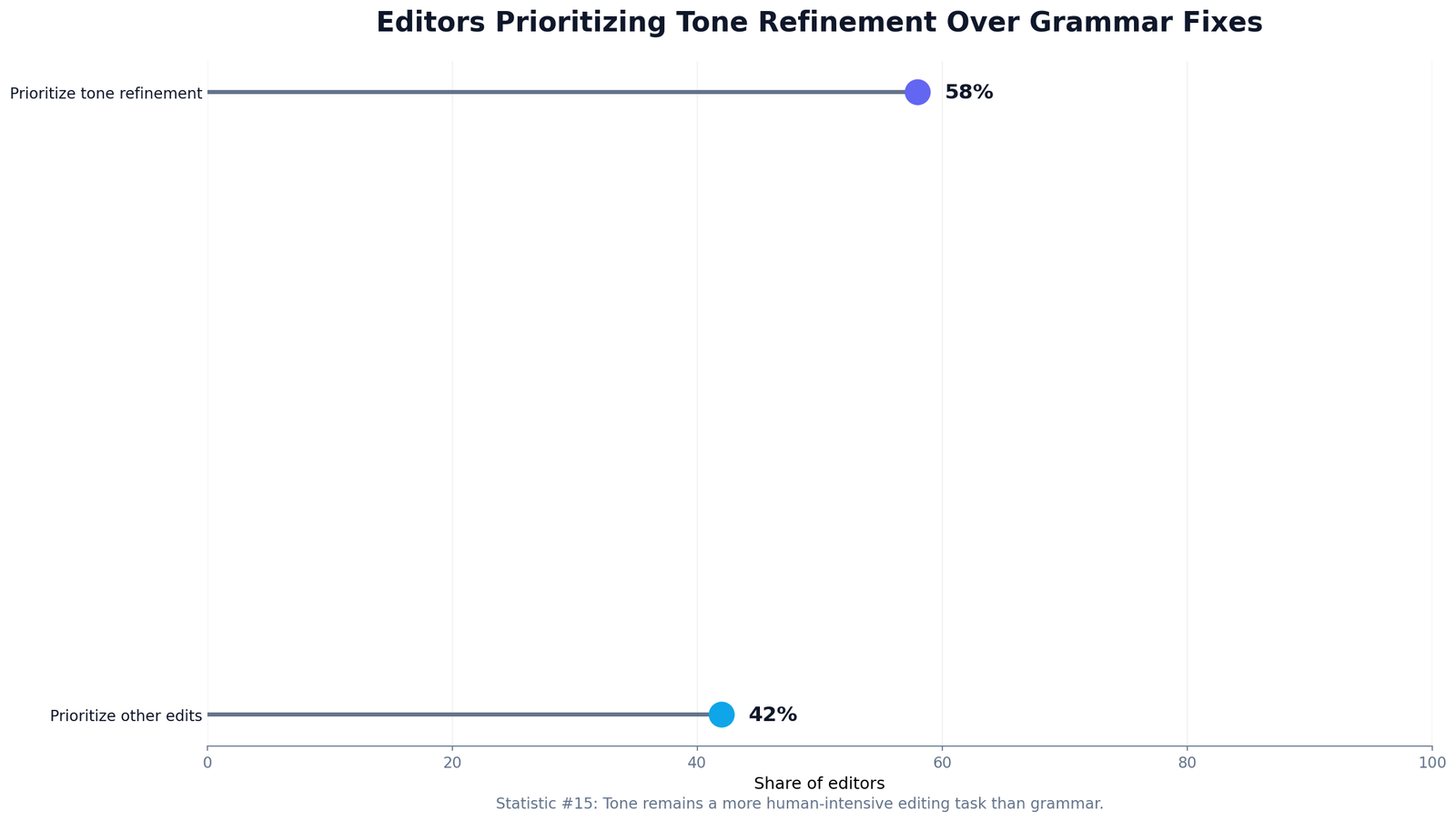
| 15 | Editors prioritizing tone refinement over grammar fixes | 58% |
| 16 | Organizations reporting faster publishing cycles with hybrid workflows | 54% |
| 17 | Executives expecting AI to augment rather than replace writers | 79% |
| 18 | Writers using AI primarily for brainstorming | 69% |
| 19 | Organizations measuring AI writing quality with human evaluation | 74% |
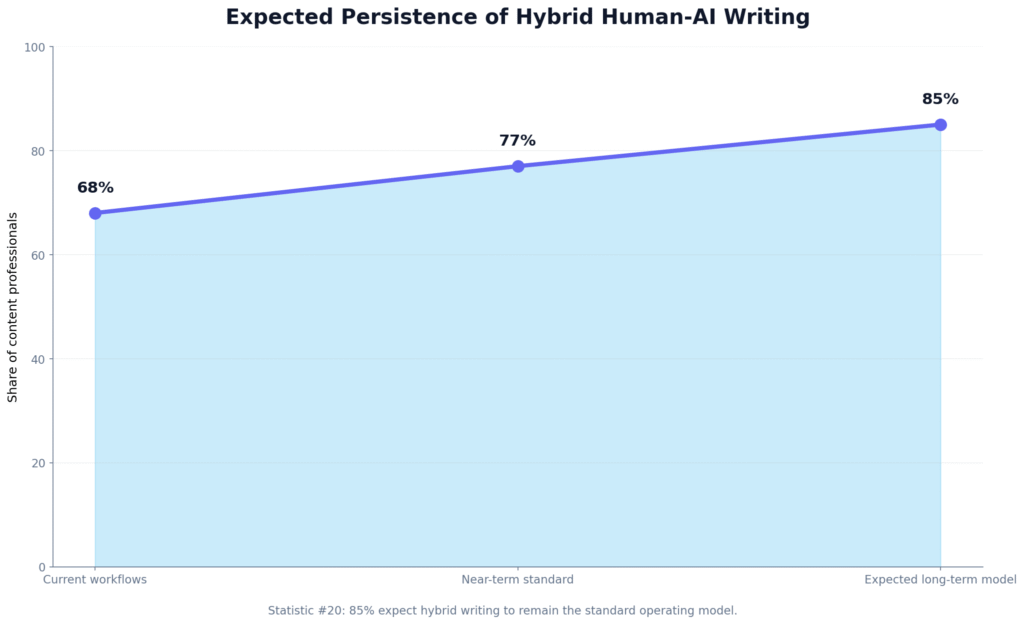
| 20 | Content professionals expecting hybrid writing to remain the standard | 85% |
Top 20 Hybrid Human-AI Writing Statistics and the Road Ahead
Hybrid Human-AI Writing Statistics #1. AI Adoption Has Entered Routine Business Work
78% of organizations reflects how AI is already embedded in at least one operating area. This pattern matters because teams have moved beyond isolated experiments and into routine work. The number therefore describes a working habit, not merely enthusiasm for a new tool.
The underlying cause is straightforward: adoption often begins where repetitive drafting, summarizing, or analysis consumes the most time. That advantage is strongest when the task is structured and the expected outcome is already clear. It becomes weaker when the assignment depends on fresh evidence, delicate judgment, or an original point of view.
In practice, human reviewers still decide whether the output fits the business context. A raw model response may be fast, but it rarely carries the same accountability as an approved document. The practical implication is that leaders should measure where AI removes friction without weakening review standards while preserving accuracy, accountability, context, and a recognizably human standard.
Hybrid Human-AI Writing Statistics #2. Content Creation Is a Leading Marketing Use Case
Over 80% of marketers now use generative AI for some part of content creation. The pattern shows that assisted writing has moved closer to the center of everyday marketing operations. It is no longer limited to experimental teams or occasional brainstorming sessions.
The underlying cause is the pressure to publish across websites, email, social media, and sales channels at once. Generative tools help because they can turn a brief into several workable starting points within minutes. Their value declines when teams expect those starting points to arrive with verified facts, distinctive positioning, and finished brand judgment.
Human editors still shape the argument, evidence, tone, and commercial emphasis before publication. A machine can produce ten variations quickly, while an experienced marketer recognizes which version sounds credible to the intended buyer. The practical implication is that teams should design workflows around automated speed followed by deliberate editorial judgment, rather than treating generated copy as completed work.
Hybrid Human-AI Writing Statistics #3. Most Generated Drafts Are Edited Before Publication
91% of professionals edit AI-generated drafts before allowing them to reach an audience. That behavior suggests users see generated language as working material rather than a finished publishing asset. High adoption therefore does not mean people have stopped intervening in the writing process.
The need for editing comes from recurring weaknesses such as generic transitions, unsupported confidence, repeated ideas, and uneven tone. Language models are designed to predict plausible wording, but plausibility does not guarantee relevance or accuracy. A sentence may read smoothly while still missing the writer’s real intention or the reader’s immediate concern.
Human revision restores specificity, accountability, and awareness of the situation surrounding the document. A generated draft may be grammatically clean, yet a person still notices when the message feels evasive, exaggerated, or bland. The practical implication is that publishers should budget meaningful editing time instead of treating human review as a quick final glance before publication.
Hybrid Human-AI Writing Statistics #4. Writing Assistance Can Produce Large Productivity Gains
40% average productivity gain illustrates how writing assistance can reduce the time required for routine communication. The improvement commonly appears during outlining, summarizing, reformatting, and initial drafting. These are stages where forward movement often matters more than polished language.
The gain occurs because AI reduces blank-page hesitation and quickly organizes predictable information into a workable structure. Workers can then spend more of their attention on decisions, exceptions, and refinements that require context. The benefit becomes smaller when the original task already demands substantial research, negotiation, or expert interpretation.
Human contribution determines whether the saved time produces a better document or simply a faster one. Saving forty minutes matters only when the remaining effort improves the reasoning, accuracy, and usefulness of the result. The practical implication is that managers should evaluate both the time removed from production and the quality created through the human attention that becomes available.
Hybrid Human-AI Writing Statistics #5. Knowledge Workers Feel the Difference in Writing Speed
73% of knowledge workers report that AI helps them complete writing tasks more quickly. This experience covers everyday materials such as emails, meeting summaries, proposals, reports, and internal updates. The strongest perceived benefit is often momentum rather than complete automation.
Writing becomes faster because the tool can provide a starting structure within seconds instead of requiring every sentence to begin from nothing. That early structure reduces cognitive switching and helps workers maintain attention on the purpose of the message. It still requires correction when emphasis, evidence, or interpersonal sensitivity matters.
People remain responsible for understanding how the language will affect colleagues, customers, and decision makers. A generated memo may arrive quickly, while a colleague must judge whether its wording sounds respectful, precise, and proportionate. The practical implication is that teams should use AI for acceleration while keeping sensitive communication under direct human control and clearly assigned editorial responsibility.
Hybrid Human-AI Writing Statistics #6. Audiences Still Expect Human Accountability
81% of consumers expect a person to oversee content produced with artificial intelligence. That expectation reveals that acceptance of AI does not automatically extend to unsupervised communication. Readers still want someone identifiable to stand behind consequential claims and recommendations.
The underlying concern is that fluent automated language can conceal factual mistakes, bias, manipulation, or an incomplete understanding of the situation. Consumers may appreciate faster answers while remaining cautious about how those answers were produced. Human oversight offers a visible layer of responsibility when the output influences purchases, finances, health, or other meaningful decisions.
A generated answer can sound confident even when its supporting reasoning is weak or absent. A named reviewer gives the audience a clearer basis for deciding whether the material deserves trust. The practical implication is that organizations should make review ownership explicit whenever public AI content carries meaningful consequences, rather than presenting automation as an invisible and unaccountable authority.
Hybrid Human-AI Writing Statistics #7. Public Content Commonly Passes Through Human Review
68% of organizations require human review before AI-assisted content is released publicly. The requirement shows that many companies distinguish between internal experimentation and externally accountable communication. Publication introduces risks that are less serious during private drafting.
Review policies emerge because generated wording may contain invented details, unsuitable promises, confidential information, or language that conflicts with company policy. A polished surface can make these failures difficult to notice during a rushed approval process. Organizations therefore add people at the stage where contextual understanding and responsibility matter most.
A model can complete a paragraph, but an employee must determine whether the paragraph should exist at all. That distinction separates sentence production from editorial judgment and organizational authority. The practical implication is that governance should define who reviews each content type, what that person must verify, and when questionable material should move to legal, compliance, or specialist review.
Hybrid Human-AI Writing Statistics #8. Quality Control Matters More Than Output Volume
72% of business leaders identify quality control as a leading priority for AI-assisted writing. Their concern suggests that production speed alone is no longer a persuasive measure of success. More content can create more work when errors and weak messaging require extensive correction later.
The underlying cause is that quality failures accumulate across websites, customer emails, sales materials, and internal documentation. Repeated inaccuracies can make an organization appear careless even when each individual mistake seems small. Leaders therefore focus on whether AI-supported output remains dependable, useful, and consistent with the organization’s actual expertise.
Human editors interrupt the pattern before minor weaknesses become a visible feature of the brand. One carefully reviewed article can strengthen confidence, while twenty rushed drafts can make genuine expertise appear synthetic. The practical implication is that teams should connect AI adoption targets to accuracy, usefulness, and editorial consistency instead of rewarding the number of generated words or documents alone.
Hybrid Human-AI Writing Statistics #9. Introductions Receive Disproportionate Editorial Attention
64% of editors rewrite AI-generated introductions before approving the larger piece. Openings attract attention because readers use them to decide whether the material offers anything specific or worthwhile. A generic beginning can weaken otherwise useful information before the main argument has started.
Generated introductions often rely on broad historical framing, familiar declarations, and predictable statements about rapid change. Models produce this pattern because conventional openings appear repeatedly throughout the language on which they were trained. The result may be coherent, but it often delays the article’s most interesting observation.
Human writers are more likely to begin with tension, a concrete consequence, or a detail that reveals why the subject matters now. An automated opening may explain the topic, while a deliberate human opening gives readers a reason to continue. The practical implication is that editors should treat the first paragraph as strategic writing rather than routine grammatical cleanup.
Hybrid Human-AI Writing Statistics #10. Drafting and Editing Are Becoming Separate Roles
87% of content teams combine AI drafting with some form of human editing. The figure points toward a division of labor rather than a completely automated publishing process. Machines create momentum, while people determine whether that momentum is moving in the right direction.
The arrangement works because initial generation and final evaluation involve different kinds of effort. AI can expand outlines, reformat passages, and suggest alternatives without fatigue. Editors contribute accuracy, originality, audience awareness, and an understanding of what the organization can responsibly claim.
A model can produce several sections quickly, but a person decides what deserves emphasis and what should be removed. That judgment becomes more important as the volume of generated material increases. The practical implication is that content leaders should document the handoff between drafting and editing so production speed never obscures who owns the argument, evidence, and final publishing decision.
Hybrid Human-AI Writing Statistics #11. Investment Is Moving Beyond Small Experiments
92% of businesses are increasing some form of investment in generative AI capabilities. Rising expenditure suggests that early trials have produced enough operational promise to justify broader deployment. Companies are now considering infrastructure, software access, training, governance, and workflow redesign together.
Investment grows because writing, customer service, research, analysis, and documentation all contain repeatable language tasks. A single platform may therefore affect several departments instead of serving one narrow use case. The financial commitment becomes harder to justify when organizations purchase tools without identifying the decisions or bottlenecks those tools are expected to improve.
Human capability determines whether expanded access becomes reliable business value or unused technical capacity. Buying more licenses creates availability, while training people determines whether that availability improves actual work. The practical implication is that leaders should pair technology budgets with governance, education, and measurement so increased spending produces stronger decisions rather than merely more generated material.
Hybrid Human-AI Writing Statistics #12. Employees See Quality Benefits Beyond Speed
75% of employees believe AI can improve the quality of workplace documents. Their perception suggests that assistance is valued for more than finishing assignments faster. Workers also use it to clarify structure, explore alternative wording, and identify weaknesses during an early draft.
Perceived quality rises because the tool can offer options that may not occur to someone writing under time pressure. Seeing several versions encourages comparison and can reveal where the original sentence is vague or unnecessarily complicated. The improvement is less dependable when users lack enough subject knowledge to recognize a confident but unsuitable suggestion.
Human judgment remains essential when deciding which recommendation actually fits the document’s purpose and audience. A cleaner sentence is useful, but a colleague still understands the relationships and consequences surrounding the message. The practical implication is that organizations should teach employees to evaluate AI suggestions rather than accepting them automatically, especially when documents influence customers, policies, or important internal decisions.
Hybrid Human-AI Writing Statistics #13. Governance Is Becoming Part of Content Operations
63% of organizations have begun establishing policies for the use of artificial intelligence. Formal governance indicates that AI writing is becoming an operational issue rather than a personal productivity preference. Companies need shared rules once generated material enters customer-facing, confidential, or regulated workflows.
Policies appear because unmanaged use creates uncertainty around privacy, attribution, accuracy, copyright, and responsibility. Employees often adopt convenient tools more quickly than organizations can assess their risks. Without practical guidance, each worker may make a different decision about what information can be entered and what output can be published.
Human rules create boundaries around what automated systems may process, retain, recommend, or release. A convenient prompt may save several minutes while exposing sensitive information that should never leave an approved environment. The practical implication is that organizations should translate broad principles into simple daily decisions employees can follow without needing to interpret a lengthy policy during every writing task.
Hybrid Human-AI Writing Statistics #14. First Drafts Are the Natural Entry Point
76% of marketing teams use AI to assist with first-draft generation. This stage attracts adoption because a rough draft needs momentum and direction more urgently than perfect precision. Teams can explore several approaches before committing substantial human effort to one version.
The underlying pressure comes from tight campaign calendars and the need to adapt messages across multiple channels. AI fits the early stage because it can quickly produce outlines, headlines, email structures, and landing-page frameworks. It becomes less dependable when the material requires defensible evidence, distinctive customer insight, or an exact understanding of the offer.
Human marketers add proof, differentiation, restraint, and commercial judgment after the initial structure exists. A model can produce a landing-page skeleton, while a strategist connects the argument to real customer objections and buying conditions. The practical implication is that teams should keep rapid first-draft generation separate from final approval, factual verification, and accountability for campaign performance.
Hybrid Human-AI Writing Statistics #15. Tone Requires More Work Than Grammar
58% of editors prioritize tone refinement over basic grammatical correction when reviewing AI-assisted writing. That emphasis shows how mechanical correctness has become only the beginning of editorial quality. Modern tools can fix many visible errors, but appropriate expression remains more difficult.
The harder problem is making language sound right for the audience, relationship, and immediate situation. Tone depends on subtle balances between confidence and humility, warmth and efficiency, or urgency and restraint. Generated writing may miss those balances because it lacks direct experience of the people and consequences surrounding the exchange.
Human editors recognize when a technically correct sentence still sounds cold, inflated, evasive, or strangely defensive. Their intervention changes not only the wording but also the emotional effect of the message. The practical implication is that editorial teams should assess how the reader is likely to feel and respond, rather than treating grammatical cleanliness as sufficient evidence of human-quality communication.
Hybrid Human-AI Writing Statistics #16. Hybrid Workflows Are Shortening Publishing Cycles
54% of organizations report faster publishing cycles after adopting hybrid writing workflows. The improvement suggests that AI removes meaningful delays without eliminating every stage of production. Drafting becomes quicker, while research, review, coordination, and approval continue to require time.
The acceleration occurs because automation can compress outlining, formatting, summarizing, and routine revision. Human contributors can then concentrate on factual questions, strategic choices, and material that carries greater reputational risk. The overall gain remains moderate because responsible publishing still includes checkpoints that should not be removed merely to increase speed.
Human involvement prevents faster production from becoming careless throughput. Publishing one day earlier can be valuable, but releasing an avoidable error may erase that advantage immediately. The practical implication is that teams should remove repetitive delays while preserving fact-checking, specialist review, and final accountability, particularly when the content makes claims readers may use to guide important decisions.
Hybrid Human-AI Writing Statistics #17. Executives Expect Augmentation More Than Replacement
79% of executives expect AI to augment writers rather than remove them from the workflow. This expectation recognizes that producing sentences represents only one portion of professional writing. The role also includes judgment, persuasion, research, negotiation, and responsibility for consequences.
Augmentation is more realistic because language models perform best when people frame the task and evaluate the result. AI can accelerate options and routine transformations, but it does not independently own the purpose behind the document. Companies still need people who understand the audience, the evidence, the organizational context, and the limits of what can be promised.
An AI system can suggest five headlines, while an editor knows which promise the organization can defend. That distinction keeps human judgment central even when production becomes heavily assisted. The practical implication is that workforce planning should focus on redesigned responsibilities, stronger editorial skills, and clearer accountability rather than assuming writing roles disappear when generation becomes easier.
Hybrid Human-AI Writing Statistics #18. Brainstorming Remains a Low-Risk Entry Point
69% of writers primarily use AI to support brainstorming and early idea development. The preference makes sense because ideation benefits from breadth without requiring every suggestion to be accurate or publishable. Weak options can be discarded before they create meaningful editorial risk.
AI performs well at this stage because it can quickly surface angles, comparisons, questions, and possible structures. The volume helps writers move past the first familiar idea and consider alternatives they might otherwise overlook. Its usefulness declines when generated suggestions begin replacing direct observation, original research, or the writer’s own interpretation of the subject.
Human writers select, combine, and deepen the ideas that contain genuine relevance or tension. A list of twenty angles creates motion, while experience identifies the one capable of sustaining a meaningful argument. The practical implication is that writers should use the tool to widen exploration without outsourcing the central point of view that gives the finished work its identity.
Hybrid Human-AI Writing Statistics #19. Human Evaluation Still Defines Writing Quality
74% of organizations use human evaluation when measuring the quality of AI-assisted writing. This reliance shows that automated scores cannot fully determine whether a document is useful, credible, or suitable for its situation. Quality changes according to the reader, purpose, risk, and expected action.
Automated measures can identify readability, repetition, grammar, and certain structural patterns with reasonable consistency. They struggle to judge whether an explanation answers the real question or whether its confidence is justified by evidence. Organizations therefore retain reviewers who understand the business context in which the language will operate.
A readability score may look excellent while an editor sees that the response avoids the customer’s actual concern. Human assessment catches failures that remain invisible when quality is reduced to surface-level metrics. The practical implication is that measurement programs should combine structured criteria with informed human review, allowing consistency without pretending that every meaningful feature of writing can be represented by a score.
Hybrid Human-AI Writing Statistics #20. Collaboration Is Expected to Become the Default
85% of content professionals expect hybrid writing to remain a standard operating model. The expectation reflects a practical compromise between the speed of machine generation and the judgment of human editors. Neither side consistently produces the same value when working entirely alone.
The approach persists because AI can support hundreds of small drafting, formatting, and revision decisions without fatigue. People supply context, purpose, experience, and responsibility for the larger argument. This combination is more durable than workflows built around unrestricted automation or a complete rejection of tools that can remove repetitive work.
AI may accelerate individual choices, while people determine whether those choices support the intended reader and organizational goal. The human contribution becomes more visible as generated language grows easier and less distinctive. The practical implication is that teams should build durable processes around collaboration, clear handoffs, and accountable review rather than treating hybrid writing as a temporary experiment that will soon disappear.
What the Shift Toward Hybrid Writing Means
The emerging pattern is not a simple transfer of writing from people to machines. AI is taking over more of the initial assembly work, while human effort moves toward judgment, verification, tone, and accountability.
This division explains why adoption and editing rates can rise at the same time without contradicting each other. Organizations use more automation because it saves time, then add structured review because greater output creates more opportunities for factual and editorial failure.
The strongest workflows recognize that speed has value only when the resulting material remains useful and trustworthy. Human contribution becomes more important, not less visible, when generated language is abundant and mechanically polished.
Editorial advantage will increasingly depend on how well teams design the exchange between machine assistance and informed human decisions. Companies that measure both efficiency and final quality will be better positioned to distinguish genuine productivity from faster production that merely moves unfinished work downstream.
Sources
- McKinsey global survey examining organizational artificial intelligence adoption
- McKinsey analysis of how organizations capture generative AI value
- McKinsey report tracking generative AI adoption during 2024
- Microsoft Work Trend Index research on workplace AI adoption
- Microsoft and LinkedIn findings about artificial intelligence at work
- Microsoft research into AI creativity, editing, and workplace productivity
- Microsoft analysis of AI agents and continued human agency
- HubSpot global report on artificial intelligence in modern marketing
- HubSpot findings on marketer AI usage and human editing
- HubSpot analysis of generative AI as a collaborative tool
- Grammarly report on AI-powered workplace communication and productivity
- Grammarly research into written communication quality and business performance