DeepSeek AI Content Trends: Top 20 Editing Workflow Insights

2026’s cheaper-output era makes DeepSeek a workflow story, not just a model story: long context, low token costs, scaled queues, stronger reasoning, and rising AI publishing volume all shift attention toward revision quality, editorial control, and post-draft judgment.
The signal worth watching is no longer whether teams can generate a draft, but whether that draft survives editing, review, and publishing without creating new cleanup work. That makes broader content rewriting statistics useful because the real trend is moving from generation volume toward revision discipline.
DeepSeek enters that shift with unusual pressure on cost, context length, and reasoning behavior, so its usefulness depends on how teams convert raw output into publishable judgment. A workflow that includes DeepSeek draft refinement matters because low-cost output only becomes strategic when structure, factual caution, and voice control improve together.
The practical pattern is that more affordable model access changes editorial behavior first, then content calendars, then quality controls. For teams comparing human-like editing tools, the useful question is not which system sounds most fluent at first pass, but which one reduces revision drag after 10, 50, or 100 drafts.
These trends also make AI content less of a standalone writing shortcut and more of a production layer that needs measurement, policy, and human calibration. A small practical aside: the teams that document before-and-after edits tend to spot drift earlier, especially when DeepSeek is used across multiple formats or writers.
Top 20 DeepSeek AI Content Trends (Summary)
| # | Statistic | Key figure |
|---|---|---|
| 1 | Daily app usage turns DeepSeek from model story into workflow habit | 22.15M daily users |
| 2 | Global download reach shows how quickly low-cost AI tools can spread | 156 countries |
| 3 | Web traffic indicates that DeepSeek demand extends beyond mobile curiosity | 350.8M visits |
| 4 | Android distribution gives DeepSeek a large practical base for everyday drafting | 50M+ downloads |
| 5 | Long-context support shifts content work from short prompts to whole-project review | 1M context length |
| 6 | Large output capacity makes extended drafting, restructuring, and documentation easier to centralize | 384K max output |
| 7 | Low input pricing changes the economics of repeated editorial experimentation | $0.14 per 1M input tokens |
| 8 | Low output pricing makes longer revisions more viable for content teams | $0.28 per 1M output tokens |
| 9 | Cached input pricing rewards repeat workflows, templates, and recurring editorial contexts | $0.0028 cached input |
| 10 | High concurrency supports scaled content operations without treating every prompt as a bottleneck | 2,500 concurrency limit |
| 11 | Model scale gives DeepSeek broad capability while keeping active computation narrower | 671B total parameters |
| 12 | Activated-parameter efficiency explains why output cost can fall while capability remains competitive | 37B activated parameters |
| 13 | Training-token scale supports broader language, code, and reasoning coverage across content tasks | 14.8T training tokens |
| 14 | Compute efficiency reframes the debate around whether better content tools require larger budgets | 2.788M H800 hours |
| 15 | Pretraining cost became a proxy for the wider pressure to build cheaper AI content systems | $5.576M pretraining cost |
| 16 | Reasoning gains show why DeepSeek is being tested for planning, outlining, and structured editorial work | 71.0% AIME pass@1 |
| 17 | Majority-vote performance highlights the value of reruns, comparison, and editorial selection | 86.7% majority vote |
| 18 | Math benchmark strength explains the appeal of DeepSeek for logic-heavy content and technical explainers | 97.3% MATH-500 score |
| 19 | AI content creation is now mainstream enough that DeepSeek competes inside an already normalized workflow | 80% of marketers |
| 20 | AI-assisted publishing volume raises the editorial burden on rewriting, verification, and differentiation | 42% more content |
Top 20 DeepSeek AI Content Trends and the Road Ahead
DeepSeek AI Content Trends #1. Daily Usage Becomes Workflow Habit
22.15M daily users show that DeepSeek has moved from launch novelty into routine writing behavior across ordinary workdays. When a tool is opened this often, teams start using it for drafts, summaries, outlines, and quick rewrites. The pattern matters because repeated use exposes both speed gains and quality gaps in real editorial conditions.
The cause is simple: lower friction makes small requests feel worth sending. Writers no longer reserve AI for major projects when everyday edits can be tested quickly and revised without much delay. That creates a wider review surface, where managers see how prompts, templates, and revisions actually behave across recurring assignments.
Raw AI use can make 22.15M daily users look like a complete adoption story. Humanized content work asks whether those drafts still carry tone, evidence, and reader judgment after editing. The practical implication is that daily usage should be measured by usable output, not access alone.
DeepSeek AI Content Trends #2. Global Reach Raises Localization Pressure
156 country reach shows that DeepSeek’s content impact is not limited to one market or language setting. When a writing tool spreads that widely, teams encounter more varied prompts, review standards, and publishing expectations across live campaigns. The pattern matters because global access quickly turns model behavior into an editorial consistency problem across regions and teams.
The cause is a mix of low-cost availability, mobile discovery, and curiosity around open model performance. Wider distribution lets students, marketers, developers, and publishers test the same system for very different tasks. That variety creates pressure for clearer workflows because one default style cannot serve every audience or cultural context.
Raw AI can make 156 country reach look like simple scale. Humanized review treats that spread as a warning that voice, localization, and context need active control. The practical implication is that global adoption requires local editorial judgment, not just broader model access.
DeepSeek AI Content Trends #3. Web Traffic Signals Deeper Workflows
350.8M website visits suggest that DeepSeek demand extends beyond quick app exploration and casual product curiosity. Web traffic at that scale points to deeper tasks such as research, coding, drafting, comparison, and longer-form prompting. The pattern matters because browser-based usage often sits closer to actual work than casual mobile testing.
The cause is that serious content workflows usually require documents, tabs, source checks, and revision notes. Users move to web sessions when the task becomes longer than a single question or a quick answer. That shift gives editors more room to test structure, factual framing, and voice across multiple passes with visible editorial context together.
Raw AI traffic can make 350.8M website visits feel like proof of writing quality. Humanized editing separates interest from finished usefulness by asking what survives review and reader scrutiny. The practical implication is that traffic should guide evaluation, but edited outcomes should drive publishing implication.
DeepSeek AI Content Trends #4. Mobile Distribution Expands Draft Supply
50M+ Android downloads show how quickly DeepSeek became available inside everyday writing moments. Mobile distribution matters because it places AI support beside messages, notes, classes, and small business tasks. The pattern matters because content creation increasingly starts outside formal editorial software, dashboards, and structured planning environments during early idea capture and drafting.
The cause is convenience, especially for users who test ideas before moving them into longer documents. When drafting begins on a phone, prompts tend to be shorter, faster, and less governed by brand or source rules. That makes later cleanup more important because casual inputs often produce uneven phrasing, thin context, and loose transitions.
Raw AI can make 50M+ Android downloads look like instant productivity. Humanized workflows ask whether those mobile drafts can become coherent articles, captions, briefs, or emails. The practical implication is that mobile adoption increases output supply, but also raises the need for review implication.
DeepSeek AI Content Trends #5. Long Context Supports Whole Project Review
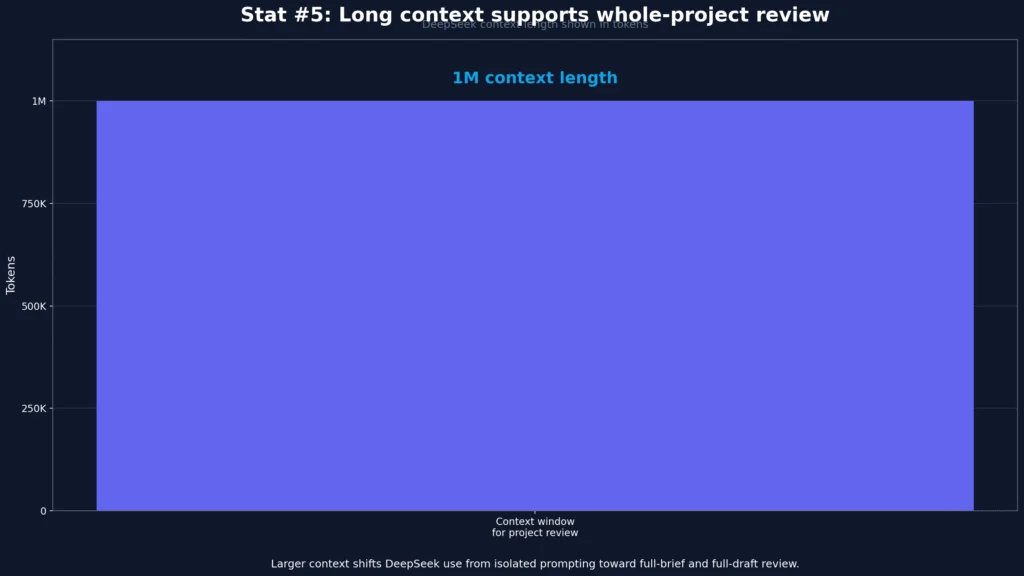
1M context length changes DeepSeek from a short-prompt tool into a whole-project review system for teams. Longer context lets users load more drafts, notes, guidelines, examples, source material, and review notes into one interaction. The pattern matters because content work often fails when systems forget earlier constraints or lose editorial continuity.
The cause is technical capacity meeting editorial reality. Teams do not only need isolated paragraphs; they need continuity across briefs, sections, examples, revisions, and style rules. A larger window lets reviewers compare more material before deciding whether a draft is consistent enough to continue through review, expansion, final polishing, and approval.
Raw AI can treat 1M context length as permission to produce more text. Humanized content work treats it as a way to preserve intent across a larger editing field with fewer resets. The practical implication is that long context is most valuable when it improves coherence, not just length implication.
DeepSeek AI Content Trends #6. Larger Output Makes Full Drafts Easier
384K max output gives DeepSeek enough room for long revisions, documentation, and multi-section drafting. That capacity changes how teams think about one-shot generation because larger outputs can cover fuller workflows with fewer interruptions. The pattern matters when editors want fewer fragmented exchanges, fewer restarts, and more complete working drafts for evaluation before writers decide what needs human tightening.
The cause is that many content tasks are not naturally short. Guides, reports, training pages, comparison articles, and internal playbooks need sustained structure across many sections. Larger output limits reduce the need to stitch pieces together, although they also make quality review more demanding for every section and transition.
Raw AI can turn 384K max output into long but uneven copy. Humanized editing asks whether the extra space improves pacing, hierarchy, reader comprehension, and continuity. The practical implication is that maximum output should be used for structured completeness, not unchecked expansion and bloat implication.
DeepSeek AI Content Trends #7. Low Input Pricing Encourages Iteration
$0.14 per 1M input tokens changes the economics of repeated content testing at scale. When input is inexpensive, teams can run more briefs, examples, outlines, audience notes, and source material through the model. The pattern matters because better prompting often requires iteration rather than one perfect request or rushed instruction from a busy editor.
The cause is that low input cost lowers the penalty for experimenting with context, examples, and constraints. Editors can compare different instructions, audience descriptions, and structural constraints without treating each trial as expensive. That makes the workflow more diagnostic because failed prompts reveal what the system misunderstands about audience, purpose, and editorial risk.
Raw AI can make $0.14 per 1M input tokens encourage careless prompting. Humanized workflows use the cheaper input layer to provide clearer background and stronger editorial guardrails before generation. The practical implication is that low input cost rewards better preparation, not just more prompting implication.
DeepSeek AI Content Trends #8. Low Output Pricing Expands Editorial Choice
$0.28 per 1M output tokens makes longer revision cycles easier to justify. Teams can ask for rewrites, simplifications, outlines, and alternate structures without turning every output into a budget decision for every request. The pattern matters because content quality often improves gradually through comparison, not a single draft delivered too quickly.
The cause is that lower output pricing reduces the cost of editorial exploration. Instead of accepting the first version, editors can request slower pacing, sharper transitions, clearer evidence framing, and better section logic. That helps teams see which draft direction and revision path actually supports the reader’s task with less wasted review time and effort.
Raw AI can make $0.28 per 1M output tokens lead to excess versions. Humanized editing uses the lower cost to compare options, then chooses the one with stronger judgment. The practical implication is that cheap output should expand choice without weakening editorial selection implication.
DeepSeek AI Content Trends #9. Cached Input Rewards Better Documentation
$0.0028 cached input rewards workflows that reuse instructions, examples, and brand context across accounts. When repeated prefixes become cheaper, teams have a reason to standardize briefs and house instructions rather than rewrite them casually. The pattern matters because consistent context often creates more consistent drafts across repeated editorial assignments across related campaigns.
The cause is caching, which favors repeated setup language across similar requests. Editorial teams can benefit when style guides, audience notes, formatting rules, and examples stay stable across sessions and projects. That turns the prompt library into an operational asset rather than a loose collection of instructions that nobody audits.
Raw AI can make $0.0028 cached input feel like a technical billing detail for finance. Humanized workflows see it as an incentive to maintain better reusable context. The practical implication is that cached pricing makes documentation valuable because good prompts compound across projects, client work, and QA implication.
DeepSeek AI Content Trends #10. Concurrency Supports Scaled Review Queues
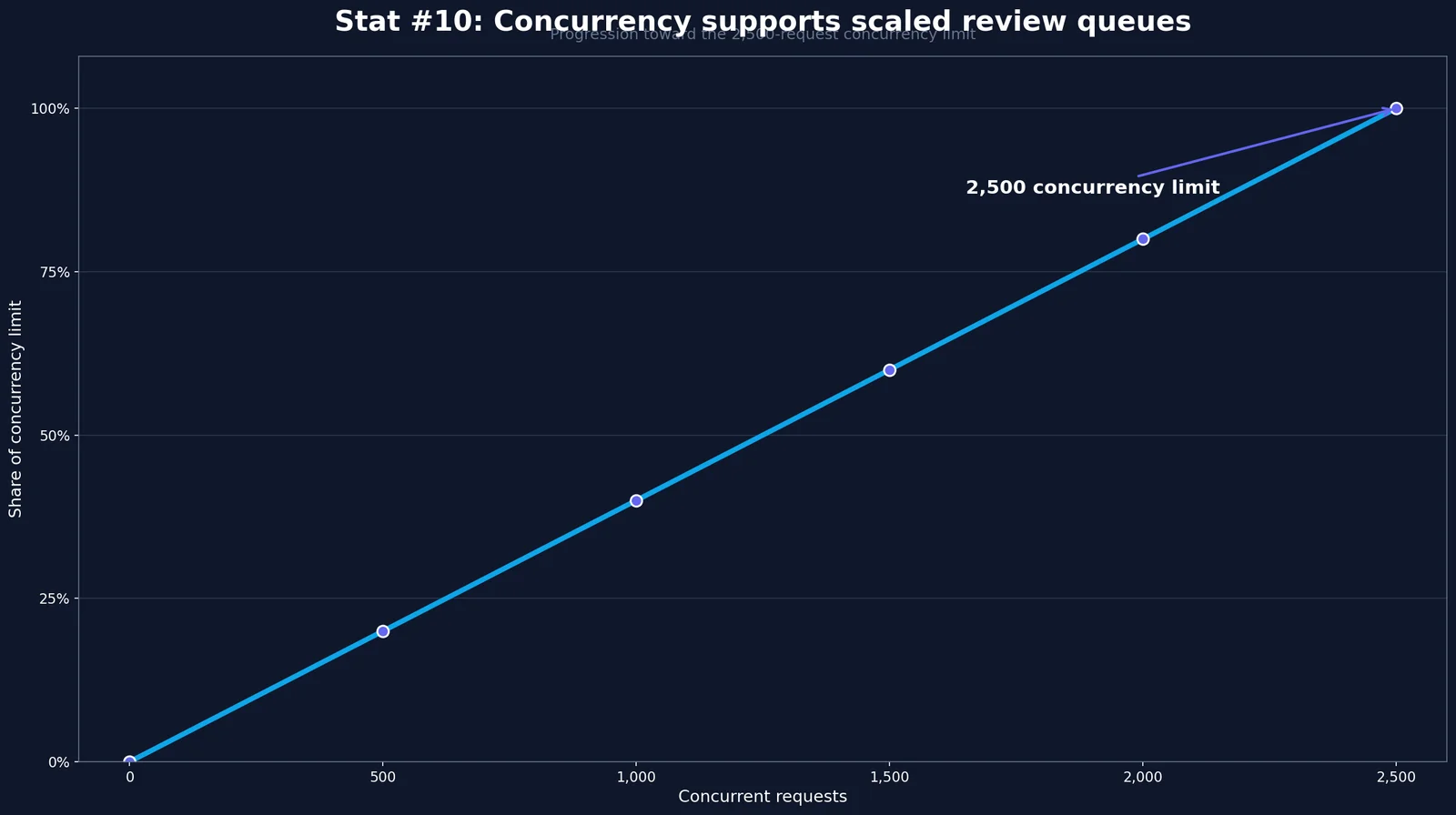
2,500 concurrency limit shows that DeepSeek can support heavier operational use, not just individual prompting or testing. High concurrency matters when many content tasks run through the same model at once during production. The pattern matters for agencies, platforms, and publishers that manage parallel drafting or review queues across many client accounts.
The cause is that scaled content systems depend on throughput as much as model quality. If requests bottleneck, editors wait, queues grow, and teams lose the rhythm that makes AI-assisted production worthwhile. A higher limit lets organizations test automation without slowing every human review step, rewrite request, or approval layer during peak production.
Raw AI can make 2,500 concurrency limit encourage mass production for its own sake. Humanized workflows use scale to support review, variation, routing, and triage across busy content pipelines. The practical implication is that concurrency should increase editorial capacity, planning, not remove editorial judgment implication.
DeepSeek AI Content Trends #11. Model Scale Broadens Content Utility
671B total parameters show the scale behind DeepSeek’s broad language and reasoning capability across tasks. A model of that size can hold many patterns across writing, coding, math, multilingual tasks, and explanations. The pattern matters because content teams increasingly expect one system to handle mixed editorial needs across strategy, research, and rewriting.
The cause is architectural ambition combined with a mixture-of-experts design. Instead of treating every task as identical, the system routes work through specialized parts of the model during generation. That helps explain why broad capability can coexist with more efficient inference and lower usage expectations in practical deployments.
Raw AI can make 671B total parameters sound like a simple quality guarantee for editors. Humanized editing knows that scale does not automatically produce voice, taste, factual restraint, or audience fit. The practical implication is that model size should inform confidence, but never replace review and brand-fit and accuracy implication.
DeepSeek AI Content Trends #12. Activated Parameters Explain Cost Efficiency
37B activated parameters explain why DeepSeek’s large model can operate with a narrower active path. Instead of using the full parameter count for every token, the system activates a smaller working subset. The pattern matters because efficient activation affects both cost and responsiveness in daily writing workflows and heavier content queues.
The cause sits in sparse computation, where only relevant experts participate in each prediction. That design lets the model carry broad capacity while spending less compute on any single step in generation. For content teams, the result is a tool that can feel capable without pricing every task like peak computation.
Raw AI can make 37B activated parameters seem like an invisible engineering detail. Humanized workflows feel the effect when lower-cost drafts still require careful voice, logic, source, structure, and factual checks. The practical implication is that efficiency improves access, while editorial review protects usefulness and reader trust implication.
DeepSeek AI Content Trends #13. Training Scale Creates Broad Draft Fluency
14.8T training tokens give DeepSeek a wide base of language, code, and reasoning exposure. That scale matters because content tasks often mix explanation, formatting, logic, and domain vocabulary inside one workflow. The pattern matters when teams ask one model to support many types of editorial work without switching systems.
The cause is that broad pretraining teaches statistical relationships across many formats, contexts, and conventions. More training text can improve pattern recognition, but it also means the model learns generic phrasing from large public mixtures. Editors therefore need to separate useful fluency from overfamiliar wording, stock transitions, and repeated sentence shapes that make drafts feel synthetic.
Raw AI can make 14.8T training tokens feel like automatic expertise. Humanized content work treats the training base as a starting point that still needs audience-specific judgment and taste. The practical implication is that scale helps generation, while editing creates relevance and audience fit implication.
DeepSeek AI Content Trends #14. Training Efficiency Reshapes Buyer Expectations
2.788M H800 hours made DeepSeek’s training efficiency part of the larger AI cost debate for buyers. The figure attracted attention because it suggested strong capability could be built and served with tighter compute discipline. The pattern matters because cheaper model development can reshape expectations for content-tool pricing and buyer expectations.
The cause is a combination of architecture, optimization, and training design. Efficient training does not remove complexity, but it changes the cost story around frontier-adjacent performance in practice. When that cost story improves, more teams expect useful AI writing systems and revision tools at lower prices across routine drafting and revision workflows.
Raw AI can make 2.788M H800 hours sound like a purely technical milestone for researchers. Humanized content teams care because cheaper training can lead to cheaper experimentation, not necessarily better prose or clearer thinking. The practical implication is that efficiency should widen access while quality standards stay intact during scale implication.
DeepSeek AI Content Trends #15. Pretraining Cost Pressures Content Budgets
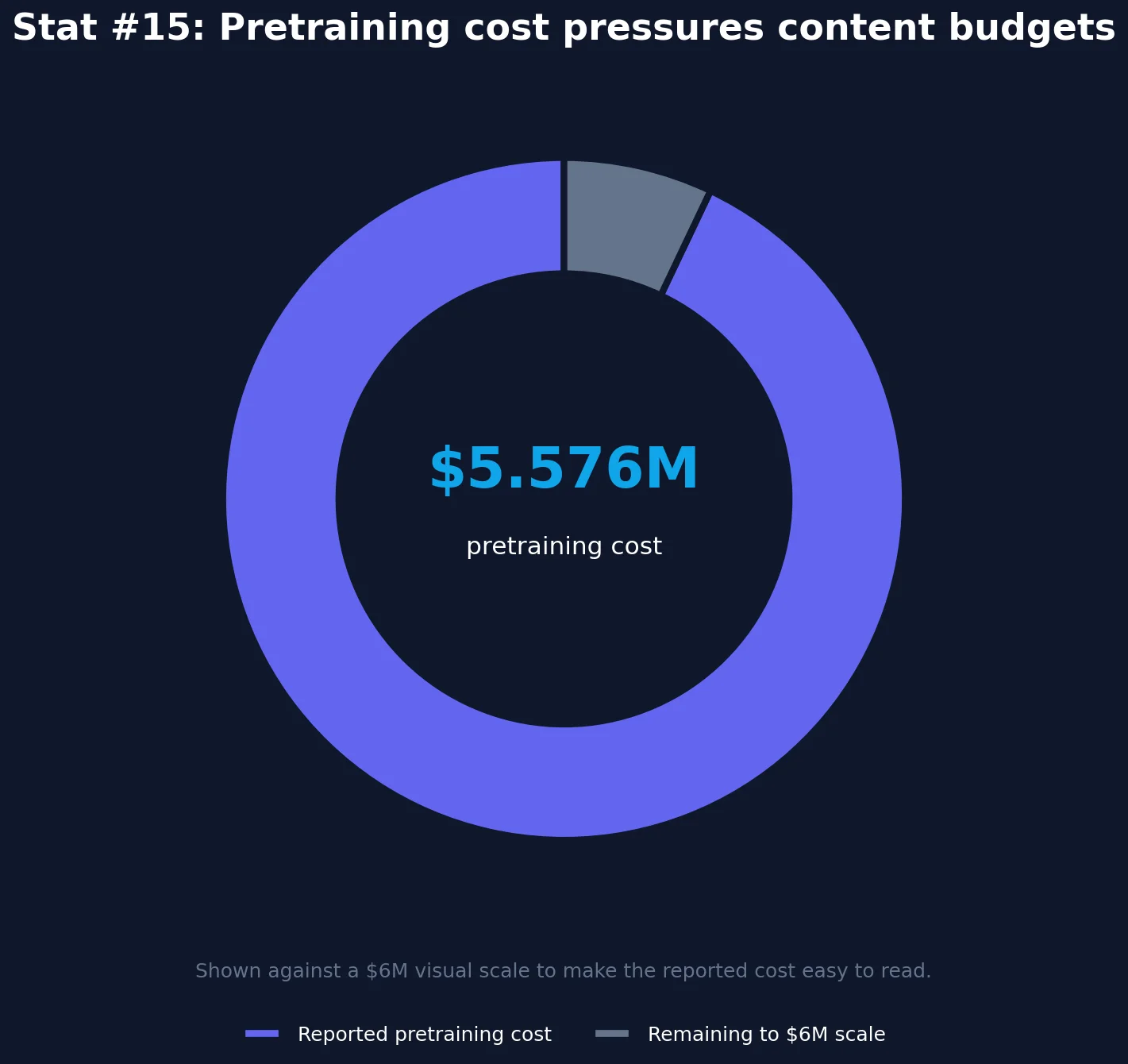
$5.576M pretraining cost became a headline because it challenged assumptions about how expensive competitive AI must be to build. For content teams, that cost signal matters less as technical trivia and more as pricing pressure across tools and plans. The pattern matters because lower upstream cost can influence downstream tool affordability and procurement confidence.
The cause is DeepSeek’s emphasis on efficient model design and training choices. When the production story looks leaner, buyers begin questioning whether every AI writing workflow needs premium pricing. That pressure can make budget-conscious experimentation more normal across smaller teams and early-stage content operations with limited budgets.
Raw AI can make $5.576M pretraining cost look like proof that cheaper tools are automatically better for readers. Humanized review keeps the focus on whether outputs are clear, credible, distinct, usable, and specific. The practical implication is that affordability improves access, but editorial value decides adoption and retention implication.
DeepSeek AI Content Trends #16. Reasoning Scores Lift Planning Tasks
71.0% AIME pass@1 shows why DeepSeek is being tested for reasoning-heavy content tasks and planning work. Stronger reasoning performance matters for outlines, comparisons, technical explainers, workflows, and structured argument development. The pattern matters because content quality often depends on logic before style or polish.
The cause is reinforcement learning that pushes the model toward multi-step problem solving across longer tasks. That training can improve how it breaks down complex instructions, layered briefs, and connects evidence to conclusions. Editors benefit when a draft arrives with clearer structure, even if the final voice still needs refinement from an editor.
Raw AI can make 71.0% AIME pass@1 sound like a writing benchmark, but it is not. Humanized workflows translate reasoning strength into better planning, then still polish tone, pacing, reader flow, and evidence framing. The practical implication is that reasoning helps structure, while editing shapes communication, trust, clarity, and usefulness implication.
DeepSeek AI Content Trends #17. Majority Vote Rewards Editorial Selection
86.7% majority vote highlights the value of rerunning and comparing model answers during review. When performance improves through multiple attempts and review passes, it suggests that selection can be as important as generation. The pattern matters because editors already work by comparing options before choosing a final direction for the reader.
The cause is variability in reasoning paths. A single answer may miss a constraint, while several attempted answers reveal stronger and weaker interpretations of the same task. That makes the human reviewer more important in practice, because someone must decide which version actually fits the brief, audience, and evidence standard.
Raw AI can make 86.7% majority vote encourage blind aggregation. Humanized content workflows use multiple outputs as material for judgment, not as an automatic final answer for publication or approval. The practical implication is that comparison improves results when humans keep authority over selection, accountability, and quality and responsibility implication.
DeepSeek AI Content Trends #18. Math Strength Supports Technical Explainers
97.3% MATH-500 score explains why DeepSeek attracts attention for logic-heavy writing and explanation. Strong math performance does not mean the model writes perfectly, but it signals skill in structured problem handling under pressure. The pattern matters for content that explains formulas, processes, tradeoffs, or technical decisions for non-expert readers.
The cause is training and reinforcement that reward stepwise reasoning and self-correction. That ability can help the model organize explanations in a way readers can follow without losing the main point. Still, technical correctness and editorial clarity are different standards, so expert review remains necessary before publishing or syndication.
Raw AI can make 97.3% MATH-500 score seem like permission to publish complex explanations quickly without checking them. Humanized editing checks whether the reasoning is understandable, sourced, proportional, and appropriate for the audience and format. The practical implication is that benchmark strength supports drafting, while verification protects trust, comprehension, and safety implication.
DeepSeek AI Content Trends #19. Marketer Adoption Normalizes AI Drafting
80% of marketers using AI content tools shows that DeepSeek competes inside an already normalized workflow. The question is no longer whether AI belongs in content operations anymore. The pattern matters because new models like DeepSeek are now evaluated against practical habits, not abstract curiosity or novelty.
The cause is pressure to produce more formats across fewer resources and deadlines. Marketers use AI for briefs, drafts, repurposing, ideation, summaries, and variants because the calendar keeps expanding across channels. That creates demand for tools that reduce workload and delay without flattening brand voice, reader expectations, or positioning.
Raw AI can make 80% of marketers look like a mandate to automate everything. Humanized content workflows ask which tasks should be accelerated and which still need human taste, context, restraint, and prioritization. The practical implication is that adoption is mainstream, but differentiation still depends on editorial control and positioning, audience, and quality implication.
DeepSeek AI Content Trends #20. AI Publishing Volume Raises Quality Risk
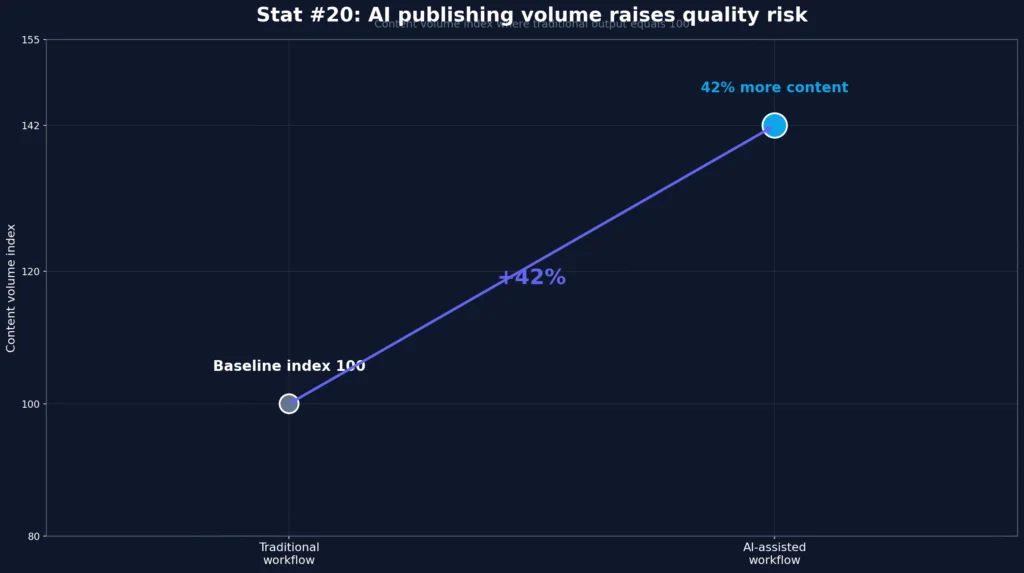
42% more content from AI-assisted teams shows how production volume changes inside teams once generation becomes cheaper. More output can help fill calendars, support testing, iteration, and cover more topics. The pattern matters because volume creates a second problem: making each piece worth publishing for a real audience.
The cause is that AI reduces the labor needed to create first drafts and variants. When drafts arrive faster, teams naturally test more pages, emails, scripts, and social variants. But the review burden also rises because weak content can scale as quickly as useful content when no one reviews it.
Raw AI can turn 42% more content into a quantity target. Humanized editing asks whether the additional pieces have clearer framing, stronger evidence, sharper purpose, and a real reason to exist. The practical implication is that higher output only helps when editorial standards scale carefully with it across channels and formats implication.
What These DeepSeek AI Content Trends Mean for Editorial Teams
The pattern running through DeepSeek is not just cheaper access, but cheaper repetition. That changes editorial behavior because teams can test more drafts while still needing stronger filters for what deserves publication.
Long context and larger output make the tool more useful for full workflows, yet those same features can hide weak structure inside confident length. The strongest evaluation lens is whether the model helps a human make better decisions about pace, source handling, and reader fit.
The architecture numbers explain why DeepSeek can feel broad and efficient at the same time. The publishing numbers explain why that efficiency matters, because AI-assisted teams are already producing more material than traditional review systems were built to handle.
For content leaders, the road ahead is less about replacing writers and more about upgrading the review layer around faster drafting. DeepSeek becomes most valuable when its cost, scale, and reasoning capacity are paired with editorial standards that protect usefulness.
Sources
- Official DeepSeek API pricing table for model costs and limits
- Official DeepSeek context caching guide explaining cache-hit billing behavior
- Official DeepSeek V4 preview release covering million-token context support
- DeepSeek-V3 technical report on parameters, training tokens, and compute
- Hugging Face DeepSeek-V3 model card with architecture overview
- DeepSeek-R1 technical report covering reasoning benchmark performance
- Backlinko DeepSeek usage statistics with daily active user estimates
- Business of Apps DeepSeek revenue and usage statistics overview
- AI Business Weekly DeepSeek statistics on visits and downloads
- Ahrefs survey on AI-assisted publishing volume and content frequency
- Adobe overview of AI marketing trends and content creation adoption
- Reuters report on DeepSeek model price reductions and cost pressure
- DeepSeek technical evolution paper on model architecture and trends
- DeepSeek-V2 report on economical mixture-of-experts design foundations