How to Edit AI Content for Hybrid Human-AI Writing: 15 Collaboration-Focused Improvements

Editing AI drafts works best when people retain judgment over voice, evidence, and purpose while AI supports speed and structure. A major meta-analysis found that human-AI teams gained most on content-creation tasks, reinforcing the value of deliberate human oversight throughout revision and review.
How to Edit AI Content for Hybrid Human-AI Writing: 15 Collaboration-Focused Improvements
AI can produce a strong first draft, but it rarely captures the judgment, nuance, and context that make writing feel genuinely useful. If your content still sounds mechanical after revision, humanize AI writing for professional use by treating editing as an active collaboration rather than a final cleanup.
Many people expect AI to deliver publication-ready work, so they overlook the small editorial decisions that shape clarity, credibility, and flow. Learning from experienced AI content editors for natural marketing copy shows how human review strengthens ideas instead of simply correcting grammar.
The most effective workflow combines AI’s speed with thoughtful human refinement at every stage of the writing process. These collaboration-focused improvements will help you build a repeatable editing system that also reflects current AI search optimization trends without sacrificing authenticity.
| # | Strategy focus | Practical takeaway |
|---|---|---|
| 1 | Define human ownership | Decide which editorial decisions always remain under human control before revisions begin. |
| 2 | Clarify the objective | Align every edit with the document’s intended audience, purpose, and desired outcome. |
| 3 | Strengthen factual accuracy | Review claims, examples, and supporting details instead of trusting generated information by default. |
| 4 | Improve narrative flow | Create smoother transitions so ideas connect naturally from beginning to end. |
| 5 | Refine the voice | Adjust wording until the content consistently reflects a recognizable human style. |
| 6 | Add practical insight | Include real observations that AI alone is unlikely to contribute. |
| 7 | Reduce repetition | Remove duplicated explanations and tighten unnecessary wording for better readability. |
| 8 | Balance sentence rhythm | Mix sentence lengths to create a more engaging and conversational reading experience. |
| 9 | Challenge weak sections | Question generic recommendations and replace them with clearer, stronger guidance. |
| 10 | Preserve consistency | Keep terminology, formatting, and messaging aligned throughout the document. |
| 11 | Improve reader guidance | Make each section easier to follow by removing ambiguity and adding helpful context. |
| 12 | Strengthen credibility | Support important statements with appropriate evidence or verifiable examples. |
| 13 | Optimize structure | Reorganize sections so information appears in the most logical sequence. |
| 14 | Perform collaborative reviews | Use multiple editorial passes to catch issues that a single review may overlook. |
| 15 | Finalize with intent | Complete a deliberate quality review before considering the work ready to publish. |
15 Collaboration-Focused Improvements to Edit AI Content for Hybrid Human-AI Writing
How to Edit AI Content for Hybrid Human-AI Writing – Strategy #1: Define Human Ownership
Begin by deciding which parts of the draft require human judgment, because a collaborative workflow becomes unreliable when neither the writer nor the system has a clearly defined role in shaping the final result. Reserve decisions involving argument, positioning, emotional nuance, ethical implications, and audience sensitivity for direct human review, while allowing AI to assist with expansion, restructuring, comparison, or language cleanup. Good execution means documenting these boundaries before editing begins, especially when several people contribute to the same article and may otherwise assume that someone else has checked the most consequential choices.
This division works because it prevents speed from being mistaken for authority, while still allowing the writer to benefit from rapid drafting and pattern recognition without surrendering editorial responsibility. For example, an AI system may produce a polished explanation of a workplace policy, but the human editor should determine whether the wording reflects the organization’s actual practices, values, and legal obligations. The boundary should remain flexible enough to suit the project, although factual claims, sensitive topics, original conclusions, and anything presented as firsthand experience should always receive deliberate human confirmation.
How to Edit AI Content for Hybrid Human-AI Writing – Strategy #2: Clarify the Objective
Before revising individual sentences, define what the finished piece must help the reader understand, believe, compare, or do, because editing without a specific objective often produces smoother language without producing a more useful article. Write a brief editorial statement that names the audience, the central problem, the intended outcome, and the level of detail the reader reasonably needs at that stage of awareness. Strong execution keeps this statement visible throughout the revision process, allowing both the human editor and the AI assistant to evaluate whether each section advances the same purpose rather than merely sounding complete.
This approach works in real projects because AI drafts frequently drift toward broad explanations, secondary themes, or generic advice that appears relevant but does not support the article’s actual job. A marketing team, for instance, may need a comparison page that helps cautious buyers evaluate tradeoffs, yet the generated draft may spend most of its space defining basic terms that the audience already understands. The objective should guide what remains, what moves, and what disappears, although it should not become so rigid that genuinely useful nuance or an unexpected reader concern is automatically excluded.
How to Edit AI Content for Hybrid Human-AI Writing – Strategy #3: Verify Every Claim
Review every factual statement, statistic, quotation, date, named source, technical explanation, and causal claim before publication, because generated prose can present uncertain or invented information with the same confidence it uses for well-supported material. Trace important claims back to primary sources whenever possible, compare several credible references when interpretation matters, and remove any statement that cannot be verified without weakening the reader’s trust. Effective verification also means checking whether the evidence actually supports the surrounding conclusion, rather than confirming that a similar number or phrase appears somewhere online.
This process works because factual reliability is not created by polished wording, and a single unsupported detail can damage the credibility of an otherwise careful article once readers recognize the error. For example, an AI draft might cite an industry percentage that originated in an outdated survey, omit the sample size, and then apply the finding to a much broader population than the research examined. Verification takes additional time, particularly for fast-changing subjects, but that constraint is preferable to publishing claims that later require corrections, weaken search visibility, or create avoidable legal and reputational problems.
How to Edit AI Content for Hybrid Human-AI Writing – Strategy #4: Rebuild the Flow
Evaluate the draft at the section level before polishing sentences, because an article can contain individually clear paragraphs while still forcing the reader through an awkward, repetitive, or poorly sequenced argument. Arrange the material so that each section answers the question raised by the previous one, introduces necessary context before complexity, and places the most valuable information where the reader is most likely to need it. Good structural editing often requires moving complete passages, combining overlapping sections, or rewriting transitions instead of attempting to repair a weak sequence through isolated wording changes.
This method works because readers experience an article as a progression of ideas, not as a collection of independently acceptable sentences, and even strong information becomes tiring when its order feels arbitrary. A guide may explain implementation details before defining the problem, for instance, leaving readers to interpret instructions without understanding when or why those steps matter. The sequence should feel intentional rather than formulaic, although specialized audiences may prefer faster entry into technical detail, while beginners usually need clearer orientation, definitions, and examples before they can use advanced recommendations confidently.
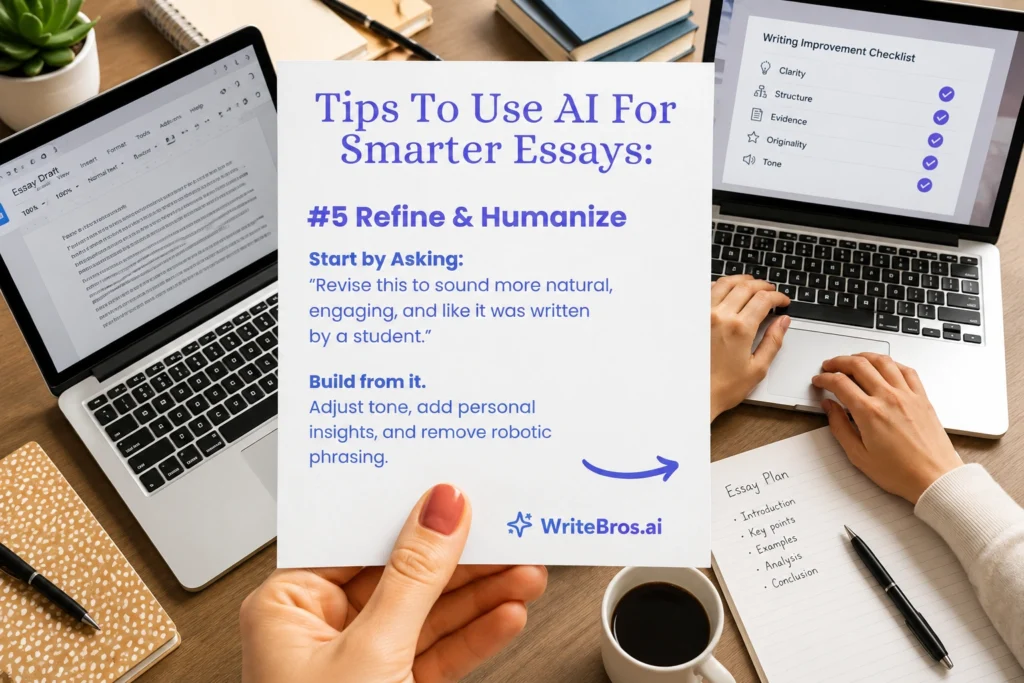
How to Edit AI Content for Hybrid Human-AI Writing – Strategy #5: Restore a Distinct Voice
Revise the draft until its vocabulary, rhythm, level of formality, and point of view reflect a recognizable human source, because generated writing often defaults to safe phrasing that could plausibly belong to almost any brand or author. Replace vague transitions, inflated claims, and familiar expressions with language grounded in the writer’s actual habits, subject knowledge, and relationship with the intended audience. Strong voice editing does not require adding personality to every line, but it should create enough consistency that the article feels guided by one mind rather than assembled from interchangeable patterns.
This works because readers respond to coherence and specificity, especially when the subject requires judgment rather than simple information retrieval, and a stable voice helps them understand how to interpret the guidance. For example, an experienced financial writer may explain risk through measured qualifications and practical scenarios, while a casual productivity blogger may rely on direct observations and everyday language without becoming careless. Voice should support clarity rather than compete with it, so unusual wording, humor, personal asides, or stylistic flourishes should remain only when they genuinely strengthen comprehension and trust.
How to Edit AI Content for Hybrid Human-AI Writing – Strategy #6: Add Lived Insight
Introduce observations, constraints, tradeoffs, and examples drawn from real work, because AI can summarize common knowledge effectively but cannot independently supply the specific experience that makes advice credible and practically useful. Review each major recommendation and ask what a knowledgeable person would add after applying it under imperfect conditions, working with limited resources, or watching an apparently sensible approach fail. Good execution turns general statements into situated guidance by explaining what changed, what surprised the writer, and which detail would matter most to someone facing the same decision.
This works because lived insight exposes the distance between an ideal process and the conditions under which people actually make choices, while helping readers recognize when a recommendation applies to them. A content manager might explain, for example, that shortening an approval workflow improved publishing speed but also removed the specialist review needed for regulated claims, requiring a different checkpoint rather than fewer checkpoints overall. Personal experience should not be treated as universal proof, however, so frame examples honestly, acknowledge their limits, and distinguish direct observation from broader evidence or established best practice.
How to Edit AI Content for Hybrid Human-AI Writing – Strategy #7: Remove Repetitive Thinking
Search for repeated ideas rather than merely repeated words, because AI drafts often restate the same conclusion through several headings, examples, or transitions while creating the impression of depth without adding meaningful information. Compare adjacent sections, identify sentences that perform the same function, and retain the version that is clearest, most specific, or best positioned within the argument. Effective reduction may require combining two seemingly different passages when both ultimately tell the reader to take the same action for the same reason.
This strategy works because repetition increases cognitive load, weakens emphasis, and makes readers less certain about which point deserves attention, even when every individual paragraph appears relevant. A generated article may explain three times that audience research improves tone, once in the introduction, again under personalization, and again under brand consistency, without adding a new application in any location. Some repetition remains useful when reinforcing a complex distinction or returning to a central idea from a different angle, but each recurrence should contribute fresh context rather than simply consume space.
How to Edit AI Content for Hybrid Human-AI Writing – Strategy #8: Vary Sentence Rhythm
Adjust sentence length, structure, and cadence across the draft, because mechanically consistent phrasing can make accurate information feel monotonous and reveal the patterned quality of generated prose. Combine closely related thoughts when continuity matters, separate dense explanations when the reader needs a pause, and vary how sentences begin so paragraphs do not repeatedly follow the same grammatical path. Strong rhythmic editing remains subordinate to meaning, which means variation should emerge from the movement of the argument rather than from random attempts to make the prose sound more human.
This works because natural writing reflects changes in emphasis, complexity, confidence, and emotional weight, while repeated sentence shapes flatten those distinctions and make every statement sound equally important. For instance, a paragraph containing six similarly sized declarative sentences may become more readable when the editor develops the central explanation fully, then uses a shorter sentence to mark the consequence before returning to detail. Rhythm should never become theatrical or distracting, especially in technical or professional material, where clarity, precision, and logical continuity still matter more than stylistic display.
How to Edit AI Content for Hybrid Human-AI Writing – Strategy #9: Challenge Generic Advice
Interrogate recommendations that sound reasonable but provide no conditions, thresholds, sequence, or practical consequences, because AI frequently produces guidance that is difficult to disagree with and equally difficult to use. Ask when the advice applies, what problem it solves, what evidence supports it, what tradeoff it introduces, and what a reader should do differently after encountering it. Strong editing replaces statements such as improve clarity or know your audience with specific decisions, observable behaviors, and examples that reveal what successful application looks like.
This works because readers rarely need another abstract principle, while they often need help translating a familiar principle into action under constraints they already recognize. A draft may recommend maintaining brand consistency, for example, without explaining whether that means preserving terminology, sentence style, emotional tone, claims discipline, or approval standards across different channels. Not every sentence requires exhaustive qualification, but central recommendations should carry enough detail to prevent shallow agreement, misleading certainty, or implementation that technically follows the advice while missing its intended purpose.
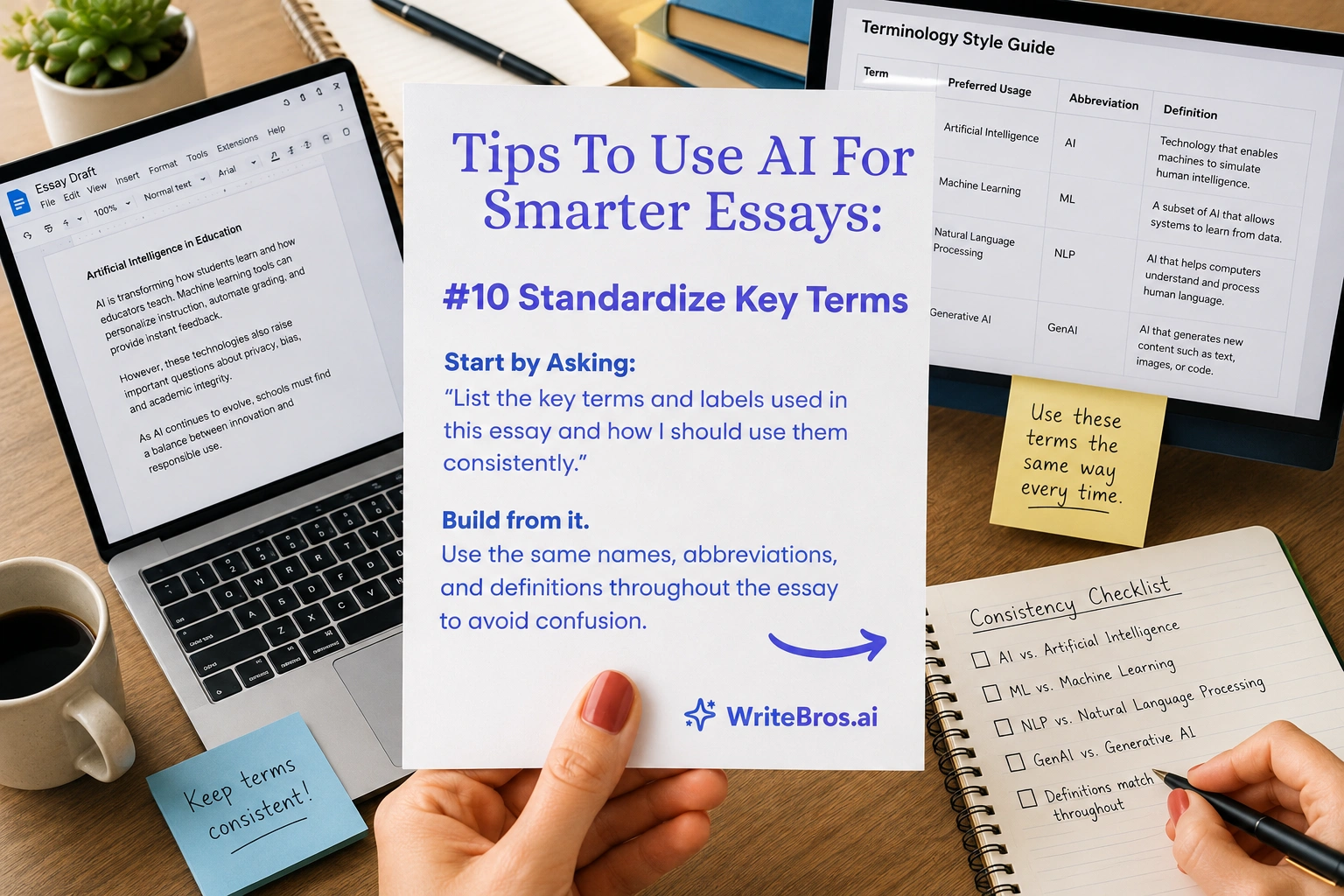
How to Edit AI Content for Hybrid Human-AI Writing – Strategy #10: Standardize Key Terms
Review terminology, capitalization, labels, abbreviations, and recurring concepts across the entire draft, because inconsistent naming creates friction and can make readers wonder whether similar phrases refer to different ideas. Choose the clearest term for each important concept, define it when necessary, and use alternatives only when variation will not change meaning or introduce ambiguity. Good execution may involve creating a brief style sheet during editing, particularly for long articles, collaborative projects, technical subjects, or brands with established language that must remain consistent across several contributors.
This works because stable terminology allows the reader to build understanding without repeatedly translating between near-synonyms, while also making the article easier to review, update, and reuse in other formats. A software guide may alternate between workspace, dashboard, console, and portal even though the product uses only one official label, creating unnecessary uncertainty during each instruction. Consistency should not produce stiff repetition when ordinary language can vary safely, but names tied to features, processes, metrics, policies, and key distinctions should remain precise enough that no reader has to infer whether the meaning changed.
How to Edit AI Content for Hybrid Human-AI Writing – Strategy #11: Improve Reader Guidance
Add the context readers need to interpret each recommendation, because AI-generated drafts often state what to do without explaining how the reader should recognize the right moment, priority, or level of effort. Introduce brief signposts that clarify where the discussion is going, why a distinction matters, and how one section connects with the decision established earlier in the article. Good guidance remains unobtrusive, helping readers move through complexity without filling every paragraph with obvious transitions or repeatedly announcing what the article has already explained.
This works because readers approach the same article with different levels of knowledge, urgency, and attention, while clear orientation reduces the chance that important advice will be misunderstood or applied out of sequence. A tutorial might tell users to revise their prompt after reviewing the output, for example, yet fail to explain which weaknesses indicate a prompt problem and which require direct editing instead. Guidance should not overprotect the reader or eliminate productive complexity, but it should remove preventable confusion around prerequisites, terminology, decision points, and the relationship between actions and expected outcomes.
How to Edit AI Content for Hybrid Human-AI Writing – Strategy #12: Strengthen Evidence Use
Examine where the draft relies on authority, research, examples, or expert opinion, because adding sources does not automatically make an argument credible when the evidence is weak, outdated, misapplied, or disconnected from the claim. Match the strength of the wording to the strength of the support, distinguish correlation from causation, and identify where the article is offering interpretation rather than reporting an established finding. Strong evidence editing also means preserving relevant limitations, sample details, and context that generated summaries may omit when compressing complex material into a confident sentence.
This works because readers need to understand not only what evidence says but also how much weight it can reasonably carry, particularly when the article informs professional, financial, medical, or operational decisions. An AI draft may cite a survey showing that respondents prefer shorter content and then conclude that all long-form articles perform poorly, even though preference, engagement, and conversion measure different outcomes. Evidence should clarify the argument rather than decorate it, so remove unnecessary citations, retain the most relevant support, and explain uncertainty whenever the available research does not justify a definitive conclusion.
How to Edit AI Content for Hybrid Human-AI Writing – Strategy #13: Reshape the Structure
Reconsider headings, section boundaries, paragraph placement, and information density after the main ideas are verified, because the structure inherited from an AI outline may be orderly without reflecting how readers actually approach the problem. Group material by decision, stage, or practical use instead of preserving categories simply because they appeared in the original prompt or draft. Strong restructuring creates a visible hierarchy in which headings make useful promises, related ideas remain together, and the most important sections receive enough space without allowing minor points to expand disproportionately.
This works because structure determines what readers notice, remember, and act on, especially when they scan before committing to a complete reading of the article. A draft about editing may separate tone, sentence rhythm, repetition, and clarity into isolated sections even though a real revision process addresses them together during the same paragraph-level pass. The ideal structure depends on the reader and format, so a reference article may support modular sections, while a persuasive essay may require a more continuous argument with fewer headings and stronger transitions between major claims.
How to Edit AI Content for Hybrid Human-AI Writing – Strategy #14: Use Layered Review
Separate the editing process into focused passes, because attempting to assess structure, accuracy, voice, grammar, evidence, and formatting simultaneously makes important problems easier to miss and encourages superficial corrections. Begin with purpose and organization, continue with factual and argumentative quality, then address voice, clarity, repetition, sentence rhythm, and final mechanical details. Good layered review also assigns clear responsibilities when several editors are involved, preventing duplicate work while ensuring that no category is assumed to have been checked without an identifiable owner.
This approach works because each pass creates a different question for the editor, allowing deeper attention than a single broad instruction to improve the draft can produce. A first reviewer may discover that two sections need to change places, while a later reviewer can then refine the transitions after the new sequence is stable instead of polishing text that will eventually move. The process should remain proportionate to the stakes, since a short internal update may require fewer passes than a public research article, but even lightweight workflows benefit from separating substantive review from proofreading.
How to Edit AI Content for Hybrid Human-AI Writing – Strategy #15: Complete a Final Integrity Check
Finish with a review that compares the published-ready draft against its purpose, evidence, audience, and real production context, because a document can be grammatically clean while still containing mismatched claims, missing disclosures, broken references, or unresolved placeholders. Read the article as a skeptical reader rather than as the person who has watched every revision, checking whether the main conclusion follows from the material and whether promised guidance is actually delivered. Strong final review also confirms links, names, formatting, accessibility, dates, source attribution, and any requirements imposed by the platform or organization.
This works because familiarity makes editors overlook gaps that have become invisible through repeated exposure, while a final integrity check restores enough distance to identify what the draft still assumes. For example, an article may mention a chart that was removed, refer to an earlier section using an outdated heading, or preserve a confident claim that no longer fits after supporting evidence was revised. The goal is not endless perfection, so establish a reasonable stopping point based on risk and usefulness, then publish only when remaining imperfections are minor rather than misleading, confusing, or structurally damaging.
Common mistakes
- Treating AI output as a nearly finished product happens because the draft already appears organized and grammatically polished, but this approach backfires when structural weaknesses, unsupported claims, and generic reasoning survive beneath a professional surface that discourages deeper review.
- Editing only at the sentence level is common because wording problems are easier to see than strategic problems, yet this backfires when editors spend time polishing paragraphs that remain irrelevant, repetitive, poorly ordered, or disconnected from the article’s central purpose.
- Removing every sign of personality often happens when editors confuse professionalism with neutrality, but the result backfires by producing content that feels interchangeable, weakens the author’s credibility, and gives readers no clear sense of judgment, experience, or perspective.
- Adding personal stories without boundaries happens because firsthand detail can make a draft feel more human, yet it backfires when isolated experience is presented as universal evidence, distracts from the reader’s problem, or reveals information that does not belong in public content.
- Requesting repeated AI rewrites instead of diagnosing the problem happens because generating another version feels faster than making editorial decisions, but it backfires when each revision introduces new inconsistencies, removes useful specificity, or replaces one generic pattern with another.
- Using sources as decoration happens because citations create an immediate appearance of authority, yet the practice backfires when evidence is outdated, unrelated to the exact claim, stripped of limitations, or repeated from secondary pages that never verified the original material.
- Letting several reviewers edit without defined responsibilities happens because collaboration appears automatically thorough, but it backfires when feedback conflicts, the same surface issues receive repeated attention, and important areas such as factual accuracy or accessibility remain unchecked.
- Continuing revisions without a stopping rule happens because every new pass reveals another possible improvement, but this backfires by delaying publication, weakening decisive language, creating inconsistent late-stage changes, and consuming effort that no longer produces meaningful value for the reader.
Edge cases
Some projects require a different balance between human judgment and AI assistance, particularly when the content is highly regulated, deeply personal, legally sensitive, or dependent on original research. In those situations, AI may remain useful for organizing notes, identifying repetition, or testing alternative structures, but the human editor should control interpretation, claims, disclosures, and final wording much more closely than in routine informational content.
At the other extreme, low-risk internal material may not justify several formal review passes, especially when speed matters more than polish and the audience already understands the context. The core principles still apply, but they can be compressed into a brief check for purpose, accuracy, clarity, and tone, with additional scrutiny reserved for anything public, permanent, consequential, or likely to be reused beyond its original setting.
Supporting tools
- A shared style guide helps editors preserve terminology, tone, capitalization, formatting, and claims standards across human and AI contributions, particularly when several writers work on the same publication or when content must remain consistent across multiple channels.
- A source-tracking document helps connect every important claim with its original evidence, publication date, context, and limitations, reducing the risk that generated summaries will rely on weak secondary references or preserve statistics after they are no longer current.
- A version-control system or revision history makes it easier to compare drafts, recover useful passages, identify who changed a claim, and prevent collaborative editing from erasing important context without leaving a clear record of the decision.
- A readability checker can reveal dense sentences, repeated constructions, and difficult passages that deserve attention, although its score should guide human judgment rather than dictate sentence length or force complex ideas into oversimplified language.
- A fact-checking checklist gives reviewers a repeatable way to confirm names, dates, quotations, calculations, links, product details, and research claims, which is especially valuable when polished AI prose makes uncertain information appear more dependable than it is.
- A text comparison tool can highlight changes between the generated draft and the edited version, helping teams understand which prompts, content types, or recurring patterns require the most human intervention and where their workflow can improve over time.
- WriteBros.ai can support the rewriting stage by helping editors revise AI-generated passages toward more natural language, while the human reviewer remains responsible for factual accuracy, strategic decisions, original insight, and final publication standards.
Ready to Transform Your AI Content?
Try WriteBros.ai and make your AI-generated content truly human.
Conclusion
Hybrid writing works best when AI handles speed, expansion, comparison, and early structure while people retain responsibility for purpose, evidence, judgment, and reader trust. The goal is not to hide where a draft began, but to ensure that every published sentence has been examined, shaped, and supported by someone who understands its consequences.
A strong editing process therefore depends less on achieving flawless prose than on making deliberate decisions at each stage, from defining the article’s purpose to completing the final integrity check. When human attention is applied where it matters most, AI becomes a useful collaborator rather than an unchecked author, and the resulting work becomes clearer, more credible, and more valuable.
Did You Know?
Combining a person with an AI system does not guarantee better writing, because collaboration works only when each participant handles the parts of the process suited to its strengths.
A large meta-analysis published in Nature Human Behaviour found that human-AI combinations produced their clearest gains in content-creation tasks, while results were less favorable in decision-making work. A productive editing workflow should therefore let AI accelerate drafting and restructuring while human editors preserve factual accuracy, original judgment, distinctive voice, contextual awareness, and responsibility for the final result.
Ready to Transform Your AI Content?