How to Revise AI Text to Pass Turnitin: 15 Targeted Corrections

Improve your submissions with actionable revision tips to help AI‑assisted writing pass Turnitin checks by enhancing natural flow, varied structure, and human‑level clarity, supported by research showing many AI detectors perform poorly on obfuscated or manually edited text from reputable studies.
How to Revise AI Text to Pass Turnitin: 15 Targeted Corrections
Many writers worry that their draft will be flagged even after making edits, especially when they are trying to improve AI essay tone without losing clarity. The frustration comes from seeing content that reads naturally still triggering detection signals.
This keeps happening because small patterns in structure, phrasing, and rhythm can still resemble machine output, even if you use the most accurate AI humanizer tools for Turnitin scores. Without deliberate revision, those subtle markers remain embedded in the text.
In this guide, you’ll learn practical corrections that address the signals Turnitin looks for, grounded in real patterns seen in Turnitin AI misclassification data. Expect clear steps that help you refine wording, vary structure, and present work that feels genuinely human.
| # | Strategy focus | Practical takeaway |
|---|---|---|
| 1 | Sentence restructuring | Break predictable phrasing patterns to create more natural flow. |
| 2 | Specific detail insertion | Add concrete context that reflects real thinking and nuance. |
| 3 | Paragraph rhythm variation | Adjust pacing so sections feel less uniform and more organic. |
| 4 | Voice alignment | Match wording to your natural tone instead of generic phrasing. |
| 5 | Transition refinement | Replace formulaic connectors with smoother logical links. |
| 6 | Example grounding | Use realistic scenarios to demonstrate understanding clearly. |
| 7 | Sentence length mixing | Blend short and long sentences to reduce mechanical cadence. |
| 8 | Concept clarification | Explain ideas more fully to show authentic reasoning. |
| 9 | Redundancy cleanup | Remove repetitive wording that signals automated output. |
| 10 | Structural tweaks | Reorder ideas so arguments feel intentionally built. |
| 11 | Personal framing | Introduce perspective cues that reflect human judgment. |
| 12 | Vocabulary tuning | Swap overly formal terms for natural word choices. |
| 13 | Logic strengthening | Tighten reasoning so arguments feel deliberate and clear. |
| 14 | Citation awareness | Ensure sources are integrated naturally within discussion. |
| 15 | Final read‑through | Review holistically to confirm a consistent human voice. |
15 Targeted Corrections to How to Revise AI Text to Pass Turnitin
How to Revise AI Text to Pass Turnitin – Strategy #1: Sentence restructuring
Start by carefully reviewing each sentence to identify patterns that feel overly uniform or mechanically balanced, then rewrite them with varied openings, embedded clauses, and more natural pacing so the prose reflects thoughtful composition rather than predictable generation. This matters most when your draft reads smoothly but lacks subtle irregularities that human writers naturally introduce through revision and reconsideration. Strong execution looks like a paragraph that flows logically yet avoids repeating similar sentence shapes or rhythms across consecutive lines.
This works because detection systems often flag repeated structural signals that accumulate across a passage, and restructuring breaks those patterns without changing meaning or intent. Imagine revising a literature response where several sentences begin with similar transitions, and you gradually replace them with context‑specific phrasing that mirrors genuine thinking in progress. Watch for overcorrection, since forcing complexity where clarity would suffice can make writing feel unnatural rather than convincingly human.
How to Revise AI Text to Pass Turnitin – Strategy #2: Specific detail insertion
Add concrete references, clarifying examples, and small contextual cues that show you are engaging with the material at a granular level rather than presenting generalized summaries that could apply anywhere. This is especially useful when a section feels technically correct yet emotionally or intellectually distant, which can signal automated drafting even if the content is accurate. Effective detail often includes situational nuance, subtle qualifiers, or brief explanations that reveal genuine interpretation.
Detection models tend to recognize generic phrasing clusters, and introducing precise detail disrupts those patterns while reinforcing authenticity through specificity. Picture revising a discussion section where you incorporate a brief scenario or clarify how a concept applies in practice, which naturally deepens the narrative. Be mindful not to insert irrelevant anecdotes, since details should support the argument rather than distract from it.
How to Revise AI Text to Pass Turnitin – Strategy #3: Paragraph rhythm variation
Review paragraph lengths and internal pacing so that sections do not follow identical patterns of three or four evenly sized sentences throughout the document, since uniform rhythm can appear algorithmic. Adjusting cadence through longer explanations followed by concise clarifications helps mirror the way real writers expand and compress ideas while refining their thoughts. Good execution creates a reading experience that feels organic and responsive to the complexity of each point.
This works because natural writing rarely maintains perfect symmetry, and subtle variation signals that the text evolved through iterative thinking rather than automated assembly. Consider revising a research summary where you expand one paragraph to explore implications more deeply while condensing another to highlight a key takeaway. Avoid extremes, since overly uneven pacing can confuse readers even if it reduces detection signals.
How to Revise AI Text to Pass Turnitin – Strategy #4: Voice alignment
Adjust wording so it reflects your typical way of explaining ideas, including preferred phrases, sentence flow, and levels of formality that align with your previous writing samples or personal style. This is most important when the draft sounds technically polished yet unfamiliar, which can happen when generated text adopts a neutral tone lacking individual character. Strong alignment makes the content feel consistent with your broader body of work.
Detection systems sometimes compare stylistic patterns across submissions, so aligning voice reduces discrepancies that could raise questions during review. Imagine revising an essay by replacing overly formal constructions with language you would naturally use in discussions or past assignments, creating continuity across contexts. Be careful to maintain clarity and professionalism even while personalizing tone.
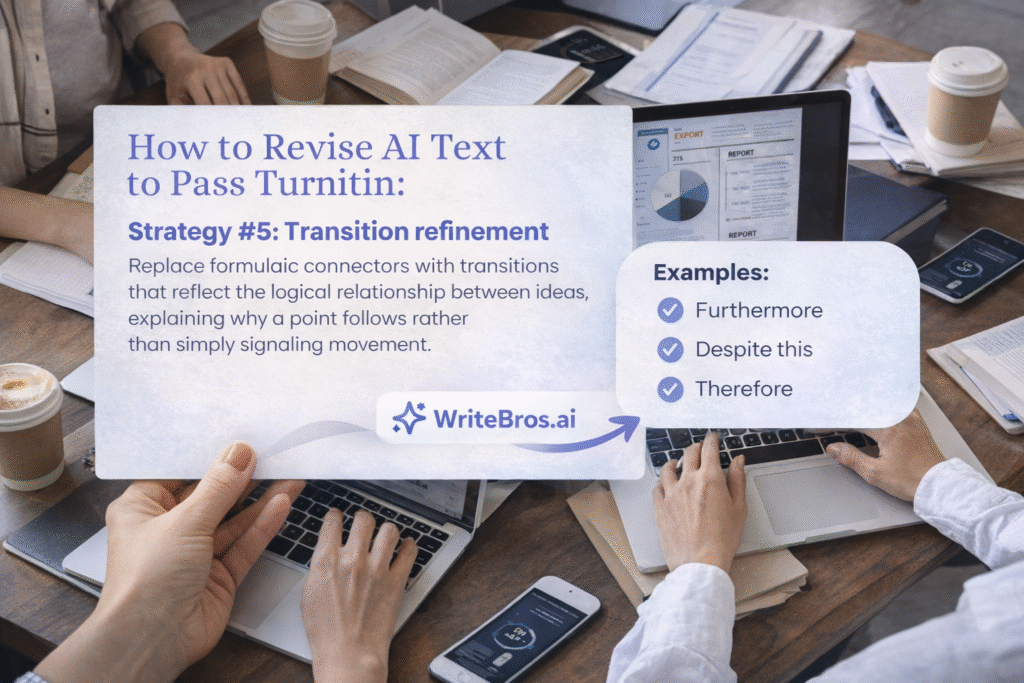
How to Revise AI Text to Pass Turnitin – Strategy #5: Transition refinement
Replace formulaic connectors with transitions that reflect the logical relationship between ideas, explaining why a point follows rather than simply signaling movement from one paragraph to the next. This helps readers follow your reasoning while reducing reliance on stock phrases that frequently appear in generated content. Effective transitions often include brief references to earlier arguments or forward‑looking clarifications.
When transitions feel intentional, the text reads as a cohesive narrative shaped through reflection rather than assembled through generic linking phrases. Picture revising a policy analysis where you explicitly connect evidence to conclusions instead of relying on repetitive connectors that add little meaning. Watch for overuse of elaborate transitions, since clarity should remain the priority.
How to Revise AI Text to Pass Turnitin – Strategy #6: Example grounding
Introduce realistic examples that illustrate how concepts operate in practice, weaving them into the discussion so they support your reasoning rather than appearing as isolated add‑ons. This is particularly helpful when arguments feel abstract or detached, since grounded illustrations demonstrate genuine engagement with the subject matter. Strong examples clarify intent while adding depth to your explanation.
Detection systems often associate purely abstract exposition with automated drafting, and contextual examples help counter that signal by showing applied understanding. Imagine revising a theoretical explanation by briefly describing how the principle might appear in a classroom discussion or research scenario, which naturally enriches the narrative. Ensure examples remain relevant and concise so they enhance rather than overwhelm the argument.
How to Revise AI Text to Pass Turnitin – Strategy #7: Sentence length mixing
Blend longer explanatory sentences with shorter clarifications to create a natural ebb and flow that reflects the way human writers emphasize certain ideas while summarizing others. This technique is especially valuable when a draft maintains a steady cadence that feels polished yet slightly artificial upon closer reading. Good mixing introduces subtle variation without disrupting readability.
Detection algorithms frequently analyze rhythm patterns, and varied sentence lengths reduce the appearance of uniform generation across sections. Consider revising a discussion by combining detailed analysis with occasional concise statements that highlight key points, which mirrors authentic writing behavior. Avoid abrupt fragments that might confuse readers even if they break patterns.
How to Revise AI Text to Pass Turnitin – Strategy #8: Concept clarification
Expand explanations where ideas may seem implied or compressed, adding clarifying language that reveals your reasoning process and demonstrates thoughtful interpretation. This is useful when sections appear technically correct yet lack the depth that comes from careful reflection and elaboration. Effective clarification anticipates reader questions and addresses them directly within the narrative.
Systems trained on large corpora often detect shallow explanation patterns, and deeper clarification signals intentional authorship through explicit reasoning. Imagine revising a complex argument by unpacking assumptions or briefly explaining why certain conclusions follow logically, which enhances credibility. Take care not to overexplain to the point of redundancy.
How to Revise AI Text to Pass Turnitin – Strategy #9: Redundancy cleanup
Identify repeated phrases or ideas that appear across paragraphs and consolidate them into clearer, more concise statements that eliminate unnecessary duplication. This step improves readability while reducing patterns that detection tools might associate with automated generation. Strong cleanup preserves meaning while streamlining expression.
Repetition often emerges in generated drafts because similar prompts produce similar phrasing, and removing these echoes helps the text feel more intentional. Picture reviewing a section where key terms appear multiple times without adding value, then refining the wording so each mention contributes new insight. Be cautious not to remove emphasis where repetition serves a rhetorical purpose.
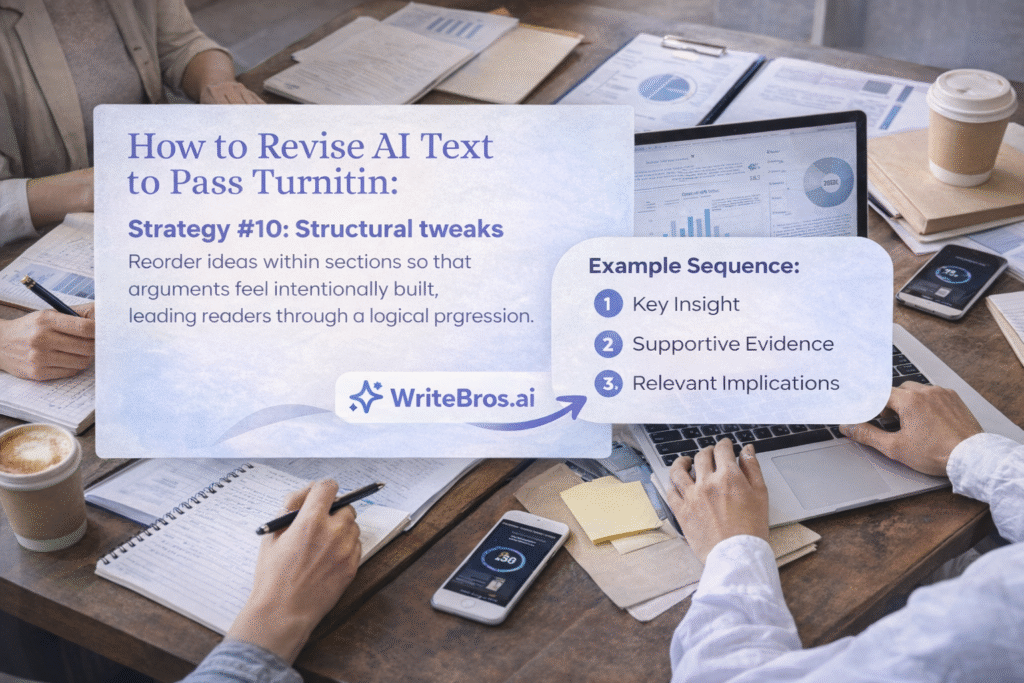
How to Revise AI Text to Pass Turnitin – Strategy #10: Structural tweaks
Reorganize sections so ideas unfold in a sequence that reflects deliberate planning, ensuring each paragraph builds logically on the previous one rather than following a generic template. This is particularly important when the argument feels loosely connected or overly formulaic despite accurate content. Effective structure guides readers through your reasoning step by step.
Detection systems sometimes identify templated organization patterns, and thoughtful restructuring introduces variation that mirrors authentic drafting decisions. Imagine revising an essay outline to foreground key insights earlier or group related points more coherently, which enhances both clarity and originality. Keep transitions clear so readers can follow the revised flow.
How to Revise AI Text to Pass Turnitin – Strategy #11: Personal framing
Incorporate subtle perspective cues that signal your engagement with the material, such as reflective observations or interpretive commentary that demonstrate ownership of the ideas presented. This is especially helpful when the text feels detached, since personal framing connects analysis to a recognizable point of view. Strong framing remains professional while conveying genuine thought.
Detection models often note the absence of perspective markers, and adding them helps differentiate your work from generic summaries. Imagine revising a conclusion to briefly reflect on why certain findings matter in context, which naturally reinforces authenticity. Maintain balance so personal voice supports rather than dominates the argument.
How to Revise AI Text to Pass Turnitin – Strategy #12: Vocabulary tuning
Replace overly formal or uncommon terms with language that feels appropriate for the context, ensuring word choices align with how you typically express ideas in academic or professional settings. This is useful when generated text introduces vocabulary that sounds technically correct yet slightly out of character. Effective tuning enhances readability while preserving precision.
Detection systems sometimes flag unusual lexical patterns that appear inconsistent with typical writing behavior, and adjusting vocabulary reduces those discrepancies. Picture revising a paragraph where complex synonyms are replaced with clearer alternatives that maintain meaning while sounding more natural. Avoid oversimplifying terms that are necessary for accuracy.
How to Revise AI Text to Pass Turnitin – Strategy #13: Logic strengthening
Review arguments to ensure each claim is supported with reasoning that clearly connects evidence to conclusions, adding explanations where logical steps may appear implicit. This helps demonstrate critical thinking and reduces the impression of surface‑level synthesis that detection tools may associate with generated content. Strong logic makes the narrative more persuasive.
When reasoning is explicit, the text reflects deliberate analysis rather than automated summarization, which can lower detection signals while improving clarity. Imagine revising a research discussion by explaining how specific findings inform your interpretation instead of simply presenting them. Be mindful to keep explanations focused and relevant.
How to Revise AI Text to Pass Turnitin – Strategy #14: Citation awareness
Ensure sources are integrated thoughtfully, with commentary that explains their relevance rather than listing them as isolated references that may appear formulaic. This is particularly important in academic contexts where meaningful engagement with sources demonstrates understanding. Effective citation connects evidence to your argument seamlessly.
Detection systems sometimes analyze how references are woven into prose, and contextual integration signals genuine scholarship. Imagine revising a literature review by briefly discussing how each source contributes to your perspective, which naturally deepens analysis. Avoid excessive quotation that interrupts flow.
How to Revise AI Text to Pass Turnitin – Strategy #15: Final read‑through
Conduct a comprehensive review that focuses on coherence, tone consistency, and subtle cues that might still feel mechanical, reading the text slowly to identify areas that could benefit from refinement. This final step ensures earlier revisions work together to create a cohesive whole rather than isolated improvements. Strong read‑through practices often reveal small adjustments that enhance authenticity.
Reading aloud or revisiting the draft after a short break can highlight phrasing that sounds unnatural, allowing you to refine it before submission. Imagine noticing a sentence that feels overly polished and adjusting it slightly so it reflects your natural expression more closely. Resist the urge to overedit, since clarity should remain intact.
Common mistakes
- Relying solely on superficial paraphrasing tools without reviewing deeper structural patterns often leads to revisions that appear different on the surface yet retain underlying signals associated with generated drafts, which can still trigger detection because the overall rhythm and logic remain unchanged.
- Overloading the text with unnecessary complexity in an attempt to appear more human can backfire when sentences become convoluted, since readers and reviewers may notice strained phrasing that feels forced rather than naturally evolved through thoughtful revision.
- Ignoring voice consistency across sections creates noticeable shifts in tone that can raise questions during evaluation, especially if earlier writing samples differ significantly from the revised draft in ways that seem abrupt or unexplained.
- Adding irrelevant anecdotes or filler content to increase uniqueness often weakens the argument and signals that changes were made without clear purpose, which can reduce credibility even if detection scores improve slightly.
- Skipping a full read‑through after making edits leaves small inconsistencies unresolved, allowing subtle mechanical patterns or awkward transitions to persist throughout the document despite other improvements.
- Assuming that passing automated checks alone guarantees acceptance overlooks the importance of clarity and coherence, since reviewers ultimately assess whether the writing demonstrates genuine understanding and thoughtful engagement.
Edge cases
In some situations, highly technical or formula‑driven writing may naturally resemble generated patterns even after careful revision, particularly when discipline‑specific conventions limit stylistic flexibility, so focus on clarity and accurate representation of concepts rather than forcing stylistic variation that could introduce confusion. When collaborating on group projects, ensure revisions reflect a consistent voice across contributors, since mixed editing styles can inadvertently introduce signals that appear inconsistent or artificial.
Short assignments or tightly structured responses may offer fewer opportunities for extensive variation, which means subtle adjustments to phrasing, explanation depth, and logical flow become especially important for maintaining authenticity without exceeding requirements. If institutional guidelines restrict certain stylistic elements, prioritize transparent reasoning and thoughtful organization, since these qualities often matter more than stylistic variation alone.
Supporting tools
- A document comparison tool can help you review differences between drafts, allowing you to confirm that revisions meaningfully change structure and reasoning rather than merely substituting synonyms, which supports more deliberate editing decisions and helps identify lingering patterns that might otherwise go unnoticed during manual review.
- Read‑aloud or text‑to‑speech software enables you to hear how the writing flows, making it easier to detect awkward phrasing, repetitive cadence, or transitions that feel unnatural, which can guide targeted refinements that improve both readability and authenticity before final submission.
- Version control platforms provide a clear history of changes, helping you track how the document evolved and ensuring that edits remain intentional rather than reactive, which can be useful when revisiting earlier sections to maintain consistency across revisions.
- Grammar and clarity checkers can highlight areas where wording may appear overly complex or ambiguous, offering suggestions that support smoother expression while still allowing you to make final decisions that reflect your intended voice and style.
- Peer review sessions with classmates or colleagues provide external perspectives that often reveal subtle issues you might overlook, such as unclear reasoning or inconsistent tone, and these insights can inform revisions that strengthen authenticity and coherence.
- WriteBros.ai can assist in reviewing drafts for tone consistency and structural refinement, offering guidance that helps you align revisions with natural writing patterns while maintaining clarity and preserving the intent of your original ideas.
Ready to Transform Your AI Content?
Try WriteBros.ai and make your AI-generated content truly human.
Conclusion
Revising thoughtfully allows you to present work that reflects genuine understanding and careful consideration, ensuring that the final draft communicates ideas clearly while aligning with expectations for originality and authenticity. Taking time to refine structure, voice, and reasoning helps build confidence that your submission represents your own perspective.
Perfection is less important than intention, since consistent effort to clarify and refine your writing naturally leads to stronger outcomes over time. Approach each revision as an opportunity to deepen engagement with the material, trusting that thoughtful adjustments will enhance both clarity and credibility.
Did You Know?
If you are working through How to Revise AI Text to Pass Turnitin, minor synonym swaps rarely influence outcomes when the document still exhibits repeated structural templates, evenly distributed explanation depth, and consistent transition logic, because detection systems evaluate a holistic writing signature formed through repeated stylistic and organizational cues across the full draft rather than reacting to isolated wording changes.
Revising how ideas expand, clarifying reasoning with varied levels of detail, and adjusting paragraph density so complex arguments receive more space than simpler observations can meaningfully alter the overall profile, since authentic writing tends to reflect uneven intellectual exploration rather than perfectly symmetrical sections repeated throughout a paper.
Ready to Transform Your AI Content?