How to Rewrite AI Learning Objectives Clearly: 15 Precision Edits

2026 classrooms rely increasingly on AI-assisted drafting, yet unclear objectives remain a major instructional problem. Evidence from a peer-reviewed study on AI-supported writing in education shows that structured revision improves clarity, alignment, and measurable learning outcomes.
How to Rewrite AI Learning Objectives Clearly: 15 Precision Edits
AI-generated learning objectives often sound polished yet vague, leaving instructors unsure whether the outcomes actually guide instruction or assessment. Questions around fair use of AI in coursework have also made educators more careful about how AI-assisted academic language appears in official materials.
Many AI systems generate objectives that sound formal but hide unclear verbs, mixed goals, or measurable actions that are missing entirely. Tools discussed in lists of AI humanizer tools show how frequently educators revise AI drafts to improve clarity and readability.
The challenge is not removing AI assistance but refining the wording so each objective clearly states what learners should actually do or demonstrate. Data highlighted in academic AI writing statistics shows how common AI-assisted drafting has become in academic workflows.
| # | Strategy focus | Practical takeaway |
|---|---|---|
| 1 | Replace vague verbs | Swap unclear wording with actions that clearly describe what learners will do. |
| 2 | Remove stacked outcomes | Break long statements into single goals that are easier to measure and teach. |
| 3 | Clarify measurable actions | Ensure every objective leads to a visible or assessable learning result. |
| 4 | Simplify academic phrasing | Reduce overly formal wording so the outcome reads naturally and directly. |
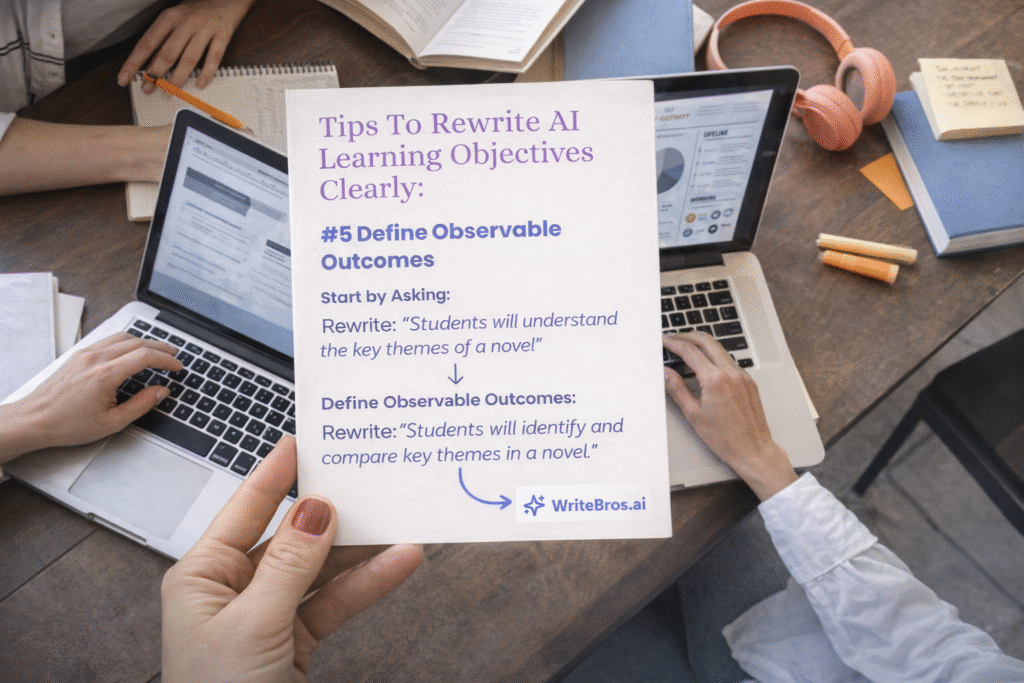
| 5 | Define observable outcomes | Describe what students should demonstrate rather than what they should “understand.” |
| 6 | Align with assessments | Match each outcome with the task or activity used to evaluate learning. |
| 7 | Limit scope | Keep objectives focused on a single skill or knowledge area. |
| 8 | Strengthen action verbs | Use verbs that signal analysis, creation, or application rather than general comprehension. |
| 9 | Remove filler language | Cut extra wording that makes objectives longer without improving clarity. |
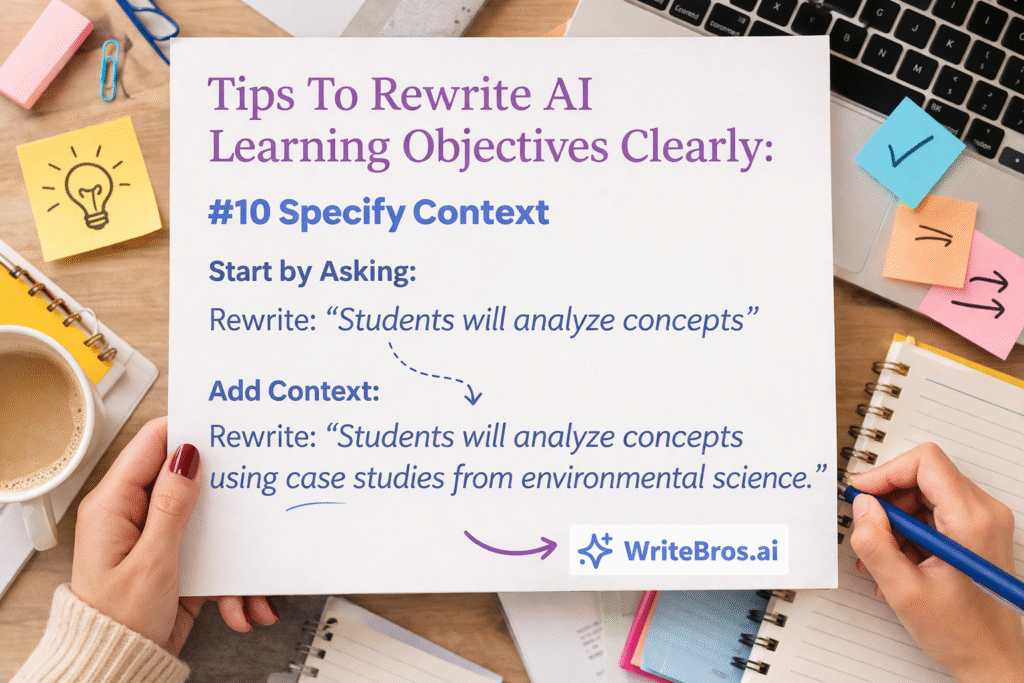
| 10 | Specify context | Add brief details showing when or how the skill should be applied. |
| 11 | Check logical flow | Ensure objectives progress in a sequence that mirrors the course structure. |
| 12 | Separate knowledge and skills | Distinguish conceptual understanding from practical application outcomes. |
| 13 | Use consistent structure | Write objectives in the same grammatical pattern to improve readability. |
| 14 | Check specificity | Replace broad goals with clearly defined outcomes tied to real tasks. |
| 15 | Test for clarity | Review whether a reader can immediately understand what success looks like. |
15 Precision Edits to Rewrite AI Learning Objectives Clearly
How to Rewrite AI Learning Objectives Clearly – Strategy #1: Replace vague verbs
Many AI-generated objectives rely on broad verbs such as understand, learn, or explore, which sound appropriate at first glance but rarely communicate what students should actually demonstrate after completing the lesson. Rewriting these verbs into precise actions helps instructors clarify expectations and prevents objectives from becoming abstract statements that are difficult to assess. When an objective states that students will analyze data patterns or compare historical arguments, the wording immediately signals what learners must do rather than leaving interpretation open.
This edit works well because it forces the objective to connect directly to observable behavior rather than conceptual intention. Instructors reviewing AI drafts often notice that replacing a single vague verb can instantly transform an unclear objective into one that aligns naturally with assignments and assessments. A rewritten sentence such as “students will interpret survey results and explain trends” creates a measurable outcome that readers can easily picture in practice.
How to Rewrite AI Learning Objectives Clearly – Strategy #2: Remove stacked outcomes
AI systems frequently combine multiple learning goals into a single objective, which produces long statements that look sophisticated but confuse both instructors and students. These stacked outcomes usually appear as sentences that include several verbs, suggesting that learners must complete many different tasks within the same objective. Separating those tasks into individual outcomes simplifies the structure and ensures that each statement represents one clear educational target.
Dividing complex objectives into smaller pieces also improves the alignment between lessons and evaluation. When instructors rewrite a sentence that originally listed analysis, comparison, and presentation into three separate outcomes, each outcome can correspond to a specific activity or assignment. This approach reduces ambiguity and helps students understand exactly which skills they are expected to demonstrate during the learning process.
How to Rewrite AI Learning Objectives Clearly – Strategy #3: Clarify measurable actions
Objectives generated through AI often sound formal but lack the detail needed to determine whether learning has actually occurred. Clarifying measurable actions means rewriting each objective so the outcome can be observed, evaluated, or demonstrated in some form of student work. Instead of stating that learners will gain knowledge of a concept, a clearer version might specify that they will describe, illustrate, or apply the concept in a structured task.
This adjustment improves instructional design because measurable language naturally connects objectives with assessment strategies. Teachers who revise AI-generated objectives frequently notice that measurable verbs help them design assignments that match the intended outcome. A rewritten objective such as “students will categorize research findings into thematic groups” immediately suggests an activity or evaluation method that reflects the learning goal.
How to Rewrite AI Learning Objectives Clearly – Strategy #4: Simplify academic phrasing
AI systems tend to produce wording that sounds excessively academic, which can make learning objectives feel distant from everyday teaching practice. Simplifying that phrasing involves rewriting complex or formal language into clear sentences that communicate the same meaning without unnecessary complexity. This process does not remove intellectual rigor but instead ensures that the objective communicates its purpose without forcing readers to decode dense wording.
When instructors simplify phrasing, objectives become easier for students to interpret and follow during the course. A sentence that originally described the “development of comprehensive analytical understanding of topic frameworks” might become “students will analyze key ideas within the topic framework.” The revised version communicates the same goal while presenting it in a format that is easier to read and evaluate.
How to Rewrite AI Learning Objectives Clearly – Strategy #5: Define observable outcomes
AI-generated objectives often describe what learners should understand or become familiar with, but these descriptions rarely indicate what students will actually produce or demonstrate. Defining observable outcomes requires rewriting the objective so the result appears in a visible form, such as a written explanation, presentation, or analytical comparison. This clarity ensures that the objective points toward an outcome that instructors can see and evaluate.
Observable outcomes also help students recognize what success looks like within a course. When objectives clearly describe actions such as presenting evidence, summarizing research, or constructing an argument, learners understand the expectations before they begin the assignment. This clarity reduces confusion and makes the objective function as a practical guide rather than a broad description of academic intention.
How to Rewrite AI Learning Objectives Clearly – Strategy #6: Align with assessments
AI-written objectives sometimes exist independently from the assignments used to evaluate student work, which creates confusion when instructors attempt to design assessments later in the course. Aligning objectives with assessments means rewriting the objective so the action described directly corresponds with a task students will complete. When the objective and the evaluation method reflect the same activity, the course structure becomes easier to understand.
Teachers who review AI-generated objectives often notice that alignment issues appear when objectives include abstract language rather than specific actions. Rewriting the statement so it mirrors the assessment helps ensure that the outcome can realistically be demonstrated through coursework. An objective that states students will interpret case studies naturally aligns with assignments that require written case analysis.
How to Rewrite AI Learning Objectives Clearly – Strategy #7: Limit scope
AI systems frequently generate objectives that attempt to cover an entire topic area within a single sentence, which makes the goal overly broad. Limiting scope requires rewriting the objective so it focuses on a single concept, skill, or analytical task that students can realistically achieve during the lesson or unit. Narrow objectives allow instructors to build clearer connections between lessons and expected outcomes.
This refinement also helps students recognize which skills they should prioritize during their learning process. When objectives concentrate on one clearly defined ability, learners can direct their attention toward mastering that specific skill rather than interpreting a large collection of expectations. A focused objective such as evaluating evidence within a research article gives students a clearer direction than a statement that combines multiple goals.
How to Rewrite AI Learning Objectives Clearly – Strategy #8: Strengthen action verbs
Another common pattern in AI-generated objectives is the use of neutral verbs that do not indicate the level of thinking expected from students. Strengthening action verbs involves replacing these neutral terms with verbs that communicate analytical or creative activity. Verbs such as analyze, construct, evaluate, and synthesize immediately convey a higher level of engagement with the material.
Stronger verbs improve clarity because they signal the type of thinking students must demonstrate. Instructors who revise AI-generated objectives often notice that selecting a more precise verb automatically clarifies the rest of the sentence. Once the verb clearly describes the cognitive task, the objective becomes easier to interpret and integrate into lesson planning.
How to Rewrite AI Learning Objectives Clearly – Strategy #9: Remove filler language
AI writing often includes extra phrases that make objectives sound formal but do not contribute meaningful information. Removing filler language requires carefully reviewing each sentence and eliminating words that extend the objective without improving its clarity. This editing process helps reveal the central action that the objective is meant to communicate.
In many cases, eliminating a few unnecessary phrases can transform a long statement into a concise description of the intended outcome. Teachers who revise AI-generated objectives frequently discover that the key idea becomes clearer once filler language disappears. The simplified version highlights the action students must perform rather than surrounding it with additional wording.
How to Rewrite AI Learning Objectives Clearly – Strategy #10: Specify context
AI-generated objectives sometimes describe a skill but fail to indicate the context in which that skill should appear. Specifying context involves rewriting the objective so it includes the situation, material, or scenario where the learning outcome will occur. Context provides the conditions under which the student will demonstrate the skill.
This adjustment helps instructors design activities that reflect the objective more accurately. When the objective states that students will analyze environmental case studies or interpret literary passages, the context clarifies what materials students will engage with during the course. As a result, the objective becomes more informative and easier to connect with classroom tasks.
How to Rewrite AI Learning Objectives Clearly – Strategy #11: Check logical flow
AI-generated objectives sometimes appear in a sequence that does not reflect the natural progression of a course. Checking logical flow requires reviewing the objectives and rewriting them so they move from foundational knowledge toward more complex analytical tasks. This progression ensures that each objective builds upon the previous one.
Instructors who reorganize objectives often notice that a clearer sequence improves the overall structure of the course. Students benefit from a progression that gradually introduces concepts before asking them to apply or evaluate those ideas. A logical sequence of objectives helps learners see how each lesson contributes to a larger learning journey.
How to Rewrite AI Learning Objectives Clearly – Strategy #12: Separate knowledge and skills
AI systems frequently combine conceptual knowledge with practical skills in a single objective, which can obscure the actual learning goal. Separating knowledge and skills requires rewriting objectives so each one focuses on either understanding a concept or performing a task. This distinction clarifies what type of learning the objective intends to measure.
When objectives clearly distinguish between knowledge and application, instructors can design activities that address each type of outcome more effectively. One objective might focus on explaining a theory, while a second objective asks students to apply that theory in analysis or problem solving. Separating these elements prevents confusion and improves instructional clarity.
How to Rewrite AI Learning Objectives Clearly – Strategy #13: Use consistent structure
AI-generated objectives sometimes vary in grammatical structure, which makes the list appear uneven and difficult to interpret. Using consistent structure involves rewriting each objective so it follows the same pattern, usually beginning with a clear action verb followed by the task or subject. Consistency improves readability and helps students interpret the objectives quickly.
When objectives share a common format, readers can focus on the meaning of each statement rather than adjusting to different grammatical styles. Instructors often rewrite AI-generated objectives into parallel sentence structures so the list feels organized and deliberate. This consistency also helps administrators or curriculum reviewers evaluate the objectives more easily.
How to Rewrite AI Learning Objectives Clearly – Strategy #14: Check specificity
Some AI-generated objectives remain so broad that they provide little guidance for teaching or assessment. Checking specificity requires rewriting these objectives so they reference clear tasks, materials, or analytical processes that students will perform. Specific objectives provide a stronger foundation for lesson planning and evaluation.
Teachers who refine AI-generated objectives often discover that adding small details significantly improves clarity. An objective that originally states students will study historical events might become students will compare two historical perspectives on the same event. The added specificity clarifies both the activity and the expected learning outcome.
How to Rewrite AI Learning Objectives Clearly – Strategy #15: Test for clarity
After rewriting objectives, instructors should review them from the perspective of someone encountering the course for the first time. Testing for clarity means reading each objective and asking whether a student could understand exactly what outcome the statement describes. If the meaning requires interpretation, the wording likely needs further revision.
This final review step ensures that the objective communicates its purpose without relying on instructor explanation. Clear objectives function as practical instructions that guide both teaching and learning. When the wording immediately conveys the expected action and context, the objective successfully fulfills its role within the course design.
Common mistakes
- Leaving vague verbs such as understand or learn in AI-generated objectives without revising them into observable actions often creates objectives that sound appropriate but fail to communicate what students should actually demonstrate in assignments or evaluations.
- Allowing multiple outcomes to remain inside a single objective can create sentences that appear comprehensive yet confuse both instructors and learners who must determine which skill or concept is the primary focus.
- Copying AI-generated objectives directly into course materials without reviewing their alignment with assessments can lead to situations where assignments measure different skills than those described in the objectives.
- Keeping overly formal AI language in objectives may give the appearance of academic sophistication but can make the statement difficult for students to interpret or apply during coursework.
- Writing objectives that describe knowledge rather than demonstration often prevents instructors from evaluating whether students have achieved the intended outcome.
- Failing to review objectives as a complete sequence may result in a list that lacks logical progression, making it harder for students to see how lessons connect throughout the course.
Edge cases
Some disciplines intentionally use broader objectives because the course emphasizes exploration rather than measurable performance. In creative writing, philosophy, or interdisciplinary seminars, objectives may describe intellectual engagement rather than specific tasks. Even in those contexts, rewriting AI-generated objectives for clarity can still help students understand the direction of the course.
Another edge case appears in introductory courses that prioritize foundational exposure rather than complex application. Instructors might intentionally keep objectives simple so they reflect early-stage learning rather than advanced analysis. Rewriting AI-generated objectives still helps ensure that the wording clearly communicates the level of learning expected at that stage.
Supporting tools
- Document editors with revision tracking allow instructors to compare the original AI-generated objective with revised versions, making it easier to identify where clarity improves during the editing process.
- Curriculum design templates help instructors evaluate whether rewritten objectives align with lesson plans, course outcomes, and assessments, which supports stronger instructional planning.
- Educational rubric builders provide structured frameworks that connect objectives with grading criteria, helping instructors confirm that each objective reflects a measurable outcome.
- Collaborative document platforms allow multiple educators to review and refine objectives together, which often improves clarity through discussion and shared editing.
- Plain language editing tools can highlight sentences that appear overly complex, helping instructors simplify wording and improve readability within course objectives.
- WriteBros.ai helps refine AI-generated academic writing so learning objectives become clearer, more natural, and easier for instructors and students to interpret during curriculum development.
Ready to Transform Your AI Content?
Try WriteBros.ai and make your AI-generated content truly human.
Conclusion
Clear learning objectives help instructors design lessons, assessments, and activities that guide students toward meaningful outcomes. Rewriting AI-generated objectives is not a rejection of AI assistance but a practical editing process that ensures each objective communicates its purpose with precision.
Effective objectives do not require perfection or complex wording to succeed. What matters is that each statement clearly describes what students should demonstrate and how that outcome connects to the structure of the course.
Did You Know?
AI-generated learning objectives often appear ready for course documents because they mimic the tone and structure commonly used in curriculum frameworks. Even so, these objectives sometimes hide vague verbs or blended outcomes that make it difficult to understand what students should actually demonstrate.
Revising the wording usually improves clarity immediately because instructors replace abstract phrases with specific actions students can perform. Edits that define the task, describe the context, and clarify the expected result transform a broad objective into a practical guide for both teaching and assessment.
Ready to Transform Your AI Content?