How to Rewrite AI Text for Academic Use: 15 Scholarly Revisions

Rewriting AI drafts for academic work requires more than paraphrasing. Research like the Nature Human Behaviour study on detecting AI-generated text shows detection systems struggle with revised passages, which is why structured scholarly editing methods matter.
How to Rewrite AI Text for Academic Use: 15 Scholarly Revisions
Students increasingly rely on AI drafts for essays, reports, and research summaries, yet those drafts rarely match the tone expected in academic writing. Understanding a few AI-assisted writing rules helps prevent obvious signals that a passage began as machine-generated text.
The difficulty comes from how AI structures language, which often sounds polished but lacks the nuance, restraint, and evidence patterns common in scholarly work. Many students experiment with rewriting strategies or explore reliable humanizer tools to reshape early drafts into something more academically credible.
Even well-written assignments can trigger suspicion because AI detection systems frequently misinterpret normal revision patterns. Research on false positive statistics shows why careful rewriting, not simple paraphrasing, is the safer path for academic submissions.
| # | Strategy focus | Practical takeaway |
|---|---|---|
| 1 | Clarify the thesis voice | Rework the opening idea so the argument sounds like a student’s interpretation rather than a polished generic claim. |
| 2 | Adjust sentence rhythm | Break up overly balanced sentences and mix shorter and longer structures to mirror natural academic drafting. |
| 3 | Insert evidence context | Introduce sources with brief framing so the discussion reads like research analysis instead of automated summary. |
| 4 | Replace generic transitions | Swap formulaic connectors with language that reflects reasoning between ideas rather than template phrasing. |
| 5 | Refine terminology use | Check discipline-specific terms and ensure they appear where a student would normally apply them. |
| 6 | Add analytical commentary | Follow cited ideas with interpretation that explains why the evidence matters in the argument. |
| 7 | Limit overly perfect grammar | Remove repetitive sentence symmetry that makes AI drafts sound mechanically balanced. |
| 8 | Rebuild paragraph flow | Ensure each paragraph develops one idea gradually instead of presenting condensed explanations. |
| 9 | Embed citations naturally | Place references where a reader expects support rather than clustering them mechanically. |
| 10 | Introduce cautious claims | Use measured language that reflects scholarly restraint rather than absolute conclusions. |
| 11 | Expand methodological detail | Explain how studies were conducted so the discussion reflects genuine engagement with sources. |
| 12 | Integrate counterpoints | Acknowledge limitations or alternative interpretations to strengthen academic credibility. |
| 13 | Remove repetitive phrasing | Identify patterns where similar wording appears across sentences and rewrite them for variety. |
| 14 | Strengthen concluding insight | Reframe the final argument so it synthesizes the discussion instead of summarizing earlier sentences. |
| 15 | Review scholarly tone | Check that the language remains formal, precise, and aligned with academic expectations. |
15 Scholarly Revisions to Rewrite AI Text for Academic Use
How to Rewrite AI Text for Academic Use – Strategy #1: Clarify the thesis voice
Learning how to rewrite AI text for academic use begins with examining the thesis statement, because AI systems tend to produce broad claims that sound authoritative yet lack the interpretive framing expected in scholarly work. A student’s argument normally reveals some level of perspective, hesitation, or prioritization of ideas, whereas AI drafts often present conclusions too cleanly. Rewriting the thesis with clearer positioning, contextual boundaries, and discipline-specific language helps the argument feel rooted in genuine academic reasoning rather than automated summary.
In practice, this means expanding the thesis so it reflects analytical intent instead of sounding like a polished encyclopedia entry. Students often insert subtle qualifiers, reference the scope of evidence, or signal methodological direction, which makes the claim sound grounded in research rather than algorithmic certainty. When a thesis reflects interpretation and intellectual framing, the surrounding paragraphs gain a more authentic scholarly tone that better aligns with expectations in academic evaluation.
How to Rewrite AI Text for Academic Use – Strategy #2: Adjust sentence rhythm
Another key step in how to rewrite AI text for academic use involves reshaping sentence rhythm, since many AI systems produce evenly balanced structures that sound mechanically refined. Academic writing rarely maintains perfect symmetry across every sentence, because students naturally vary sentence length while working through ideas and evidence. Revising rhythm by mixing extended explanations with shorter analytical statements helps the text feel closer to genuine drafting behavior.
One useful approach is to break apart long AI sentences that combine several claims into one polished structure. Splitting ideas into multiple sentences allows room for clarification, interpretation, and small shifts in emphasis that occur naturally in academic thinking. Over time, these adjustments create paragraphs that feel less algorithmically uniform and more reflective of a student gradually building a scholarly argument.
How to Rewrite AI Text for Academic Use – Strategy #3: Insert evidence context
Understanding how to rewrite AI text for academic use also requires strengthening the relationship between evidence and analysis, because AI often introduces research findings without explaining why they matter. In academic writing, sources rarely appear as isolated facts; they are usually framed within a discussion that clarifies relevance, reliability, or theoretical implications. Adding this contextual layer helps transform a generic statement into a meaningful part of a research argument.
Students frequently achieve this by introducing a study with brief background before presenting the result itself. A sentence might explain the author’s research focus, the population studied, or the methodological angle that shaped the findings. These additions signal that the writer understands the research environment surrounding the source, which helps the rewritten passage feel grounded in authentic scholarly engagement.
How to Rewrite AI Text for Academic Use – Strategy #4: Replace generic transitions
A common challenge when learning how to rewrite AI text for academic use is recognizing the repetitive transitional phrases that AI models rely on to maintain coherence. Expressions such as predictable connectors or formulaic summaries often appear repeatedly across paragraphs, giving the writing a templated quality that instructors quickly notice. Replacing these with transitions that reflect reasoning between ideas makes the progression of arguments feel more deliberate and human.
Instead of relying on standardized connectors, students can emphasize logical relationships between claims and evidence. A transition might highlight contrast between two studies, acknowledge a limitation in earlier research, or explain how one concept expands another. These reasoning-focused links transform transitions into analytical bridges rather than mechanical connectors.
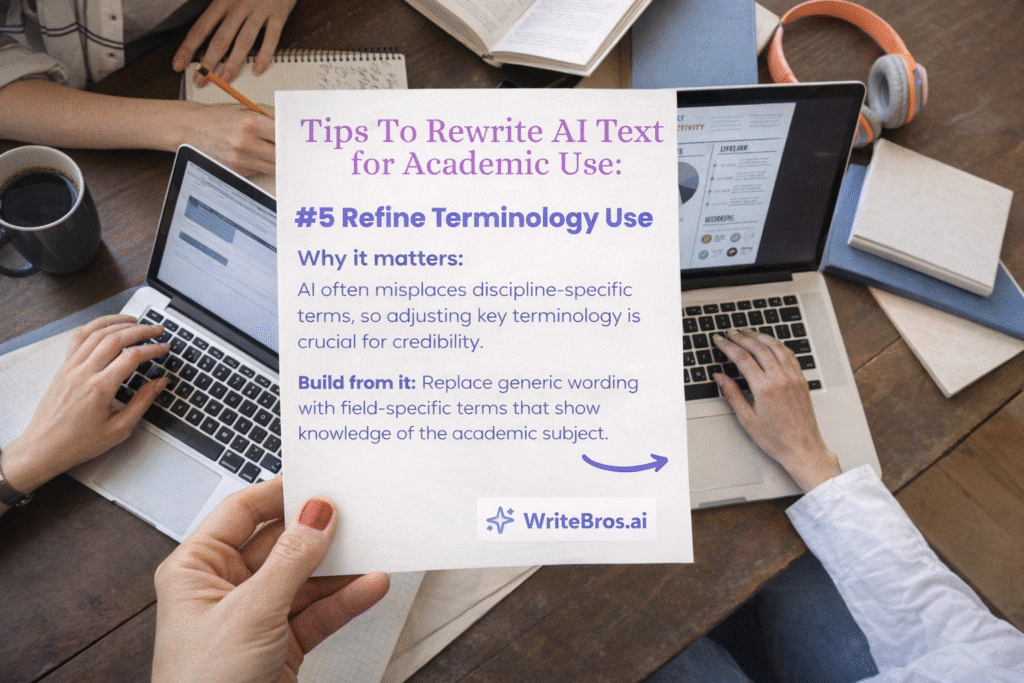
How to Rewrite AI Text for Academic Use – Strategy #5: Refine terminology use
Mastering how to rewrite AI text for academic use often depends on refining discipline-specific terminology, since AI frequently applies specialized terms too broadly or without sufficient contextual precision. Academic writing usually places technical vocabulary in carefully chosen locations where the concept directly supports analysis. Adjusting these placements ensures that terminology contributes meaning rather than sounding like decorative complexity.
This refinement sometimes means replacing vague academic words with terms more appropriate for the field. In a psychology essay, for instance, methodological language may appear alongside interpretations of participant behavior, whereas in history writing the vocabulary might emphasize archival sources or historiographical debate. Aligning terminology with disciplinary habits makes the text sound far more consistent with real scholarly practice.
How to Rewrite AI Text for Academic Use – Strategy #6: Add analytical commentary
Developing the skill of how to rewrite AI text for academic use requires adding interpretation after evidence appears, because AI drafts frequently present research findings without explaining their intellectual significance. Academic writing normally moves through a pattern of presenting a claim, introducing evidence, and then interpreting that evidence within the argument. Expanding the analytical portion of each paragraph helps the text reflect genuine scholarly reasoning.
This commentary often clarifies why a study supports the thesis or how it relates to competing viewpoints. Students might explain what the findings imply for the broader topic, identify potential limitations, or connect the research to earlier arguments in the essay. These interpretive steps demonstrate intellectual engagement that rarely emerges from automated drafts alone.
How to Rewrite AI Text for Academic Use – Strategy #7: Limit overly perfect grammar
Another subtle technique in how to rewrite AI text for academic use involves softening the mechanical precision that many AI systems produce. Perfectly balanced clauses and repeated grammatical patterns can create an unusually polished tone that feels detached from real student writing. Revising structure, punctuation placement, and clause order introduces the small variations common in authentic academic drafting.
This does not mean intentionally making grammatical mistakes, but rather allowing natural variation in expression. A student might restructure a sentence so the key idea appears later in the paragraph or expand a clause that originally felt compressed. These modest adjustments break the repetitive symmetry that often reveals automated composition.
How to Rewrite AI Text for Academic Use – Strategy #8: Rebuild paragraph flow
Learning how to rewrite AI text for academic use also requires paying attention to paragraph development, because AI often compresses several ideas into a single tightly structured block of explanation. Academic paragraphs typically unfold more gradually as a writer introduces a concept, examines evidence, and then reflects on its implications. Reorganizing this sequence helps each paragraph feel like part of a sustained academic discussion.
Students frequently rebuild paragraphs by separating overlapping ideas and expanding the reasoning between them. A paragraph might begin with a focused topic sentence, followed by a study or example that illustrates the concept in context. The closing sentences then connect the evidence back to the broader thesis, reinforcing coherence across the essay.
How to Rewrite AI Text for Academic Use – Strategy #9: Embed citations naturally
Effective revision of AI drafts also involves learning how to rewrite AI text for academic use with more natural citation placement. AI-generated passages sometimes cluster citations together or attach them to sentences that do not require evidence. Repositioning references so they appear precisely where support is needed helps the writing resemble the citation patterns found in scholarly articles.
This adjustment may require dividing a single sentence into multiple analytical steps so that each reference clearly supports a specific claim. Writers often introduce a source, summarize its finding, and then integrate it into their argument before moving forward. Such integration demonstrates awareness of how academic conversations develop across sources.
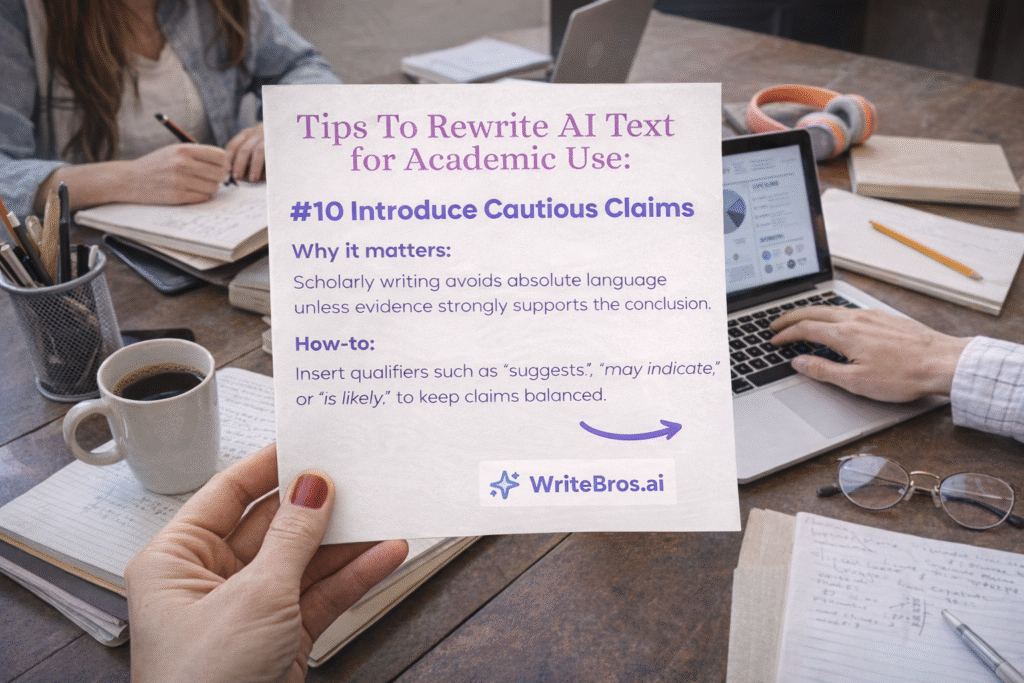
How to Rewrite AI Text for Academic Use – Strategy #10: Introduce cautious claims
When exploring how to rewrite AI text for academic use, students quickly notice that AI drafts often express conclusions with excessive certainty. Academic writing typically avoids absolute claims unless overwhelming evidence supports them, because scholars acknowledge that knowledge evolves through ongoing research. Introducing measured language helps the argument align with this intellectual humility.
Writers often revise sentences by inserting qualifiers that reflect the limits of available evidence. Phrases that signal probability, interpretation, or contextual variation allow the discussion to remain persuasive while avoiding overstated conclusions. This careful balance of confidence and restraint is a defining feature of credible academic writing.
How to Rewrite AI Text for Academic Use – Strategy #11: Expand methodological detail
A deeper level of how to rewrite AI text for academic use involves expanding methodological explanations when discussing research. AI summaries frequently present study outcomes without clarifying how the data were collected or interpreted. Academic writing normally situates findings within methodological context so readers understand why those findings hold analytical value.
Students may add brief descriptions of research design, participant groups, or analytical techniques before discussing results. Even a short explanation of how a study was conducted helps readers interpret the credibility and relevance of the evidence. These details make the discussion feel anchored in genuine research literacy.
How to Rewrite AI Text for Academic Use – Strategy #12: Integrate counterpoints
Another essential aspect of how to rewrite AI text for academic use is acknowledging competing viewpoints within the discussion. AI drafts often present information in a linear progression that assumes agreement across sources. Academic writing tends to explore tensions between perspectives, allowing readers to see how debates shape understanding of the topic.
Students often revise paragraphs by introducing a contrasting study or theoretical interpretation that challenges earlier claims. The writer then explains how these perspectives interact, sometimes reconciling them or identifying conditions where each interpretation applies. This analytical negotiation between viewpoints strengthens scholarly credibility.
How to Rewrite AI Text for Academic Use – Strategy #13: Remove repetitive phrasing
A noticeable trait in many AI drafts becomes apparent when learning how to rewrite AI text for academic use, because repeated phrases often appear across several paragraphs. These patterns occur when AI models reuse familiar linguistic structures while maintaining topical coherence. Rewriting the text with varied expressions helps eliminate this mechanical repetition.
Students often begin by identifying recurring wording that appears in transitions, topic sentences, or analytical statements. Rephrasing these sections with alternative structures prevents the essay from sounding algorithmically generated. Over time the revised version develops a more flexible and natural academic voice.
How to Rewrite AI Text for Academic Use – Strategy #14: Strengthen concluding insight
Developing a strong ending is also central to how to rewrite AI text for academic use, since AI systems frequently conclude essays with simple summaries of earlier points. Academic conclusions typically synthesize the argument by emphasizing broader implications or future research directions. Expanding the closing section transforms it into a reflective endpoint rather than a repetition of previous sentences.
Students often revisit the thesis and show how the evidence discussed throughout the essay reshapes its meaning. The conclusion might connect findings to theoretical debates, policy implications, or unanswered questions in the field. These broader reflections signal that the writer understands the academic conversation surrounding the topic.
How to Rewrite AI Text for Academic Use – Strategy #15: Review scholarly tone
The final stage in how to rewrite AI text for academic use focuses on evaluating overall tone, ensuring that the essay maintains the level of formality expected in scholarly communication. AI drafts sometimes mix conversational phrasing with overly complex wording, creating a voice that feels inconsistent. Revising tone across the document helps unify the argument.
This process often involves smoothing abrupt language changes and aligning vocabulary with academic conventions in the relevant discipline. Writers review sections where phrasing appears excessively casual or unnecessarily ornate, adjusting them to achieve clarity and precision. The finished essay should read as a coherent piece of scholarly analysis rather than a compilation of generated passages.
Common mistakes
- Many students attempt to rewrite AI drafts only at the surface level, replacing a few words or restructuring individual sentences without reconsidering the argument itself. This mistake happens because the text initially appears polished, yet the deeper reasoning remains generic. As a result, the essay continues to sound algorithmically constructed even after superficial editing.
- Another frequent mistake occurs when writers remove large sections of AI phrasing without rebuilding the logical connections between ideas. Paragraphs may become shorter and less repetitive, but the transitions that explain how evidence supports the thesis disappear in the process. Without restoring these analytical links, the argument loses coherence and credibility.
- Some students focus exclusively on paraphrasing vocabulary while leaving structural patterns unchanged. AI drafts often repeat the same sentence rhythm or paragraph structure throughout the essay, which instructors quickly recognize as formulaic writing. Without adjusting these deeper patterns, the rewritten version still reflects automated composition.
- A related problem emerges when citations remain exactly where the AI system placed them. These references might cluster around general statements or appear disconnected from the claim they supposedly support. When citations are not repositioned carefully, the essay may appear poorly researched even if the sources themselves are credible.
- Writers sometimes try to eliminate all traces of AI language by aggressively simplifying the text. While the intention is understandable, excessive simplification can remove necessary nuance and make complex arguments sound incomplete. Academic writing benefits from clarity, yet it also requires enough depth to demonstrate understanding of the topic.
- One final mistake occurs when students overlook tone consistency during the revision process. AI drafts may alternate between formal analysis and conversational explanation, creating a voice that feels uneven. If this inconsistency remains after rewriting, the essay can still appear unnatural despite extensive editing.
Edge cases
Some situations make rewriting AI drafts more complicated than usual. Highly technical subjects, such as advanced mathematics or specialized engineering topics, sometimes require dense terminology that naturally resembles algorithmic phrasing. In these cases the goal is not to simplify the language excessively, but to ensure that explanations clearly demonstrate understanding of how the concepts interact within the broader academic discussion.
Another edge case appears when students rely on AI to summarize extremely large research collections. The resulting draft may condense multiple studies into brief descriptions that require significant expansion during revision. Instead of rewriting sentence by sentence, it can be more effective to reorganize the entire discussion around a smaller number of studies analyzed in greater depth.
Supporting tools
- Grammar and editing platforms can assist in identifying repeated sentence structures or phrasing patterns that remain after initial revisions. These tools highlight sections where stylistic variation may be necessary, helping writers refine tone without replacing the analytical content they have already developed.
- Reference management software supports academic rewriting by organizing sources and ensuring that citations remain consistent throughout the document. When writers adjust paragraphs or restructure arguments, these systems help maintain accurate attribution and prevent misplaced references that could undermine credibility.
- Academic writing assistants often provide feedback on tone, clarity, and vocabulary choices within scholarly contexts. Instead of generating new text, they focus on improving phrasing so that explanations remain precise and consistent with disciplinary conventions.
- Plagiarism and similarity checkers can also be useful during revision, particularly when AI drafts summarize large bodies of research. Running a similarity report allows students to confirm that paraphrased material is sufficiently distinct while still accurately representing the original source.
- Outline planning tools help restructure AI drafts when the argument itself requires deeper revision. These systems allow writers to rearrange sections visually, making it easier to evaluate whether each paragraph contributes clearly to the thesis.
- The rewriting process itself becomes more manageable when supported by WriteBros.ai, which helps reshape generated passages so they align with the tone, pacing, and reasoning patterns expected in academic writing.
Ready to Transform Your AI Content?
Try WriteBros.ai and make your AI-generated content truly human.
Conclusion
Learning how to rewrite AI text for academic use ultimately comes down to transforming a polished draft into a thoughtful scholarly argument. The goal is not simply to disguise automated language, but to rebuild reasoning, evidence integration, and analytical voice so the essay reflects genuine engagement with the topic.
Perfect rewriting rarely happens in a single pass, and most strong academic papers evolve through multiple layers of revision and reflection. Writers who focus on clarity of thought, careful interpretation of sources, and steady improvement in structure will consistently produce work that feels authentic and intellectually grounded.
Did You Know?
People learning how to rewrite AI text for academic use often assume the main issue is polished vocabulary, yet the clearer signal usually appears in the repeated structure of the explanation itself. If each paragraph introduces its point with the same tidy certainty, develops evidence with the same pacing, and finishes with the same controlled logic, the paper can still read like generated writing.
Reworking the movement of the argument usually helps more because authentic academic writing rarely unfolds with perfect balance from beginning to end. Let one section spend more time framing evidence, let another complicate the point before resolving it, and allow the final idea to arrive more gradually, since that irregular scholarly rhythm makes the writing feel much more credible in an academic setting.
Ready to Transform Your AI Content?